




















![Kingdom Hearts Collection [I-III] Review](https://gazettely.com/wp-content/uploads/2026/10/Kingdom-Hearts-Collection-I-III-1-360x180.webp "Kingdom Hearts Collection [I-III] Review: KHII Holds Steady as Newer Entries Fluctuate 35")






Maomao’s efforts to improve literacy among the palace women give her intelligence a social purpose beyond solving another poisoning. Reading offers access to information that otherwise arrives through someone else’s authority. For servants whose movements and futures are largely arranged by others, that access matters.
The Apothecary Diaries Season 2 understands how knowledge can travel through a hierarchy without dissolving it. Maomao can help another woman understand her circumstances; she cannot simply release her from them. Her own pharmaceutical expertise, shaped by an upbringing in the pleasure quarter, remains indispensable to people who occupy positions far above hers.
Her service during Gyokuyou’s second pregnancy makes this dependence especially clear. Imported oils, spices, and medicines require scrutiny because the court’s appetite for luxury can expose women to physical harm. Meanwhile, information about pregnancies circulates before official announcements, connecting apparently private medical conditions to factional calculation.
A woman’s body becomes something other people interpret for political advantage. Maomao’s attention to substances and symptoms restores a practical question to this traffic in speculation: what is happening to the person herself? Gyokuyou’s trust gives that work room to proceed, preserving a meaningful difference between supportive relationships within the palace and the arrangements that make protection necessary.
The season’s quieter episodes are valuable because they allow women to exist outside that immediate usefulness. Maomao’s companionship with Xiaolan and the insect-loving Shisui gives her time to enjoy company without an investigation supplying the entire reason for an encounter.
Treating these stretches as disposable would reproduce the palace’s own narrow valuation of its servants. Their pleasure deserves dramatic space. Bathhouse visits also create an informal exchange of information, an advantage Gyokuyou recognizes when she permits Maomao to attend. Leisure and practical knowledge occupy the same setting, without every friendship becoming a transaction.
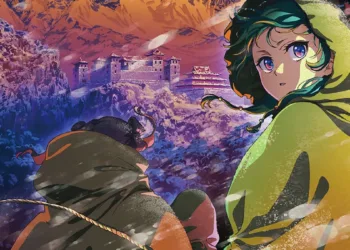
The visual design helps sustain these distinctions. The palace women’s shared styling gives institutional belonging a visible form, while Maomao remains readily distinguishable within it. Elaborate hair, clothing, and makeup make the court attractive, yet their patterned presentation also suggests how carefully people are assigned recognizable places.
Maomao’s increasingly warm relationships complicate that order through familiarity rather than spectacle. Shisui’s perceptiveness, slipping through her apparently innocent manner, is particularly effective: the friendship has enough substance for her concealed knowledge to disturb something the audience has learned to enjoy.
With Jinshi, familiarity carries different risks. Maomao was abducted and sold into palace service before her abilities attracted his attention; her position supplies good reasons to resist further entanglement. Discovering during the ambush that he cannot be the eunuch he claims to be threatens the protective fiction under which their relationship operates.
The ensuing exchange about frogs turns this discovery into suggestive comedy. Maomao’s insistence on avoiding its implications remains credible as self-preservation. A servant can understand that a secret matters and still decide that acknowledging it would make her life harder.
The romance becomes less persuasive when the writing repeatedly substitutes interruption for development. A dog disrupts one attempted kiss; an opening door disrupts another. Jinshi’s attempts to disclose his identity encounter comparable obstruction. These devices preserve anticipation while allowing the relationship’s difficult questions to remain suspended.
Their mildly adversarial rapport has energy because Maomao’s resistance gives Jinshi something specific to respond to. Scenes presented as romantic require clearer grounds for reciprocity than his beauty and persistence provide. Her reluctance belongs to her characterization, and the series weakens it whenever it treats that reluctance chiefly as another obstacle on the way to an expected embrace.
The former emperor’s history gives secrecy a harsher significance. The empress dowager’s backstory shows how suffering within an imperial household can acquire consequences across generations. Grievances among women associated with the clinic and Suirei’s connection to the former emperor bring that inheritance into the present conspiracy.
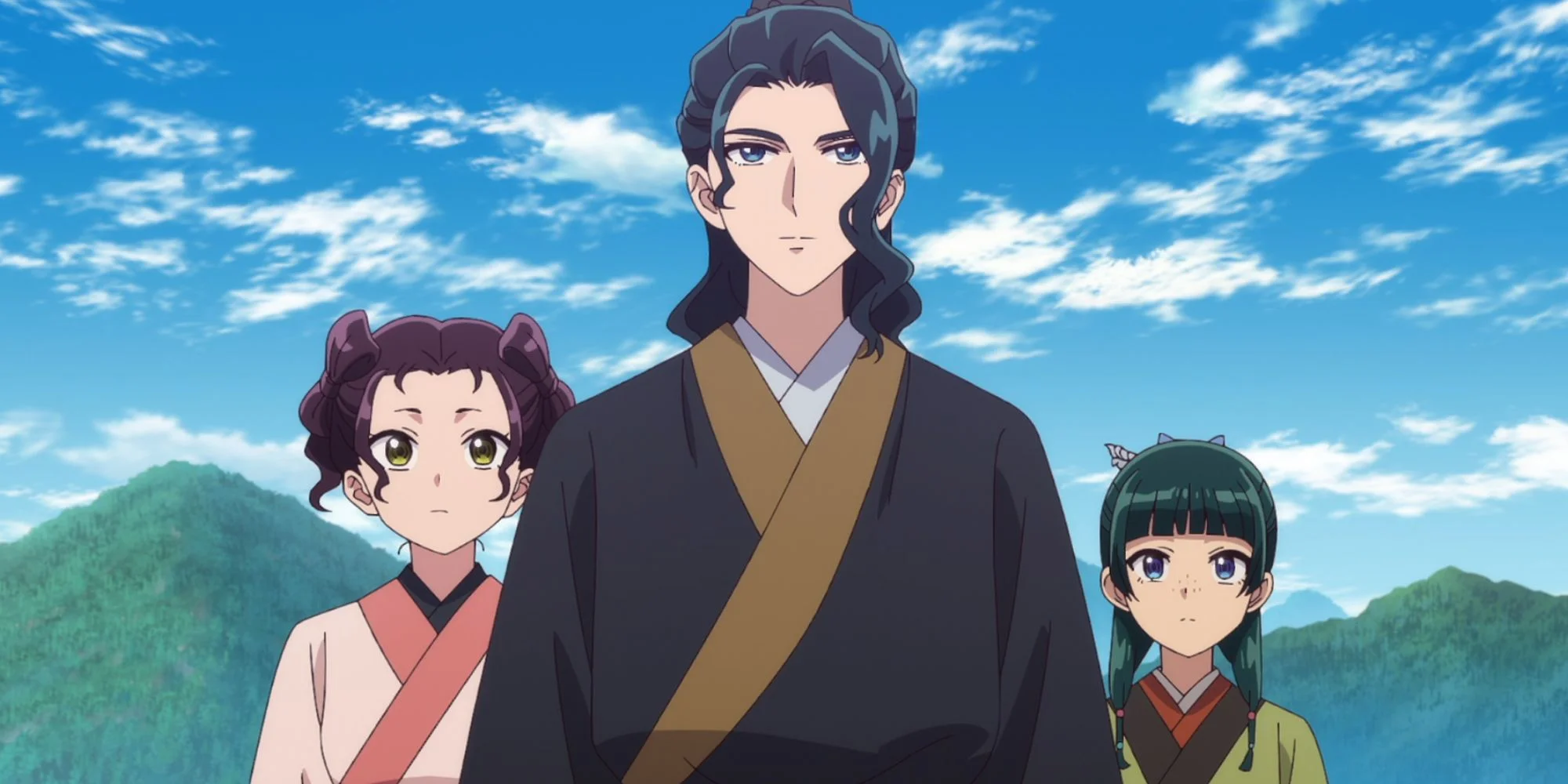
Kinship here distributes danger alongside status. The court’s treatment of concubines as expendable people makes personal injury politically consequential, even when the injured possess little formal power. These passages deepen the season because they give the succession drama a human cost beyond identifying the next rightful occupant of a privileged position.
Shenmei’s late arrival makes the eventual explanation less spacious. Her cruelty receives concentrated attention, and her grievance over the former emperor’s failure to choose her pulls the conspiracy toward a single destructive personality. A woman exercising power abusively belongs within this account of the court. The weakness lies in how heavily her characterization comes to bear the explanatory burden after the season has established wider grounds for resentment.
Shishou presents a related dramatic problem: his concealed opposition to his wife and her associates is disclosed near the resolution, giving an intricate strategy limited time to become an intelligible personal choice. Explanation supplies connections that earlier characterization could have made emotionally active.
Loulan’s revelation works better because Shisui has already acquired a life in Maomao’s company. Discovering that the friend and the high-ranking consort are the same person gives their intimacy a new political dimension. Loulan’s apparent place in the hierarchy has concealed a range of choices from those around her. The revelation also exposes an imbalance in the preparation: Shisui is familiar as a person, while Loulan has been comparatively remote. Its emotional force comes chiefly from discovering what a friend has withheld, rather than bringing two equally developed relationships into collision.
Maomao’s abduction changes the season’s method more awkwardly. Her freedom to move around the village and attend festivities lowers the immediate sense of danger, affecting the suspense of Jinshi and Luomen’s search. The audience already possesses reassurance unavailable to them. When Maomao encounters the gun workshop, Loulan intervenes and installs her as Shenmei’s apothecary. The situation keeps changing around her, but her discoveries increasingly give way to explanations supplied by others. For a series whose pleasures depend on watching her make knowledge consequential, this transfer reduces the satisfaction of the conspiracy’s resolution.
Giving Loulan and Suirei expertise outside Maomao’s understanding is still an important choice. Other women can hold plans she cannot anticipate; intelligence need not belong exclusively to the protagonist. The late military confrontation expands the action without exhausting the means by which survival is being arranged.
Loulan’s concealed identity and Suirei’s medical knowledge remain consequential alongside the force brought against the fortress. The difficulty is that Maomao’s presence sometimes serves chiefly to provide an audience for their disclosures, making her personal investment stronger than her influence on events.
That tension becomes tangible when children believed dead begin to wake. Their death-feigning preparation exposes the distance between an apparent political catastrophe and the hidden intervention that may save its victims.
Children caught in clan conflict have been placed beyond ordinary protection, requiring secrecy even in the means of preserving their lives. Maomao has not been told what they received. When one begins waking, her surprise interrupts the expected pleasure of seeing her understand before everyone else. Faced with a medical event she cannot yet account for, she calls for Suirei, the woman whose knowledge the plan has required all along.
The Apothecary Diaries Season 2 premiered on Crunchyroll on January 10, 2025. The historical mystery anime continues to follow the clever young poison taster Maomao as she solves intricate court secrets and medical puzzles inside the imperial rear palace.
Where to Watch The Apothecary Diaries Season 2 Online








Full Credits
Title: The Apothecary Diaries Season 2
Distributor: Crunchyroll, Toho Animation Studio, OLM
Release date: January 10, 2025
Rating: TV-14
Running time: 23 minutes per episode
Director: Akinori Fudesaka
Writers: Norihiro Naganuma
Producers and Executive Producers: Kazutaka Yamanaka
Cast: Emi Lo, Kaiji Tang, Takeo Otsuka, Aoi Yuuki, Yuko Kaida, Megumi Han
- Composer: Satoru Kosaki, Kevin Penkin, Arisa Okehazama
The Review
The Apothecary Diaries Season 2
The Apothecary Diaries Season 2 finds its richest drama in women’s knowledge, friendships, and constrained choices. Maomao’s medical work and Loulan’s concealed identity give palace politics an intimate human cost. The expanding conspiracy is less assured: late explanations reduce Maomao’s investigative influence, while Shenmei’s characterization narrows the account of dynastic harm. Repeated romantic interruptions also postpone the difficult questions that make her relationship with Jinshi interesting.
PROS
- Medical knowledge connects personal vulnerability to court politics.
- Female friendships receive meaningful emotional space.
- Loulan’s revelation gains force from her bond with Maomao.
- Character styling makes institutional belonging visible.
CONS
- Maomao loses investigative influence during the climax.
- Romantic interruptions delay meaningful relationship development.
- Shenmei’s late characterization narrows the political explanation.
- Shishou’s strategy relies heavily on closing exposition.