
























![Kingdom Hearts Collection [I-III] Review](https://gazettely.com/wp-content/uploads/2026/10/Kingdom-Hearts-Collection-I-III-1-360x180.webp "Kingdom Hearts Collection [I-III] Review: KHII Holds Steady as Newer Entries Fluctuate 37")





Lisa has already survived the cannibal when journalist Doris starts asking how. In Salvatore Sclafani’s The Hermit, her account keeps sending us into the woods and pulling us back to the interview chair. The movement encourages us to listen for omissions rather than brace for the next attack. There is potential in that change of attention, especially with Malina Weissman playing a survivor whose careful answers leave room for doubt. We know she got out. Her telling of it is another matter.
Weissman makes Lisa’s reserve useful. The distress of the woodland scenes gives way to a guarded presentation during the interview, where Doris, played by Julie Chang, probes inconsistencies. Lisa’s reluctance to explain herself can make a question feel invasive before it starts to sound necessary. For a while, the film gives us two different reasons to stay close to her: concern for what she endured and curiosity about what she is withholding. The difficulty comes when the questions take the place of experiences we needed to share with her.
Lisa’s camping trip follows the death of her mother. Accompanied by her widowed father, Tony, and boyfriend, Eric, she enters the wilderness carrying an unhappiness that predates the danger. Getting lost with Eric leads her to the property of Hugo, a pig farmer whose locally sold jerky has a human ingredient. Once the teenagers are trapped, the repeated interview returns keep breaking their ordeal into pieces. Some important events reach us through Lisa’s explanation instead of unfolding on screen. We receive information about her fear without always spending enough time inside it.
The problem is less the certainty of her survival than the rhythm of these departures. A survivor’s account can make a familiar situation disturbing by changing our understanding of it. Here, the cuts frequently provide relief before suspicion has grown strong enough to replace the immediate threat. Lisa and Eric’s captivity loses continuity, while the interview asks us to wait for answers. The eventual revelations give the interruptions a purpose, but knowing why we were pulled away does little for the tension that drained out during the telling.
Lou Ferrigno’s Hugo supplies a different reason to remain interested. His size makes the imbalance between captor and captives instantly readable, yet his performance is often most affecting when he seems dependent. Long hair hangs across his face, grunts and limited speech carry much of his expression, and his encounters with his deceased mother expose a man still waiting for instructions. The mother scenes change the feeling of his presence. He can occupy the screen like a physical obstacle, then seem painfully small in relation to someone who is no longer alive.
Flashbacks to bullying and injury help explain that dependence, while his mother’s insistence that he never waste meat connects family obedience to the grotesque business he maintains. The maternal fixation recalls Friday the 13th, but the useful part of that resemblance is the emotional mechanism: an attachment that should have offered protection has become inseparable from killing. Hugo’s ordinary interactions outside his attacks also give him a place in the surrounding community. Ferrigno lets us recognize a need for connection without making the victims’ predicament any less appalling.
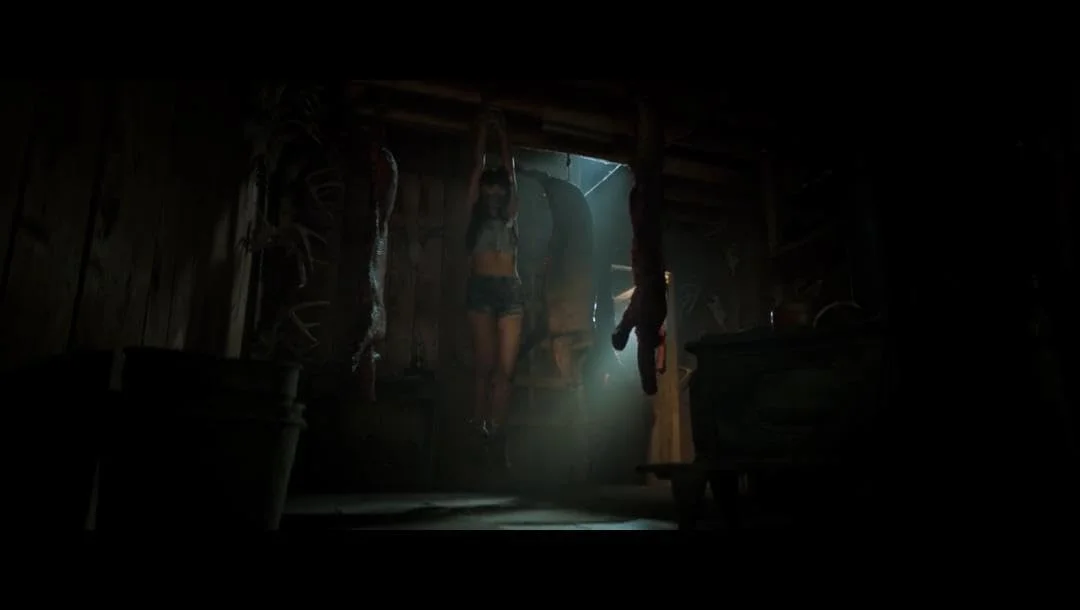
Lisa’s bereavement puts another loss alongside his. Their circumstances are plainly different, but the absence of a mother gives the film a possible route toward a disturbing recognition between them. That possibility deserves attention. A killer who invites pity can leave us uncomfortable about our own response, particularly when we are still afraid of what he might do. The Hermit struggles with the second half of that experience. Hugo’s enormous pointed wooden pole promises brutal force, but the impalements seldom deliver the physical shock his presence prepares us for.
The setting produces a similar gap. The cabins, farm furnishings, and surrounding woods give Hugo’s property enough character to suggest a place the teenagers should never have entered. Yet the clean presentation often leaves captivity feeling strangely comfortable to watch. The objects tell us that the environment is unpleasant; the images do relatively little to make us recoil from being there. Combined with the interview’s breathing spaces, that visual softness allows Hugo’s sadness to register more steadily than the danger of sharing a room with him.
There are moments when the film finds pleasure in precisely that awkward combination of feelings. Flesh preparation accompanied by Shirley Temple’s “Animal Crackers in My Soup” invites a smile that sits badly beside the image. It is a cheerfully tasteless choice, and the discomfort of enjoying it gives the film some life. Ranger Cadet Scott’s goofy TikTok videos offer another small, specific pleasure. Christopher Collins makes the character’s silliness worth watching, rather than leaving the comedy entirely dependent on the prospect of another victim.
The comic hikers are less helpful. Their buoyant musical accompaniment establishes a separate pocket of entertainment that repeatedly takes attention away from Lisa and Eric. Horror and comedy can intensify each other, but these detours tend to let the previous feeling expire before supplying a new one. Scott’s videos have a recognizable comic personality; the hikers’ musical cues do much of the work of announcing amusement. The difference matters in a film already struggling to keep us involved across its interruptions.
Late in the film, Yaz’s “Only You” accompanies a montage that revises our understanding of the ordeal. The song’s tenderness gives the grisly material an unexpectedly affectionate register, bringing the possibility of connection into sharper focus. This is where the film’s sympathy for Hugo and uncertainty about Lisa begin to acquire a shared emotional purpose. But several revisions arrive in a compressed stretch, leaving little time to absorb each change. I wanted to stay with the unease of that tenderness, to feel my response to these people shifting. The film was still busy explaining what had happened.
The Hermit was released on digital and VOD platforms by Uncork’d Entertainment on March 3, 2026. The backwoods horror thriller follows two teenagers on a woodland vacation who must fight for survival against a menacing, cannibalistic pig farmer.
Where to Watch The Hermit (2025) Online






Full Credits
Title: The Hermit
Distributor: Uncork’d Entertainment
Release date: March 3, 2026
Running time: 1 hour 26 minutes (86 minutes)
Director: Salvatore Sclafani
Writers: Salvatore Sclafani
Producers and Executive Producers: Gerry Pass
Cast: Lou Ferrigno, Malina Weissman, Anthony Turpel
- Composer: John Jesensky
The Review
The Hermit
The Hermit left me curious about its people and rarely afraid for them. Ferrigno’s damaged dependence and Weissman’s guarded testimony give this cannibal tale an emotional pull, while mischievous musical choices supply flashes of pleasure. But the interview interruptions drain suspense, comic detours scatter attention, and the killings lack force. The late montage finds an unsettling tenderness that the rushed revelations leave little time to absorb.
PROS
- Ferrigno gives Hugo a affecting vulnerability.
- Weissman makes Lisa’s guarded answers suggestive.
- Playful musical choices create uneasy amusement.
- Ranger Cadet Scott’s TikTok videos provide memorable comedy.
CONS
- Interview interruptions weaken sustained suspense.
- Polished visuals and weak impalements soften the danger.
- Comic hikers disrupt emotional continuity.
- Closing revelations compress too many changes.







