







![Kingdom Hearts Collection [I-III] Review](https://gazettely.com/wp-content/uploads/2026/10/Kingdom-Hearts-Collection-I-III-1-360x180.webp "Kingdom Hearts Collection [I-III] Review: KHII Holds Steady as Newer Entries Fluctuate 36")





Calvin Penney wants his children to inherit a way of life conducted on somebody else’s boat. The Crocker family owns the vessel, the distillery that buys his harvested iceberg fragments, and interests in the local science center. Calvin supplies the labor and the attachment to place. In Jesse McKeown’s six-part Netflix series Below, the Newfoundland settlement of Snook’s Arm faces resettlement while its remaining residents try to keep an increasingly precarious economy functioning. Calvin’s insistence on independence comes with a fairly extensive list of dependencies.
Then marine researcher Fonda Howander examines material from his supposedly defective ice haul and identifies a huge creature’s mucus membrane. The discovery changes the meaning of the work itself. Calvin has brought something ashore expecting to sell it; he does not even know what he has taken. Scientific examination exposes a mistake in the town’s commercial relationship with the sea before the creature’s scale becomes fully apparent. The disturbing possibility is that everyone has been treating an environment as inventory without understanding what lives there.
The iceberg-vodka business gives the ecological argument an uncomfortable specificity. A deteriorating world can still supply a marketable product. Calvin and his son Wade supplement their income by sharing their house through Airbnb, so even domestic space must earn its keep. Preserving the old life involves selling fragments of it to visitors (preferably visitors who leave good ratings). These details make the resettlement question difficult to resolve through declarations of community pride. Leaving means surrendering a place; staying already requires changing how that place is used.
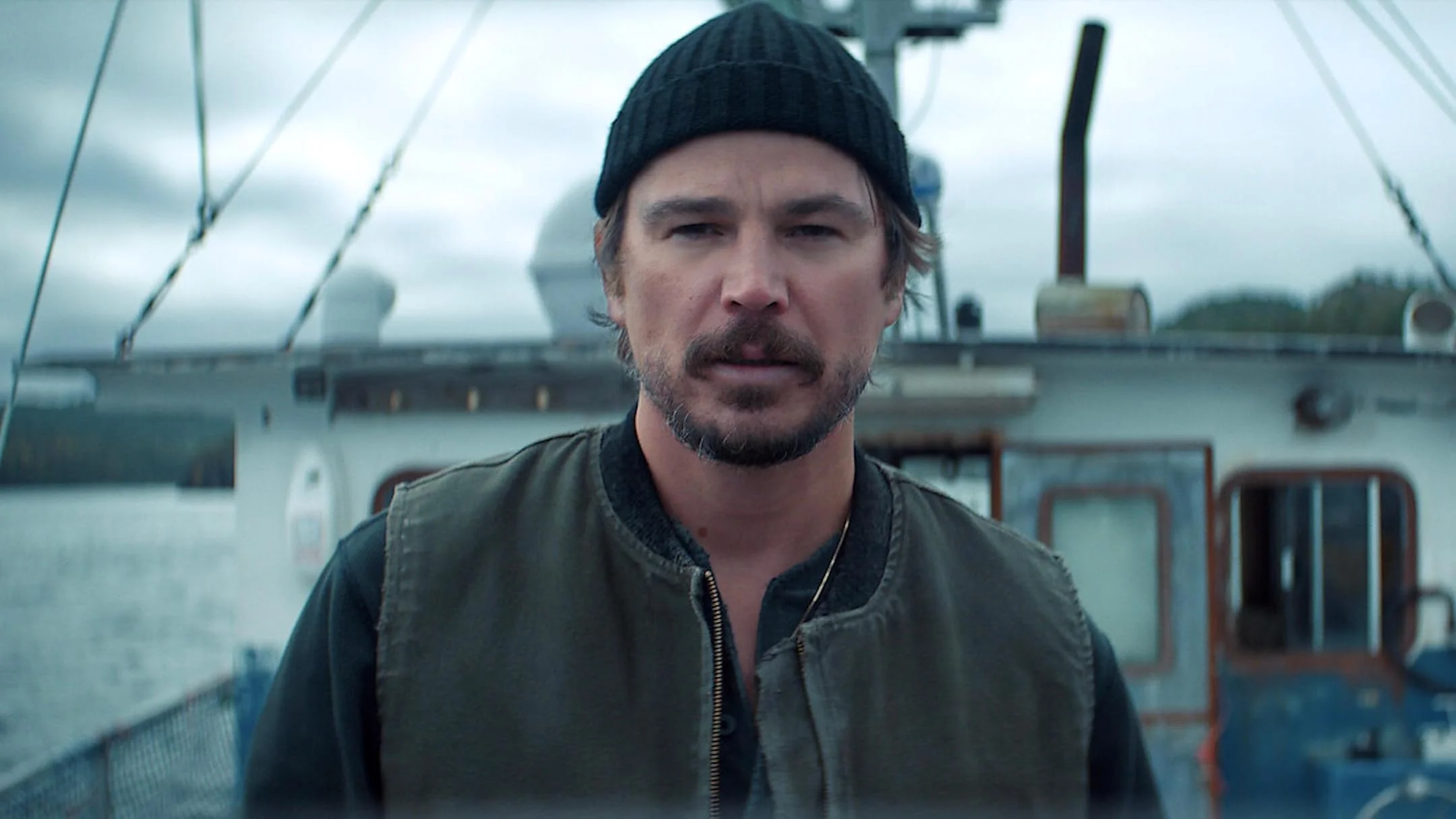
Calvin, played by Josh Hartnett, wants his adult children involved in the ice-harvesting business. Wade, played by Charlie Heaton, has remained nearby and wants to become his father’s trusted partner. Mary and Jay have left, returning during Come Home Year with a boyfriend and concealed financial trouble, respectively. The celebration accommodates departure by giving it a return date. Calvin’s hopes extend beyond a visit. His version of family continuity asks the next generation to maintain a livelihood whose future he cannot guarantee.
My first instinct was to read that demand as possessiveness dressed up as fidelity. Wade’s hunger for recognition certainly supports the suspicion: proximity to his father has not secured the approval he needs. But that reading makes Calvin too easy to dismiss.
In the 1986 prologue, his family transports its house across the water during resettlement. His father dies when the house is pulled under, and the young Calvin cuts the connection to the boat to save everyone else. For him, relocation is inseparable from an actual catastrophe. Staying can be an effort to prevent repetition, however little protection it offers against the present. He once saved his family by severing its connection to a home.

That action complicates the adult Calvin’s stubbornness without making it wise. Hartnett gives the character sufficient reserve that his history does not become a constant announcement of suffering. His determination carries the vulnerability he tries to contain. Heaton supplies a less settled energy, with Wade’s goofy risk-taking rubbing against his need to be taken seriously. Their scenes give the preservation argument a human cost: a son can embrace the family’s way of life and still struggle to find a secure position within it. The father’s wish to keep everyone close cannot resolve that problem.
The horror is most effective when it attacks the ordinary uses of the water. A Portuguese trawler disappears; Wade’s encounter ends with another man ripped in half, the practical gore supplying a revolting physical consequence to the largely unseen threat.
Boats cease to be reliable extensions of the town’s working space. The mysterious illness goes further, creating a thirst that drives residents toward the water. Need itself becomes dangerous. The sea does not have to lure people through some exotic temptation when their bodies and occupations already direct them there.
The submersible expedition turns investigation into another form of exposure. Calvin enters a confined vessel with people tracking the creature, exchanging the familiarity of surface work for dependence on a small enclosure inside its environment. The claustrophobia gives the search a persuasive vulnerability. Fonda’s inquiry, meanwhile, offers a reason to keep thinking rather than merely panic.
Mackenzie Davis makes her approachable enough that the scientific partnership with Calvin has warmth, but the membrane discovery is what gives her expertise dramatic value. Learning something about the organism enlarges the danger. Explanation can sustain dread when knowledge reveals how badly the original assumptions fit.
The later episodes are less disciplined about what further knowledge contributes. Creature hunters, additional human antagonists, and a remote-island interlude expand the field of activity. The island material has a legitimate purpose, bringing regional history into the encounter with the unknown.
Nor must the series remain a single kind of monster story throughout. Its family drama belongs to the premise. Yet each expansion draws attention away from relationships that need development, especially Wade’s desire for recognition, while Mary’s romance and Jay’s debts compete for space with the accumulating revelations.
Six episodes give Below useful momentum, but brevity and selectivity are separate achievements. The finale moves quickly through explanation and resolution, increasingly spelling out themes that the ice trade, the rented rooms, and Calvin’s family expectations had already made tangible. The creature’s revealed origins and intentions shift the emphasis toward heartfelt drama; the difficulty is how little time remains for that shift to acquire emotional weight. Identifying greed and affirming community are easier tasks than examining the compromises through which this particular community survives.
Calvin’s wish to protect his children remains the more difficult proposition. Wade wants a place beside him; Mary and Jay’s return does not erase the lives they have begun elsewhere. Come Home Year allows those different attachments to coexist for a visit. A permanent future asks something harder of them, and the late rush gives too little space to the possibility that loving Snook’s Arm might lead its children to make different decisions about staying.
Below premieres globally on Netflix on October 8, 2026. The supernatural thriller miniseries follows a fisherman in a remote coastal town who must fight to protect his family and community when a mysterious creature emerges from the ocean depths.
Where to Watch Below Online


Full Credits
Title: Below
Distributor: Netflix
Release date: October 8, 2026
Rating: TV-MA
Running time: 45–55 minutes per episode
Director: Not publicly specified
Writers: Jesse McKeown
Producers and Executive Producers: Not publicly specified
Cast: Josh Hartnett, Mackenzie Davis, Charlie Heaton, Ruby Stokes, Natasha Henstridge, Rohan Campbell, Joshua Close, Kaleb Horn
The Review
Below
Below gives its endangered community an economy, a history, and family attachments that make staying difficult to dismiss. Hartnett and Heaton make that loyalty painfully human, while the maritime horror turns dependence on the sea into physical danger. I found the contaminated ice and rented rooms sharper than the finale’s increasingly explicit message. As revelations accumulate, the series leaves too little room for its hardest question: what exactly is Calvin asking his children to preserve?
PROS
- Hartnett and Heaton’s emotionally credible family dynamic.
- Concrete links between economic survival and ecological danger.
- Effective maritime dread, claustrophobia, and practical gore.
- Calvin’s history complicates easy judgments about staying.
CONS
- Expanding mysteries crowd out family development.
- Rushed resolutions limit the finale’s emotional weight.
- Explicit messaging weakens the earlier thematic subtlety.