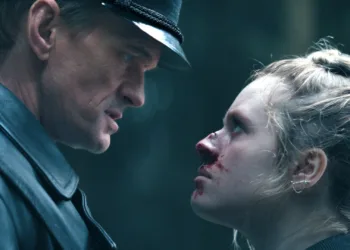




























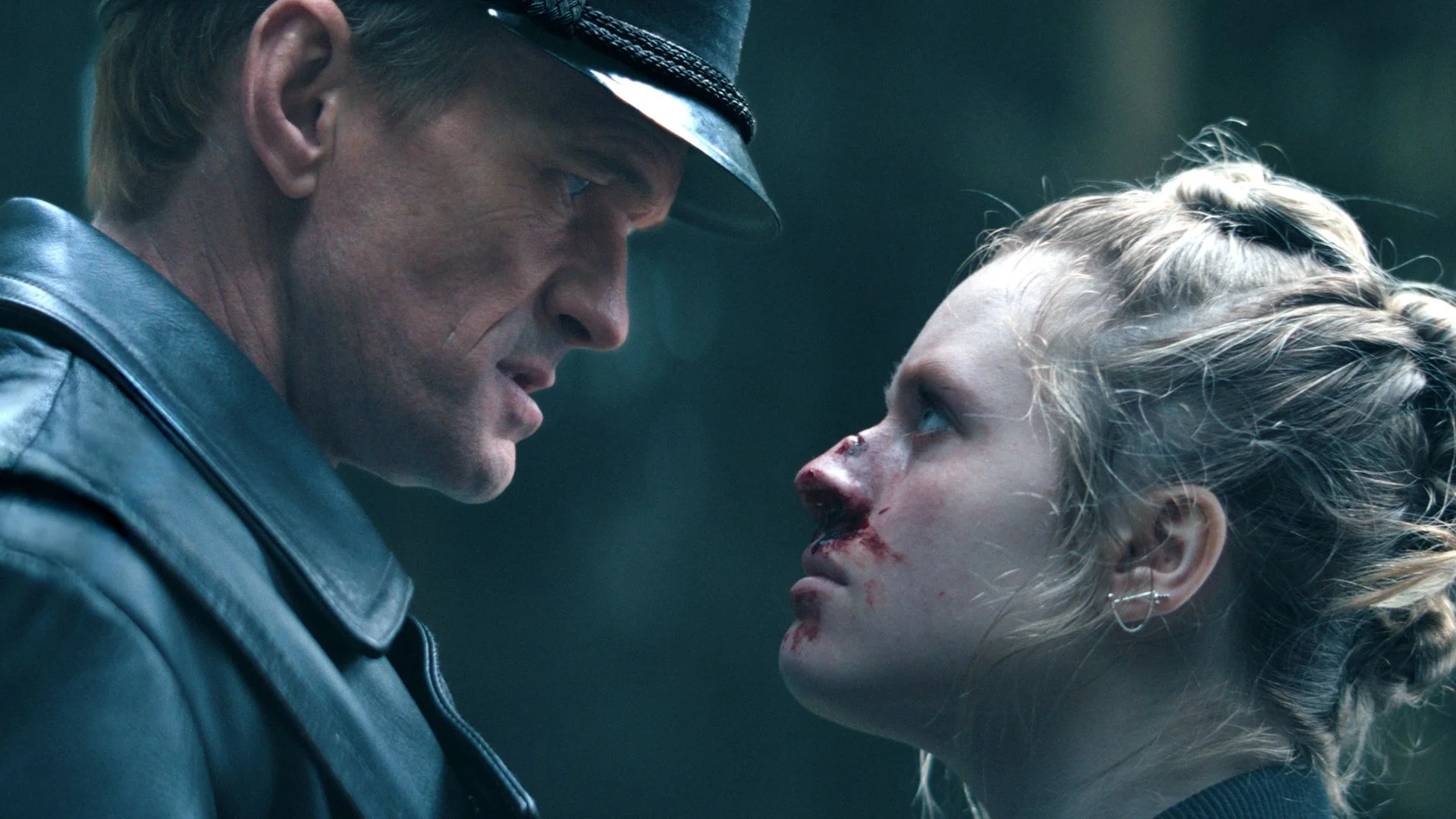

General Reuss runs an inn at the Wolf’s Lair, Hitler’s former military headquarters in what is now Poland. When Becky arrives undercover, Neil Patrick Harris gives Reuss the warmth of a man who knows how to receive a guest. His performance makes the inn feel like a family business before we see what else the family has inherited. Director Jenn Wexler gets a sharper effect from that welcome than from any of the general’s experiments. For a moment, Becky has to keep up her side of a social exchange with a man whose plans she has come to uncover.
Reuss takes pride in a grandfather who served Hitler and dresses in the uniform of his regime. That detail changes the terms of a series that began with American neo-Nazis invading a lake house. The men in the first Becky had already carried an old ideology into an ordinary American setting. In The Last Temptation of Becky, a descendant tries to revive the regime at one of its former headquarters.
The inn briefly makes that continuity feel plausible. It gives the family a place in the present and a way to receive strangers. Once the uniforms and the bunker experiments take over, the continuity becomes much easier to see and the villains much easier to dismiss. Reuss wants a Fourth Reich, and Wexler invites us to laugh at the man who thinks his grandfather’s clothes still confer authority.
To get Becky to Poland, the series borrows a set of conventions from British spy cinema. The girl who fought for her life at thirteen now has a CIA posting, gadgets, and a cover identity. Director Baker gives her a first solo assignment with a modest aim for a film so taken with James Bond.
She is to gather intelligence and come home. The assignment makes good use of Lulu Wilson, whose brief undercover performance shows how much Becky can do by keeping her temper out of sight. Wilson gets to play someone who understands the value of being underestimated.
We see the agency’s predicament in the nightclub, where Becky beats a target on the dance floor. The clubgoers are horrified. Her partner, Jordan Rigby, has seen enough of her work to take it in stride. His reaction is the comic beat that gives the violence its shape. The people on the dance floor are witnessing an outrage, while Rigby is watching a colleague fall back on a familiar routine.
This is Becky’s “Plan C.” Bond’s breaches of protocol can carry the assurance that the agent knows what his superiors have missed. Wilson gives Becky a different sort of confidence. She has already found the part of the job she likes, and a reconnaissance mission gives her very little of it.

The discovery that Reuss may be tied to her father’s death gives Becky a personal reason to stay. It also gives the film an excuse to return to a motive it knows how to handle. The midfilm explanations spend enough time connecting Reuss to the past to slow down a story that moved briskly from the nightclub to the undercover assignment.
The result is a curious sort of coming of age. At eighteen, Becky can work alone and sustain a cover in a room with a dangerous man. Yet the screenplay devotes much of its middle to giving her a fresh reason to fight as she did at thirteen. I wanted to see what the adult Becky might do with the self-command she briefly displays at the inn.
Once she abandons the assignment, the film gets mixed results from the license it gives her. There is a difference between coming up with a funny death and staging a fight that makes the death funny. Some of the later fights move so sluggishly that the gore has to supply the surprise on its own.
An exploding head can deliver a good nasty laugh, and Wexler gets mileage out of giving men in such self-important uniforms such undignified deaths. The conspicuous effects make some of the bloodshed look less like the consequence of a blow than a visual gag pasted onto it.
The film finds a cleaner joke in the old saying about living well being the best revenge. It puts the words on screen, then erases “living well” and substitutes “revenge.” The edit leaves a wonderfully useless piece of advice. It also gives Becky an instant of comic authorship in a film where other people keep telling her what to do with her life. Baker can give her orders and Montana can offer her perspective. Give Becky a sentence about getting on with her life and she’ll change the subject before you finish reading it.
The Last Temptation of Becky premieres in theaters on November 4, 2026, distributed by Quiver Distribution. Directed by Jenn Wexler, the action-horror thriller follows newly minted CIA agent Becky as she goes undercover at a tourist inn at Hitler’s former bunker in Poland to stop a fanatical leader plotting to resurrect the Fourth Reich.
Where to Watch The Last Temptation of Becky (2026) Online
Full Credits
Title: The Last Temptation of Becky
Distributor: Quiver Distribution
Release date: November 4, 2026 (Theaters)
Rating: R
Running time: 1 hour 29 minutes (89 minutes)
Director: Jenn Wexler
Writers: Jenn Wexler, Matt Angel, Suzanne Coote
Producers and Executive Producers: Jordan Yale Levine, Jordan Beckerman, J.D. Lifshitz, Raphael Margules, Russ Posternak
Cast: Lulu Wilson, Neil Patrick Harris, Kate Siegel, James Urbaniak, Brandon Flynn, Catherine Walker, Aoife Hughes, Noah Leggott
The Review
The Last Temptation of Becky
Becky takes the gadgets of British spy cinema to Poland and gives the CIA a field agent who treats reconnaissance as a prelude to a brawl. Lulu Wilson is sharpest when Becky has to keep her temper under cover, and Neil Patrick Harris makes fascism feel closer to the present as a genial innkeeper than he does in full uniform. The film has a mean comic streak worth keeping. Its sluggish fights and detour through Becky’s past leave too little room for the adult she’s become.
PROS
- Wilson makes Becky’s brief undercover turn count.
- Harris makes Reuss’s hospitality unsettling.
- The Bond conventions give Becky’s insubordination a fresh comic setting.
- The nightclub beating gets its dark humor from the crowd and Rigby’s reactions.
CONS
- The midfilm backstory slows the mission.
- The revenge plot gives Becky’s new skills little room to change her choices.
- Sluggish fights lean heavily on conspicuous gore.
- The bunker spectacle makes Reuss easier to dismiss.