




























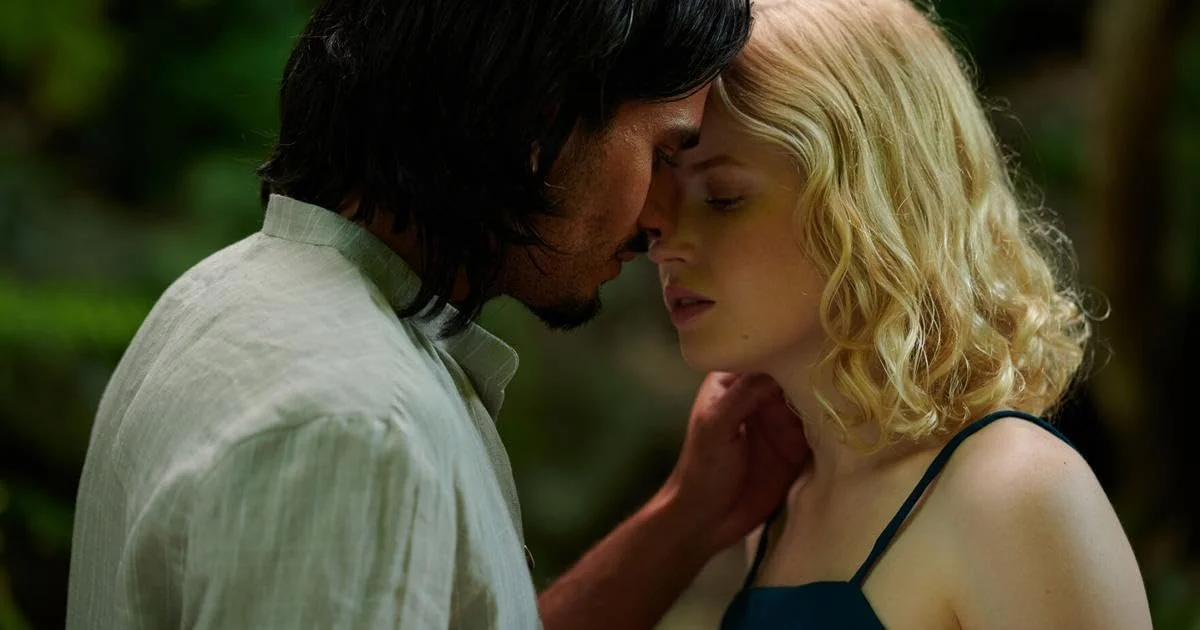

George has found a way to keep his sugar plantation afloat. It requires his niece to marry a man she has no reason to want. Seventeen-year-old Lucy (Ellie Bamber) arrives at Ambleside in colonial Mauritius in 1925, after her mother’s death, and finds that her uncle has already put her to work in the family finances. The wealthy Antoine (Edward Akrout) is his candidate. Rupert Penry-Jones lets some of George’s anxiety leak through his upper-class assurance. The man who expects to be obeyed is depending on a teenager to get him out of trouble.
The marriage scheme gives an argument about women’s freedom a decision to turn on. Lucy can refuse Antoine, and that refusal could cost George the estate. Yet the script insists on having George raise women’s rights in an early nighttime conversation that was going perfectly well without a motion from the chair.
The abrupt change of subject makes both characters sound as though they have been called upon to state their positions. Penry-Jones has better material in the marriage scheme itself, where George’s conviction that he knows what is best for Lucy is inseparable from his need for her to say yes.
George’s power over Krishna (Mehdi Dehbi) is easier to establish and harder for the film to dramatize. Krishna works in George’s fields. Shackles still hang from a post in the garden at Ambleside, a piece of the plantation’s history of slavery left in place while George goes on defending racial superiority. Lucy can register her disgust at his views and at the easy racism of his circle. Krishna has to earn a living on the estate. Prisoners of Paradise sets up that difference with economy, then gives us too little of Krishna’s life in the fields or his village to see how it shapes the decisions he makes.
The film is on surer ground when it asks Bamber and Dehbi to convey the pleasure of seeing each other. Lucy catches sight of Krishna bathing at a waterfall, and the scene establishes her interest with a directness the conversation about women’s rights could have used.
There’s a quiet warmth to the leads in their secret meetings. The scenes are less successful at moving the relationship beyond the anticipation of another meeting. Lucy’s refusal of the future George has arranged is easy to understand because the film has made that future concrete. It gives Krishna fewer opportunities to show what a future with Lucy would demand of him.

That imbalance matters most in the stretch between the first attraction and George’s discovery. Once Lucy and Krishna begin meeting in secret, the suspense depends on what they do with the knowledge that they could be caught. There is room for a quiet romance to tighten the screws through small choices, especially when one lover answers to George at home and the other answers to him at work. The film spends enough time with the pair to establish their longing, but their meetings do too little to make the next encounter feel riskier than the last.
Once George finds out, the confrontation has the urgency that was hard to sustain while the lovers were still going undetected. The low angles give Penry-Jones a physical command of the scene. Earlier, the prospect of losing the plantation exposed how badly George needed Lucy’s cooperation. Here the camera makes it easy to see what he can still do with the authority he has.
The score competes with the dialogue in that confrontation, when hearing the two of them clearly would let the exchange carry some of the menace. The same problem costs the film something different when Lucy and Krishna swim together. George has the camera angle and Penry-Jones’s presence to establish his control even when the words are hard to catch. The lovers have fewer scenes in which they can speak freely, and in one of them you have to strain to hear what they say to each other.
Prisoners of Paradise premiered in 2026 and is available to rent or buy on digital platforms such as Apple TV and Prime Video. Directed by Mitch Jenkins, the period romantic drama follows a young 1920s orphan sent to Mauritius under her uncle’s guardianship, where she defies social expectations and family plans by initiating a passionate, forbidden affair with a local laborer.
Where to Watch Prisoners of Paradise (2025) Online



Full Credits
Title: Prisoners of Paradise
Distributor: Signature Entertainment, Vantage Media / VMI Worldwide
Release date: 2026
Rating: PG-13 / TV-14
Running time: 1 hour 48 minutes (108 minutes)
Director: Mitch Jenkins
Writers: Mitch Jenkins, Jason Wingard, Alan Govinden
Producers and Executive Producers: Alan Govinden, Maria Govinden, Paula Crickard, Julia Govinden
Cast: Ellie Bamber, Mehdi Dehbi, Rupert Penry-Jones, Rhona Mitra, JJ Feild, Edward Akrout, Amy Beth Hayes
Director of Photography (Cinematographer): Stuart Howell
Editors: Chris Gill
Composer: Sturdivant Adams
The Review
Prisoners of Paradise
Prisoners of Paradise gives George a practical reason to interfere and Rupert Penry-Jones the chance to show how much bluster that dependence requires. Ellie Bamber and Mehdi Dehbi make the attraction easy to believe, but the script gives Krishna too little room to show what he’s risking. The secret meetings establish longing without building much suspense. When George finally discovers the affair, the confrontation has the force the middle of the film needed.
PROS
- Penry-Jones lets George’s insecurity show through his bluster.
- The marriage scheme gives Lucy’s defiance concrete stakes.
- Bamber and Dehbi convey quiet affection.
- Low angles give the late confrontation immediate force.
CONS
- Krishna’s life away from Lucy gets too little attention.
- The secret meetings build limited suspense.
- The nighttime debate about women’s rights feels forced.
- The score obscures dialogue in key scenes.