





























Disney+ has taken the Korean web novel and webtoon The Remarried Empress to palaces in Germany and the Czech Republic, giving its invented monarchy the architectural credentials of an established European dynasty. The grand interiors lend physical scale to ceremonies and court appearances; the Korean cast inhabits these spaces without the story assuming the obligations of historical reconstruction. This is royalty assembled for romantic consumption. Across the first four episodes, the production makes inherited privilege look comfortable, beautiful, and exceptionally difficult to leave.
The costumes begin sorting the women within that arrangement. Empress Navier’s formal gowns give Shin Min-a an assured silhouette, while the sweeter, doll-like dresses worn by Lee Se-young’s Rashta suggest innocence awaiting protection. One woman appears born to occupy these rooms; the other looks newly dressed for admission. Such distinctions make the court immediately readable, an asset for an adaptation introducing an elaborate fantasy setting. They also lend established rank an aesthetic authority before the drama has examined what entitles anyone to possess it. Disney+ presents hereditary wealth with the confidence of a luxury hotel brochure.
Navier’s position, however, comes with conditions that beautiful clothing cannot satisfy. Her husband, Emperor Sovieshu, wants a pregnancy to announce at the approaching New Year’s ceremony. Their lack of a child has already attracted gossip. When his uncle requests a pardon after an earlier attempt to seize the throne, Navier identifies the danger of restoring him to favor; Sovieshu returns to the security an heir would provide. The exchange gives reproductive pressure a specific political function. Her judgment helps protect the monarchy, but her body is expected to settle its legitimacy.
Shin makes the work of remaining empress perceptible. A slight widening of the eyes, a trembling lip, a fist tightening while the rest of Navier stays composed: these gestures register feelings she cannot comfortably express in public. After Sovieshu installs Rashta as his mistress, Navier still has festivities to organize and a ceremonial role to fulfill. Her restraint acquires meaning through that continued labor. The performance allows hurt and competence to exist together, resisting the assumption that a woman must abandon control before an audience can recognize her distress.
The writing gives Ju Ji-hoon a much less convincing transition. Early scenes establish Sovieshu and Navier laughing and cuddling in bed, discussing political matters, and sharing the familiarity of a long marriage. By the second episode, he is prepared to humiliate her and punish her servants. His anxiety about succession establishes a vulnerability; it scarcely accounts for this speed of deterioration. The cruelty efficiently directs sympathy toward Navier, but it also reduces the marriage’s dramatic possibilities. A husband who changes this quickly becomes easier to condemn and harder to understand, leaving Shin to supply much of the emotional continuity.
Rashta’s introduction briefly creates a harder problem for the romance to manage. Pursued by slave hunters, she reaches imperial protection with scratches on her body and a history of abuse. She begs Sovieshu not to return her to her master. He wipes away her tears and kisses her. The sequence moves from a request for safety into romantic contact with the man who can provide it. Nothing requires us to invent a threat from Sovieshu to recognize how little bargaining power Rashta possesses. His affection arrives attached to the authority that determines her immediate future.
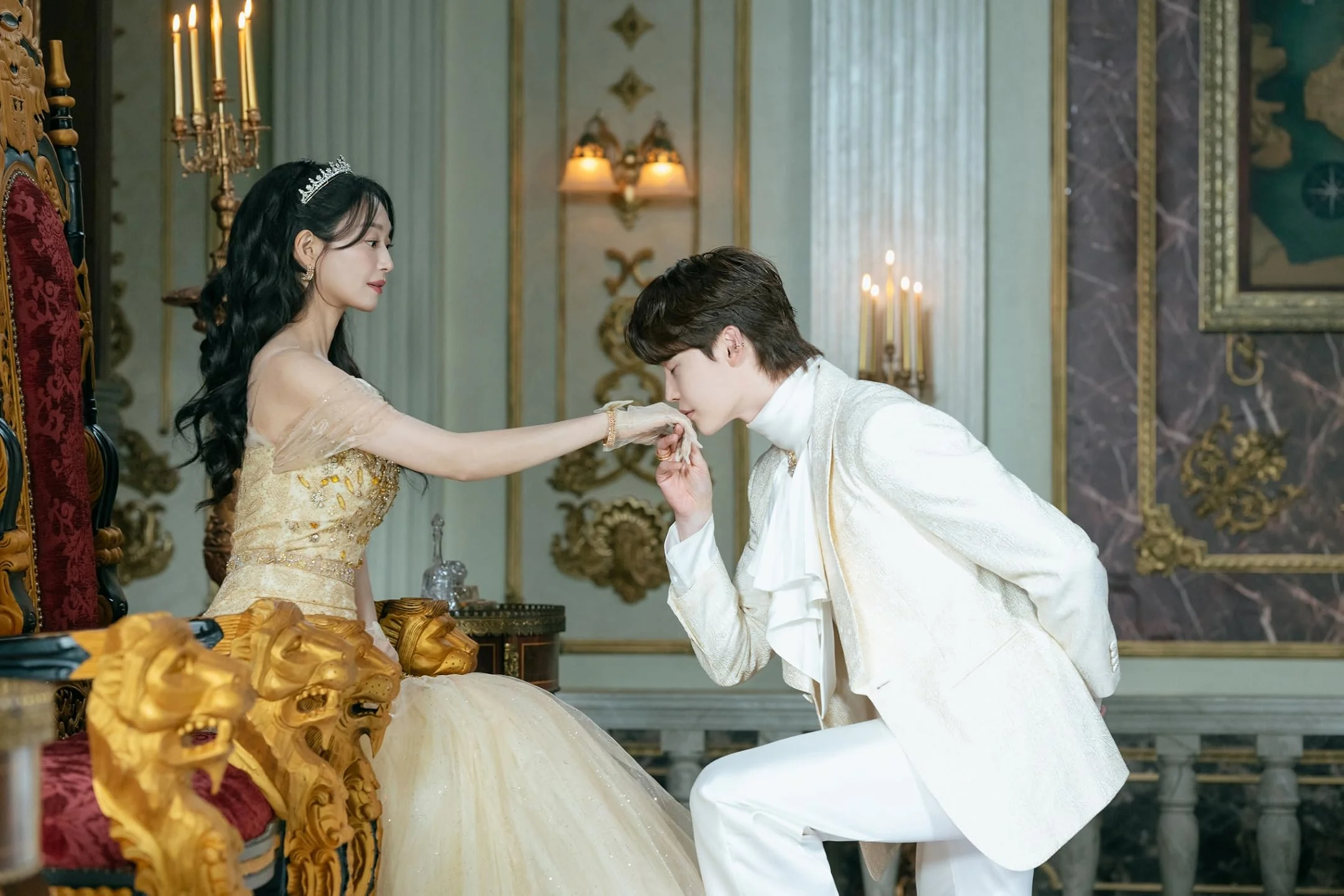
That scene deserves greater weight than the subsequent emphasis on Rashta’s pettiness allows it. The adaptation gives Navier’s distress the expressive dignity of Shin’s controlled gestures, while Rashta increasingly functions as an irritating rival whose presence makes the empress’s suffering worse. Recognizing Rashta’s circumstances need not excuse her behavior.
It does require remembering that she entered this palace seeking protection from ownership. Her apparent innocence, reinforced by those sugary dresses, offers a less demanding image than her dependence on imperial favor. Sovieshu has arranged the rivalry, and his ability to determine both women’s circumstances should remain visible when the drama invites us to choose between them.
The succession dispute gives the political material firmer stakes than the threatened collapse of the imperial marriage, whose consequences for anyone outside the household remain hazy. Four episodes cannot establish the season’s eventual treatment of that question, but the opening often borrows importance from titles and ceremonial surroundings. We understand what Navier stands to lose emotionally before we understand what her departure would change about the empire she helps govern.
Heinrey gives the fantasy a more immediate purpose. Played by Lee Jong-suk, the Western Kingdom’s crown prince first assists Navier in the form of a white bird during a hunt. A creature moving beneath the ground pursues her, and the bird helps direct her toward a magical barrier. Her riding and judgment remain essential to the escape, preserving an active role for a heroine otherwise expected to absorb indignity gracefully. The sequence establishes fantasy through a practical relationship between danger, assistance, and choice. The magic becomes useful before it becomes an explanation of the world.
The bird’s later work as a messenger creates a more intimate complication. Navier exchanges letters with an anonymous admirer and confides in the creature, unaware that the courier and the prince are the same person. It is an appealing mechanism for a woman whose official life affords little room for unguarded speech. It also gives Heinrey access to feelings she does not know she is sharing with a prospective lover. The dramatic irony carries charm and an imbalance of knowledge at once. Lee’s playful manner provides welcome relief, though the concealed identity deserves to remain part of how that intimacy is understood.
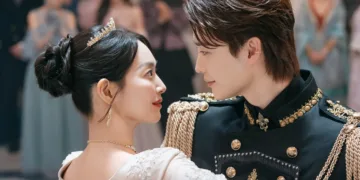
His arrival in human form gives the early episodes a clearer romantic direction. A monster attack, a rescue, correspondence, and preparations for court festivities provide plenty of incident, yet motives develop less readily than events accumulate. The ballroom dance between Heinrey and Navier finally gives the lavish surroundings something emotionally specific to accommodate. His attention reaches a woman who has been required to continue appearing in public while her husband disregards her. Another prince offers a familiar solution to her predicament, and the royal hierarchy remains comfortably in place around them. For the length of the dance, her attention has somewhere else to go.
The Remarried Empress premiered globally on Disney+ and Hulu on November 3, 2026. Based on the popular web novel, the fantasy-romance series follows an intelligent empress who asks for permission to remarry a neighboring prince after her emperor husband demands a divorce to marry his mistress.
Where to Watch The Remarried Empress Online

Full Credits
Title: The Remarried Empress
Distributor: Disney+ / Hulu
Release date: November 3, 2026
Rating: TV-14
Running time: 60 minutes per episode
Director: Jo Soo-Won, Shim Na-Yeon
Writers: Alphatart (web novel), Yeo Ji-Na, Hyun Chung-Yeol
Producers and Executive Producers: Studio N
Cast: Shin Min-a, Ju Ji-hoon, Lee Jong-suk, Lee Se-young, Lee Bong-ryun, Choi Dae-hoon, Park Ho-san, Jung Young-joo
The Review
The Remarried Empress
The first four episodes of The Remarried Empress turn palace grandeur and marital humiliation into an inviting streaming fantasy, anchored by Shin Min-a’s finely controlled performance. Heinrey’s courtship supplies warmth and direction, but Sovieshu’s abrupt cruelty and Rashta’s narrowing characterization simplify the unequal relationships the premise establishes. Disney+ makes royal privilege easier to desire than to examine. The romance offers genuine pleasure; its political imagination remains less developed than its wardrobe.
PROS
- Shin Min-a makes Navier’s restraint emotionally expressive.
- Palace locations and costumes establish a persuasive royal fantasy.
- Heinrey’s playful courtship brings warmth and romantic momentum.
CONS
- Sovieshu’s sudden cruelty lacks convincing development.
- Rashta’s rivalry role diminishes her established vulnerability.
- The marriage’s wider political consequences remain hazy.