




















David invites influencers to his supposedly eco-friendly island resort, then struggles to conceal his contempt for the people expected to advertise it. Andy Nyman makes that dependence wonderfully unpleasant. His hotelier has to flatter guests whose habits disgust him, and the effort keeps breaking down into aggression.
The launch party in Christopher Smith’s Spider Island is a commercial transaction conducted through mutual vanity: complimentary luxury buys favorable attention, while everyone pretends the invitation recognizes something special about its recipient. David wants the publicity without acknowledging the power he has lent his guests.
The film enjoys humiliating those guests, though its choice of targets is less straightforward than the invitation to laugh at influencers suggests. Their activities range from fashion and lifestyle promotion to Mongoose’s drug consumption; one member of this publicity economy is a dog.
These distinctions widen the comic field without giving everyone much substance. Yet David’s hostility prevents the ridicule from settling into a comfortable alliance between the film and its owner. He recruited these people. Their appetite for attention is part of his business plan, and Nyman’s furious impatience exposes the absurdity of resenting the machinery one has chosen to purchase.
The spiders make the distribution of responsibility clearer. Construction on a protected tropical island has disturbed their habitat, driving them into the resort’s air-conditioning ducts. Switching on the ventilation releases the infestation. Here, the environmental argument acquires a satisfying physical mechanism: the equipment installed to make the island comfortable for visitors delivers the consequences of building there. The guests may be irritating, but their irritation value does not explain the outbreak. Smith gives the disaster a cause that survives the broad jokes about its victims, even as David’s extravagant nastiness makes ecological destruction look conveniently easy to recognize.
Claire, the journalist played by Rose Williams, has returned to expose the development’s environmental claims. Her connection to the island also brings her back into contact with her estranged father, Curtis, an alcoholic former stage actor played by Tim McInnerny.
He runs an older hotel catering to nature researchers, a detail that gives the film two different uses for tourist accommodation. That distinction matters. Treating both buildings as interchangeable would erase the purpose of the reserve; accepting Curtis’s business as automatically harmless would let family affection do the work of environmental scrutiny. The film supplies a difference in purpose, without examining its practical limits very closely.
Its treatment of Claire has a less productive imbalance. Her direct confrontations with David repeatedly require Williams to state the ethical position the plot has already made obvious. Curtis receives Shakespeare quotations, anecdotes about his acting career, and the awkward task of expressing love through a personality accustomed to evasion. McInnerny has room to make conviction coexist with embarrassment.

Williams is too often left defending conviction itself. The difficulty lies in that allocation of dramatic opportunities. Repeated declarations give Claire little chance to reveal anything through hesitation, humor, or an unexpected response, while her father gets to be politically sympathetic and personally exasperating at once.
Curtis’s friendship with Mongoose helps loosen that arrangement. The older man’s attraction to intoxication meets the younger man’s professional commitment to it, creating a bond that has its own comic logic. Divian Ladwa’s Mongoose earns attention by consuming substances for an audience; Curtis has no comparable business justification. Their companionship lets McInnerny move between disreputable pleasure and the urgency of reaching his daughter. Caring about the island has plainly failed to make Curtis a reliable father. His attempts at reconciliation are affecting because shared ecological beliefs cannot simply settle the emotional debt.
These relationships earn some of the time spent waiting for the spiders, though the extended preparation also allows the influencer jokes to repeat their point. Once the swarm breaks loose, Smith finds a livelier rhythm in people scrambling for whatever protection the hotel supplies.
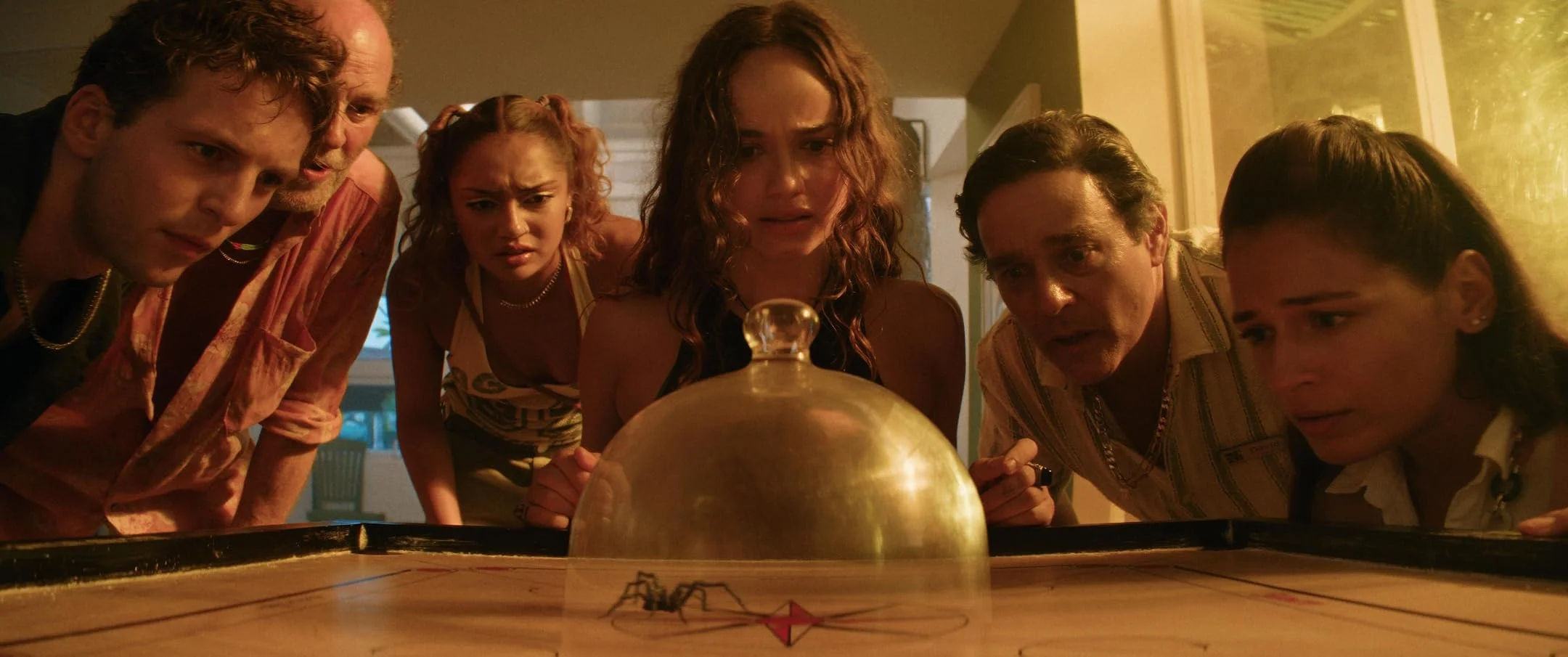
Fire extinguishers become improvised weapons; small bodies spread across human ones. The spiders’ crawling legs provide an unpleasantly precise kind of movement, and their numbers do the work that an enormous monster might otherwise perform. The attacks create bursts of panic without much graphic gore. Crawling and frantic resistance supply enough discomfort without dwelling on torn flesh.
Mongoose receives the film’s most useful reversal. His encounters with mushrooms and a cane toad carry the familiar comedy of a man determined to consume whatever he finds. Under threat, however, his intoxicated calm permits a different relationship with the spiders.
The guest whose entire livelihood appeared to consist of damaging himself for spectators becomes unusually receptive to the creatures everyone else wants away from their bodies. Ladwa makes that change endearing without requiring a sudden transformation into a sensible person. The joke retains its foolishness while redistributing competence, giving this apparently expendable character an unexpected place in the film’s environmental imagination.
Winnie, an older island worker, expresses that imagination in less mischievous language. His warning against ownership and control treats human possession as temporary, extending the principle from the island to the body. Placed beside David’s demands, the idea has an immediate target.
Its application inside the siege is trickier: accepting that a body cannot be possessed forever offers scant reassurance when spiders are crawling over it. Mongoose can relax into that loss of control. The guests reaching for fire extinguishers have understandable reasons to resist, and the comedy depends on keeping their panic recognizable.
The closing stretch has to carry that resistance to ownership into a genre built around removing a threat. A larger queen brings the prospect of a decisive confrontation, yet extermination would resolve the suspense by endorsing the same human entitlement that created the disturbance.
Spider Island resists that solution without adequately developing the practical alternative. Mongoose’s calm offers an amusing individual accommodation; it cannot establish safety for everyone else. The remaining spiders retain their claim on the habitat and their capacity to kill its human occupants, a danger left hanging after the film has begun making peace with their presence.
Spider Island was released theatrically on August 28, 2026, followed by a screening at the FrightFest film festival in London on August 30, 2026. Directed by Christopher Smith, the horror-comedy follows a group of social media influencers who travel to the launch of a luxury hotel on a tropical island, only to discover that the paradise is swarming with deadly spiders.
Where to Watch Spider Island (2026) Online





Full Credits
Title: Spider Island
Distributor: Vertigo Films, Fiction Films, NOW Films
Release date: August 28, 2026
Director: Christopher Smith
Writers: David Quantick, Ben Jacques, Christopher Jolley
Producers and Executive Producers: Allan Niblo, James Richardson, Michael Knowles, Ben Jacques
Cast: Rose Williams, Tim McInnerny, Avani Gregg, Owen Warner, Andy Nyman, Divian Ladwa, Lena Mahfouf, Carlotta Banat
The Review
Spider Island
Spider Island finds its sharpest comedy in a developer who despises the influencers hired to sell his paradise. Nyman’s venomous hospitality, McInnerny’s awkward affection, and Mongoose’s unexpected affinity with the spiders give its ecological argument humor and feeling. The swarming attacks deliver lively discomfort, though the preparation stretches thin and Claire receives too many declarations beside her father’s richer characterization. Its resistance to extermination creates a worthwhile complication that the ending never adequately resolves: respecting the spiders’ habitat still leaves people needing protection.
PROS
- Nyman’s hilariously hostile hospitality.
- McInnerny’s mixture of comic embarrassment and affection.
- Mongoose’s endearing reversal from liability to unlikely survivor.
- Spider attacks rooted in the resort’s environmental damage.
CONS
- Extended buildup repeats the influencer jokes.
- Claire’s speeches restrict her characterization.
- The ending leaves physical danger insufficiently addressed.







