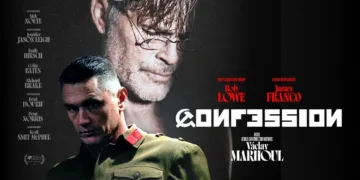








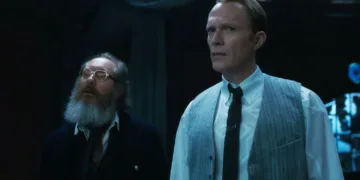


















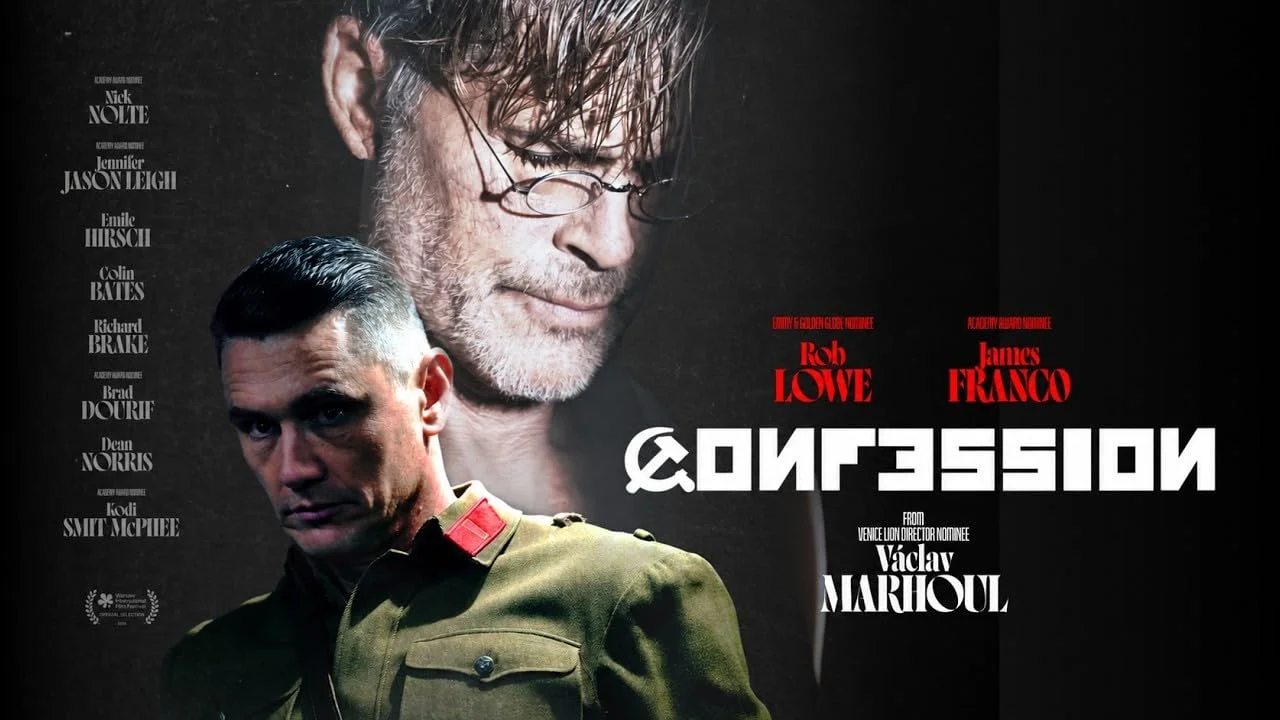

Vladimir knows what his prisoner has read because he once studied under him. Now the gifted pupil interrogates the professor in Lubyanka Prison, demanding testimony that would implicate an Orthodox priest in counterrevolutionary activity. Set in Moscow in 1938, Václav Marhoul’s Confession casts Rob Lowe as Alexei, the teacher, and James Franco as the student entrusted with breaking him.
Their shared education gives the encounter a disturbing intimacy. Vladimir is soliciting the cooperation of someone whose judgment he once respected. The state has its accusation; it needs Alexei’s voice attached to it. A signed statement would make coercion resemble testimony. The demand exposes a peculiar dependency within absolute power: the authorities can imprison the professor, yet still need something that looks like his consent.
Ben Shapiro’s screenplay has found a situation in which words carry practical consequences. Naming Father Mikulski could destroy him. Refusing could destroy Alexei. Yet the dialogue repeatedly leaves these immediate dangers to establish the speakers’ familiarity with Dostoevsky, Pushkin, and the philosophical disputes surrounding freedom and belief. Books supply much of the conversation’s prestige while doing too little to change its direction. The men keep explaining the positions from which they entered the room.
The former teacher and student relationship should make every appeal unusually targeted. Vladimir knows the intellectual habits of the man before him; Alexei knows the promise that preceded his pupil’s brutality. Franco’s role holds both cultivated discussion and physical assault, but the exchanges rarely make those activities feel psychologically entangled. Violence increases the cost of refusal without making the literary conversation much less predictable. The beating can interrupt the debate. The debate too often resumes as if it has been waiting politely outside.
Alexei’s allegiance to the priest gives his resistance a firmer foundation than the quotations do. Mikulski helped him during a period of alcoholism and isolation, when his family relationships had collapsed. Christianity reached him through someone’s care. His refusal therefore involves gratitude toward a particular person, alongside his belief in an afterlife. Betrayal would mean surrendering someone who had encountered him at his least admirable and chosen to help.
That history matters to Lowe’s part. Alexei has a past that complicates his present courage, and the family visits briefly put those competing versions of him in the same room. Jennifer Jason Leigh plays his former wife, who urges him to inform and objects to his persistent literary references. Her frustration punctures the professor’s preferred mode of speech. Someone who knows the damage he has done has limited patience for the authority of his reading list.
Her impatience tempted me to treat her as the film’s accidental critic. I think that would repeat Alexei’s mistake. She has an injured relationship to discuss; making her useful to an argument would be another way of avoiding it.
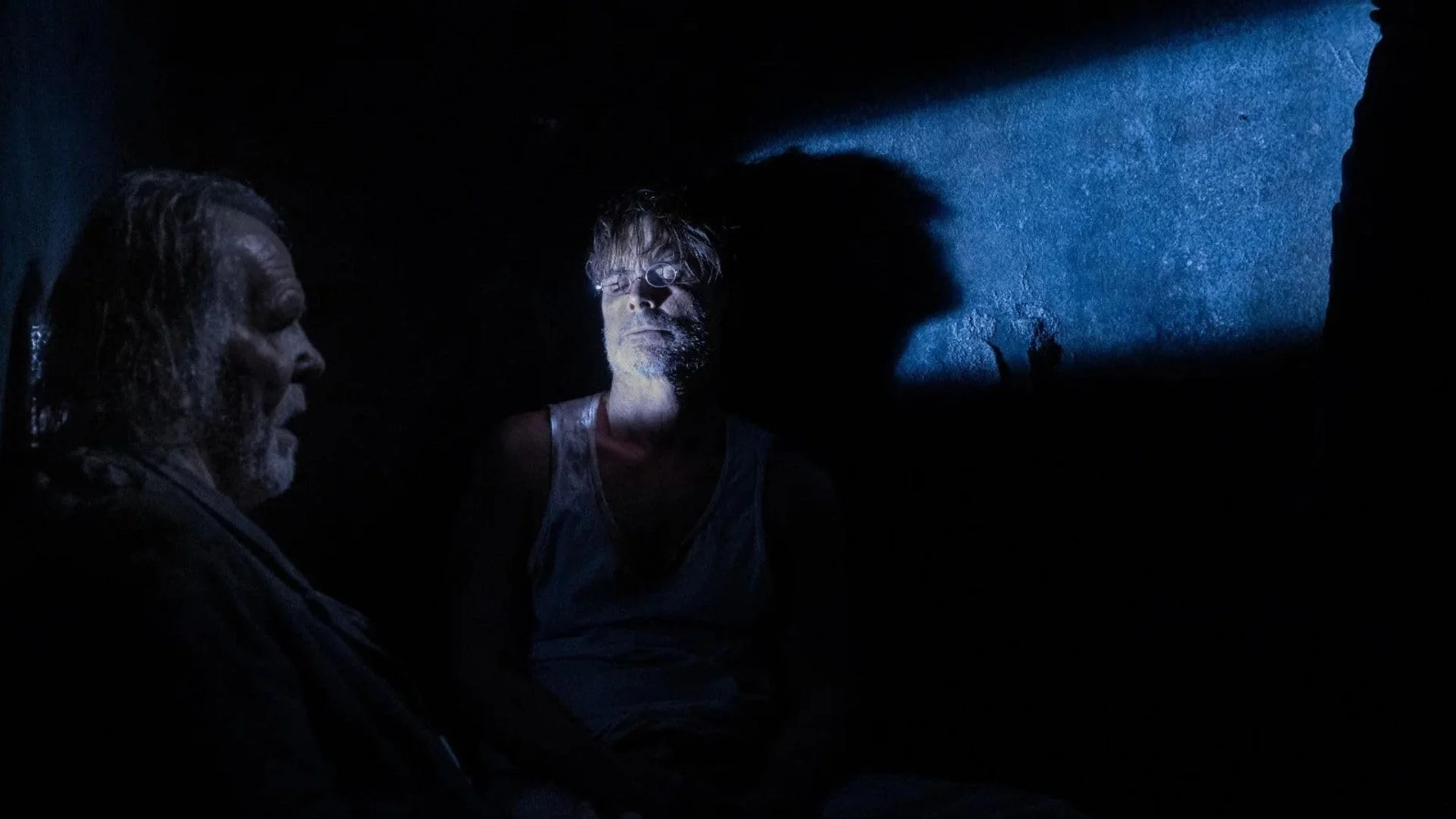
Kodi Smit-McPhee’s estranged son sharpens that difficulty when he confronts Alexei over his treatment of his mother. Courage under interrogation cannot settle this complaint. Nor does the state’s monstrous behavior make the complaint trivial. Here the title acquires a productive ambiguity: the authorities demand an admission that serves their purposes, while his family brings grievances for which an honest acknowledgment might be warranted. There are different accounts to answer, and innocence before the state cannot close all of them.
The film gives these encounters room, then returns to the larger contest between belief and ideological obedience. The family’s anger remains less developed than Alexei’s defense of his convictions. His wife and son can expose the limits of his self-understanding, but their accusations do too little to disturb the moral argument he carries back into the interrogation room. The painful possibility is that a man might become steadfast before he becomes accountable. Confession touches that possibility without staying with its discomfort for long.
Marhoul and cinematographer Peter Menzies Jr. give the prison a physical severity that the dialogue sometimes lacks. Harsh light, stark close-ups, dirty surfaces, and worn interiors locate these discussions among bodies that can be exhausted and hurt. Recurring rain and restrained music allow the place to feel indifferent to the significance its occupants attach to their words. The confinement has a purpose. Expanding the action into additional locations would scarcely improve an argument already struggling to develop inside two rooms.
Returning to those rooms, however, needs to change our apprehension of them. Across 132 minutes, repeated literary exchanges keep announcing the intellectual stakes while torture supplies the bodily ones. The distinction becomes too tidy. Conversation should itself be capable of inflicting damage here, especially between people who know each other. Instead, the harsh imagery often bears the burden of sustaining dread between declarations about morality.
The shared cell offers other ways of speaking about survival. Nick Nolte’s Jewish inmate recounts atrocities he has witnessed, bringing the authority of experience into a film preoccupied with cited authorities. Emile Hirsch’s former concert pianist maintains a conspicuous cheerfulness, a response to confinement that sits uneasily beside Alexei’s solemnity. Richard Brake’s hardened prisoner supplies practical advice, and his presence is particularly valuable because usefulness has a different meaning in his conversations. He wants Alexei to understand how to remain alive.
Brake’s advice leaves a difficult question beside the professor’s spiritual certainty. Alexei’s loyalty to Mikulski began with help offered during his isolation. Inside the cell, another man offers help in a harsher, less consoling vocabulary. He is concerned with the life that remains endangered now, with its fear and unfinished obligations. The priest gave Alexei a belief he could hold onto; his fellow prisoner is trying to get him through confinement.
Confession premiered at the Warsaw Film Festival on October 15, 2026, before receiving a one-night-only theatrical engagement and debuting on streaming via The Daily Wire on November 11, 2026. Directed by Václav Marhoul and written by Ben Shapiro, the psychological historical drama takes place in 1938 Moscow inside Lubyanka Prison, where a political prisoner faces a intense ideological interrogation by his former student.
Full Credits
Title: Confession
Distributor: The Daily Wire
Release date: October 15, 2026 (Warsaw Film Festival), November 11, 2026 (United States)
Running time: 2 hours 12 minutes (132 minutes)
Director: Václav Marhoul
Writers: Ben Shapiro
Producers and Executive Producers: David Guglielmo, Travis Mills, Dallas Sonnier, Sean Calvano, Lillian Campbell, Amanda Presmyk, Ben Shapiro
Cast: Rob Lowe, James Franco, Jennifer Jason Leigh, Nick Nolte, Brad Dourif, Kodi Smit-McPhee, Emile Hirsch, Colin Bates, Richard Brake, Dean Norris
Director of Photography (Cinematographer): Peter Menzies Jr.
Editors: Luděk Hudec
The Review
Confession
Confession understands why a dictatorship wants its victims to speak in its favor. It is less adept at making those conversations develop. I hesitate to dismiss the literary sparring: Alexei’s wounded family gives his eloquence an uncomfortable meaning. Yet those grievances barely trouble the film’s defense of his faith. Harsh prison imagery and Richard Brake’s practical humanity offer resistance to a screenplay that keeps restating its positions. The spiritual stakes are credible; the dramatic movement is painfully limited.
PROS
- Harsh imagery gives imprisonment a tangible physical severity.
- Alexei’s gratitude to the priest grounds his faith in personal experience.
- Richard Brake gives survival advice the weight of human care.
CONS
- Literary exchanges repeat positions instead of changing tactics.
- Vladimir’s intellectual and violent sides remain poorly integrated.
- Family grievances barely affect Alexei’s moral argument.