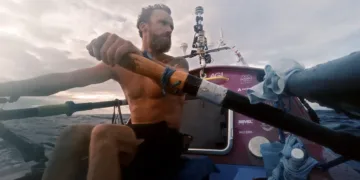






















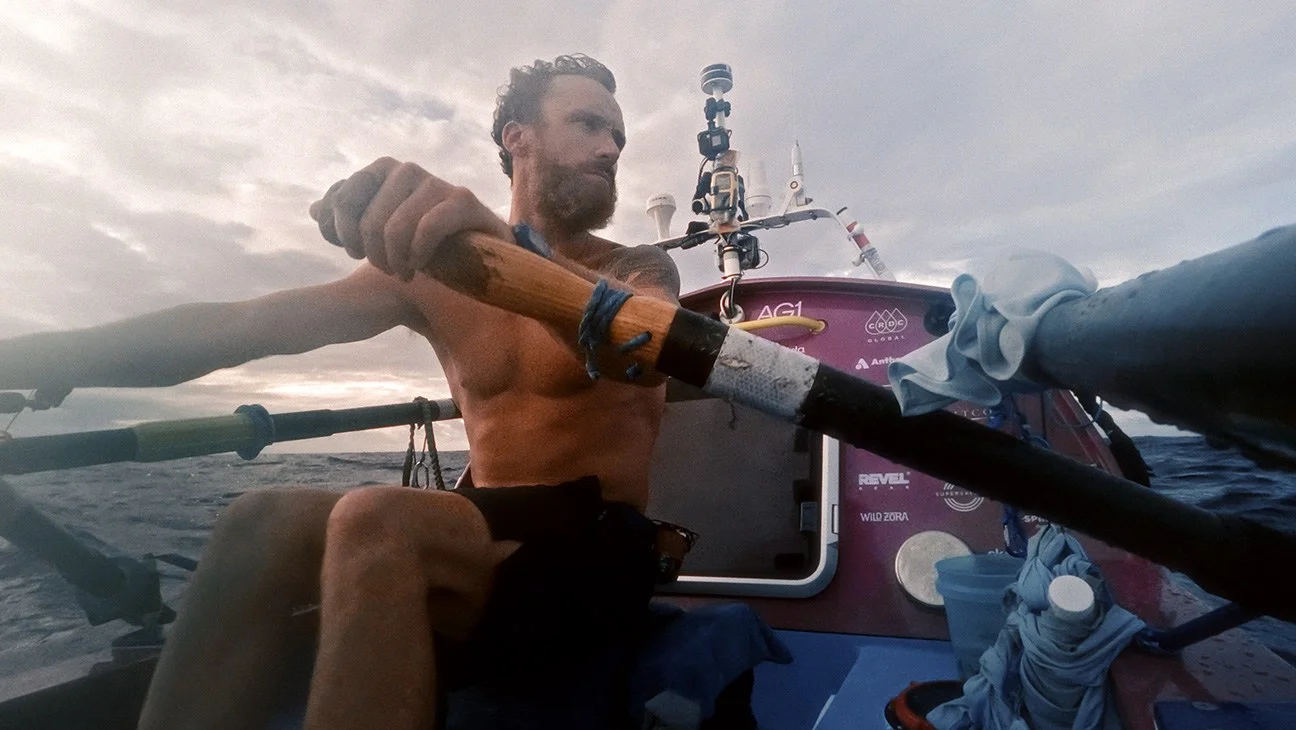

Tez Steinberg’s onboard camera has a fixed position and no firm ground beneath it. As his boat pitches through the Pacific, the image carries the movement into the viewer’s body; even the stretches of glassy water offer little promise of rest. The surface can settle without becoming habitable. Bryan Fogel’s The Row draws much of its force from this uncomfortable proximity, placing us close enough to register how exposure wears a person down, while the boat remains the small, unstable place to which every practical problem must be brought back.
Steinberg’s hands swell and crack. His lips become infected. The body acquires damage that cannot be put aside while he attends to something else, because those same hands must keep working. A broken rowing seat makes progress dependent on an improvised repair; later, a failed steering mechanism threatens the second expedition. Editors Justin Krook, Collin Kriner, and RJ Buckley compress extensive recordings into sequences whose suspense grows from the shrinking distance between an equipment problem and a bodily emergency. Watching him work through them, I felt an admiration that survived my uncertainty about the undertaking itself.
Fogel follows two solo crossings in a roughly 23-foot boat, first from California to Hawaii, then from Hawaii toward Australia. Steinberg came to rowing without previous experience in the sport, though his history of marathons, triathlons, and ultradistance running had already made endurance a familiar response to emotional distress. His father died by suicide before the first crossing. Before the second, his mother had also died by suicide, and Steinberg had suffered a heart attack. The distances become inseparable from these losses, yet the film’s account of what rowing does for him remains harder to grasp than its record of what rowing does to him.
Physical effort gives his distress an immediate task. There is something understandable, even tender, in the wish to make pain answerable to an action: repair this, endure this, keep the boat moving. His addresses to the camera allow that wish to emerge alongside the labor, while interviews on land give it a more considered explanation. The difficulty lies in the passage between those registers. Survival demands his attention so insistently that the idea of emotional repair can seem placed over the experience afterward, giving the crossing a meaning the footage itself can only partly disclose. The relief of having something necessary to do is persuasive. Its relationship to living with loss receives less patient attention.
Steinberg does acknowledge that rowing cannot simply fix him. That admission deserves to remain unsettled. A second crossing need not expose the first as a failure, since another bereavement changes the life to which he has returned. Fogel has material here for a painful reconsideration of repetition: an activity that once helped him persist is undertaken again by a body with a newly evident limit. During a video consultation, his doctor warns that another cardiac episode in the Pacific could kill him before assistance arrived. The ordinary form of the call makes the warning especially sobering. Medical advice reaches him through a screen; medical care may be impossibly far away.
His sister’s concern also gives the film a perspective beyond his own certainty. These objections are present, though they receive little sustained weight in the account of his determination. The sharpest opening into that uncertainty comes after the steering mechanism breaks, when Steinberg talks of diverting to the Marshall Islands and returning to his family. For a moment, the destination changes its emotional meaning. Home becomes something he actively wants. He continues toward Australia, and Fogel gives us too little understanding of how the competing wishes have been negotiated. Completion supplies the forward movement; the wish to stop remains behind, insufficiently explored, even though it has briefly made him easier to know.
Those relationships have a curious place in the film. His brother, sister, and aunt appear in interviews, yet their presence supplies limited understanding of what his prolonged absences mean between them. The solitude at sea is so forcefully rendered that people on land can seem to belong to a different order of experience, available to speak about him without acquiring comparable depth beside him. His sister’s worry makes that limitation felt: it introduces a relationship under pressure, then leaves much of the pressure unexplored. The film has no obligation to disclose every private attachment. The attachments it includes could have complicated its understanding of endurance.
Practical connections also remain at the edges. Satellite communication, references to medical and logistical support, and a tow across the Great Barrier Reef establish that a solo row still depends on others. None makes the water safe or diminishes the work of crossing it. They do, however, make the distinction between being alone aboard and being wholly disconnected worth attending to. United World Challenge is identified without much explanation of its relationship to the undertaking. The boat carries signs of a life organized with other people, while the documentary keeps returning to the solitary body as its principal measure of experience.
During a FaceTime conversation with family on the second crossing, that separation becomes briefly more specific. Steinberg can see people he cannot sit beside. They can speak to him without sharing the weather or the immediate demands of keeping the boat moving, and he can remain within their sight while staying far beyond their reach. I wanted the film to spend longer with the relationship made possible by that imperfect contact. His earlier wish to return to his family lingers over it, giving the conversation a pressure that continuing toward Australia has not resolved.
The Row had its world premiere at the 53rd Telluride Film Festival on September 4, 2026, and is currently screening on the festival circuit ahead of wider distribution. Directed by Academy Award winner Bryan Fogel, the gripping documentary chronicles endurance athlete Tez Steinberg’s perilous solo rowing expedition across the Pacific Ocean as a raw journey to confront personal grief and family trauma.
Full Credits
Title: The Row
Distributor: Orwell Productions (Festival Circuit / Telluride Film Festival)
Release date: September 4, 2026 (Telluride Film Festival)
Running time: Not publicly specified
Director: Bryan Fogel
Writers: Bryan Fogel, Mark Monroe
Producers and Executive Producers: Bryan Fogel
Cast: Terence “Tez” Steinberg
Director of Photography (Cinematographer): Terence “Tez” Steinberg
Composer: Adam Peters
The Review
The Row
Fogel makes exhaustion intimate, turning damaged hands and failing equipment into absorbing survival cinema. I believed in the relief Steinberg finds in having something necessary to do. The connection between that relief and emotional repair remains thinly examined, while family relationships and outside support recede behind the solitary ordeal. His wish to return home briefly opens a richer uncertainty than the film's emphasis on continuing allows it to explore.
PROS
- Onboard footage makes exposure and exhaustion palpable.
- Sharp editing builds suspense from failures and improvised repairs.
- Video calls give physical distance an intimate human cost.
CONS
- Endurance's relationship to emotional repair receives limited scrutiny.
- Family interviews leave the costs of prolonged absence underexplored.
- - Outside support and United World Challenge remain poorly contextualized.