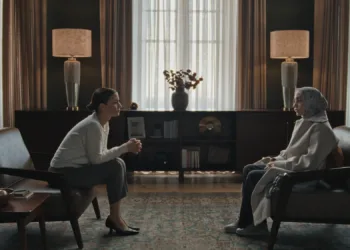












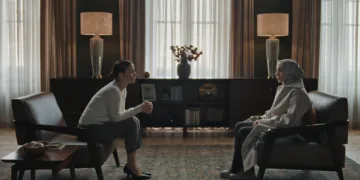

















The Swedish chamber drama Cries and Whispers makes a servant the source of comfort that sisters struggle to provide. Across the Baltic, No Me Without You puts that work back into a sister’s hands: bringing food, vacuuming, cutting the grass. The comparison makes these ordinary tasks worth watching closely. In Janno Jürgens’s Estonian family drama, help restores a relationship that proximity has failed to maintain. The women teach at the same school in a small community, yet have managed to keep each other out of their lives.
What changes the meaning of the housework is Katrin’s fear that she has killed Mari’s son. After an unexplained impact during a drive, she finds nothing beside the road; the boy’s death leaves her increasingly convinced of a connection. Her arrival with provisions can express affection and an attempt to repay a debt she cannot acknowledge. It also gives her something to do with her guilt. Eva Koldits makes Katrin’s practical competence uneasy here, as the apparently steadier sister takes charge of Mari’s neglected household. Accepting help brings Mari back into contact with the person who may have caused her loss.
The film is worth seeking out for these uncomfortable exchanges and its precise use of domestic space. Its emotional escalation is less persuasive. Jürgens and co-writer Anti Naulainen leave too much of the sisters’ old hostility unexplained for every new cruelty to carry its intended weight.
The houses establish differences that the dialogue scarcely needs to name. Katrin lives with her husband Raivo and their daughter in a modernist home whose glass frontage admits the surrounding greenery. Plants carry the outdoors inside; the family’s comfort looks carefully cultivated. Mari’s less affluent home is cluttered and eccentric, with a beauty that resists the tidiness of her sister’s arrangements. This is a particular Estonian community seen through two ways of inhabiting it. Katrin’s greater material security gives her the resources to intervene after the death, entering Mari’s routines with food and household labor.
Raivo complicates any easy reading of that modern house as an attractive prison. Played by Andres Mähar, he cooks and takes part in family life. Katrin has something substantial to lose when Mari begins reaching into her marriage, and the film has already shown us that substance through his presence in the kitchen. Affluence has not made everyone inside the glass emotionally unavailable.
Erik Põllumaa’s forest images offer a less regulated form of contact. Ferns crowd the frame, light breaks unevenly through foliage, and mist makes depth uncertain. The childhood sequences place the sisters barefoot in this terrain, running and wrestling; the opening scream might belong to pleasure or fear. Their intimacy has a physical volatility that the adult homes cannot accommodate. When closeness returns between the women, the woodland memories make its aggression feel familiar. The same ground has held their games and their fights.

This is where the film earns its reluctance to explain. Bodies remember ways of being together that an account of a childhood grievance could flatten. Koldits’s movement from efficient caretaking toward physical distress gives that persistence an adult cost. Beside Mari Abel’s more restrained expression, her loss of control exposes how much effort Katrin’s earlier composure required.
Yet the flashbacks have limited explanatory power. Childhood wrestling establishes that affection and aggression have long occupied the same relationship. It gives little sense of how two girls became colleagues who barely acknowledge each other. The missing history becomes harder to accept as the demands grow extreme. Põllumaa can make the Estonian woodland hold several emotional possibilities at once; the script still needs to connect the women’s present choices to the estrangement they have sustained for years.
Mari’s wish for another child pushes this problem into the marriage. She wants Raivo to be the father. Her attempt to seduce him turns the difference between the households into a dispute over access to Katrin’s family, and Abel gives Mari’s renewed dependence an uncomfortable direction: accepting her sister’s care has not satisfied her need for attachment.
A useful comparison here comes from South Korea. In Lee Chang-dong’s Secret Sunshine, a bereaved mother’s attempt to forgive is shaken by the discovery that her son’s killer already considers himself forgiven by God. Grief becomes a struggle over who has the authority to grant relief. That question makes Mari’s proposition harder to dismiss as a sensational twist. She appears to be seeking some power to determine what restitution should look like. Katrin can offer groceries and labor, but Mari’s demand reaches into the family that remains intact.
For an international viewer approaching through psychological-thriller conventions, this can register chiefly as a threat to Katrin’s marriage. Seen beside a bereavement melodrama such as Secret Sunshine, it invites attention to the desperate effort to give loss a reparative shape. I find that second reading productive, though the writing does too little to develop Mari’s passage toward this particular demand. Her grief makes the need intelligible; Raivo’s selection still carries the weight of an imposed provocation.
The detective’s suggestive questions pull attention back toward culpability and discovery. With little existence beyond that function, she keeps announcing an investigative story that the sisters’ behavior repeatedly displaces. The ominous drones make a similar intervention, insisting on danger where the practical exchanges between the women have supplied subtler reasons for unease. Repetitive humming near the end further reduces the room available for an uncertain response. The sound presses toward menace even when the homes, bodies, and forest sustain less settled meanings.
Mari’s proposal also involves someone the struggle between the sisters risks overlooking: Katrin and Raivo already have a daughter. A new child fathered by Raivo would change that girl’s place in both households. The attempt to repair Mari’s loss would create obligations for people who never agreed to take part, extending the sisters’ childhood pattern into another generation’s family arrangements.
No Me Without You held its world premiere in the Official Selection competition at the Tallinn Black Nights Film Festival on November 17, 2026, ahead of its Estonian theatrical release on November 27, 2026. Directed by Janno Jürgens, the Estonian psychological drama-thriller follows two estranged sisters working at the same small-town school whose shared grief over a sudden family tragedy pulls them back together while threatening to unearth a devastating secret.
Full Credits
Title: No Me Without You (Mind ei ole sinuta)
Distributor: Filmivabrik, Loco Films
Release date: November 17, 2026 (Tallinn Black Nights Film Festival), November 27, 2026 (Estonian theatrical release)
Running time: 1 hour 35 minutes (95 minutes)
Director: Janno Jürgens
Writers: Janno Jürgens, Anti Naulainen
Producers and Executive Producers: Marju Lepp, Manfred Vainokivi
Cast: Eva Koldits, Mari Abel, Andres Mähar, Katariina Unt, Ingrid Isotamm
Director of Photography (Cinematographer): Erik Põllumaa
Editors: Andres Hallik
Composer: Maarja Nuut
The Review
No Me Without You
Estonian woodland and immaculate glass walls give this family drama a persuasive geography of estrangement. Food, housework, and renewed physical closeness make reconciliation uneasy before the thriller machinery starts insisting on danger. Koldits and Abel keep the relationship abrasive and watchable, but the unexplained rupture weakens its most extreme demands. Worth seeing for the way place and practical care carry emotion; less satisfying when the script asks grief to explain its sharpest escalation.
PROS
- Domestic acts make affection and guilt inseparable.
- Forests and contrasting homes express the sisters’ estrangement.
- Koldits and Abel give renewed intimacy an abrasive physical tension.
- Raivo’s established family life gives Mari’s demand real stakes.
CONS
- The sisters’ unexplained history weakens their later choices.
- The detective functions chiefly as an investigative device.
- Ominous drones and repetitive humming overstate the menace.