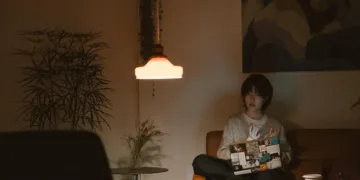










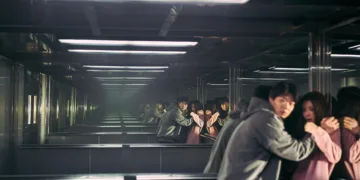

















I wanted to spend an afternoon inside the café in The Table: Day and Night. I wasn’t always eager to hear what its visitors had to say. That contradiction followed me through Kim Jong-kwan’s romantic anthology, a film whose inviting atmosphere and accomplished performances frequently make its conversations pleasurable, even as those same conversations struggle to maintain dramatic momentum. The curious thing is how much cinematic attention Kim gives to people doing so little. A glance, a change in someone’s voice, or the smallest conversational misunderstanding can become an entire scene’s reason for existing.
The premise builds on Kim’s earlier film, The Table, which followed four couples meeting at the same café table over a single day. This companion piece expands the arrangement across several weeks, following the change from summer into autumn.
Four separate encounters unfold inside a fashionable Seoul coffeehouse, each with its own characters and emotional concerns. Kim has spent much of his career working with interconnected stories and brief encounters, and the café provides an effective setting for that interest. People enter carrying histories we know almost nothing about, spend some time talking, and disappear from view.
I found this approach appealing, particularly in the way it allows the film to move between romance, awkward comedy, and melancholy. The results, however, are inconsistent. The Table: Day and Night is worth recommending to viewers who enjoy intimate, performance-driven filmmaking, especially for two excellent central encounters and its beautiful presentation. Those seeking a steadily developing story will find the experience frustrating, and at 79 minutes, the film occasionally feels surprisingly long.
The strongest evidence for Kim’s approach arrives in the third chapter, “T.P.A.,” featuring Shim Eun-kyung as successful web novelist Hye-jin and Lee Hee-jun as Dong-nam, a filmmaker interested in adapting her work. Their conversation begins with professional intentions that become increasingly difficult to separate from personal attraction.
Dong-nam tries to win her cooperation, but Hye-jin has good reasons to protect her creative independence. Shim gives her a fascinating combination of confidence and caution. She can appear uninterested one moment and unexpectedly receptive the next, without surrendering control of the encounter. Lee responds with an appealing slyness, making Dong-nam’s intentions difficult to read.
What makes this chapter work is its understanding of dialogue as a form of dramatic action. In an ordinary conversation scene, the camera may simply record information being exchanged. Here, the information matters less than the changing relationship between the speakers.
Every response alters their positions slightly. A professional disagreement becomes an opportunity for flirtation, then shifts back toward suspicion. I particularly enjoyed how Shim and Lee establish this movement through their contrasting delivery. The filmmaker hardly needs to move his characters around the room because the actors keep changing the emotional situation from across the table.
There is a welcome visual component to this encounter, too. Kim and his cinematographers, Kim Ji-yong and Lee Ju-yeon, make expressive use of light and shadow, giving the exchange a subtly heightened atmosphere that suits its playful uncertainty. The actors remain the attraction, and the visual treatment helps distinguish this meeting from the other chapters.
The second story, “Still Ourselves,” finds an equally effective source of tension in a much stranger encounter. Young-min (Chang Ryul) unexpectedly meets Sang-mi (Han Sun-hwa), a former middle-school acquaintance whose increasingly alarming claims leave him struggling to understand the situation. Sang-mi believes that unseen enemies threaten her, and she desperately wants him to accept her account.
Han plays the character with an escalating nervous energy that keeps the scene moving between comedy and genuine discomfort. Chang’s restrained skepticism gives her performance something useful to push against. The audience shares his uncertainty, trying to determine how seriously these claims should be taken. A later comic payoff provides a release from the increasingly peculiar exchange.
The opening chapter, “A Midsummer Night’s Dream,” presents a different kind of experiment, and one I initially found especially promising. Kim alternates between conversations involving two young women and two young men at different times in the café. This technique is called intercutting, which means alternating between separate scenes so that the audience begins looking for connections between them.
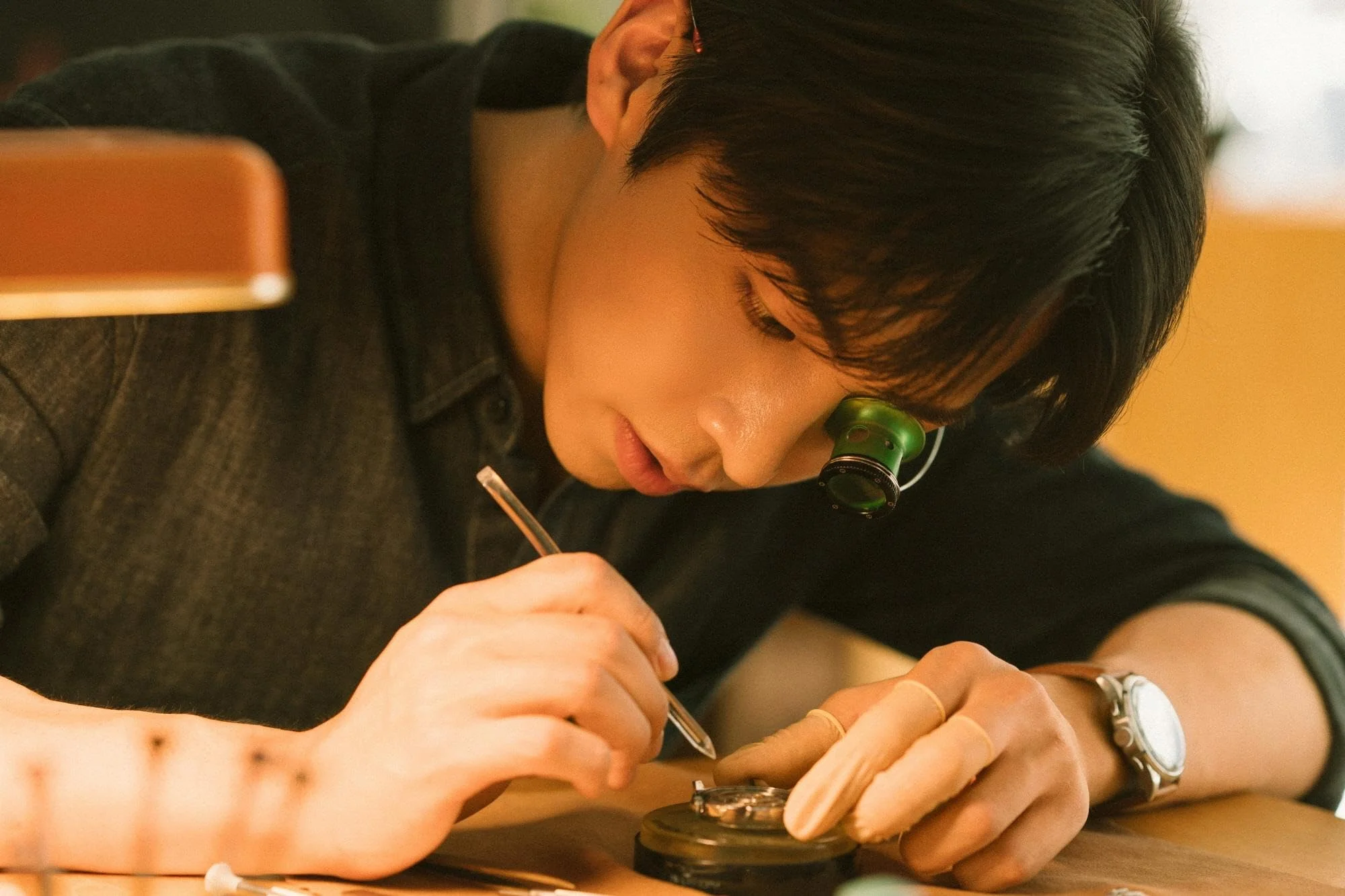
Here, the relationship gradually emerges through Hyeon-oh (Joo Jong-hyuk), an enthusiast for repairing old watches, and Yoo-jin (Kim Min-ha), who possesses an inherited antique watch that has stopped working. Their shared connection to dreams and the broken timepiece gives the encounter a gentle fairytale character.
The editing makes the eventual connection satisfying, but the characters never become equally interesting. Kim Min-ha and Joo Jong-hyuk have an easy rapport, and the watch provides a tangible expression of the story’s fascination with time and coincidence. Once the initial relationship between the conversations becomes apparent, however, there is relatively little to discover about the people involved. Yoo-jin’s wistfulness hints at an interesting emotional history, yet the chapter leaves much of that potential untouched.
“Autumn Story,” the final principal chapter, restores some of the emotional substance through a quieter approach. Jeon So-young plays Na-kyung, an aspiring pop idol whose career is beginning to develop, opposite Kim Dong-hwi as Jong-su, her longtime boyfriend. He has completed his military service and begun pursuing a different professional future. Their conversation gradually reveals two people whose lives are moving in separate directions, despite the affection they still share.
I appreciated the restraint of this encounter. The couple’s separation needs no villain, shocking revelation, or elaborate confrontation. Their shared history gives ordinary remarks an emotional weight that the opening chapter struggles to establish. Jeon and Kim create a convincing sense of familiarity, allowing the sadness to emerge through the courtesy with which their characters approach an increasingly unavoidable decision.
Across these chapters, the café itself becomes an essential part of the storytelling. Kim Ji-yong and Lee Ju-yeon photograph its interiors in warm, welcoming tones, allowing the furniture, carefully arranged surroundings, and changing light to establish a consistent visual identity.
Particularly interesting are the oil paintings decorating the walls, many depicting solitary or melancholy figures. They almost seem to offer an alternative collection of characters, each suggesting a private history that remains beyond our knowledge. The paintings suit Kim’s fascination with passing encounters, and the visual continuity allows the four chapters to feel connected even when their emotional concerns differ considerably.
The recurring location also exposes the screenplay’s principal weakness. Kim gives his actors considerable room to develop conversations, but there are stretches where the dialogue stops revealing anything meaningful. The third chapter creates movement through competing intentions, and the second generates uncertainty through Sang-mi’s increasingly frantic behavior.
Elsewhere, extended exchanges circle around emotions the audience has already understood. The experience can become unexpectedly static, particularly because the film offers few changes of location or significant events to refresh our attention. Its measured tempo belongs comfortably within independent and art-house traditions, but restraint alone cannot sustain a scene.
Kim introduces a self-referential element near the end, connecting the café to Dong-nam’s filmmaking and drawing attention to the constructed nature of these encounters. I was less convinced by this development. Hye-jin and Dong-nam’s earlier discussion already raises interesting questions about storytelling and creative ownership through their competing professional interests. The later device brings those questions into the film’s presentation, but its cleverness distracts from the relationships that have supplied the strongest material.
The closing images of empty tables are considerably more effective. After spending so much time watching people occupy this small space, seeing it unoccupied invites us to imagine the countless other conversations that might take place there. Kim leaves the paintings on the walls and the tables ready for another collection of visitors, suggesting stories that his camera has yet to observe.
The Table: Day and Night (Naggwa Bameun Seoroege) opened the 31st Busan International Film Festival on October 6, 2026, before arriving in South Korean theaters on November 4, 2026, through K-Movie Entertainment. Written and directed by Kim Jong-kwan as a follow-up to his 2016 film The Table, the anthology romance drama weaves together four interconnected love stories centered around a quiet neighborhood café as seasons transition from summer to autumn.
Full Credits
Title: The Table: Day and Night (Naggwa Bameun Seoroege / 낮과 밤은 서로에게)
Distributor: K-Movie Entertainment, Be Leaf Inc., Alleyway Co., Purple A Co.
Release date: October 6, 2026 (31st Busan International Film Festival opening film), November 4, 2026 (South Korea theatrical release)
Rating: 15 (South Korea)
Running time: 1 hour 20 minutes (80 minutes)
Director: Kim Jong-kwan
Writers: Kim Jong-kwan
Producers and Executive Producers: Baek Gyeong-suk
Cast: Kim Min-ha, Joo Jong-hyuk, Han Sun-hwa, Chang Ryul, Shim Eun-kyung, Lee Hee-jun, Jeon So-young, Kim Dong-hwi, Park Ji-young
Director of Photography (Cinematographer): Kim Ji-yong, Lee Ju-yeon
The Review
The Table: Day and Night
The Table: Day and Night finds genuine charm in ordinary conversations, supported by inviting cinematography and a talented ensemble. Shim Eun-kyung and Lee Hee-jun make their chapter particularly entertaining, while the final story delivers affecting emotional restraint. Kim Jong-kwan's anthology structure allows for welcome shifts in mood, but uneven character development and extended passages of static dialogue limit its impact. A distracting late narrative trick weakens an otherwise thoughtful exploration of fleeting connections. Patient viewers will find plenty to appreciate, even if the film's strongest moments promise a richer experience than it delivers.
PROS
- Excellent chemistry between Shim Eun-kyung and Lee Hee-jun
- Warm, inviting cinematography
- Inventive use of the anthology format
- Affecting restraint in the final chapter
CONS
- Uneven character development across the four stories
- Static conversations weaken the pacing
- Self-referential ending distracts from the characters
- Opening chapter leaves its promising ideas underdeveloped