


























A barricade changes the route enemies take toward the gate. Place one across the broad approach and a wave has to move around it, giving your followers a different angle of attack and your hero a different problem to solve. That small piece of battlefield control is the smartest thing about The Gate Must Stand. You can make a tactical decision, watch enemy movement respond, and immediately discover if your defensive arrangement works.
The comparison with Kingdom Rush is useful here. In that series, established lanes determine where threats will travel, and your job is to make the most of the positions available. Senmu Studio gives you a wider approach to defend and lets barricades reshape enemy movement. Your towers are characters, including guardians and elemental mages, rather than stationary structures.
The resulting fights ask you to think about where enemies will go, where your followers can hurt them, and where you need to stand yourself. This is an enjoyable variation on tower defense, and there is enough substance here to recommend it to players who like experimenting with builds. Getting to that substance, however, takes patience with a game that often explains its own rules poorly.
You control a hero who can attack enemies directly and use up to two active skills. Between attacks, you place followers, upgrade existing units, collect experience from fallen enemies, and make purchases from a merchant who appears during a run. These jobs compete for your attention, but they give you useful ways to recover from a mistake.
A defensive layout that leaves an opening does not mean standing helplessly by as monsters pass through it. You can move to intercept them. Equally, the hero’s damage alone cannot replace an effective deployment of followers, especially as the battlefield fills with enemies. Preparation and participation become part of the same tactical process, with the hero responding to whatever problems the defensive arrangement has failed to solve.
The most satisfying decisions produce feedback you can read without consulting a menu. Directing a wave around barricades changes its path. Placing followers along that route changes where their attacks land. If enemies continue slipping past, you know your arrangement needs attention.
This clear relationship between player choice and outcome gives the gate’s otherwise minimal premise a practical meaning. The sparse narrative offers little beyond establishing the objective, leaving the mechanics responsible for most of the tension. A failed defensive arrangement provides a much clearer account of what went wrong than the story ever does.
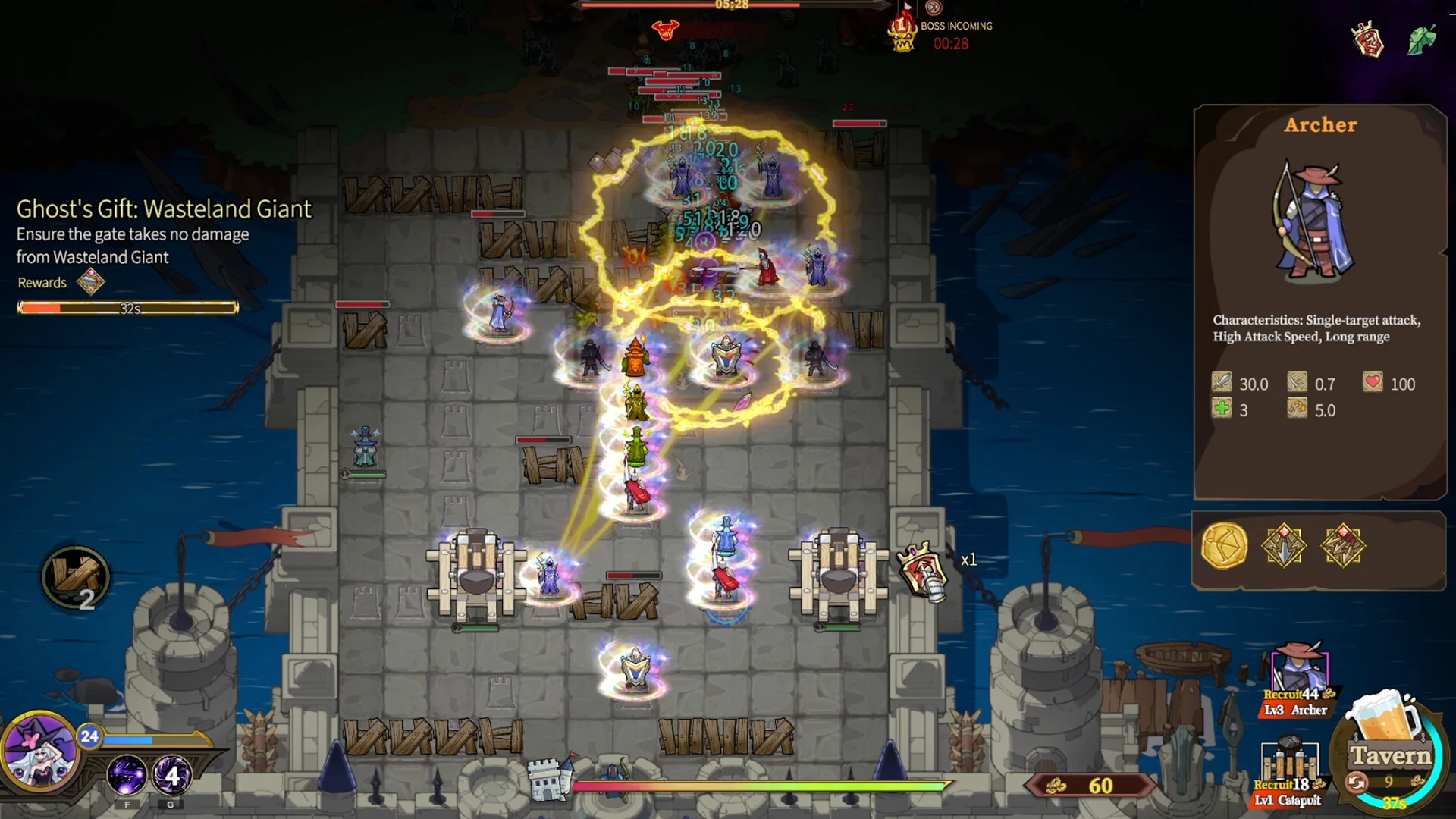
Progression is where the design becomes substantially less clear. Followers can be strengthened by purchasing duplicates and stacking them, up to level ten. Leveling a follower or raising the hero’s level through collected experience presents a choice of three randomized upgrades. Boss encounters and quests introduce relics, creating further possibilities for changing a build mid-run. There is plenty to think about, particularly because the abilities of one unit can affect the value of another. The game rewards attention to interactions rather than simple accumulation of higher numbers, and the most rewarding combinations can change your approach to an entire encounter.
Consider the Fire Amulet, which can convert burn damage into healing, alongside the Pillar of Symbiosis, which periodically applies burn stacks to followers. Together, those effects can support a sustained healing setup and change how aggressively the player deploys a defensive force. The value becomes apparent when the interaction changes your risk calculation. Followers who previously needed protection can participate in a more aggressive setup, allowing you to reconsider how much of the defensive arrangement must be devoted to survival.
Unfortunately, working out which upgrades can produce those changes is harder than it needs to be. Descriptions are frequently long, unclear, or awkwardly translated. Some bonuses have additional upgrade paths, while others have effects that are difficult to judge from the information provided.
When three random options appear, the player ought to be deciding which one fits the current strategy. Too often, the task becomes deciphering what each option actually does. The upgrade interface is bad at its job. That’s a significant weakness in a game where so much of the reward comes from choosing intelligently, particularly when the number of interacting effects continues to grow throughout a run.
Randomized options should sometimes be a poor fit. A fire-focused build ought to have good reasons to reject upgrades that serve an entirely different strategy. But there is no tactical calculation in selecting a bonus whose effect remains obscure. Experimentation becomes guesswork when success arrives without any reliable explanation.
That uncertainty carries into the game’s longer progression structure. A successful run takes you through three stages and can occupy about an hour at normal speed. Winning opens harder difficulties, while victories and defeats both award currency for permanent improvements. New followers, alternative relic combinations, and different heroes provide incentives to return, so the structure has genuine replay value.
Yet the pacing struggles to justify the time it asks for. Playing at double speed and pausing when you need to rearrange defenses or choose upgrades is often a better way to engage with the systems. At that setting, the important choices arrive with less downtime between them, and the option to pause preserves the opportunity to think through a defensive change. It raises questions about why the default rhythm is so drawn out.

Permanent progression introduces another source of friction. Upgrades carry enough cumulative cost that obtaining a full spread of improvements can demand many repeated clears. That might be tolerable if each attempt consistently presented a fresh problem, but the familiar wave structure and limited variation in enemy encounters become increasingly noticeable after extended play.
Repetition is part of roguelite design, and the strongest reason to start another run here is testing how a different set of followers and relics changes the defense. Having to repeat familiar challenges for another small installment toward an expensive unlock makes that experimentation feel less voluntary.
Technical issues are particularly unfortunate because they damage the feedback that makes the combat work. Enemies can become stuck on barricades, followers, or the environment. That’s a pathfinding failure, not a successful defensive maneuver. Heavy waves and overlapping attack effects can make the action harder to follow, with occasional slowdowns adding to the confusion. The presentation has inconsistencies in its visual assets, and dense text sometimes competes with information you need at a glance.
These problems affect different parts of the experience, but they can all interfere with the player’s ability to understand what is happening on the battlefield. An enemy stuck against a barricade tells you nothing useful about the effectiveness of your intended route, just as an unreadable upgrade description tells you nothing useful about the next decision.
Senmu Studio has made post-launch improvements to presentation and controls, although those changes cannot entirely compensate for the remaining friction. The free demo offers a sensible way to judge how manageable the interface and pacing feel before committing to longer runs. Pay particular attention to how easily you can interpret the first few upgrade selections and recognize what your followers are doing during crowded encounters. Those problems become increasingly demanding as new relic interactions enter the equation and more enemies arrive, precisely when the game expects you to make increasingly sophisticated tactical decisions.
The Review
The Gate Must Stand
The Gate Must Stand succeeds when barricades, followers, and direct combat create tactical decisions with visible consequences. Its relic synergies offer satisfying opportunities for experimentation, but confusing upgrades frequently turn strategic choices into guesswork. Slow pacing, demanding permanent progression, and occasional pathfinding problems further weaken the experience. Tower defense enthusiasts willing to tolerate an awkward interface will find an enjoyable game with worthwhile depth. Everyone else should try the demo before committing.
PROS
- Barricades allow meaningful tactical control.
- Hero combat complements defensive planning.
- Relic synergies reward experimentation.
- Varied builds encourage replayability.
CONS
- Confusing upgrades and cumbersome interface.
- Slow pacing and repetitive encounters.
- Excessive permanent progression grind.
- - Pathfinding issues and visual clutter.