
























The freest camera movement in To Be Ordinary precedes the accident that leaves its protagonist unable to walk. What initially appears to be an expression of independence becomes, retrospectively, evidence of how little control anyone possesses over the direction of a life.
Taiwanese director Lee Yun Chan builds her family drama around this disturbing contradiction, tracing how one person’s devastating loss can unexpectedly improve the circumstances of those closest to him. The film understands the moral discomfort of that arrangement remarkably well, even if its later determination to extract further suffering from its characters threatens the delicacy of its earlier observations.
Cinematographer Ming Lee opens with a fluid tracking shot accompanying 22-year-old university student and web designer Yu-Jie (Junior Hsieh) as he rides his scooter through rain-slicked streets at night. The camera glides with an assurance that Cicada’s swelling strings reinforce, granting an ordinary commute an almost dreamlike continuity. Then a car strikes him at an intersection.
The visual freedom established moments earlier acquires a terrible irony when Yu-Jie learns that he has permanently lost the use of his legs. From here, movement becomes constrained, interiors assume greater prominence, and the film’s attention shifts toward the family whose existing difficulties the accident exposes.
That complication makes To Be Ordinary a genuinely affecting and worthwhile film, particularly during its first half. Lee and co-writer Ginger Wang resist the conventional structure of a disability drama in which every supporting character exists to facilitate the protagonist’s inspirational recovery. They examine people who love one another but have grown accustomed to living apart emotionally, and an accident that offers them a peculiar opportunity to reconstruct their relationships.
The family’s cramped rented apartment becomes a physical expression of that estrangement. Yu-Jie’s father, played by Weber Yang, has been unemployed for years, his diminished authority reflected in his tendency to withdraw behind his more forceful wife (Chang Shih-ying). Their younger daughter Yu-Qing (Chen Pin-hsuan) struggles with adolescence in a household already short on patience.
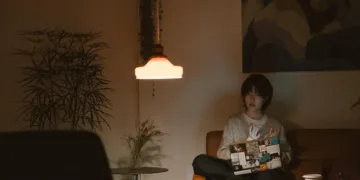
Lee frequently positions characters toward the edges of the frame, allowing conversations to be overheard rather than giving every exchange the reassurance of direct confrontation. The compositional separation has ethical force. These people share an address but rarely appear to acknowledge one another’s needs. Even the subdued natural light illuminates domestic spaces that provide little apparent comfort.
The accident introduces a strange financial solution to the family’s troubles. Mr. Ma (Liang Hsiu-shen), the elderly driver responsible for Yu-Jie’s injuries, is consumed by guilt and offers substantial compensation, housing, and continuing financial support. His generosity enables the family to escape some of the pressures that previously kept them divided. Guilt, apparently, has an excellent property portfolio.
Yet Lee treats his actions with considerable seriousness. Mr. Ma is neither an obvious villain seeking a convenient pardon nor a benevolent stranger whose wealth erases his responsibility. His increasingly obsessive restitution raises an uncomfortable question about the relationship between material compensation and moral accountability. At what point does helping the victim become another means of serving the guilty party’s emotional needs?
This territory belongs to the philosophical tradition of noir, although Lee rejects its most recognizable visual conventions. Classical noir frequently externalizes compromised morality through emphatic chiaroscuro, expressionistic shadows, and spaces that seem designed to imprison their occupants. Here, overcast light, grey hospital wards, and restrained compositions establish a less theatrical atmosphere of entrapment. Responsibility cannot be isolated in a dramatically illuminated face. The driver who caused the catastrophe is capable of considerable generosity, and the family that benefits from his remorse remains dependent on an event it would desperately wish undone.
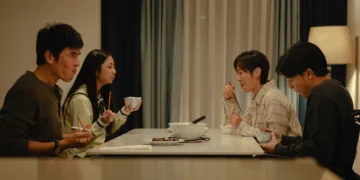
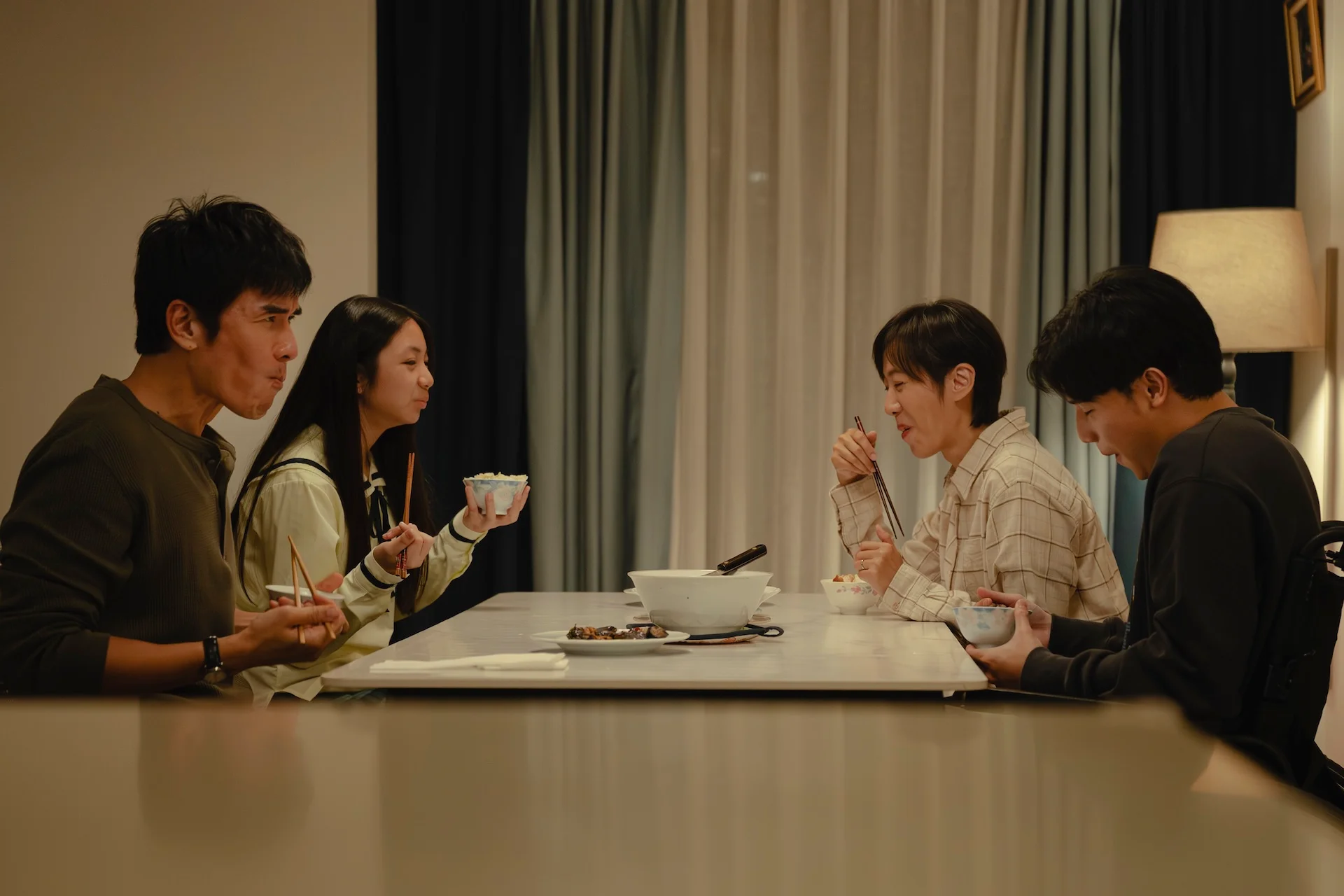
The family’s changed living arrangements bring an equally significant transformation in Lee’s spatial storytelling. Where earlier compositions emphasize disconnection, shared meals begin to acquire genuine significance. A dinner-table gathering, with family members discussing the mundane events of their days, offers a modest indication of reconciliation. The practical act of sitting together begins replacing their previously disconnected routines. The larger home gives them room to become a family, although its existence remains inseparable from Yu-Jie’s injuries.
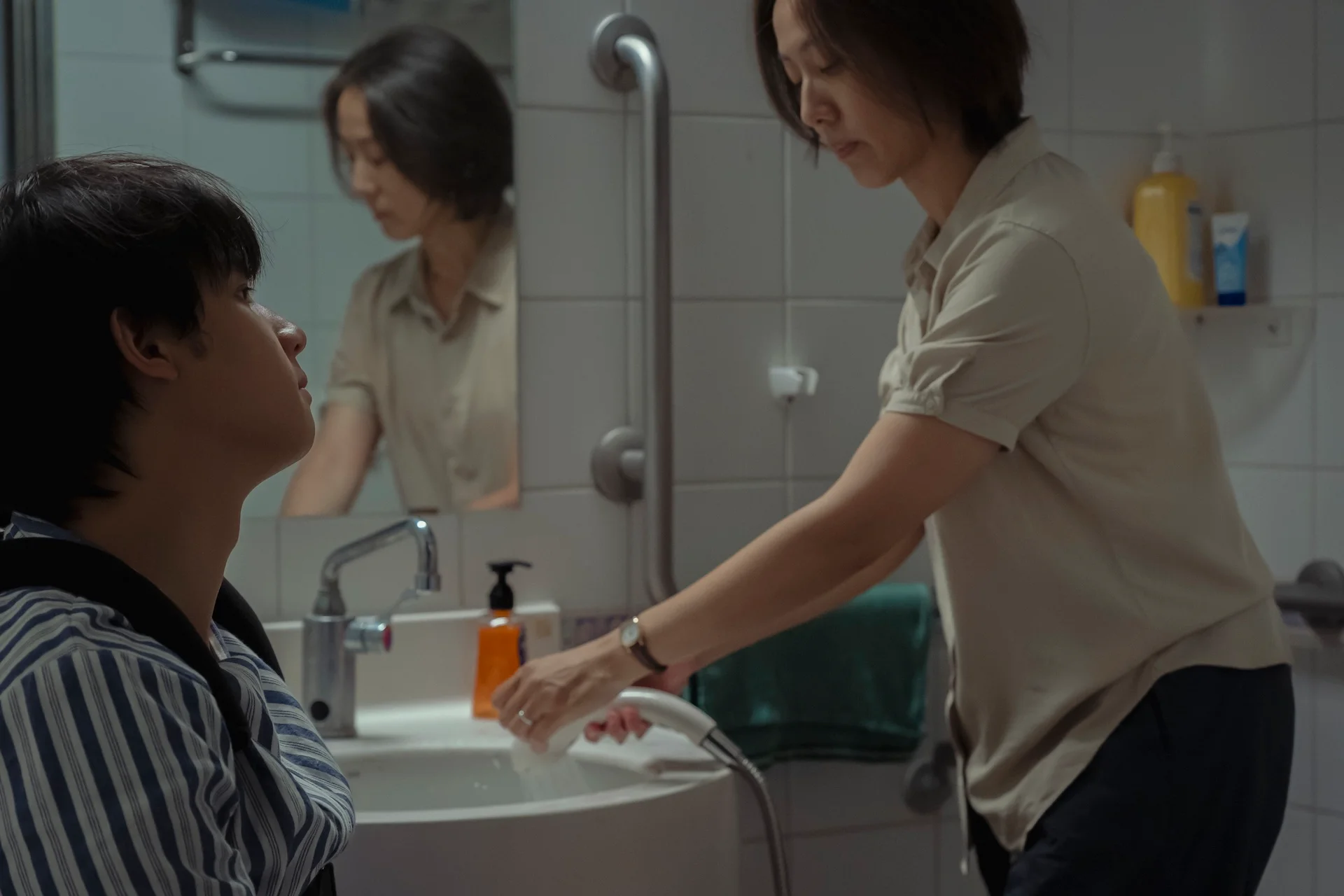
Weber Yang’s performance gives this uneasy arrangement its sharpest personal dimension. The father’s earlier passivity reflects a man whose unemployment has damaged his sense of usefulness. Becoming Yu-Jie’s principal caregiver restores a purpose that conventional expectations of financial provision had denied him.
Yang charts this change through the contrast between his withdrawn participation in family life and his increasing involvement in his son’s care. There is something troubling about a father rediscovering his worth through his child’s dependence. His emotional rehabilitation rests on circumstances that have permanently restricted his son’s autonomy.
Chang Shih-ying approaches the family’s crisis from the opposite direction. Her mother initially responds through relentless practicality, managing immediate necessities and suppressing the emotions that threaten to overwhelm her. Chang’s controlled expressions are particularly effective when Yu-Jie’s developing attachment to physiotherapist Yi-Han (Phoebe Chu) provokes concern beneath an outwardly reassuring demeanor.
As the years pass, the character increasingly seeks stability through religious faith, eventually encountering tensions between spiritual conviction and medical reality. Religion provides her with an explanation for suffering that practical responsibility cannot supply. Yet her need for certainty becomes another source of conflict, and Chang’s later desperation reveals the limitations of her earlier composure.
Yu-Qing offers the most convincing perspective on the emotional costs of the family’s apparent recovery. Chen Pin-hsuan captures the resentment of an adolescent whose needs have become secondary to her brother’s condition, particularly when parental attention is continually redirected toward his care. Her frustration is credible because the film gives her genuine affection for Yu-Jie alongside her anger. Chen’s lively observation of the adult world supplies a welcome variation in the ensemble’s emotional register. Her difficult behavior exposes how easily necessary caregiving can leave another child feeling abandoned.
Yu-Jie’s own characterization proves less persuasive. Junior Hsieh brings an appealing lack of self-pity to the role, and the character’s determination to continue working and developing relationships prevents his disability from becoming his sole defining characteristic. His growing romantic involvement with Yi-Han allows the screenplay to confront the social prejudices surrounding wheelchair use.
Her parents’ opposition, rooted partly in their preference that she pursue opportunities abroad rather than commit herself to someone with permanent physical limitations, exposes the cruelty that can hide inside supposedly practical advice. Encounters with uncomfortable strangers extend that observation beyond the family. Yet Yu-Jie’s transition from anger and devastation toward relative emotional stability occurs with remarkable speed. The screenplay gives his relatives considerable room to struggle with their altered identities but allows the person most directly affected by the accident a comparatively convenient adjustment.
Cicada’s score works carefully within the film’s restrained aesthetic, combining gentle guitar with violin and viola to create an atmosphere of persistent vulnerability. Its contribution is especially effective during the opening movement, where musical serenity prepares the audience for a security that will shortly disappear. Elsewhere, the subdued instrumentation complements Ming Lee’s muted photography and the actors’ tendency to contain strong emotions beneath ordinary behavior. Tu Su-ling’s editing initially handles the competing family perspectives with similar patience, allowing one character’s situation to modify our understanding of another’s.
Unfortunately, that confidence deteriorates as the narrative extends across approximately eleven years. Further tragedy forces the family to confront feelings that its apparent reconciliation has never entirely resolved. The problem lies in the increasing insistence with which new misfortunes accumulate.
Earlier emotional tensions emerge from precise arrangements of space, money, and interpersonal obligation. Later passages become progressively absorbed in grief, with significant developments sometimes receiving insufficient preparation and the pacing growing noticeably heavier. The consistently solemn visual atmosphere compounds the problem. Lee allows so few moments of spontaneous humor or domestic absurdity that suffering gradually becomes the family’s most predictable activity.
The ensemble remains persuasive through these difficulties, particularly Chang, whose increasing desperation brings an intensity that her earlier controlled behavior has carefully prepared. Yet the screenplay begins demanding emotional responses that the cinematography once trusted viewers to discover independently.
The restrained framing, diffused lighting, and patient observation of ordinary family interactions had established a world in which uncertainty could exist without immediate explanation. As the mother’s religious convictions collide with medical reality and the family’s fragile stability faces another threat, Lee increasingly emphasizes the pain that her actors’ faces and carefully organized domestic spaces had already made unmistakable.
To Be Ordinary (You Yong De Ren) had its world premiere in competition at the 31st Busan International Film Festival on October 11, 2026, where Lee Yun-chan won Best Director, before screening at the Tokyo International Film Festival on October 30, 2026, and expanding into release on November 13, 2026, with international distribution handled by Mandarin Vision. Directed by Lee Yun-chan and starring Weber Yang and Winnie Chang, the Taiwanese drama follows a family whose dynamics and financial reality shift after a motorcycle accident leaves a young man permanently dependent on a wheelchair and the remorseful driver provides housing and support.
Full Credits
Title: To Be Ordinary (You Yong De Ren / 有用的人)
Distributor: Mandarin Vision Co. Ltd (International Sales and Distribution)
Release date: October 11, 2026 (31st Busan International Film Festival world premiere), October 30, 2026 (Tokyo International Film Festival screening), November 13, 2026 (wide release)
Running time: 1 hour 52 minutes (112 minutes)
Director: Lee Yun-chan (Robin Lee)
Writers: Lee Yun-chan (Robin Lee), Ginger Wang
Producers and Executive Producers: Inch Lin, Alvin Chang
Cast: Weber Yang, Winnie Chang, Liang Hsiu-shen, Junior Hsieh (Hsieh Chan-jung), Chen Pin-hsuan, Phoebe Chu, Jacqueline Zhu, Shih Ming-shuai, Chen Yuu, Angel Lee
Director of Photography (Cinematographer): Lee Ming
Editors: Su Ling-tu
Composer: Cicada
The Review
To Be Ordinary
To Be Ordinary finds its greatest strength in the uncomfortable morality of a family rebuilt through another person's suffering. Lee Yun Chan's restrained compositions, subdued lighting, and sensitive ensemble performances reveal emotional fractures that dialogue seldom needs to explain. Weber Yang and Chen Pin-hsuan are particularly effective. Yet Yu-Jie's hurried adjustment and the increasingly relentless tragedies weaken the film's early precision. Its finest moments trust the camera to expose what guilt, gratitude, and obligation conceal. Later, the screenplay becomes rather determined to ensure nobody misses the suffering.
PROS
- Thoughtful cinematography that expresses moral ambiguity.
- Strong ensemble performances, particularly Weber Yang and Chen Pin-hsuan.
- Nuanced treatment of guilt, dependence, and family obligations.
- Restrained early storytelling and effective domestic compositions.
CONS
- Yu-Jie's emotional adjustment feels rushed.
- Later tragedies accumulate with insufficient preparation.
- Increasingly sluggish pacing weakens the second half.
- Persistent solemnity leaves little room for tonal variation.