





















In James Mangold’s film A Complete Unknown, we are invited into Bob Dylan’s labyrinthine psyche during a pivotal moment in the 1960s. The film, which follows Dylan’s rise from obscurity to iconic stature, reflects the nature of creativity and is a biopic. Set against America’s volatile sociopolitical scene, it masterfully combines personal ambition with greater cultural upheaval.
Dylan, portrayed with remarkable intensity by Timothée Chalamet, emerges as a captivating and perplexing person—an artistic genius grappling with the weight of expectation and the fleeting nature of fame. The film shows his duality as he navigates the Greenwich Village folk scene: attractive poet and harsh riddle (much like a Picasso—startling, gorgeous, yet perplexingly disconnected).
A Complete Unknown resonates strongly within our current conversation, challenging us to ponder the consequences of artistic integrity in a world that demands accessibility and relatability. It was released when audiences were increasingly drawn to stories of complicated, imperfect geniuses. While this film depicts an individual, it also reflects a collective struggle that calls into question the essence of authenticity in an increasingly commercialized artistic scene.
The Arc of Ambiguity: Plotting Dylan’s Journey
A Complete Unknown takes place between 1961 and 1965 when the musical and political landscapes were in constant flux. This era, marked by the shadows of McCarthyism and the flickering brightness of civil rights movements, serves as an ideal backdrop for Dylan’s emerging image. Here, the timeline is more than simply a chronological framework; it reflects a culture battling with its identity while cultivating a voice that will speak to a generation.
Dylan’s entrance into New York City is portrayed as a moment of promise and danger. A 19-year-old from Minnesota, he enters the wild embrace of Greenwich Village, where the coffeehouses throb with poetic enthusiasm. However, his early problems are obvious. He is an outsider, a “completely unknown” in a world that seeks authenticity but is hesitant to provide it. The film captures this tension beautifully, illustrating how the lively folk scene—often romanticized—can be as cruel as it is inspiring.
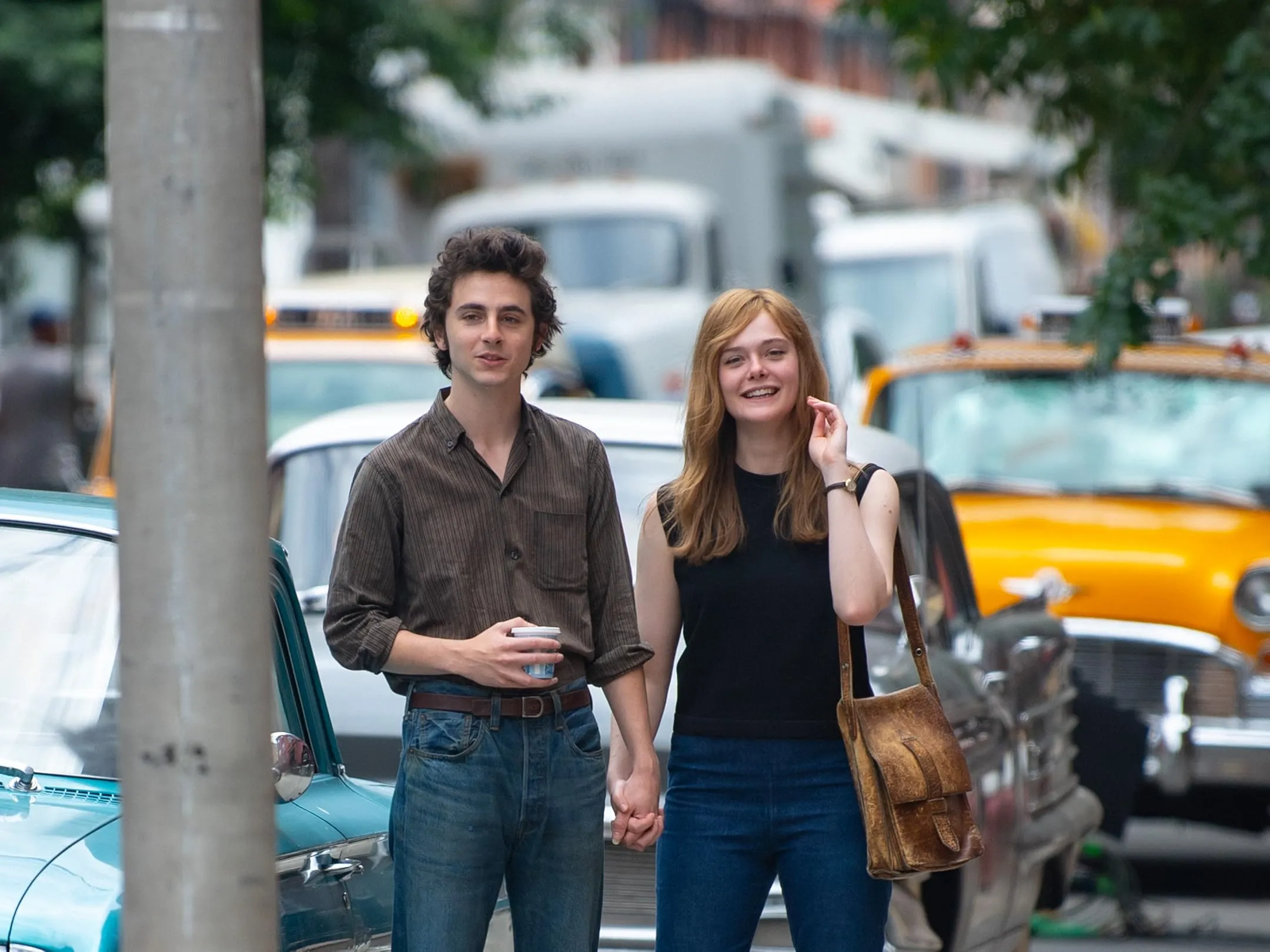
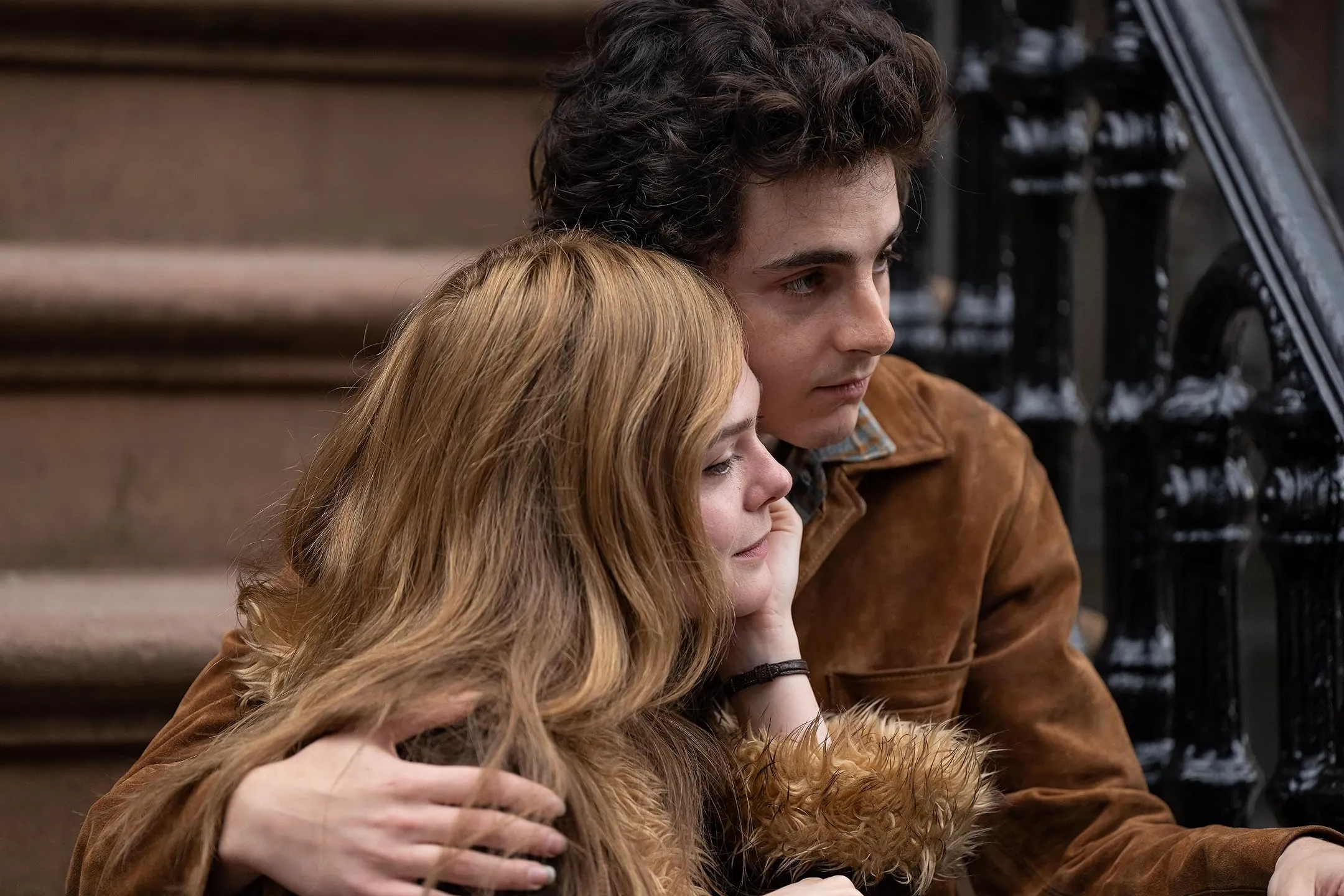
Dylan’s journey is built around key relationships. His romance with Sylvie Russo (Elle Fanning), a character with almost tragic fragility, demonstrates the personal implications of his artistic ambition. Sylvie’s seriousness contrasts dramatically with Dylan’s enigmatic character; she serves as both muse and casualty in his quest for self-definition. Meanwhile, his relationship with Joan Baez (Monica Barbaro) is a powerful representation of the competing currents within the folk movement itself—her established celebrity contrasts Dylan’s burgeoning fame, creating a tension that is both passionate and fraught with rivalry with fame.
We witness Dylan’s evolution from acoustic troubadour to electric innovator as the film moves toward the key Newport concert in 1965, a moment of historical significance. This transformation is more than just musical; it is a deeper cultural shift in which the ideals of the folk movement collide with the explosive energy of rock ‘n’ roll. The audience’s varied reactions at Newport—cheers and jeers—serve as a microcosm of cultural change, reflecting the discomfort frequently associated with development.
Thus, the narrative not only records Dylan’s development but also discreetly challenges the very fabric of the cultural landscape in which he lives, making us ponder: at what cost does one become a cultural icon?
The Many Faces of Dylan: Characterization and Performances
Timothée Chalamet’s portrayal of Bob Dylan in A Complete Unknown is a masterclass in nuanced acting. Chalamet nails Dylan’s essence through vocal impersonation and by embodying the man’s contradictions—a mix of magnetism and aloofness, ambition and insecurity.
His Dylan is a kaleidoscope figure, alternating between the attractive troubadour and the melancholy artist who frequently withdraws within himself (he’s a walking existential crisis covered in a leather jacket).
Chalamet’s acting approach exudes a sense of urgency; he transmits Dylan’s youthful energy and revolutionary zeal, particularly in scenes where he performs classic songs. His performance of “Blowin’ in the Wind” has a raw sensitivity that feels both urgent and reflective, as if he’s struggling with the weight of the words while allowing the audience to partake in his epiphany. Dylan’s emotional struggles—his dread of being weighed down by expectations or relationships—are conveyed by the actor, adding depths to the character that resonate beyond the screen.
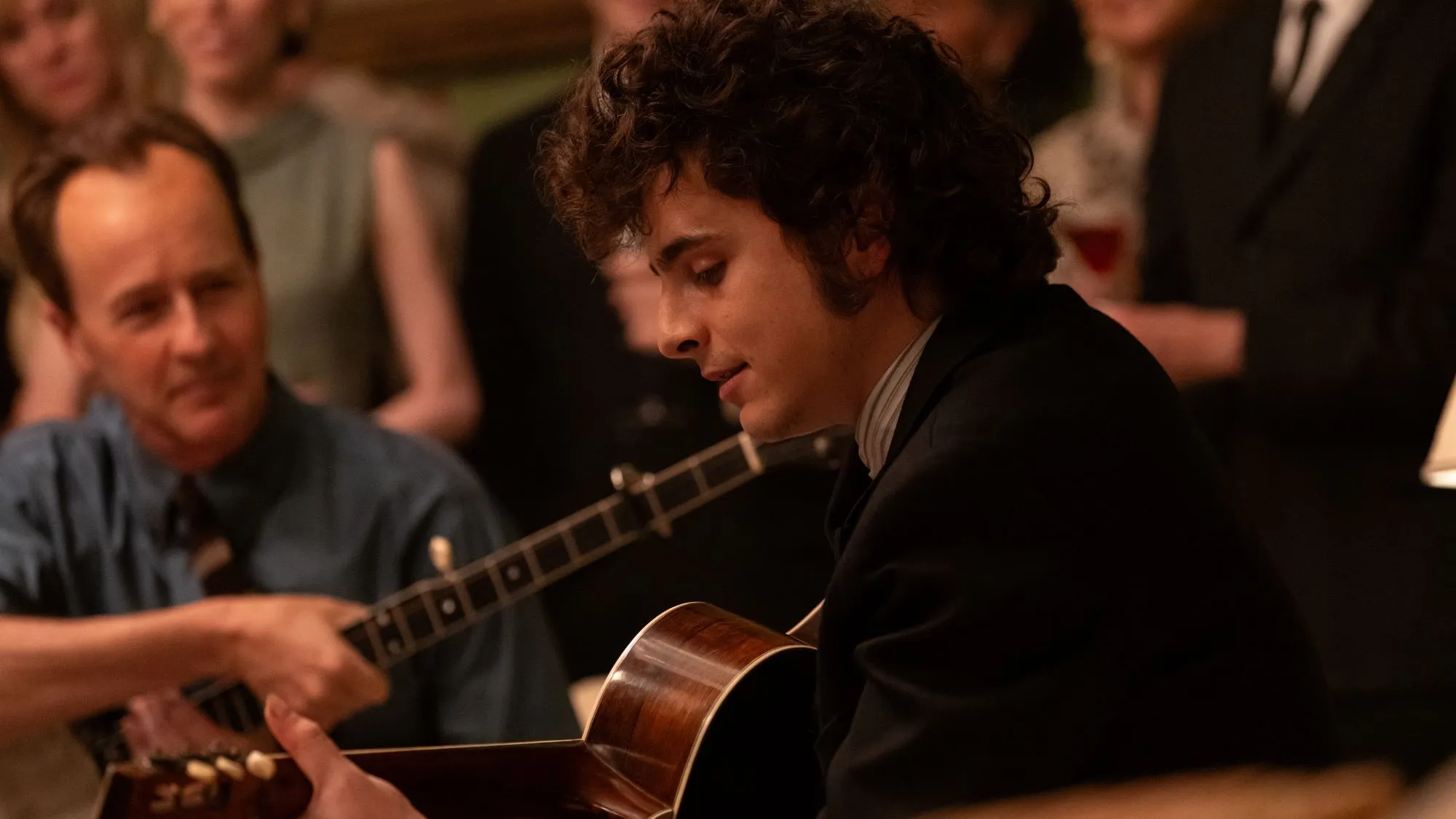
The supporting characters in the film are equally interesting, each adding depth and dimension to Dylan’s journey. Like Pete Seeger, Edward Norton provides a wise and reassuring presence. His portrayal is not simply that of a mentor but of a guy stuck between artistic ambitions and the harsh reality of fame.
Seeger’s subtle sadness in Dylan’s departure from acoustic purity represents the folk movement’s greater cultural schism (here, we see the traditional generational struggle—a parent watching their child trade in their bicycle for a motorcycle).
Elle Fanning plays Sylvie Russo, a tragic antithesis to Dylan’s enigmatic aura. Sylvie, Dylan’s real-life lover, Suze Rotolo’s character, is distinguished by her emotional depth and vulnerability. Fanning imbues her with a sense of longing, embodying a woman who is inspired by Dylan’s unwavering quest for excellence.
An almost tragic poignancy marks their interactions; she becomes a mirror reflecting Dylan’s shortcomings, acting as both muse and emotional anchor. In this partnership, the film tackles themes of love and ambition, a dichotomy that frequently leaves both partners feeling lost.
Monica Barbaro’s Joan Baez adds another level of depth. Baez, a renowned artist in her own right, exemplifies the tension between respect and rivalry that pervades her interactions with Dylan. Her forceful voice and elegant posture are a striking reminder of Dylan’s ability to accomplish while resisting. The film looks into female artists navigating a male-dominated landscape through Baez, emphasizing women’s sacrifices in the service of love and art.
Dylan’s interactions with these women are fraught with push and pull, reflecting greater societal tensions of the time. Dylan’s relationships are more than just sexual entanglements; they represent the struggle between personal desire and artistic ambition. His teachers, such as Seeger, represent the old guard of folk music, fostering but ultimately suffocating Dylan, forcing him to confront the challenge of how one may be true to one’s roots while striving for something altogether new.
Through its character interactions, A Complete Unknown challenges the viewer to ponder the inherent contradictions in the pursuit of greatness. The performances give the film life, making it a rich tapestry of love, ambition, and the inevitable pain of the quest for identity.
The Tug-of-War: Themes in A Complete Unknown
A Complete Unknown is a beautiful tapestry woven with themes that resonate deeply inside the fabric of American culture, most notably the investigation of fame. Bob Dylan is presented as a famous icon and a fragile artist in the film, successfully navigating the duality of public acclaim and personal struggle.
Fame is portrayed here not as a glittering pedestal to be adored but rather as a two-edged sword capable of severing the essence of self-identity. Audiences praise Dylan, yet he is always plagued by feelings of loneliness and disconnection—a guy adored by many but understood by few.
This duality is poignantly portrayed in life as he performs to euphoric applause, only to retreat into the shadows afterwards, wrestling with the weight of fame that fame imposes.
Another critical issue emerges as the clash between artistic integrity and financial success. Dylan’s transition from folk troubadour to electric provocateur depicts the tension between his roots and his ambitions. The film depicts his struggle as a microcosm of a greater social shift—from the earnestness of folk music to the electric mayhem of rock.
This transition raises questions about the quest for innovation’s price: can one be honest while pursuing mainstream success? Dylan’s decision to “go electric” at Newport becomes a symbol of rebellion against genre constraints, representing not only a personal decision but a broader cultural moment that reflects a generation’s growing pains (similar to trading in a beloved old pickup truck for a flashy new sports car—exciting, but fraught with its own set of challenges).
Furthermore, the significance of personal relationships on artistic expression is interwoven throughout the narrative, illustrating how love, betrayal, and mentorship influence an artist’s creative output. We witness Dylan’s growth and failings through his interactions with Sylvie and Joan.
These relationships are more than just subplots; they serve as catalysts for his songwriting, impacting his music’s themes and emotional depth. The film indicates that art is rarely generated in solitude but is inextricably linked to the artist’s experiences and connections. Dylan’s personal life flows into his art, creating a symbiotic relationship that defines his career as he navigates the complexities of love and ambition.
A Complete Unknown uses these themes to chronicle the life of a musical legend and stimulate reflection on the broader ramifications of fame, artistic ambition, and the complicated web of human connections that define our identities.
The Soundtrack of Change: Music and Performances in A Complete Unknown
In A Complete Unknown, music is more than just a backdrop; it is the narrative’s essential heartbeat. Dylan’s songs are a narrative device and a prism through which we may see the man behind the myth.
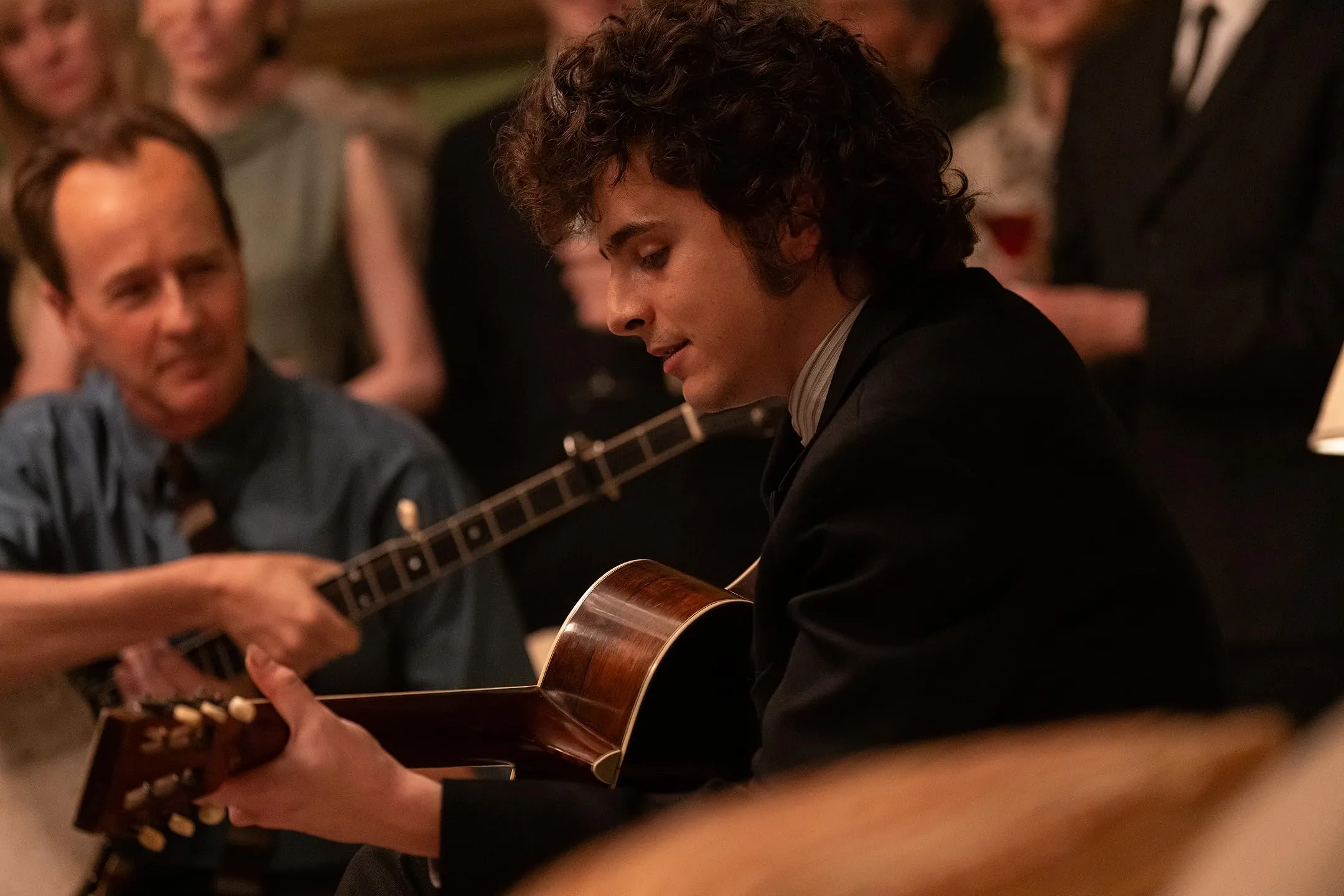
The film smoothly blends this legendary music into the tale, allowing the lyrics to resonate with the scenes’ emotional and historical circumstances. Each performance represents a chapter in Dylan’s life, a heartbreaking reminder that his artistic production is intrinsically related to his journey (one could argue that his songs are unwritten diary entries).
Dylan’s music captures the spirit of the early 1960s, imbuing the film with sociopolitical relevance. When he performs “Masters of War” against the backdrop of news clips from the Cuban Missile Crisis, the power of his words heightens the tension of the moment.
This is more than just a concert; it is a statement of artistic intent that addresses the concerns of a generation on the verge of disaster. Such moments demonstrate how music can go beyond simply enjoyment and become a vehicle for social commentary—a concept as old as folk culture itself.
The live performances in the film stand out from the traditional biopic style, which sometimes depends on fragmented fragments of songs to fill time. Instead, A Complete Unknown uses prolonged musical sections to convey a sense of immediacy and authenticity.
The audience is not simply given a montage of hits; they are invited into the intimate confines of clubs and festivals, where they can feel the excitement and urgency of every note. This method injects life into the performances, making them feel electrifying rather than prepared.
The emotional impact of these musical moments is immense. Each performance provides insight into Dylan’s personality, showcasing his difficulties, victories, and the complexities of his relationships. The film captures the essence of live music—the unpredictable alchemy between artist and audience that transforms each song into a communal experience. We witness the transformative power of music as Dylan strums his guitar and sings, not only for the artist but also for the listeners, who find peace and strength in his words.
A Complete Unknown enriches the biopic genre by incorporating music and live performances, reminding us that creation is as much about the artist’s journey as it is about the resonances of their work in the larger cultural environment.
Visual Poetry: Cinematography and Production Design in A Complete Unknown
The visual style of A Complete Unknown pays homage to the 1960s Greenwich Village, a time and place brimming with artistic zeal and cultural radicalism. Cinematographer Phedon Papamichael uses a palette that conveys the warmth and grit of the time, capturing the essence of a neighbourhood that is as much a character in the film as Bob Dylan himself.
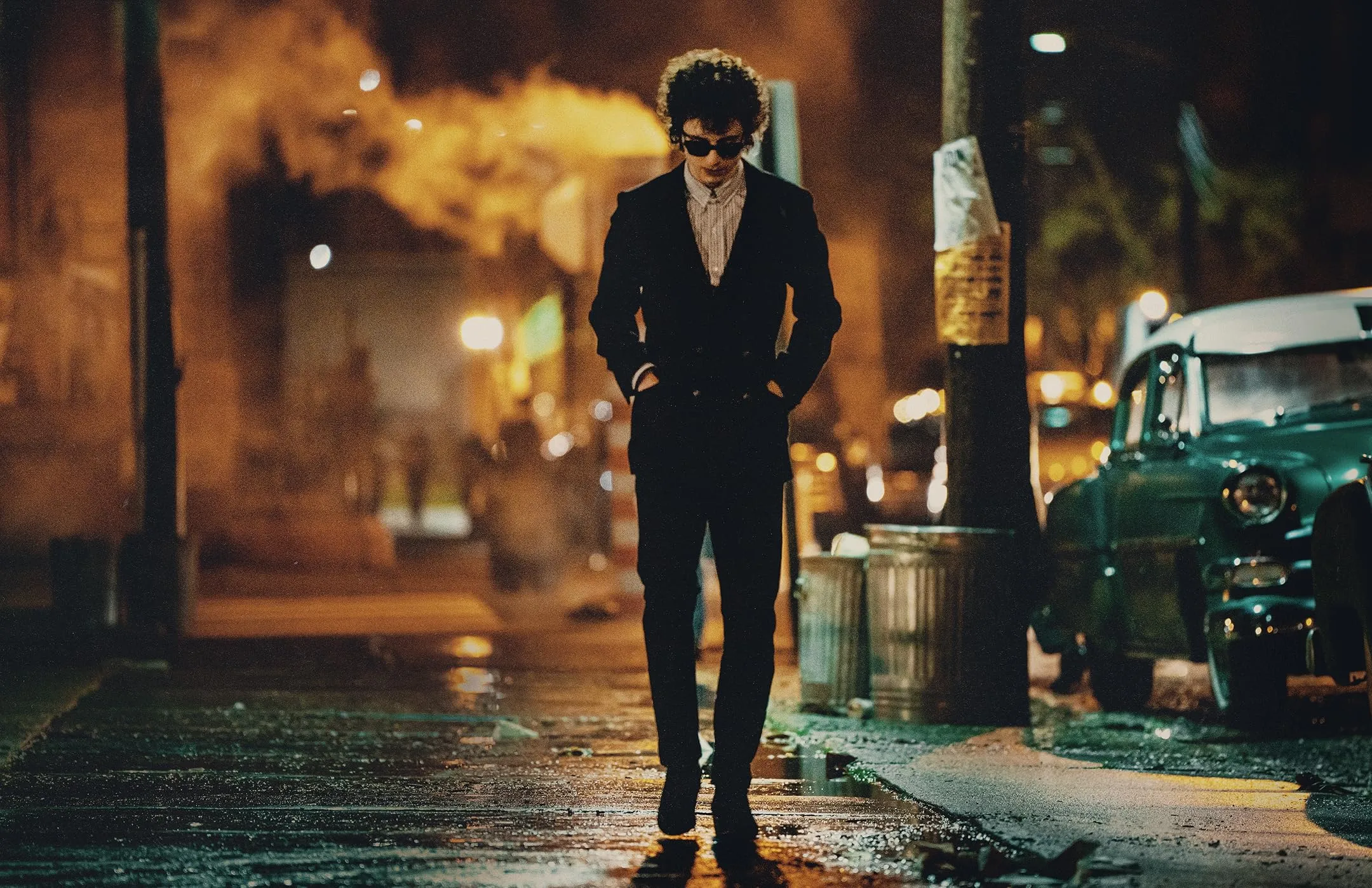
The camera moves through darkly lit coffeehouses and crowded streets, making it seem that one could practically breathe the creativity (and perhaps a whiff of cigarette smoke) that marked the folk scene.
Set design and clothing add to the authenticity. They are precisely constructed to mirror the period’s look without falling into kitsch. Every detail, from Dylan’s rumpled attire to the overcrowded dwellings, conveys a sense of lived-in authenticity.
The production choices feel less like decorations and more like antiques from a bygone period, providing layers of meaning to the narrative. This attention to detail serves not only as a backdrop for Dylan’s story but also as a reminder of the rich cultural tapestry that gave rise to his music—a world in which poets, dreamers, and revolutionaries could be heard whispering around every corner.
The film’s visual storytelling emphasizes that art does not exist in a vacuum. Greenwich Village’s lively streets serve as both a breeding ground and a furnace for creativity, influencing the artists who live there.
Directing the Enigma: Direction and Writing in A Complete Unknown
James Mangold’s directing of A Complete Unknown reflects a thorough understanding of the complexities inherent in biographical storytelling. Rather than following the traditional cradle-to-grave template, which frequently reduces his subjects to mere caricatures, Mangold takes a more impressionist approach.
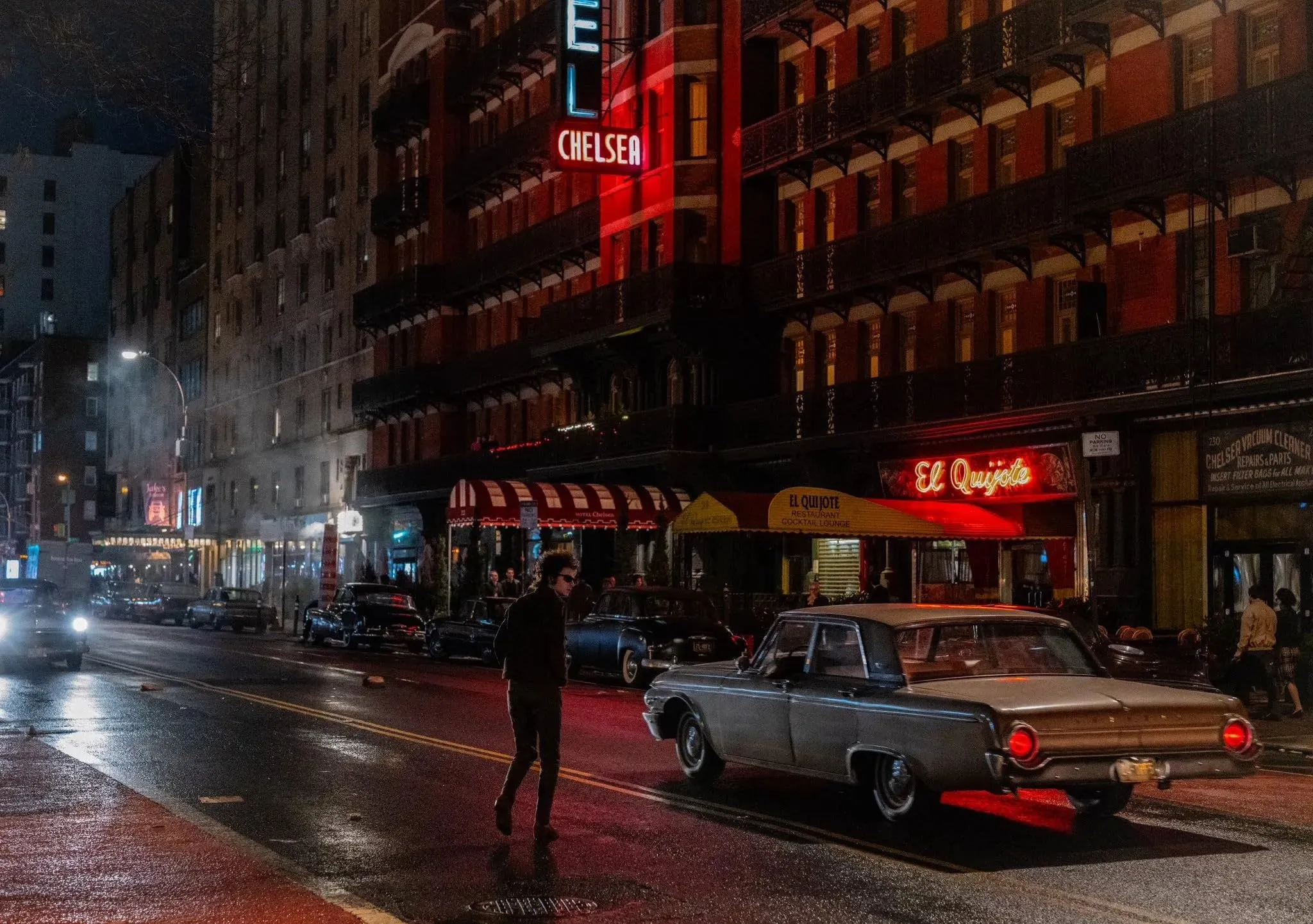
He immerses the audience in the lively surroundings of 1960s Greenwich Village, allowing the setting to affect Dylan’s journey. This style highlights the notion that an artist is not only a product of their talent but also a reflection of their surroundings—a mash-up of influences that may be as chaotic as it is inspiring.
However, the screenplay, created by Mangold and Jay Cocks, has both virtues and shortcomings in its narrative framework. While the film excels in portraying important moments—such as Dylan’s spectacular Newport performance—there are times when the pacing falters, leaving the moment seeming more like a highlight reel than a unified narrative arc.
The conversation sometimes deviates into clichés, detracting from the usually vivid characterizations. However, when the screenplay allows for introspection, it brilliantly depicts the weight of Dylan’s artistic legacy, illustrating how his music serves as both an escape and a burden.
Ultimately, A Complete Unknown confronts the contradictions of artistic genius: the quest for authenticity vs the pull of fame. It raises issues about what it means to be a true artist in a world frequently requiring compromise. The film thus becomes more than just a biography of Dylan’s life but also a broader reflection on the price of creativity in a constantly shifting cultural milieu.
The Review
A Complete Unknown
In A Complete Unknown, James Mangold creates a complex portrayal of Bob Dylan that mixes musical brilliance with personal struggle. While the film excels in its bright picture of 1960s Greenwich Village and contains outstanding performances, particularly from Timothée Chalamet, it occasionally fails in narrative rhythm and dialogue. Finally, it conveys the complexities of artistic ambition and the often painful price of fame. This biopic is a riveting voyage through a significant time in music history, yet some may want a more in-depth look at its mysterious subject.
PROS
- Strong performances, particularly by Timothée Chalamet as Bob Dylan.
- Vibrant cinematography that captures the essence of 1960s Greenwich Village.
- Effective integration of Dylan's music into the narrative.
- Thoughtful exploration of themes like fame, artistic integrity, and personal relationships.
CONS
- Occasional pacing issues and narrative inconsistencies.
- Some dialogues feel clichéd or lack depth.
- Limited exploration of Dylan’s broader cultural impact.
- May not satisfy viewers looking for a more traditional biopic structure.