

























At ninety-four, Eleanor Morgenstein uproots herself from sun-drenched Florida to the gray grid of New York City—an act that reads less like senile wanderlust and more like a defiant thesis on aging (she refuses to recede). Under Scarlett Johansson’s camera, directed with austere clarity, Eleanor is propelled by grief—a scholarly case study in how loss propels us into unfamiliar spaces, both physical and moral. Tory Kamen’s screenplay grants June Squibb a razor-sharp voice, one that snaps through polite small talk and lands squarely on the aching nerve of human loneliness.
There is laughter here, yes, but it rattles against a deeper disquiet: Eleanor’s chance stumble into a Holocaust survivors’ circle becomes a provocation about ownership of narrative (when is memory communal, when is it personal?). The cityscape—crowded delis, hushed community-center halls—serves as a crucible for her deception and eventual reckoning.
Squibb’s performance oscillates between bristling humor and raw vulnerability (her eyes betray the toll of imitated trauma). Johansson stages each scene with deliberate restraint, allowing silences to swell. The film’s central conflict—Eleanor’s claimed heritage versus her true past—echoes broader debates over identity politics and the ethics of remembrance. At times, the narrative feels almost too tidy; then a subtle discordant note undercuts our certainty. And suddenly, we’re unsure whose story we’re witnessing—hers, or the city’s?
Narrative Architecture: From Ritual to Reckoning
The film opens in Florida with a portrait of quotidian intimacy: Eleanor and Bessie—two nonagenarians bound by decades—navigate grocery aisles and share morning coffee (a sequence that feels like a thesis on interdependence). These domestic rituals aren’t merely slice-of-life vignettes; they function as thematic prologues, foreshadowing Eleanor’s habitual boundary-crossing (her barbed quips at the deli clerk signal a mind that refuses to be domesticated).
Then comes the inciting blow: Bessie’s sudden death. In an instant, the film’s gentle cadence fractures, and we witness a displacement that transcends geography. Eleanor’s grief is both conspicuous and ineffable—a duality that echoes collective mourning after historical catastrophes (the way societies rebuild routines after trauma, for instance).
Her move to New York City constitutes more than a change of address. It’s an intergenerational collision: Lisa’s cramped East Side apartment becomes the crucible of spatial tension and emotional claustrophobia. Here, physical proximity does not equate to understanding; motherhood and mortality are separated by more than just thin walls.
A tonal pivot occurs when Eleanor wanders into a Holocaust survivors’ support group. This “mistaken-identity” plot thread crystallizes into a philosophical litmus test: what is the line between empathy and appropriation? Choosing to embody Bessie’s story, Eleanor ignites a moral conundrum that recalls debates over narrative ownership in post-colonial discourse.
Key moments—her first address to the circle, Nina’s (the journalism student) wide-eyed interview invitation—are staged with clinical precision. They mark the axis where intent and impact diverge.
As complications rise, the bond between Eleanor and Nina deepens, mirroring historical alliances of convenience (think wartime collaborations) that outgrow their origins. The revelation that Nina’s father is Roger, the very anchor Eleanor once admired, introduces an almost absurd symmetry: personal deception intersecting with public persona.
The climax arrives when Eleanor’s fabrications collide with media scrutiny and familial doubt. It is, in effect, a cultural mirror—our infatuation with sensationalism laid bare. The resolution sees her grappling with outrage and remorse, stepping tentatively toward honesty.
The final image (herself, gap-toothed grin softened by tears) lingers like a question: can truth, once warped, ever fully realign with memory?
Portraits in Paradox and Performative Memory
June Squibb’s Eleanor is equal parts Schopenhauerian curmudgeon and reluctant philosopher-queen of the mundane (a “granny-grrrl,” if you will). With a voice as crackling as autumn leaves underfoot, she wields wit like Occam’s razor—paring down social niceties to expose raw necessity.
Beneath the surface sarcasm, however, lies a vulnerability so deftly buried that each tear she sheds during her mock bat mitzvah registers like seismic activity. The roller-set scenes are more than comic relief; they become ritualized self-reconstruction, a metaphor for molding identity in midlife—or, in Eleanor’s case, twilight life.
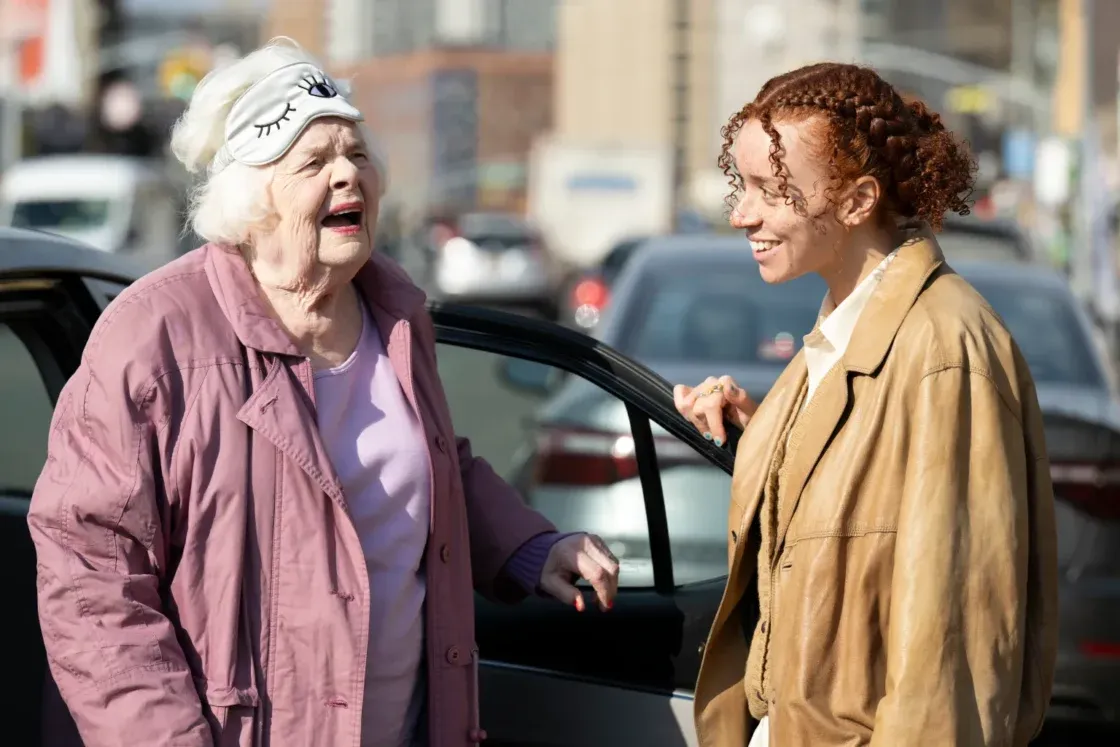
Her emotional apex arrives in moments of genuine connection with Nina. When Emma Goldman meets Buddy Holly in spirit form, sparks fly—sweet and strange. These flashes of warmth (seen most vividly in their Staten Island outing, with the Verrazzano Bridge looming like history’s long shadow) hint at a bridge not just between two characters, but two eras: survivors of genocide and survivors of contemporary loss.
Nina, as portrayed by Erin Kellyman, is a study in “millennial melancholy.” Fresh from her mother’s funeral and armed with a camera and collective empathy, she personifies hope’s fragility. Her raw grief mirrors Eleanor’s own, yet each approaches memory differently: one as lived experience, the other as borrowed narrative. Their chemistry—equal parts electric and uneasy—underscores a paradox of the digital age: the yearning for authentic stories in a world rife with manufactured ones.
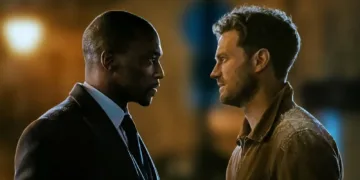
Chiwetel Ejiofor’s Roger stands at the confluence of public performance and private desolation. His polished news-anchor persona acts as a foil to Eleanor’s theatrical dishonesty (he tells truths on air; she packages untruths as truth). Off-camera, his silence speaks volumes—each pause a testament to the unspoken sorrow of a world still grappling with collective trauma.
Jessica Hecht’s Lisa embodies filial duty and generational impatience. Her protective instincts clash with her mother’s insatiable need for autonomy, illustrating a universal tension when children become caregivers (see also: the 2008 financial crisis, when adult children returned home en masse). Rita Zohar’s Bessie, though largely confined to early scenes and flashbacks, functions as an emotional catalyst. Her monologue on survival is less backstory and more moral imperative—an insistence that remembrance must be active, not passive.
The ensemble of actual Holocaust survivors lends the group scenes an almost liturgical weight. When Eleanor addresses the circle, it’s as if she’s testing the elasticity of collective memory—how far one may stretch another’s trauma before it snaps back into accusation.
Interactions between generations—Eleanor and Lisa, Eleanor and Nina—reveal hidden strata of identity. In one moment, a shared laugh betokens unity; in the next, a furrowed brow hints at betrayal. This constant oscillation creates a new term: “schizo-solidarity,” a bond simultaneously adhesive and fissile, capturing the film’s uncanny capacity to fuse humor with historical gravitas.
Echoes of Absence and Acts of Memory
Grief and loneliness permeate every frame, as if loss has its own chiaroscuro (light and dark intermingling). Eleanor’s missteps—her leap into Bessie’s Holocaust narrative—feel less like conscious deceit and more like a desperate cartography of absence. Nina’s fresh sorrow (her mother’s passing) runs parallel: two women mapping their voids, one with inherited memory, the other with immediate ache. Both forms of mourning blur into “grief adjacency,” a term for when different losses resonate like sympathetic strings on a violin.
Identity and storytelling collide on ethically fraught terrain. Eleanor’s assumption of another’s trauma poses the question: is empathy a trapdoor or a bridge? The film forces us to ask whether comfort can justify appropriation—or if truth must always outshine solace. Here, narrative becomes a double-edged sword: it heals, yet it can wound when wielded without consent.
Intergenerational friendship emerges as both balm and crucible. Eleanor and Nina trade archetypes—wise elder, eager pupil—only to find that their roles invert with startling frequency. Each imparts resilience: Eleanor rediscovers purpose beyond her routines; Nina learns that history’s weight cannot be distilled into neat sound bites. Their bond exemplifies “chronosymbiosis,” a concept of mutual growth across time’s divides.
Jewish heritage and memory anchor the film in cultural resonance. The community centre functions as a sacred agora—where collective remembrance unfolds in song, story, and shared ritual. Eleanor’s belated bat mitzvah becomes a potent symbol: an overdue rite of passage that transcends age, affirming that initiation into communal history knows no expiration date. Casting actual survivors lends the ensemble an austere authenticity—these faces carry living echoes of atrocity.
And then there’s the city as character. Florida’s languid hues give way to Manhattan’s kinetic rhythm: JCC hallways as arteries of identity, Staten Island vistas as liminal spaces between past and present. In this urban theatre, Eleanor’s deception and redemption play out against a backdrop of ceaseless motion—reminding us that memory, like the city, is always in flux.
The Aesthetics of Age and Atmosphere
Scarlett Johansson’s directorial debut navigates tone like a tightrope walker—sometimes with breathtaking poise, other times with a reassuring wobble. Comedy and drama interlace (her pacing often mirrors the erratic tempo of grief), yet she never lets one dominate the other. Scenes bloom or retraumatize depending on how long she lingers on a reaction shot. Close-ups become philosophical microscopes: a twitch of Squibb’s brow can speak volumes about regret.
Hélène Louvart’s cinematography distinguishes realms of emotion through color temperature. Florida feels bathed in honeyed light, evoking the golden nostalgia of “Thelma” (no accident). Manhattan interiors adopt a cooler, steel-blue glow, as if the city itself were holding its breath. Two-hander frames—Eleanor and Nina at the JCC—are composed like duets, each face occupying its own visual cadence. In those exchanges, space becomes a silent third character.
Sound design merits its own credit. Dustin O’Halloran’s piano motifs are so discreet, they risk going unnoticed—until you realize emotion has already unfurled beneath them. Ambient city noises (distant sirens, subway rumbles) contrast sharply with the hush of the survivors’ circle, creating what I’d call “sonic chiaroscuro.”
In quieter moments, every whisper or footstep seems amplified, underscoring how isolation can feel magnified in communal settings. The soundtrack and ambient audio collaborate to remind us that memory and environment are inseparable.
Lasting Impressions and Audience Appeal
Eleanor the Great resonates through Squibb’s impish magnetism and Johansson’s quietly daring ambition (a surprising directorial flourish from an actor best known for screen presence). At times the tonal shifts feel like potholes on an otherwise scenic route, yet those jarring moments underscore the film’s willingness to grapple with life’s messiness.
Viewers drawn to character studies—particularly those exploring bonds across generations—will find fertile ground here. And anyone fascinated by the interplay of personal narrative and collective memory may discover a curious kind of kinship in Eleanor’s audacious quest to keep stories alive. Her spirit, once ignited, refuses to be extinguished.
Eleanor the Great premiered at the 2025 Cannes Film Festival in the Un Certain Regard section on May 20, 2025.
Full Credits
Director: Scarlett Johansson
Writer: Tory Kamen
Producers: Jessamine Burgum, Charlotte Dauphin, Kara Durrett, Keenan Flynn, Jonathan Lia, Celine Rattray, Trudie Styler
Executive Producers: Andrew Calof, Ezra Gabay, Jamey Heath, Raj Kishore Khaware, Jan McAdoo, Steve Sarowitz, Peter Sobiloff, Mike Sobiloff, Lucy Keith, Robert Kessel, Susan Leber, Jenny Halper, Erin Cressida Wilson, Justin Baldoni
Cast: June Squibb (Eleanor Morgenstein), Chiwetel Ejiofor (Roger), Jessica Hecht (Lisa), Erin Kellyman (Nina), Will Price (Max), Lia Lando (Female Anchor), Greg Kaston (Peter), Swanmy Sampaio (Actriz), Michael Everett Johnson (Uber Driver), Rita Zohar (Bessie), Stephen Singer (Rabbi Cohen), Lauren Klein (Vera), Elaine Bromka (April), Tristan Murphy (Charlie Cole)
Director of Photography (Cinematographer): Hélène Louvart
Editor: Harry Jierjian
Composer: Dustin O’Halloran
The Review
Eleanor the Great
Eleanor the Great dazzles in its exploration of memory’s elasticity, anchored by June Squibb’s incandescent performance and Scarlett Johansson’s assured visual poise. Though its tonal shifts occasionally falter, the film’s thematic reach—grief, identity, the ethics of storytelling—remains compelling, inviting viewers into a poignant dialogue between generations.
PROS
- June Squibb’s vividly sharp performance
- Thoughtful exploration of grief and identity
- Nuanced intergenerational chemistry
- Authenticity lent by real Holocaust survivors
- Subtle, supportive score
CONS
- Occasional tonal unevenness
- Some plot conveniences feel contrived
- Underused supporting characters
- Emotional peaks verge on melodrama







