




























“Sirens” immediately plunges viewers into a world where extravagant surfaces barely conceal an unsettling reality. This series, a potent concoction of dark comedy, biting social satire, and simmering thriller elements, also carries distinct melodramatic undercurrents, crafting an atmosphere thick with anticipation and unease from its opening moments. The visual language often contrasts the sunny, picture-perfect island with the shadowed intentions of its inhabitants, a common technique in narratives that explore deceptive appearances, a theme resonating with stories across global cinema that question idyllic facades.
At its heart are two estranged sisters: the street-smart Devon DeWitt and the younger, aspirational Simone. Their fractured relationship is forced into sharp focus when Devon, armed with a symbolic (and rotting) fruit basket—a glib response to news of their father’s advancing dementia—tracks Simone to a lavish, isolated island. Simone has found refuge, and a new persona, as the personal assistant to the magnetic, immensely wealthy Michaela “Kiki” Kell. The disparity in their reactions and life choices immediately signals deep-seated familial tensions, a universal touchstone.
Devon’s arrival pierces the carefully constructed facade. Her immediate suspicion paints Michaela as a Svengali-like figure, holding Simone captive within a gilded cage where extreme wealth cultivates intricate, often dangerous, human dynamics. The island itself becomes a character, its beauty a deceptive veneer over the brewing storm.
Fractured Reflections: The DeWitt Sisters at a Crossroads
The narrative engine of “Sirens” is powerfully fueled by the complex dynamic between its two protagonists, sisters Devon and Simone DeWitt, whose intertwined fates and clashing worlds provide fertile ground for character study. Devon, portrayed by Meghann Fahy, is introduced amidst the grit of Buffalo, a semi-functioning alcoholic juggling the care of their dementia-afflicted father, a dead-end falafel joint job, and an affair with her married boss.
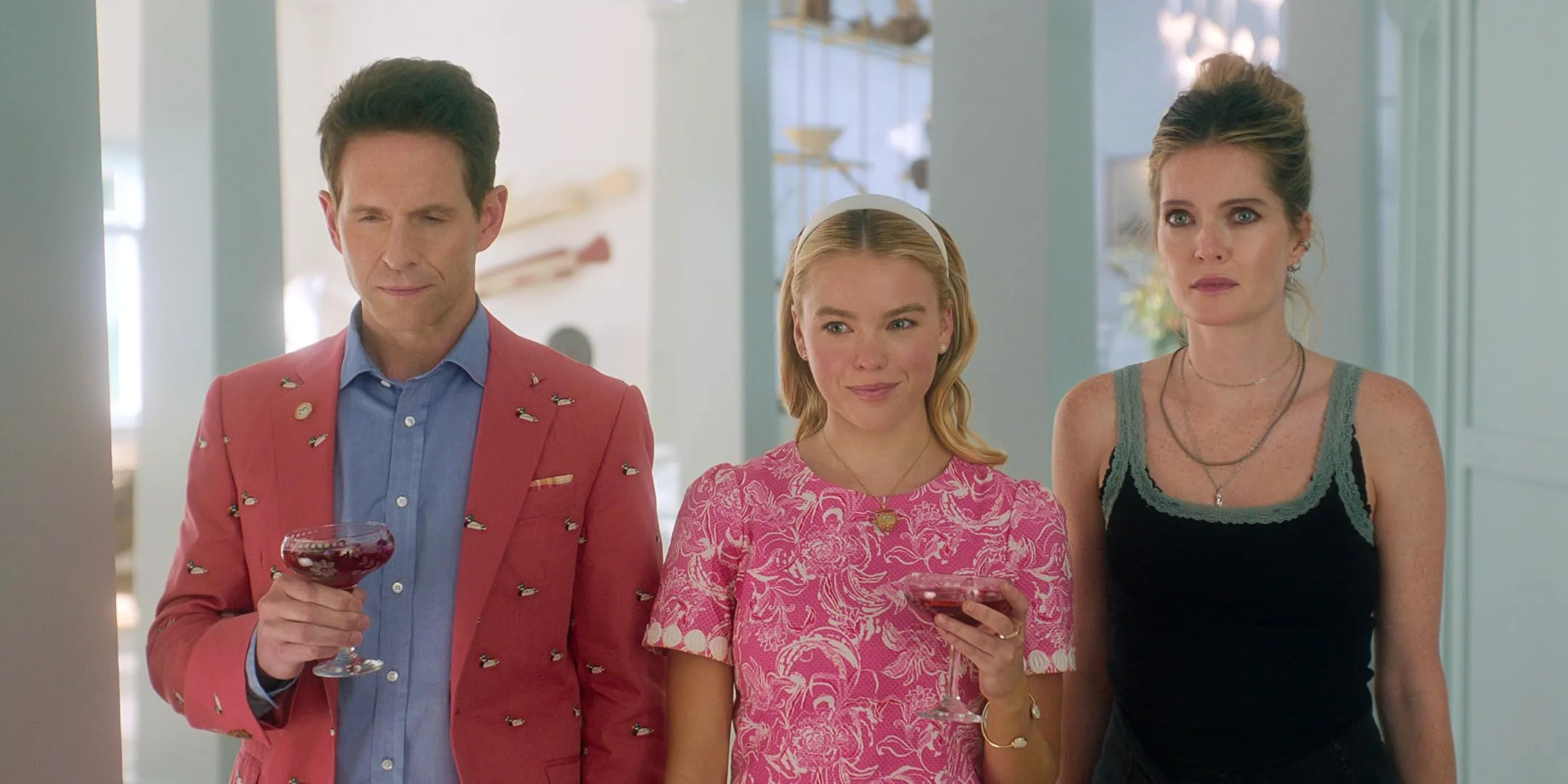
Her personality is a potent mix of outspokenness and world-weariness; she is fiercely protective, a confrontational truth-teller whose arrival on Michaela’s island in stark all-black attire serves as immediate visual shorthand for her outsider status and resistance to the prevailing aesthetic of manufactured calm. This deliberate costuming choice acts as a cinematic signifier, a clear rebellion against the pastel-hued conformity she encounters, a technique often employed in global cinema to denote a character’s internal state or social dissonance. Devon’s motivation is twofold: to demand accountability from Simone regarding their familial duties and to instinctively “rescue” her younger sister from what she perceives as a dangerously alluring, cult-like environment.
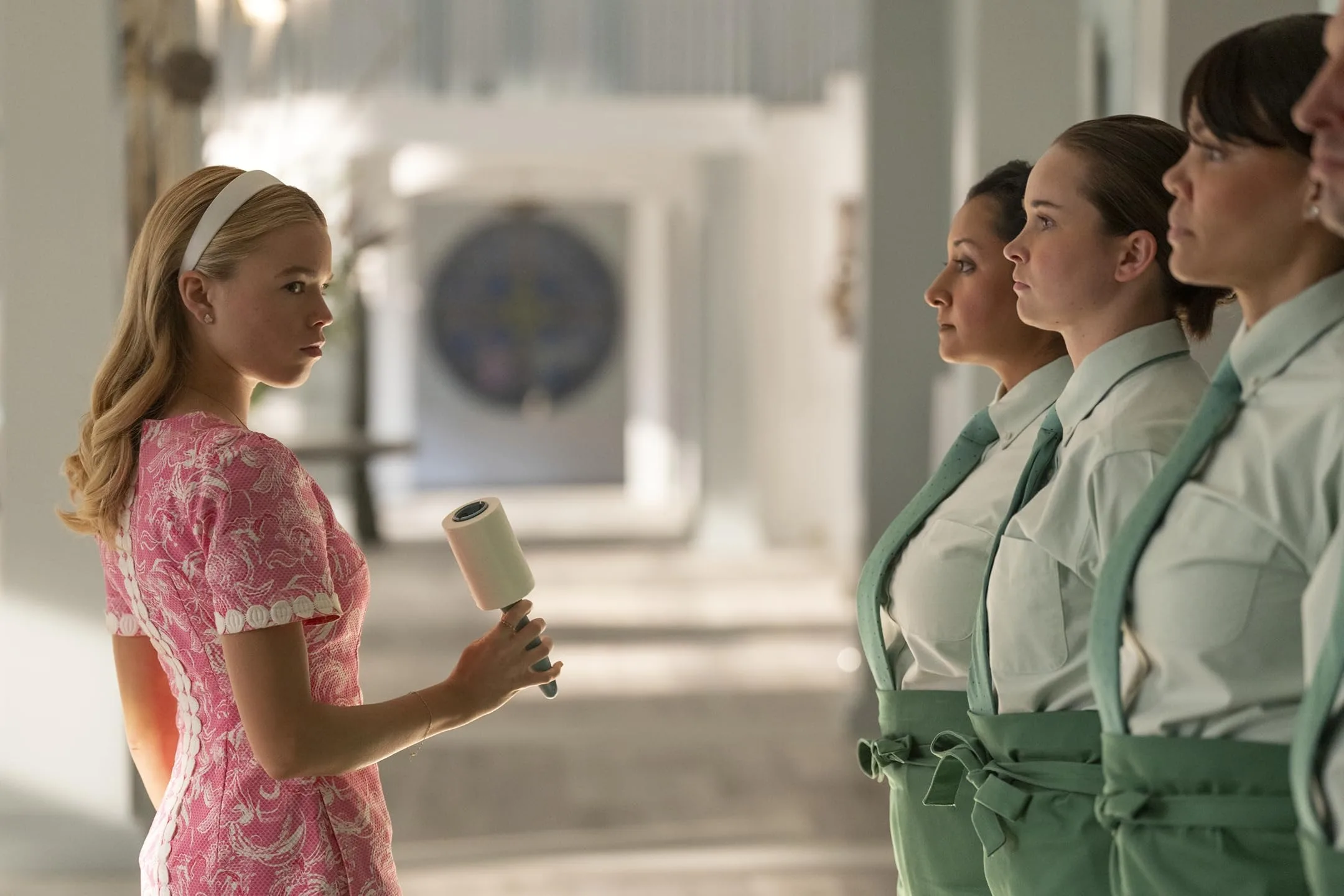
In stark contrast, Milly Alcock’s Simone has meticulously crafted a new existence as Michaela Kell’s indispensable live-in assistant. Her life is one of borrowed luxury, complete with a relationship with the older Ethan Corbin III. Simone’s transformation is visually and thematically significant: new blonde hair, a reshaped nose, and symbolically, the lasering off of shared sisterly tattoos.
These physical alterations speak volumes about her desperate attempt to shed her past and embrace a new identity, a theme resonating with countless narratives worldwide where individuals seek to transcend their origins, sometimes at great personal cost. Dressed in soft hues dictated by Michaela, Simone initially embodies an eager-to-please subservience, her composure visibly cracking only upon Devon’s disruptive appearance, which threatens to unravel the fragile tapestry of her new life.
Their shared history is the crucible in which their current conflict was forged. Simone’s stint in foster care following their mother’s death and Devon’s subsequent sacrifice—dropping out of college to become her guardian—has woven a dense web of resentment, obligation, and a buried, fiercely potent affection. The “SIRENS” code word, once their emergency signal, now hangs between them, a poignant symbol of their broken communication.
The narrative peels back these layers, revealing the raw wounds of abandonment and the burden of responsibility, allowing for moments of intense emotional confrontation. This exploration of familial duty versus individual aspiration, set against a backdrop of class disparity, finds echoes in socially conscious storytelling traditions, including Indian parallel cinema, which often delves into the intricate sacrifices and compromises shaping family bonds within challenging societal structures.
The House of Kell: Charisma, Control, and Cracks in the Facade
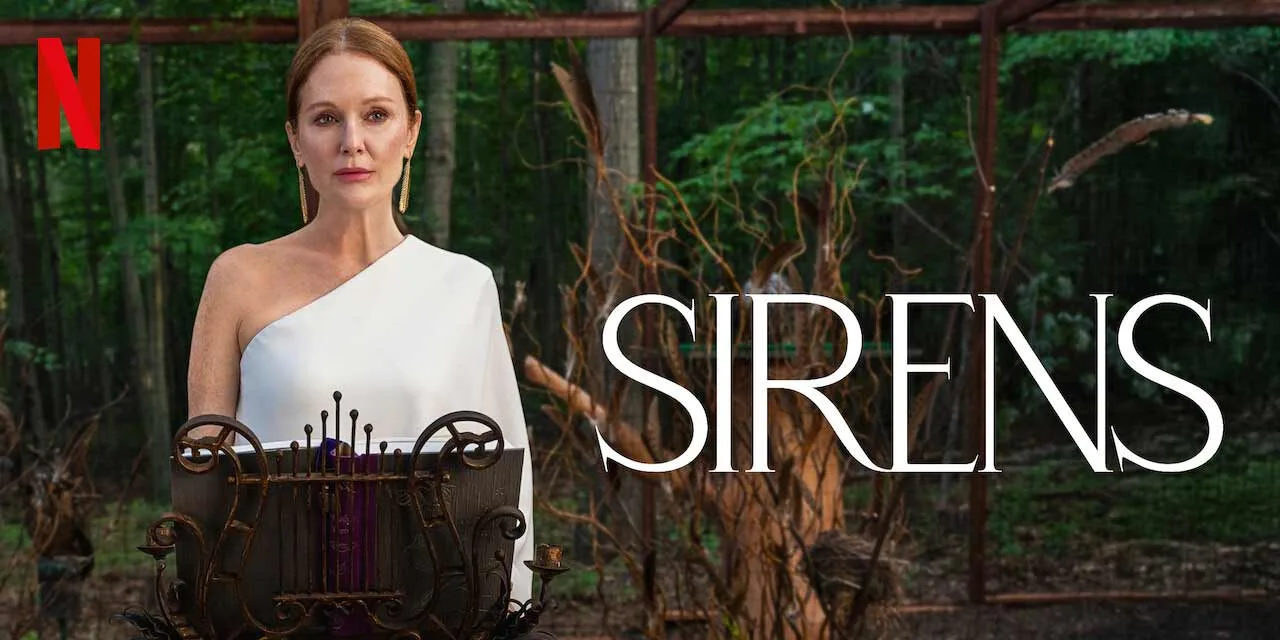
At the glittering, treacherous center of “Sirens” stand Michaela “Kiki” Kell and her husband Peter, presiding over an estate that is as much a psychological battleground as it is a physical space. Julianne Moore’s Michaela is a mesmerizing study in controlled charisma. A former corporate lawyer turned socialite and raptor conservationist, her philanthropic endeavors and beatific pronouncements often feel like a carefully curated performance. Her manipulative charm is a silken net, drawing in acolytes and ensnaring Simone.

This power is depicted through unsettlingly intimate gestures, such as Michaela placing her chewed gum directly onto Simone’s awaiting tongue – a potent visual symbol of dominance and the porous boundaries she enforces. Her smiles can be disarmingly warm or chillingly plastic, capable of melting into a sneer when her desires are thwarted. The relationship with Simone veers into intense codependency, Michaela seemingly molding the younger woman into a version of herself, a dynamic with unsettling, almost psychosexual undertones.
This Svengali-like influence, where a charismatic figure shapes and controls a protégée, is a recurring motif in global storytelling, from classic Hollywood dramas to complex character studies in Indian cinema exploring guru-disciple relationships. Michaela’s control extends to her staff, who murmur about her in a clandestine group chat, and her trio of acolytes who chant Rachel Carson quotes in unison, evoking comparisons to “The Stepford Wives” and underscoring her cult-leader aura. Yet, whispers of a missing first wife and fleeting glimpses of insecurity hint at a fractured persona beneath the serene, goddess-like exterior.
Kevin Bacon’s Peter Kell, the hedge fund billionaire, offers a contrasting, yet equally enigmatic, form of power. His initially laid-back, casual demeanor – at times inviting staff for impromptu meals – feels at odds with the expected gravitas of a “titan of industry.” This studied casualness could be interpreted as a different kind of manipulation, a disarming tactic that makes his underlying influence and potential menace all the more ambiguous. The unresolved mystery of his first wife’s disappearance and the true extent of his sway within the Kell empire add a layer of quiet threat, suggesting he may be a far more calculating figure than his relaxed posture indicates. This archetype of the deceptively unassuming powerful man is a staple in thrillers worldwide.
Life at the palatial Kell estate, aptly named “Cliff House,” is steeped in an atmosphere of unreality. This fictional island enclave, reminiscent of moneyed havens like Martha’s Vineyard or the Hamptons, functions as a gilded prison. The grand house, complete with its own lighthouse and a precarious, teetering staircase to the beach, is under the constant gaze of surveillance cameras, reinforcing a sense of being watched. The visual landscape is often dream-like, sometimes nightmarish, with the uniform Lilly Pulitzer pastels of the guests creating a Stepford-esque homogeneity.
This curated perfection feels oppressive, a critique of elite insularity. The discontent among the household staff – head groundskeeper Jose, chef Patrice, and others – who resent Simone’s high-handed authority, provides a vital counter-narrative, an “upstairs-downstairs” perspective that highlights the fissures in this seemingly flawless world. These interactions, coupled with the surreal pronouncements of Michaela’s devoted female trio, solidify the island’s status as a realm where wealth breeds a peculiar, almost fantastical, isolation.
Weaving Worlds: Thematic Threads and Tonal Shifts in “Sirens”
“Sirens” casts a wide net, exploring a confluence of potent themes through a narrative that delights in its own tonal unpredictability. The stark juxtaposition of the DeWitt sisters’ working-class struggles against the Kells’ insulated hyper-wealth fuels a biting satire of the ultra-rich, their self-absorption, and the performative nature of their existence. Simone’s metamorphosis, a desperate shedding of her authentic self for a precarious perch in this elite world, poignantly illustrates the often-crushing cost of upward mobility – a theme with global resonance, extensively explored in cinema from various cultures examining class aspiration and its attendant sacrifices.
The series delves deeply into the enduring impact of childhood trauma on family dynamics, particularly the complex bond between Devon and Simone, which oscillates between fierce loyalty, profound resentment, and inescapable obligation. This exploration of sisterhood, freighted with shared history and unspoken pain, finds parallels in countless family melodramas worldwide, including the emotionally rich narratives of Indian cinema that often center on familial duty and sacrifice.
The motif of caretaking – Devon for her father, Michaela’s possessive nurturing of Simone and her raptors – further complicates these relationships, questioning the nature of dependence and control. Michaela’s methods of manipulation are a constant undercurrent, highlighting the pervasive power struggles that define almost every interaction, from Devon’s battle for Simone’s soul to Simone’s own attempts to wield authority over the Kell household staff, revealing the chasm between the illusion of power and genuine agency.
Mythological allusions enrich the narrative fabric, beginning with the evocative title “Sirens”—suggesting irresistible allure, hidden danger, and a transformative, perhaps monstrous, feminine power. References like the virtual assistant “Zeus” and recurring bird imagery, such as Michaela releasing falcons or the striking visual of her clutching a bloodied bird, imbue the story with symbolic weight. This use of myth to contextualize and deepen contemporary anxieties is a timeless storytelling technique.
Tonally, “Sirens” is a bold, if sometimes precarious, balancing act. It swerves from genuinely laugh-out-loud dark comedy, reveling in absurd situations and razor-sharp dialogue, to heightened melodrama, particularly evident in the emotionally charged monologues of its later episodes. These moments of theatricality, where characters lay bare their souls, recall cinematic traditions that embrace overt emotional expression.
Interwoven are threads of suspenseful thriller and a pervasive “fantastical feel,” occasionally tipping into outright camp. This ambitious blend creates a unique, often thrillingly unpredictable energy, even if the seams between these disparate elements occasionally show, making for a viewing experience that is as multifaceted as the characters themselves.
Staging the Spectacle: Performances and Artistry in “Sirens”
The captivating power of “Sirens” owes a significant debt to its exceptional ensemble and the deliberate artistry shaping its world. The core trio of actresses delivers performances that are central to the series’ impact. Meghann Fahy as Devon provides a crucial grounding presence, her sharp-tongued delivery and keen comedic timing beautifully balanced with an undercurrent of empathy. She expertly navigates Devon’s internal friction, especially when her character feigns conformity within the opulent Kell domain.

Milly Alcock masterfully portrays Simone’s chameleonic transformation, revealing the cracks in her carefully constructed facade and the roiling inner turmoil of a young woman caught between worlds; her ability to shift from luminous aspiration to a haunted, almost recessive state is compelling. Commanding the screen is Julianne Moore as Michaela, who imbues the potentially one-note matriarch with unsettling charm and magnetic layers. Her performance, a “living legend” at work, oscillates seamlessly between beatific allure and veiled menace, crafting a truly memorable antagonist.
The supporting cast further enriches this tapestry. Kevin Bacon as Peter Kell offers an intriguing study in understated power, his laid-back demeanor hinting at a potentially sinister core. Glenn Howerton provides welcome comedic notes as Simone’s somewhat hapless older boyfriend, Ethan, while Bill Camp movingly portrays the tragic decline of the sisters’ father, Bruce. Sterling comic turns, such as Catherine Cohen in the drunk tank, and the simmering resentment conveyed by Felix Solis and Lauren Weedman as long-suffering Kell staff, add texture and moments of levity. This use of supporting characters to reflect different facets of the central conflict and to provide tonal shifts is a hallmark of well-structured ensemble narratives across various cinematic traditions.
Molly Smith Metzler’s adaptation of her own play, “Elemeno Pea,” translates effectively to the screen, retaining a potent theatricality. The dialogue is consistently witty and sharp, allowing for impactful monologues that delve deep into character motivations – a strength often found when playwrights adapt their own material. The series’ concise, five-episode structure is a refreshing choice, ensuring a tight narrative pace that avoids the “streamer bloat” common in contemporary television.
Visually, “Sirens” employs a striking aesthetic to underscore its themes. Cinematography often contrasts the harsh, unfiltered lighting of Devon’s world in Buffalo with the gauzy, dream-like, or even nightmarish, glow that envelops Michaela’s island domain. This visual dichotomy emphasizes their differing realities and Devon’s alienation.
The Stepford-esque uniformity of the wealthy inhabitants, often clad in prescribed pastels, enhances the unsettling, surreal atmosphere. Michael Abels’ score contributes significantly, weaving a dreamy, haunting, and often unsettling auditory landscape that complements the fast-moving, addictive pacing and helps cement the series’ memorable, symbolic imagery.
The Lingering Echo: “Sirens” and its Haunting Melody
“Sirens” ultimately stands out due to its captivating central performances, an audaciously preposterous plot that remains thoroughly engaging, and a consistently sharp wit. The series ambitiously navigates a complex terrain of shifting tones and substantial themes—from class dynamics and societal pressures to deep-seated trauma and the elusive nature of identity.
It commendably strives for, and often achieves, a poignancy that elevates it beyond simple satire of the wealthy, offering instead a more resonant exploration of human frailty within extreme circumstances. This thematic depth, coupled with its stylistic verve, aligns with a global cinematic appetite for stories that entertain while also provoking thought on societal structures and personal cost.
The tightly woven five-episode narrative reaches a conclusion that is both narratively compelling and emotionally charged for its central sisterly relationship, though some secondary character arcs, like Peter Kell’s, might leave viewers with lingering questions, perhaps intentionally. “Sirens” undeniably leaves a distinct impression: it’s an addictive, often unsettling, and thoroughly entertaining journey.
Its particular alchemy of dark humour, heightened melodrama, and social critique creates a viewing experience that is memorable and distinctive. The series’ bold, sometimes eclectic, composition of elements ensures that its unique tune, with all its intriguing cadences, stays with the audience well after the final scene fades.
Sirens is a five-episode dark comedy series that premiered on Netflix on May 22, 2025.
Full Credits
Creator and Writer: Molly Smith Metzler
Directors: Nicole Kassell (Episodes 1–2), Quyen Tran (Episodes 3–4), Lila Neugebauer (Episode 5)
Writers: Molly Smith Metzler, Bekah Brunstetter, Colin McKenna
Executive Producers: Molly Smith Metzler, Margot Robbie, Tom Ackerley, Dani Gorin, Nicole Kassell, Colin McKenna
Producers: Maureen Shepard Orozco, Bruce Dunn, Kristyn Macready
Main Cast: Julianne Moore, Meghann Fahy, Milly Alcock, Kevin Bacon, Glenn Howerton, Bill Camp, Felix Solis, Josh Segarra
Cinematographers: Gregory Middleton, Zoë White
Editors: Catherine Haight, Laura Zempel, Isaac Hagy, Jen Bryson
Composer: Michael Abels
The Review
Sirens
"Sirens" is a wickedly entertaining and stylishly executed dive into a world of wealth, trauma, and manipulation, anchored by stellar lead performances and sharp, witty writing. While its ambitious tonal blend occasionally falters and some narrative threads feel less resolved, its addictive plot and thematic depth make for a truly memorable and thought-provoking watch that resonates beyond its compact runtime.
PROS
- Outstanding performances from Meghann Fahy, Milly Alcock, and Julianne Moore.
- Sharp, witty dialogue and an engaging, often preposterous plot.
- Meaningful exploration of complex themes like class, family trauma, and identity.
- Strong visual aesthetic and an atmospheric, effective musical score.
- Concise five-episode structure that maintains a brisk pace.
CONS
- The ambitious blend of multiple tones (dark comedy, melodrama, thriller) can occasionally feel inconsistent.
- Some supporting character arcs, notably Peter Kell's, could have benefited from further development or clearer resolution.
- At times, the series tries to juggle so many elements that it can feel slightly overstuffed.