


























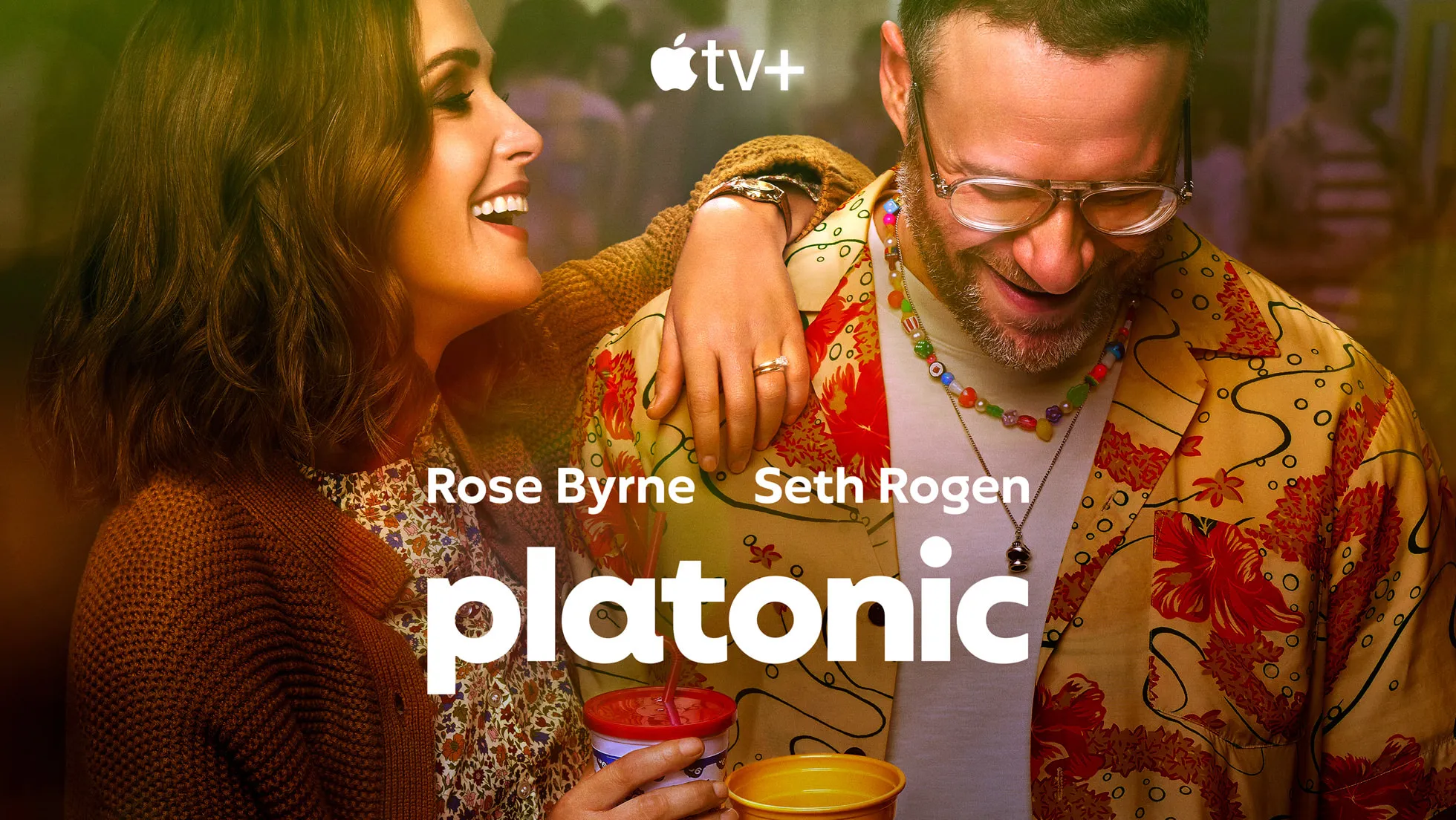

The second season of Platonic opens on a picture of deceptive stability. A year has passed since the explosive reunion of former best friends Will (Seth Rogen) and Sylvia (Rose Byrne). Things appear settled. Will has left his hipster brewery for a corporate gig in San Diego and is now engaged to his CEO boss, Jenna.
Sylvia, having escaped the gravitational pull of stay-at-home motherhood, is launching a promising career as an event planner. For a moment, it seems these two forty-somethings might have finally figured it out. That moment lasts for about ten minutes.
The season kicks off with Will getting a severe case of cold feet, and his first call is, naturally, to Sylvia. This immediately yanks them back into their shared vortex of codependent chaos. The central question sharpens: what happens when a friendship this intense, a bond built on shared history and mutual enabling, crashes into the very real demands of adult life?
The show dives headfirst into the messy, hilarious collision of past selves and present problems, proving that for some people, middle age is just adolescence with a mortgage and more back pain.
A Two-Person Chaos Engine
The engine of Platonic runs on the kinetic, lived-in chemistry between Seth Rogen and Rose Byrne, an on-screen partnership so natural it borders on documentary. Their connection feels less like a performance and more like a candid recording of two people who have known each other since their bones were still setting.
This history fuels every scene, allowing their comedic timing to land with the precision of a shared inside joke. Byrne has carved out a particular niche playing tightly wound women whose composure is cracking under pressure, and Sylvia is a masterclass in the form. She deploys a polite, sing-song voice as a defense mechanism against the chaos erupting around her, but her frantic eyes tell the real story. Her Australian accent, a deliberate choice for the character, subtly reinforces her status as an outsider looking in on the absurdity of her own life. It is a performance of magnificent, controlled panic.
Rogen, in turn, offers a thoughtful evolution of his comedic persona. This is the guy from Superbad all grown up, facing a crisis that cannot be solved with a trip to the liquor store. His portrayal of Will is a nuanced study in regression. He is a man-child, yes, but one who is painfully aware of it. His rebellion against a conventional adult life is worn on his sleeve, quite literally. His wardrobe, a chaotic explosion of loud prints and painfully hip streetwear, is a visual protest against the corporate beige he is flirting with.
Together, their friendship is a strange and wonderful thing. It is deeply supportive yet spectacularly co-dependent, a retreat into a shared language that predates their marriages, children, and careers. They are each other’s greatest champion and worst influence.
This season’s hijinks include a disastrous bachelor party that goes predictably sideways and a kayaking trip down the concrete-lined L.A. River that is funnier for its sheer pointlessness. Will’s season one penchant for kicking scooters hilariously evolves into a one-man war on autonomous delivery robots. The tension they create is not about romance; it is about an emotional intimacy so profound it threatens their other relationships not with infidelity, but with irrelevance.
The Expanding Orbit
While the first season orbited tightly around its two leads, the second confidently expands its world, making a strong case for Platonic as one of the best ensembles in modern comedy. The writers have wisely invested in the supporting cast, giving them arcs that are both funny and emotionally resonant. Sylvia’s husband, Charlie (Luke Macfarlane), is finally freed from his role as the concerned, straight-laced foil.

He gets a full-blown existential crisis, and it is a joy to watch. His professional burnout from a high-pressure law career sends him searching for a different kind of validation, which he finds in a surprisingly deep passion for Jeopardy!. The subplot, which culminates in a contestant appearance, is more than a gag; it is a search for meaning. Macfarlane perfectly captures the insecurity of a man whose impressive physique houses a deeply nerdy, anxious soul. His later attempts at writing legal fiction show a yearning for narrative control in a life he feels is slipping away.
At the same time, Sylvia’s other friend, Katie (Carla Gallo), steps into the spotlight with a more prominent role. She develops an odd, funny friendship with Will that complicates the central dynamic in fresh ways. Their connection seems built on their shared status as people adjacent to Sylvia’s whirlwind, and it works. Katie’s quiet, determined pursuit of a career in podcasting unfolds with a steady competence that serves as a crucial counterbalance to the spectacular flameouts of the main duo.
Her success is a quiet reminder that not everyone’s midlife journey involves public meltdowns. The world is further populated by a slate of sharp guest stars who function as perfect comedic agitators. Aidy Bryant brings a chaotic, high-speed energy as a Hollywood marketer whose life makes Sylvia’s look quaint. Kyle Mooney is delightfully irritating as a smug antagonist designed specifically to puncture Will’s fragile ego. These are not empty cameos; they are catalysts who enrich the show’s universe by forcing the main characters into new and uncomfortable situations.
Growing Up Is a Joke
Platonic is fundamentally a show about the performance of adulthood, a theme that resonates deeply in an era where millennials are navigating their forties with a lingering sense of impostor syndrome. Its characters are haunted by nostalgia, constantly looking back to a time when life felt simpler, even as they are pulled forward by the inescapable gravity of responsibility.

The series finds its richest material in this gap between who society expects them to be and who they stubbornly remain. Will’s struggle with “selling out” to a corporate job is a classic midlife dilemma, presented with fresh humor. Sylvia’s attempt to build a new career while managing the logistics of her family is a painfully relatable tightrope walk. Even Charlie’s story, which explores creative burnout within a seemingly stable profession, speaks to the quiet desperation that can hide behind a successful life.
The show’s humor is smart and specific, rooted in character and keen observation rather than a string of telegraphed punchlines. Its comedic tone is more amusing than outright hilarious, but it feels earned and authentic because it stems directly from the characters’ flaws. The writers have a sharp eye for the absurdities of modern culture, gently mocking everything from the overproduction of podcasts to the strange nature of parasocial relationships without ever feeling preachy or condescending.
A random, out-of-nowhere gag about a Celsius energy drink lands perfectly because it is the kind of specific, throwaway detail that makes a fictional world feel real. This all plays out against the backdrop of a sun-drenched, upper-middle-class Los Angeles that functions as a beautiful, aspirational fantasy land.
The show acknowledges financial realities—Will has money problems—but keeps them safely within the realm of solvable television problems. This choice is key to its identity as a “comfort watch,” where the internal crises are always more pressing than any insurmountable external threat.
The Art of the Comfort Watch
In a television landscape crowded with grim, high-stakes prestige dramas, Platonic is a welcome and necessary relief. It is an affable, low-stakes comedy that knows exactly what it is and has no ambition to be anything else. The show is a “good hang,” plain and simple.

This identity feels like a deliberate choice, a move away from the plot-heavy, puzzle-box narratives of many streaming hits and toward a classic focus on character and rhythm. Its structure, a blend of self-contained episodic stories and serialized character development, echoes the great sitcoms of the past but is infused with a distinctly modern sensibility and patience.
The show’s confidence is apparent in its execution. The pacing is breezy and assured, never lingering too long on one joke or dramatic beat. This comfort extends to its stylistic choices, which are all deployed with purpose. The soundtrack is impeccably curated, functioning as a character in its own right. Each opening and closing song is a perfect needle drop, a carefully selected track that distills the episode’s emotional core into a few minutes of music.
The production design and cinematography work in concert to create the show’s warm, inviting tone. The lighting is soft, and the homes feel lived-in, making the world feel like a pleasant place to visit for thirty minutes.
By deepening its ensemble and sharpening its thematic focus, the second season solidifies the show’s identity as a reliable, genuinely funny series about the beautiful, frustrating, and necessary mess of human connection. It suggests that the point of adult friendship is not to solve each other’s problems, but to simply agree to sit beside each other in the wreckage.
Full Credits
Directors: Nicholas Stoller, Francesca Delbanco
Writers: Francesca Delbanco, Nicholas Stoller, Ron Weiner, Andrew Gurland, Brittany Ann Miller, Guy Endore-Kaiser, Justin Nowell, Noah Findling
Producers and Executive Producers: Rose Byrne, Seth Rogen, Nicholas Stoller, Francesca Delbanco, Conor Welch, Evan Goldberg, James Weaver, O’Shea Read, Werner Walian, Brett Derdiger, Andrew Gurland, Justin Nowell, Ron Weiner, Alexandra Rushfield
Cast: Rose Byrne, Seth Rogen, Luke Macfarlane, Tre Hale, Andrew Lopez, Carla Gallo, Alisha Wainwright, Janet Varney, Vinny Thomas, Sophie Leonard, Max Matenko, Sophia Kopera, Guy Branum, Emily Kimball, Aidy Bryant, Kyle Mooney, Beck Bennett
Director of Photography (Cinematographer): John Guleserian
Editors: Summer Spiro, Ryan King, Joe Gallagher
Composer: Michael Andrews
The Review
Platonic Season 2
Platonic Season 2 elevates an already strong comedy into something truly special. By expanding its world and deepening its character arcs, the show solidifies its status as a top-tier comfort watch. The unmatched chemistry between Rose Byrne and Seth Rogen remains the series' brilliant core, but it is the growth of the ensemble that makes this season so satisfying. It is a sharp, funny, and refreshingly low-stakes exploration of midlife friendship that is confident in its rhythms and a genuine joy to watch. It never tries to be more than it is: a perfect hang.
PROS
- The phenomenal, lived-in chemistry between leads Rose Byrne and Seth Rogen.
- Meaningful character development for the supporting cast, particularly Luke Macfarlane's Charlie.
- Smart, observational humor that is rooted in authentic character moments.
- A confident and comforting tone that makes it a standout "good hang" show in a crowded streaming landscape.
CONS
- The deliberately low-stakes nature of the plot might not engage viewers seeking high drama.
- Its humor is more consistently amusing and clever than laugh-out-loud funny.
- The focus on a privileged, upper-middle-class lifestyle could feel insular to some viewers.