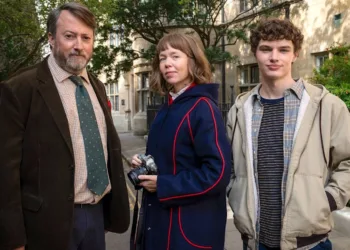











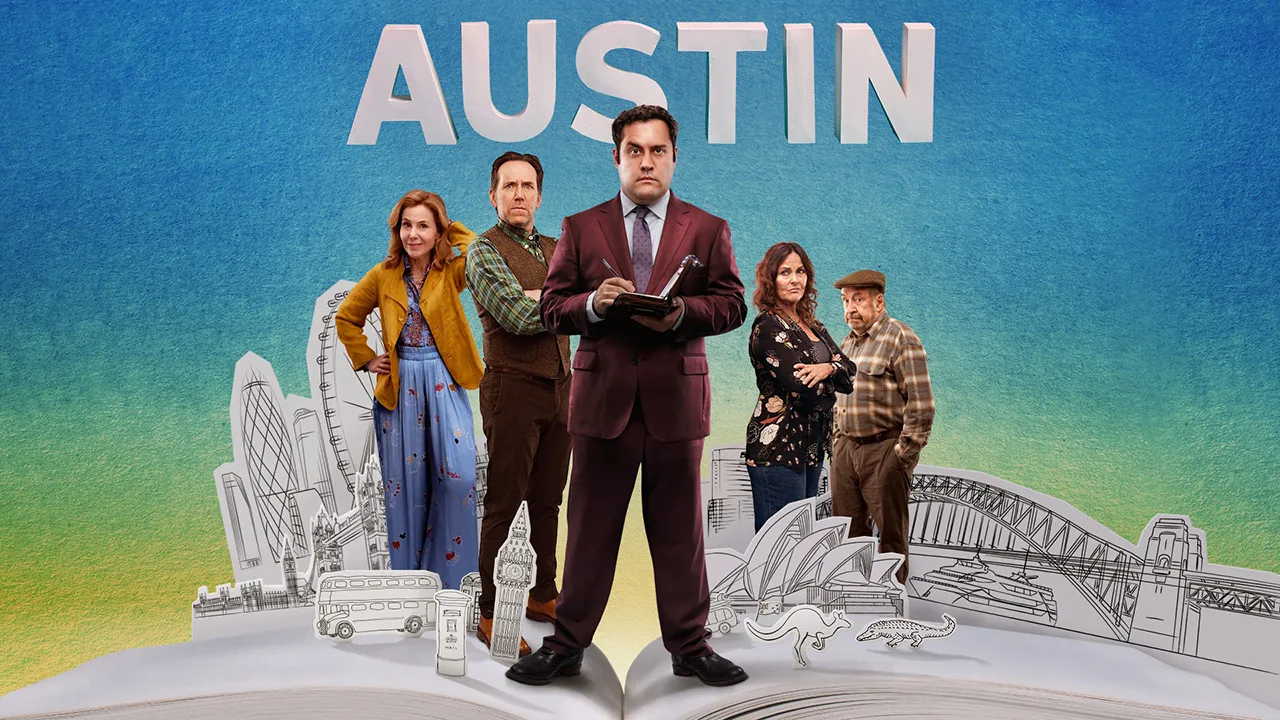

The first season of Austin introduced us to a delightfully awkward pairing: Julian (Ben Miller), a self-absorbed British children’s author, and Austin (Michael Theo), the earnest, autistic Australian son he never knew he had.
Season 2 wisely relocates the action to Julian’s home turf of London, a move that feels less like a simple change of scenery and more like a shift in the power dynamic. The city itself becomes a character, testing the duo’s burgeoning relationship. The central question from last season’s cliffhanger hangs in the air: is Julian truly Austin’s father?
This DNA-fueled drama runs alongside two compelling professional subplots. Austin attempts to become an author in his own right, while Julian and his estranged wife, Ingrid, navigate the treacherous waters of adapting their creative work for television. It’s a setup ripe for gentle comedy and heartfelt exploration.
The Long Way ‘Round to Fatherhood
What’s so brilliant about the narrative architecture of Austin’s second season is how it takes a classic sitcom trope—the lab mix-up—and elevates it into a meaningful exploration of fatherhood itself. The season opens with the bombshell that the DNA test is negative. For a moment, the entire premise of the show is thrown into question.
For Julian, this news is a complex blow to his already fragile ego. After spending the first season grappling with the responsibilities of being a father, the sudden removal of that biological imperative leaves him adrift. It forces him to question whether his newfound affection for Austin was genuine or merely a convenient tool for his own redemption. Ben Miller’s performance in these early scenes is pitch-perfect, showing the flicker of selfish relief warring with a deeper, more confusing sense of loss.
This narrative choice sends the characters on a literal and figurative journey. The road trip to North Hampton to meet Austin’s supposed real father is filled with the kind of understated, character-driven comedy the show excels at. It’s on this journey that the story’s central thesis becomes clear: biology is incidental to the act of parenting.
The show argues that fatherhood is a verb, an action, a choice made every day. We see this choice most clearly in a tense scene on a train. When a group of louts begins to mock Austin’s hat, Julian’s first instinct is his typical passive avoidance. But as the situation escalates, something shifts.
He confronts the men, not with bravado, but with a clumsy, desperate protectiveness that feels more authentic than any heroic act. In that moment, he isn’t a canceled celebrity or a failed husband; he is simply a dad. This scene is expertly staged, using the confined space of the train car to amplify the social pressure and highlight Julian’s internal struggle.
The subplot involving Julian’s own parents adds another rich layer to this exploration. Prompted by Austin’s meticulous genealogical research—a beautiful character trait that turns his focused interest into a narrative engine—they discover Julian’s parents are alive and running a post office. The reunion, after a 15-year silence, is excruciatingly funny.
We learn the estrangement stems from Julian naming the porcine villains in his “Big Bear” books after them, a petty grievance nursed for over a decade. This detail does more than just provide a laugh; it re-contextualizes Julian’s own selfish behavior, showing it as a learned trait, a cycle of familial dysfunction.
When his mother slams the door in his face, only to be charmed moments later by Austin, the show demonstrates how this new generation, represented by Austin’s directness and lack of guile, has the power to break old patterns. The eventual reveal of the lab error feels less like a narrative reset and more like a quiet affirmation of the bond we’ve just watched them forge through action and choice. The journey was the point, not the destination.
Art vs. Algorithm in a Cancel Culture World
Austin is a show that feels incredibly tuned in to the cultural frequency of 2025, and nowhere is this more apparent than in its parallel professional storylines. These plots transform the series into a thoughtful commentary on the anxieties of creative life in the digital age. The show’s structure, which often feels like two distinct sitcoms running in tandem, mirrors the fragmented way we consume media and the siloed nature of our modern lives. It’s a bold choice that resists the neat, integrated plotting of traditional television.
First, there’s Austin’s journey into the world of publishing. His manuscript, a heartfelt guide to his experiences, is retitled The Autistic Guide to Britain by his publisher. This is the first step in a process of commodification that feels all too real. The publisher’s demand for a compelling “British origin story” is a sharp critique of the authenticity economy, where personal identity is mined for marketable content.
Austin, a person of profound sincerity, is pushed to manufacture a narrative that fits a commercial algorithm. His budding romance with his agent, Greta, is sweet and awkward, but it also underscores the blurring lines between the personal and the professional.
The storyline culminates in a moment of pure 21st-century absurdity: his book becomes a viral hit not through reviews or literary merit, but because pop star Billie Piper happens to post about it on social media. It’s a clever observation on the arbitrary nature of fame and how cultural currency is minted in unpredictable ways, often disconnected from the artist’s intent.
Running parallel is the effort to adapt Julian and Ingrid’s “Big Bear” books for television. This plotline serves as a direct examination of cancel culture and its long tail. Julian, still a pariah from his social media faux pas in season one, is unceremoniously sidelined by the production company.
The series doesn’t offer a simple take on the issue; instead, it explores the messy fallout. It questions whether public shaming allows for growth or simply creates professional lepers. This conflict is the catalyst for Ingrid’s fantastic character arc. Played with a brilliant, simmering frustration by Sally Phillips, Ingrid has spent her marriage in Julian’s creative shadow.
The TV deal is her chance to claim her artistic independence. Her fight to have the show animated, honoring her original illustrations, versus Julian’s push for live-action, which would center him, is a potent metaphor for their entire relationship.
Her journey out of the garden shed and into her own creative power speaks to a broader cultural conversation about women reclaiming their narratives and professional spaces. It reminds me of so many artistic partnerships where one person, often the woman, provides the foundational work without receiving the commensurate credit.
The Quiet Charm of Witty Repartee
In an era of loud, fast-paced television, the gentle rhythm of Austin feels like a balm. The show’s greatest artistic merit lies in its confidence to be quiet, to trust its characters and its dialogue to do the heavy lifting. The direction and editing contribute significantly to this, favoring longer takes and a relaxed pace that lets the comedy breathe.
It eschews a constant laugh track or rapid-fire punchlines for a humor that bubbles up from character and situation. This approach feels more aligned with an independent film sensibility than a mainstream sitcom, and the show is all the stronger for it.
The performances are, without exception, superb. Michael Theo is the heart of the series. His portrayal of Austin is a masterclass in subtlety. It’s in his precise, formal vocal delivery, his slightly stiff posture, and the way he processes the world with wide-eyed sincerity.
He generates humor not by telling jokes, but by simply being himself in a world that often doesn’t know what to make of him. It’s a performance that builds empathy and understanding from the ground up. In contrast, Ben Miller’s Julian is a fascinating study in flawed humanity.
Miller allows Julian’s vanity and selfishness to be fully on display, yet he skillfully reveals the cracks of insecurity and yearning underneath. You can see the internal calculations behind his eyes as he tries to manipulate a situation, only to be foiled by his own ineptitude or a flicker of conscience.
The comedic style is a perfect fusion of British and Australian sensibilities. It has the dry, sardonic wit of classic UK comedy, where the biggest laughs come from what’s left unsaid, but this is blended with a more direct, earthy Australian humor, often delivered by Roy Billing as Austin’s grandfather. The writing is the true star, prioritizing clever repartee over slapstick.
A line like Julian’s demand for “justice,” immediately followed by a request for “chamomile,” tells you everything you need to know about his character: his capacity for high drama and his simultaneous need for gentle comfort. It’s this attention to detail, this commitment to character-driven humor and a relaxed, confident style, that makes Austin such a worthwhile and deeply enjoyable watch. It’s a show that trusts its audience to appreciate the nuance, and it rewards that trust at every turn.
Austin is an Australian comedy-drama series. Season 2 of the series premiered in Australia on ABC TV and ABC iview on July 27, 2025.
Full Credits
Directors: Darren Ashton, Madeleine Dyer, Rebecca O’Brien
Writers: Joe Tucker, Lloyd Woolf, Adam Zwar, Andy Riley, Kevin Cecil, Amy Stewart, Emma Jane Unsworth
Producers: Joe Weatherstone (Producer), Peter Anderson, Rebecca Anderson, Darren Ashton, Ben Miller, Catherine Nebauer, Rachel Okine, Jessica Parker, Sally Phillips, Joe Tucker, Lloyd Woolf (Executive Producers)
Cast: Michael Theo, Ben Miller, Sally Phillips, Gia Carides, Roy Billing, Kate Elliott, Ellie McKay, Natalie Abbott, Katrina Milosevic, Claire Lovering, Richard Davies, Rob Collins, Tai Hara, Zahra Newman, Rodger Corser, Charlotte Nicdao, Billie Piper, Obadiah, Scout Boxall, Catherine Van-Davies, Trystan Go
Director of Photography (Cinematographer): Nicholas Owens
Editors: Amelia Ford, Danielle Boesenberg
The Review
Austin Season 2
Austin Season 2 is a triumph of quiet, character-driven comedy. It thoughtfully explores complex themes of fatherhood, creative ownership, and authenticity in the digital age, all while maintaining a gentle, endearing rhythm. Buoyed by superb performances from Michael Theo and Ben Miller, the series deftly balances its parallel storylines, creating a rich and rewarding viewing experience that is both intelligent and deeply human. It’s a witty, warm, and wonderfully confident season of television.
PROS
- Nuanced and heartfelt lead performances from Michael Theo and Ben Miller.
- Intelligent writing that blends dry British wit with earthy Australian humor.
- Thoughtful exploration of contemporary themes like cancel culture and the commodification of identity.
- A confident, gentle pacing that allows character moments to breathe.
- Strong supporting cast that enriches the comedic and emotional landscape.
CONS
- The parallel plot structure can occasionally make the show feel like two separate series.
- Its relaxed, gentle pace may not appeal to viewers seeking high-stakes drama or rapid-fire jokes.
- Relies on a familiar narrative trope (a lab mix-up) for a key plot resolution.