




















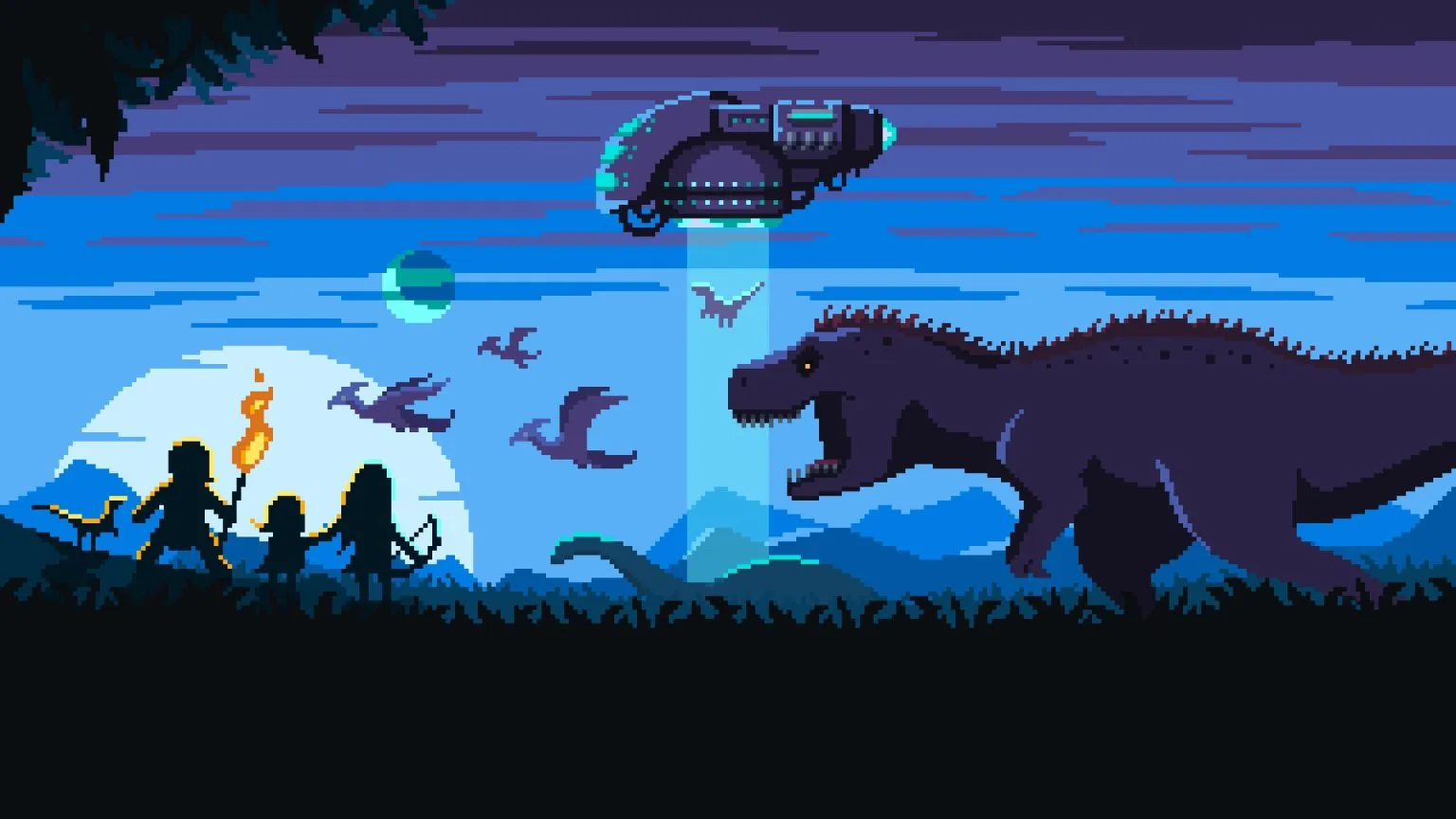

The scene opens on a tranquil, prehistoric tableau. A small family huddles around a fire, a small point of light against a vast, indifferent wilderness. Silhouetted dinosaurs parade across the title screen, and you are immediately pulled into this world. Then, disaster strikes. A terrifying dinosaur attack scatters the family, separating our caveman protagonist from his loved ones.
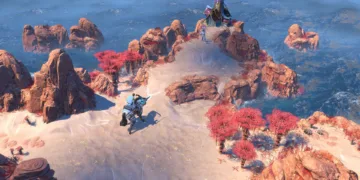
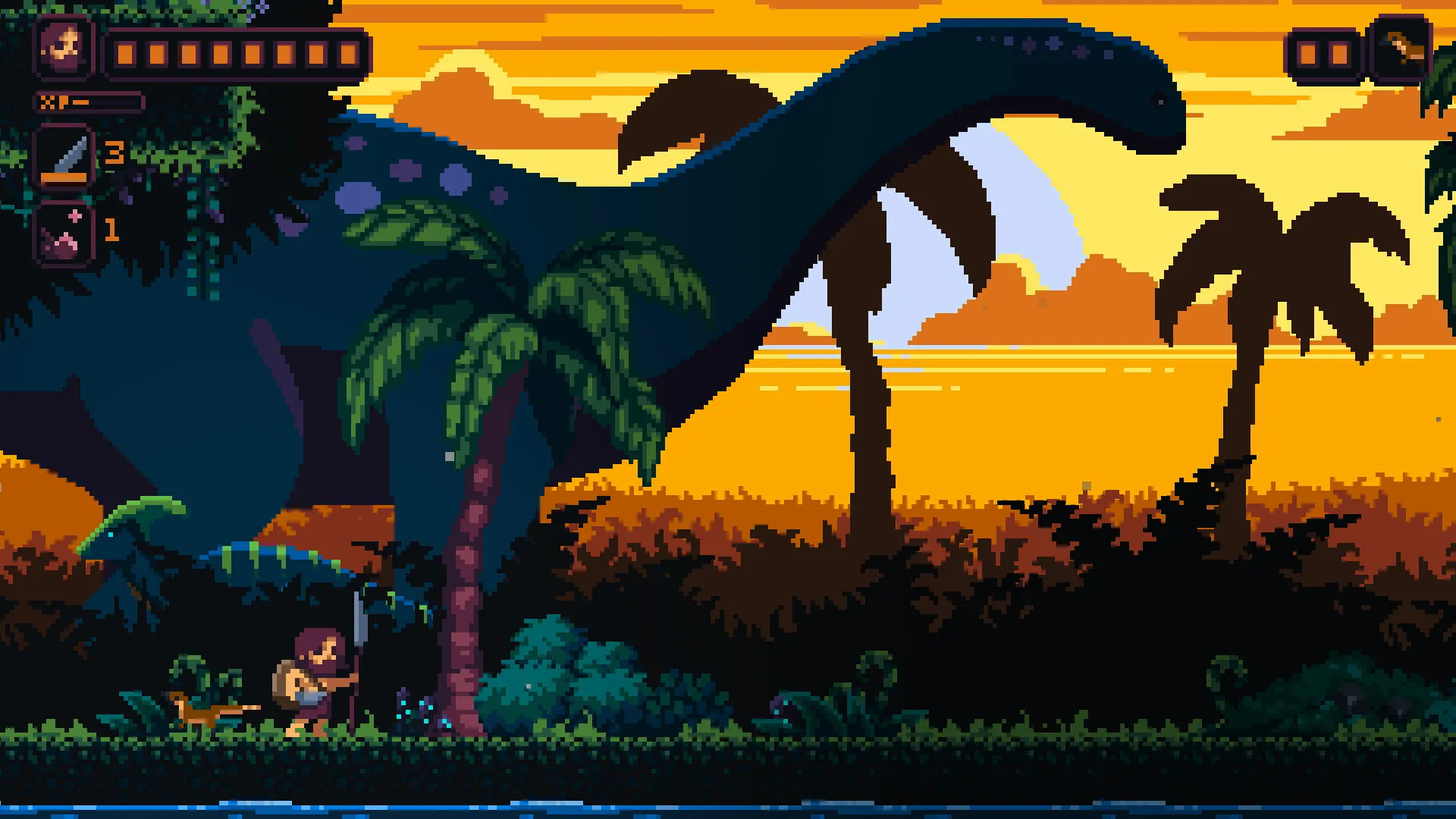
His quest is clear: find them and bring them back together. This simple, powerful motivation kicks off an adventure into a dangerous and beautiful land. The game’s presentation is built on exceptionally detailed pixel art that makes its world feel truly alive. This isn’t static scenery; it’s a dynamic environment. Lush forests, teeming oceans, and rolling plains are packed with movement. Insects buzz through the air, birds swoop from the sky, and waterfalls gush into rivers below.
This sense of a living ecosystem is deepened by a full day-night cycle and changing weather patterns. The sound design is a critical part of the experience. The unsettling roars of distant predators and the constant hum of insects create a thick atmosphere of both wonder and dread. Playing with headphones is the best way to become fully absorbed in this striking world.
The Tools of Survival
The gameplay of Primal Planet is built on a foundation of survival, though it approaches the concept with a forgiving hand. Your health is a primary concern, and the world offers numerous ways to replenish it, each with its own small wrinkle. Hunting a dinosaur might yield life-saving meat, but consuming it raw is a gamble; you might regain some strength, or you might be struck with a bout of indigestion, leaving you vulnerable for a few precious seconds.
This small detail reinforces the game’s theme of humanity’s precarious relationship with nature. True safety is found only at a lit campfire. These serve as checkpoints and hubs for all your key activities. Here, you can cook your meat to ensure its benefits, rest to restore your health completely, and manage your inventory. The checkpoint system is generous, a far cry from the punishing loops of Soulslike games. Death means losing a bit of progress, not a crushing amount of resources or time, which encourages experimentation and daring exploration.
This sense of preparedness is directly tied to the crafting system. Your inventory space is limited, pushing you to use what you find rather than hoard it. You will constantly gather wood, stone, herbs, and other materials to fashion the tools of your trade. The crafting menu, accessible at any campfire, is simple and effective. You can create basic clubs and throwing bones, but the real star is the spear. It serves as a reliable weapon with decent range, but its utility extends far beyond combat.
In a brilliant piece of design, spears can be thrown into wooden walls, where they stick and become temporary platforms. This opens up new pathways and adds a puzzle-like quality to traversal. You will also craft torches to illuminate pitch-black caves, but their timers are short, creating a natural tension as you race to find your objective before being plunged back into darkness.
You are not entirely alone in this hostile world. The theme of community is woven directly into the mechanics. As you explore, you will find and rescue other humans who then populate your village. This village is not a static location; it is a mobile base of operations that you can move between several designated spots on the map, reinforcing the hunter-gatherer lifestyle.
Each rescued villager offers a unique benefit. By upgrading their personal huts, you can turn your camp into a source of specific, regenerating resources, rewarding your investment in the community. You can also recruit one of these human companions to follow you, providing support in fights. Beyond these allies, you have a constant companion in Sino, a small, orphaned dinosaur who joins you early on.
He fights at your side and, in a wonderful nod to classic couch co-op games like Kirby Super Star, can be controlled by a second player. Sino is effectively immortal; if he’s defeated, he just comes back after a short time. He’s weaker than the main character, but his speed and ability to heal by eating insects make him an excellent partner.
The one missed opportunity here is that the co-op feature is limited only to Sino; the other human companions remain controlled by the computer. Still, the system as a whole makes your small group feel like a true family unit fighting to survive together.
Charting the Lost World
Structurally, Primal Planet presents itself as a 2D Metroidvania, offering a large, interconnected world filled with secrets and branching paths. The world itself is a triumph of design. Every screen feels dense with life, from herds of peaceful herbivores grazing on the plains to the sight of dolphins flipping through the air along the coast. Stumbling upon a T-Rex hunting its own prey as you sneak by is a genuinely thrilling moment that sells the fantasy of being a small part of a massive, functioning ecosystem.
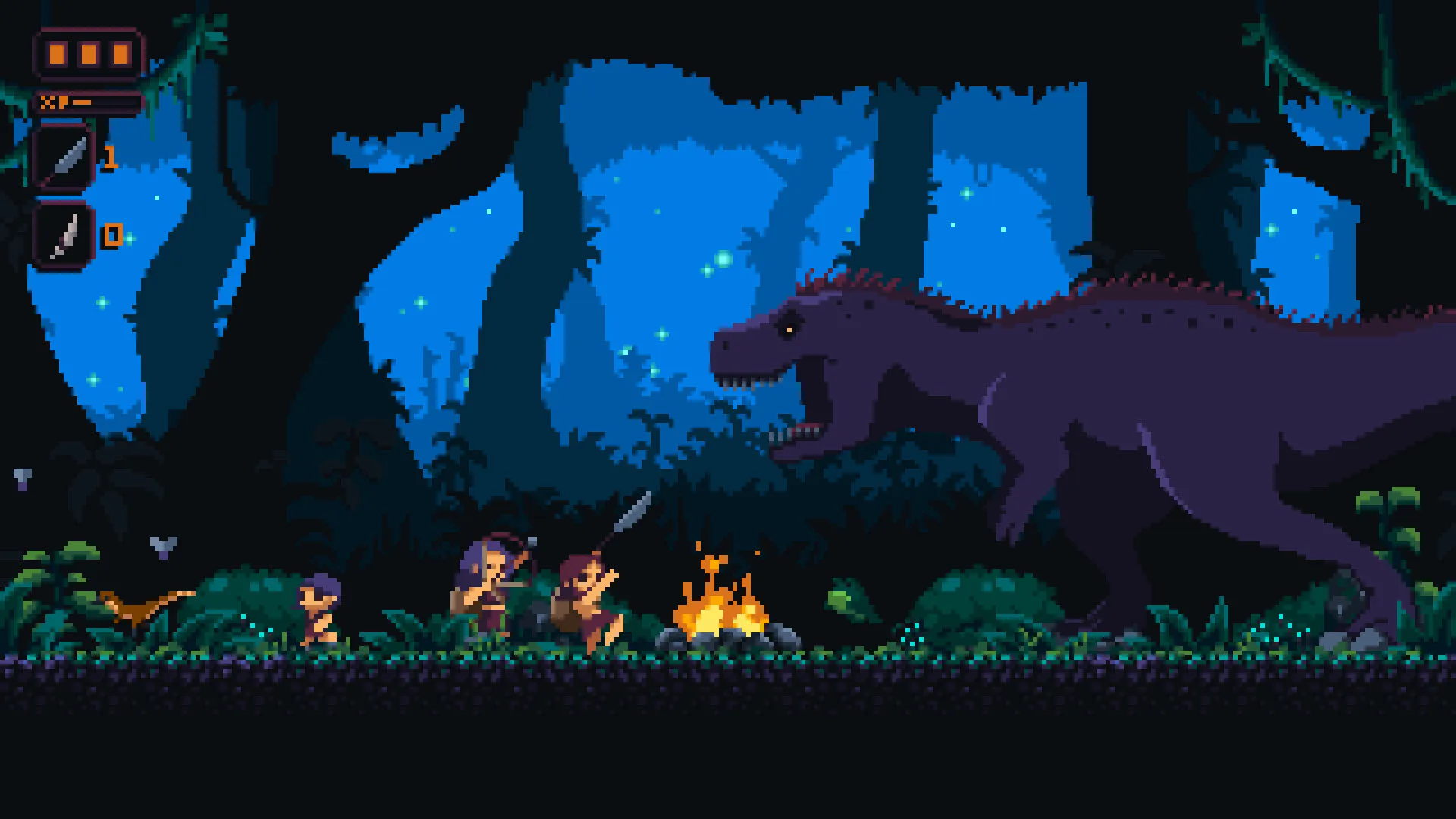
The game excels at creating these memorable environmental encounters. The underwater sections are a particular highlight. Far from being the sluggish, frustrating levels they often are in other platformers, these are vast, mysterious, and beautiful zones with their own unique enemies and physics, evoking the sense of discovery found in the best aquatic areas of classics like Super Mario World.
For all the beauty of its world, the game falters significantly in how it allows you to find your way through it. The map system is a profound source of friction. After a guided opening, you are left to your own devices with little direction. This would be fine in a game with strong navigational tools, but Primal Planet lacks them. You have a detailed map for your current sector, but you can only view one at a time.
The world map, which shows how these sectors connect, is a vague, sketchy drawing with no labels. It’s nearly impossible to plan a route from one side of the world to the other. There are no custom markers to note points of interest or roadblocks, a standard feature that is sorely missed here.
This design choice makes getting lost a constant occurrence, and not in the joyful, discovery-filled way of a game like Hollow Knight. It can feel like you are simply wandering in circles, an issue so pronounced that one might resort to taking screenshots of each sector map to piece together a coherent world view on their own.
Combat is a straightforward and speedy affair. Encounters are fast and often over in seconds. Enemies are jumpy and aggressive, often attacking without much telegraphing. This isn’t a system built on learning intricate enemy patterns; it’s about quick reactions and smart positioning. While you have a basic club, crafted weapons like the spear give you a necessary edge.
The absence of traditional boss fights is a notable departure from the genre. The challenge comes from the environment and surviving encounters with powerful dinosaurs in the wild, not from set-piece battles. Progression is tied to a sprawling skill tree fueled by XP gained from hunting and discovery. This system grants immense flexibility. You can unlock powerful movement abilities like a double jump and an air dash very early, which feels liberating.
However, the skill tree is a classic case of quantity over quality. It’s bloated with an overabundance of options, many of which feel redundant or poorly balanced. Why invest points in lengthening the timer on an antidote when the poison areas are so short? Why upgrade the damage of throwing bones when the spear is superior in almost every way? These choices feel unbalanced, and because you cannot respec your points, a poor investment is permanent.
Cave Paintings and Starships
The narrative of Primal Planet is its most surprising and affecting element, especially given its delivery method. The game contains no written text and no spoken dialogue. Every piece of the story, every emotional beat, is conveyed through action and meticulously crafted character animation. Its effectiveness is undeniable.
You understand the terror of the opening attack, the warmth of a shared campfire, and the joy of a reunion through body language alone. A simple animation of the protagonist hugging his partner or gently patting his loyal dino companion, Sino, carries more weight than pages of text could. This non-verbal method, reminiscent of the powerful storytelling in games like Inside, creates a strong, direct connection to the characters and their plight.
This powerful storytelling, however, is not evenly distributed. The narrative is heavily front-loaded and back-loaded. The opening is an intense, gripping sequence that establishes a clear emotional stake. The ending sections resolve the game’s major conflicts in a dramatic fashion. The long stretch in the middle, however, suffers from a contextual void.
As you become absorbed in the gameplay loop of exploring, crafting, and grinding for XP, the initial motivation of finding your family can fade into the background. The lack of narrative beats or character moments during this extended period of gameplay can leave the experience feeling mechanically focused to a fault.
Just as you settle into the prehistoric survival fantasy, the game introduces a shocking twist. The strange lights in the sky are not meteors; they are alien spaceships. The world is being invaded by extraterrestrial beings armed with advanced technology. This startling genre mashup, throwing laser beams and UFOs into the Stone Age, works surprisingly well. The alien designs are slightly goofy, preventing the tone from becoming too serious, and the clash of stone spears against sci-fi invaders is consistently entertaining.
This plot development also introduces deeper thematic ideas. The aliens’ practice of capturing dinosaurs for study brings up notions of colonization and the scientific exploitation of nature. Your fight against them becomes a defense of the natural world against a technologically superior, unfeeling force.
The story revolves around the core theme of community and family as the ultimate defense against a hostile world. While the initial setup of a man setting out to save his wife and child could be seen as a traditional trope, the game avoids cliché.
The female characters, especially the protagonist’s partner, are depicted as strong and capable fighters, not as helpless damsels in distress. This is a welcome update compared to the 8-bit and 16-bit games like Joe & Mac that Primal Planet clearly homages. The final ending is very open, which may feel anticlimactic for players seeking definitive closure. Yet, it feels appropriate for the game’s world, suggesting that life and its struggles continue on this enigmatic planet long after the credits roll.
The Review
Primal Planet
Primal Planet is a beautiful and ambitious survival adventure with a stunningly realized pixel art world and a surprisingly heartfelt, wordless story. Its blend of prehistoric survival and sci-fi invasion is unique and memorable. While the core loop of exploring and crafting is engaging, the experience is held back by significant frustrations, namely a poor map system that makes navigation a chore and a bloated skill tree. It’s a diamond in the rough; a gorgeous journey that is sometimes difficult to love, but easy to admire.
PROS
- Exceptionally beautiful and detailed pixel art and animation.
- A living, dynamic world teeming with life.
- Effective, wordless storytelling with a unique sci-fi twist.
- Engaging survival-lite and crafting mechanics.
- Fun and useful companion system, including local co-op.
CONS
- The map system is vague and frustrating, making navigation difficult.
- Narrative pacing sags significantly in the middle portion of the game.
- The skill tree is bloated with some unbalanced or unnecessary upgrades.
- Lack of traditional boss fights might disappoint some players.