
























![Kingdom Hearts Collection [I-III] Review](https://gazettely.com/wp-content/uploads/2026/10/Kingdom-Hearts-Collection-I-III-1-360x180.webp "Kingdom Hearts Collection [I-III] Review: KHII Holds Steady as Newer Entries Fluctuate 37")





American television loves a broken school system because collapse packages neatly into prestige drama. Murder 101 offers a less convenient image: teenagers in rural Tennessee learning how government neglect works by calling county offices and being routed to voicemail.
Stacey Lee’s three-part Prime Video docuseries turns that friction into its sharpest lesson. Public institutions fail slowly, through missing records, unanswered calls, discarded evidence, and language that teaches society whose death deserves urgency.
The Case Enters the Classroom
At Elizabethton High School, sociology teacher Alex Campbell asks students to continue an investigation begun by earlier classes in 2018. Their subject is the Redhead Murders, a cluster of women found near interstate highways during 1984 and 1985. Many remained unidentified. The apparent pattern drew attention to hair color while race, class, addiction, sex work, transient lives, and jurisdictional gaps helped officials keep the women separate on paper.
Autopsy reports, interviews, court documents, and crime-scene photographs arrive within a school day. A bell can interrupt a theory about a serial killer. A Freedom of Information Act request becomes homework.
The suspected link is Jerry Leon Johns, convicted of attempting to murder survivor Linda Schacke and later connected through DNA to Tina Farmer’s death. Johns died in prison in 2015, denying the documentary an easy confrontation. The students must work through patterns and exclusions instead of waiting for a villain to explain himself under interview lighting.
True-crime television has spent years polishing perpetrators into marketable characters. Lee keeps Johns largely functional, a name attached to evidence, while the unidentified women retain the moral weight.
Learning to Change Their Minds
The series is strongest when investigation becomes civic education. Students call county offices seeking records and encounter transfers, voicemail boxes, disconnections, and vague refusals. Campbell does not rescue them from the awkwardness. He makes them state requests clearly, call again, and learn that public information often remains public only in theory.
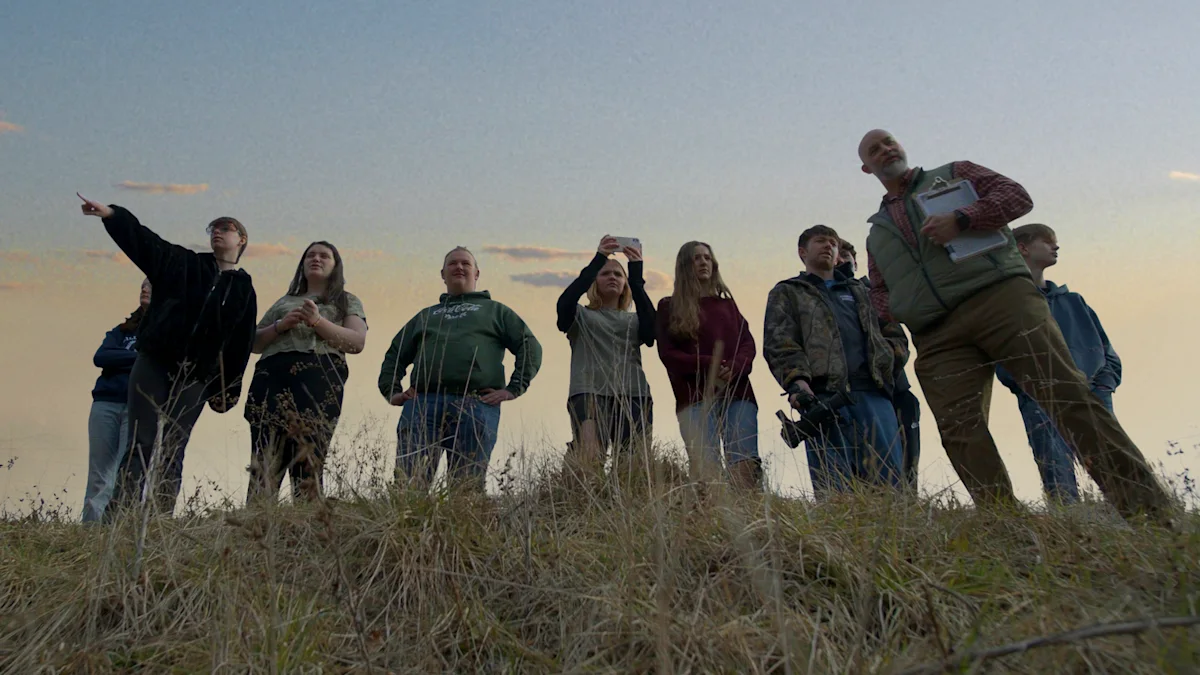
The students also learn that empathy cannot replace evidence. When facts weaken a favored theory, Campbell expects revision. William McDuffie’s reasoning about Tracy Sue Walker shows the process at its most alert. A wasp nest had been found inside her skull.
William works through the timing: the remains must have been exposed long enough for insects to build there, wasps would not have formed the nest during winter, and they would have avoided a skull still containing brain matter. His observation helps separate Walker from the presumed pattern around Johns.
Lee lets the reasoning unfold without manufacturing a prodigy narrative. William is a student making a careful inference, not a teenage Sherlock packaged for streaming. Hannah Metcalf brings a different intensity. She returns to the class, treating records and timelines with patience. Their intelligence is disciplined attention. Television rarely grants teenagers that seriousness unless it plans to turn them into trauma symbols, suspects, or social-media warnings.
Whose Death Becomes News
Campbell repeatedly directs the class toward the language used around the victims. Several women were described first through sex work or addiction, allowing their deaths to be treated as extensions of their circumstances. The distinction between reporting a life and explaining away a murder becomes one of the series’ clearest arguments.
The class’s contact with Linda Schacke gives that argument a human voice. After the students send her a video expressing care for the victims and asking to hear her account, she joins them through a video call and discusses the attack after roughly four decades. Lee keeps the exchange hesitant and painful. The students understand that listening carries responsibility.
Crimson Lashorne, newly settled with guardians, finds a place in the group while classmates describe her as strange. Lacey Campbell applies the class’s methods to the unresolved death of her mother, who fell in 2018. Her attempts to contact investigators expose what happens when a young person inherits unanswered questions from agencies that have stopped explaining themselves.
These student portraits give the series a wider social frame, yet Lee sketches them quickly. Crimson’s home life, Hannah’s determination, and Lacey’s private investigation could each sustain longer treatment. The documentary wants coming-of-age intimacy and cold-case propulsion. Three episodes leave both forms competing for oxygen.
Streaming Finds the Wrong Length
The format problem becomes visible in the second and third episodes. A tighter feature could have concentrated the class’s strongest discoveries and the resistance they meet. A longer season could have followed another school year, giving the students’ lives and the Tennessee Bureau of Investigation’s response room to develop. The chosen length creates stretches where personal material interrupts the case, then disappears before gaining shape.
Agent Brandon Elkins eventually recognizes the value of Campbell’s work and offers official assistance. The shift carries hope, yet it exposes the industry-friendly fantasy hovering near the series: persistent citizens attract a camera, institutions finally listen, and neglected cases regain momentum. Many families never receive that sequence.
Lee is too attentive to claim a clean victory. Records remain missing. Links remain uncertain. The students cannot compel agencies to reopen every file. They can identify gaps, challenge assumptions, speak with a survivor, and reject the old hierarchy that made some women easier to forget.
Streaming platforms often sell true crime as a puzzle with grief attached. Here, the puzzle exists because the grief was administratively misplaced, and a classroom has put it back on the record.
Murder 101 premiered on Prime Video on July 13, 2026, where all three episodes are currently available for streaming globally. The gripping true-crime docuseries follows an unforgettable real-life investigation where a high school sociology class in rural Tennessee sets out to look into the long-unsolved “Redhead Murders” cold case.
Where to Watch Murder 101 Online




Full Credits
- Title: Murder 101
- Distributor: Prime Video
- Release date: July 13, 2026
- Rating: TV-14
- Running time: 61 to 64 minutes per episode (3 episodes total)
- Director: Stacey Lee
- Producers and Executive Producers: Jon Watts, Dianne McGunigle, Stephanie Lydecker, William Crouse
- Cast: Alex Campbell, Austin Lyons, William McDuffie, Andrew Barnett, Bekah, Will Bowers Sr., Will Bowers, Brittney Campbell, Lacey Campbell
- Director of Photography (Cinematographer): Alex Pritz, Faye Tsakas, Jack Weisman
- Editors: Eva Dubovoy, Camilla Hayman
The Review
Murder 101
Murder 101 finds its strongest case inside the classroom rather than the evidence locker. Stacey Lee captures Alex Campbell teaching teenagers to question neglected files, bureaucratic indifference, and the language once used to reduce murdered women to their circumstances. The three-part structure occasionally strains for material, yet the students’ phone calls, revised theories, and meeting with survivor Linda Schacke reveal an educational system capable of producing empathy and civic pressure when one teacher is allowed to reject the worksheet. Streaming television could learn from him.
PROS
- Victim-centred investigation
- Sharp institutional criticism
- Remarkable student participation
- Campbell’s practical teaching methods
- Linda Schacke’s moving testimony
CONS
- Uneven three-episode pacing
- Personal stories feel underdeveloped
- Limited investigative resolution
- Some repetitive stretches







