








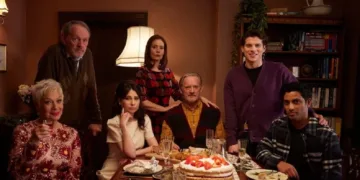




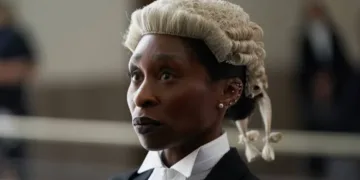












In the cinematic landscape of war stories, the focus is often fixed upon the front lines. The Choral, however, tunes its narrative to a quieter, more domestic frequency. The film places us in a Yorkshire town in 1916, where the Great War is a constant, ambient hum of dread.
Telegrams arrive, young men disappear, and the community of Ramsden is left to grapple with the absences. The story finds its central metaphor in the local choral society, a tradition now threatened by a severe shortage of male voices.
The attempt to stage a performance becomes the town’s small act of persistence, a way to create something structured and beautiful while the world outside is collapsing. A controversial new conductor is brought in to lead this effort, serving as the catalyst for a story about finding solace on the home front.
A Choir of Crossed Fates
The film constructs its narrative as a community portrait, using the choir as a device to assemble a cross-section of Ramsden society. Alan Bennett’s screenplay populates the town with numerous figures whose lives intersect through music, though the character arcs are not all drawn with equal care.
We meet the choir’s patron, the quietly grieving mill owner Alderman Duxbury (Roger Allam), whose personal loss fuels his determination to see the performance through. His motivation is a clear, grounding element in the story.
The film’s youthful energy comes from friends on the cusp of conscription: the cheeky Ellis, who sees the absence of men as a romantic opportunity, and the burdened Lofty, a telegram boy who literally delivers the town’s grief. Their differing perspectives offer a glimpse into the ways young men processed the war’s approach.
The auditions introduce a wider cast, including the earnest Salvation Army singer Mary (Amara Okereke) and Bella (Emily Fairn), a young woman suspended in the uncertainty of waiting for her boyfriend, missing in action. The rehearsal room becomes a temporary equalizer, a space where the town’s rigid class lines blur and the local sex worker (Lyndsey Marshal) can stand beside the church’s faithful. Here, personal anxieties and nascent romances unfold, with the looming threat of war hanging over every musical phrase.
The Unwelcome Maestro
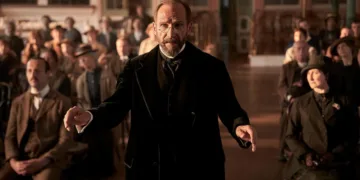
The narrative gains its primary momentum with the arrival of Dr. Henry Guthrie, played by Ralph Fiennes with a familiar, calibrated imperiousness. Guthrie enters the story nearly twenty minutes in, an outsider viewed with deep suspicion by the provincial townspeople. His years spent working in Germany have made him a near pariah in wartime Britain, and his private life is a subject of whispered condemnation, rendering him a potent symbol of unwelcome truths.

Guthrie’s demanding, perfectionist style immediately creates friction within the amateur group, challenging their traditions and their complacency. Fiennes excels in these moments, his performance a study in subtle control; a slight narrowing of the eyes or a clipped command conveys a man driven by his own private sorrows and an unwavering professional conviction. His choice of Edward Elgar’s “The Dream of Gerontius,” a piece about the journey of a soul after death, is a deliberate narrative stroke.
It transforms the choir’s simple project into a profound reflection on mortality. This becomes sharper with the battlefield return of Clyde (Jacob Dudman), a shell-shocked soldier, whom Guthrie astutely casts in the lead role of Gerontius. This decision forces the entire community to channel its collective trauma through their art, making the performance a direct confrontation with their grief.
A Harmony of Flaws
The Choral succeeds admirably in cultivating a sustained tone of melancholy, a mood that feels authentic to its time and place. Director Nicholas Hytner makes an intelligent choice to use only diegetic music; every note is sourced from the choir itself, grounding the film in a stark realism that amplifies the story’s emotional weight.
This approach pays dividends in the final performance, a sequence that feels earned and potent. For all its atmospheric success, the film’s narrative architecture is uneven. The screenplay’s ambition to capture an entire community results in a collection of underdeveloped threads that fray at the edges. The most significant structural weakness is the treatment of its female characters. They are sketched with little interiority, often functioning as passive objects for male grief, desire, or protection.
Mary’s character is defined almost entirely by the men who are smitten with her, while Bella’s emotional state seems to exist only as a precursor to her boyfriend’s return. A scene involving a sexual assault is framed almost entirely around the male character’s response, a baffling choice that highlights a persistent misogynistic blind spot in the writing. The film’s emotional power is authentic, yet it is generated from a script that offers genuine empathy to only half its characters.
The Choral is scheduled to be released in theaters on November 7, 2025. You can check Fandango and Atom Tickets for showtimes in your area. Some limited theatrical releases also become available for purchase or rental on video-on-demand services such as Prime Video and Apple TV.
Full Credits
Director: Nicholas Hytner
Writers: Alan Bennett
Producers: Kevin Loader, Nicholas Hytner, Damian Jones
Cast: Ralph Fiennes, Roger Allam, Mark Addy, Alun Armstrong, Robert Emms, Simon Russell Beale, Lyndsey Marshal
Director of Photography: Mike Eley
Editors: Tariq Anwar
Composer: George Fenton
The Review
The Choral
The Choral succeeds as a handsome and often moving period drama, elevated by Ralph Fiennes's controlled performance and a powerfully melancholic atmosphere. The film's use of music is masterful, creating moments of genuine emotional weight. These strengths cannot fully overcome a flawed screenplay that underwrites its ensemble and treats its female characters as little more than narrative afterthoughts. It is a film of beautiful notes played in a frustratingly unbalanced composition.
PROS
- An effective and sustained melancholic tone that captures the home front experience.
- A strong, subtle central performance from Ralph Fiennes.
- Intelligent use of diegetic music that enhances the film's realism.
- An emotionally resonant climactic performance sequence.
CONS
- A screenplay that treats its female characters with a lack of depth and agency.
- Problematic handling of sensitive subject matter, revealing a misogynistic viewpoint.
- An overstuffed narrative with too many underdeveloped character arcs.