































The telegram arrives without ceremony: “MOTHER DECEASED. BURIAL TOMORROW.” For Meursault, a French shipping clerk in the stifling heat of 1930s Algiers, these words are facts to be processed, not a tragedy to be felt. He performs the duties of a son at the funeral with a placid correctness, observing the proceedings as if he were a spectator at his own life. He does not cry.
The next day, under the brilliant Algerian sun, he goes for a swim. There he meets Marie, a former colleague, and their encounter quickly blossoms into a raw, physical affair. This immediate pivot from a parent’s burial to a lover’s embrace defines the man at the film’s center.
His life continues its placid course, until his entanglement with a thuggish neighbor draws him toward a moment of shocking, senseless violence on a sun-drenched beach, an act that will force a society to pass judgment on a man it cannot comprehend.
Anatomy of an Absence
Meursault’s detachment is not a choice but a condition of his existence. He is a man guided by a stark, unnerving honesty, a state of being that precludes the performance of unfelt emotion. Benjamin Voisin captures this profound emptiness with a quiet, statuesque precision.

His portrayal is one of careful physical containment; the way he holds a cigarette, the rigid line of his posture, and his unblinking gaze all suggest a man who observes the world from a great distance. His handsome features provide a disquieting mask, a surface of youthful vitality that conceals a complete internal void.
The film’s tension arises not from Meursault’s actions but from society’s frantic attempt to interpret his blankness. His failure to perform grief is treated as a confession of monstrosity, a more damning piece of evidence than the murder he commits. The supporting characters exist to refract his strangeness. Marie is drawn to his simplicity, her desire for pure physicality mirroring his own lack of romantic pretense.
Raymond, his neighbor, represents a more conventional masculinity, one that uses emotion and social codes as tools for manipulation and violence. He is the dark inverse of Meursault: where Raymond performs feeling to conceal his corruption, Meursault’s lack of feeling reveals the world’s absurd insistence on performance.
Black-and-White Heat
François Ozon presents this story in a stunning, high-contrast black and white that gives the Algerian sun a metallic, oppressive weight. The cinematography by Manu Dacosse is a study in texture and form. Light does not just illuminate; it bakes, bleaches, and cuts sharp shadows that stripe the screen like prison bars long before Meursault is incarcerated.
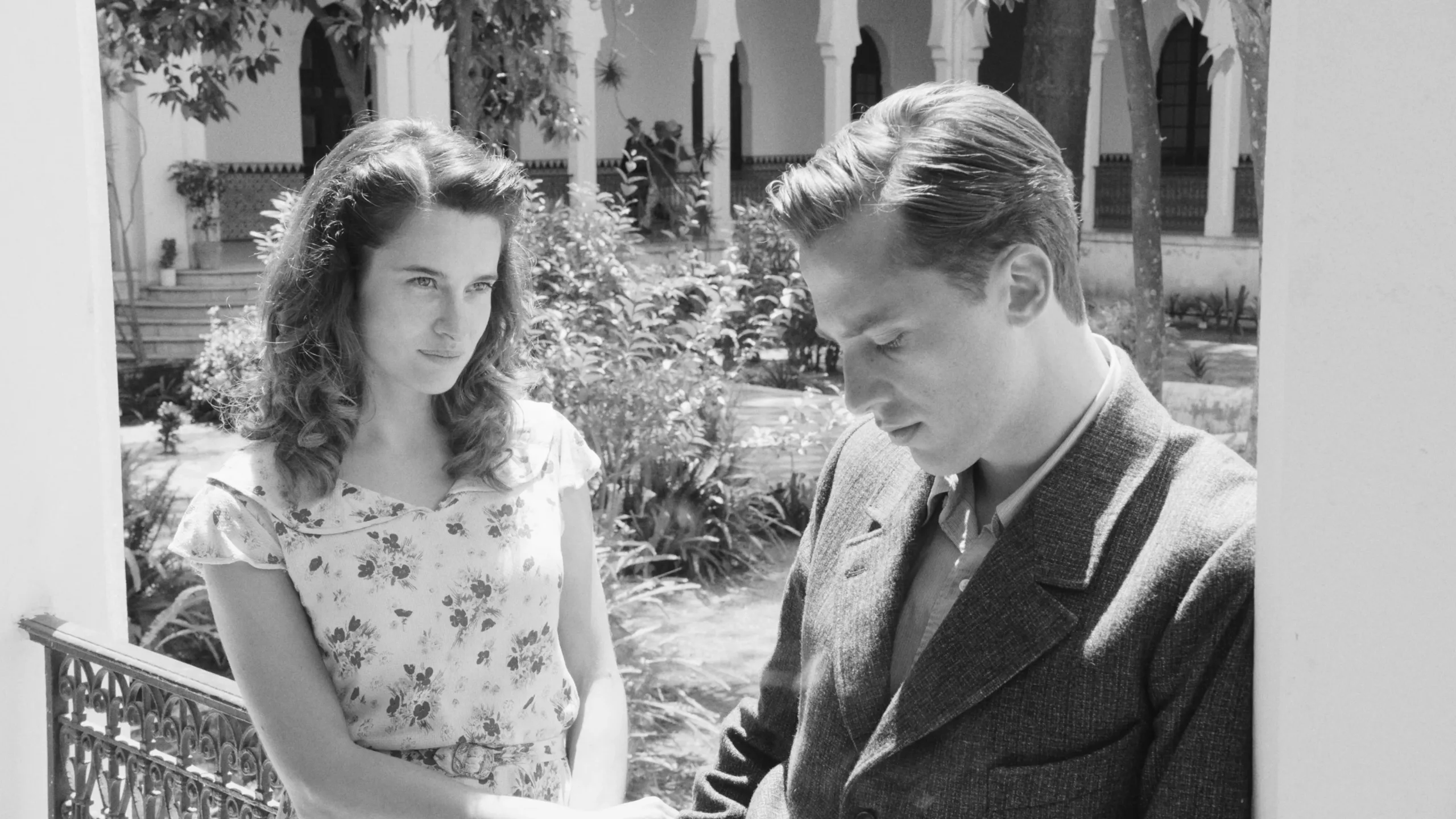
The visual style creates a fascinating paradox: it renders the world with an intense, sensual physicality while mirroring the protagonist’s emotional sterility. The camera finds beauty in the glistening sweat on skin, the cool spray of seawater, and the oppressive stillness of a hot room, giving the audience the tactile sensations that Meursault registers but does not process.
This technique creates a palpable gap between the viewer’s experience and the character’s reality. The meticulous production design recreates a 1930s Algiers that is more than a backdrop; it is a space of implicit tension, its colonial architecture and segregated social spheres reinforcing themes of alienation.
Fatima Al Qadiri’s spare, atmospheric score further deepens this mood, its electronic tones feeling as alien in the sun-scorched setting as Meursault himself. Every element is a testament to Ozon’s precise, controlled direction, which constructs a cohesive atmosphere of beauty and dread.
Camus in a Postcolonial Light
The film is a direct adaptation of Albert Camus’s celebrated novella, L’Étranger, a work long considered a challenge for the screen due to its deep interiority. The novel’s power is rooted in Meursault’s first-person narration, a famously flat prose that Ozon translates into a purely cinematic language of detached observation and stark imagery.

The script is remarkably faithful to its source, lifting passages of dialogue verbatim. It also introduces subtle but meaningful shifts in perspective. The colonial context of French-ruled Algeria is brought into sharper focus. Archival footage and glimpses of anti-colonial graffiti root the story in a specific political reality.
The film gives the Arab characters, anonymous in the novel, a more defined presence, reframing Meursault’s crime as an act with undeniable racial and political dimensions. This adjustment allows the story to be seen through a modern lens, suggesting that personal alienation is inseparable from broader historical forces.
The film powerfully conveys the book’s central theme of absurdity, particularly during the trial. The prosecutor constructs a narrative of a soulless monster based not on evidence but on Meursault’s failure to adhere to social rituals. Ozon films these sequences with a procedural coldness that highlights their profound irrationality, creating a stylistically confident work that honors its source while asking new questions of a canonical text.
The French drama film The Stranger (L’Étranger) was written and directed by François Ozon, based on the novel by Albert Camus. It had its world premiere in the main competition of the 82nd Venice International Film Festival on September 2, 2025. The film is set to be theatrically released in France on October 29, 2025, by Gaumont.
Full Credits
Director: François Ozon
Writers: François Ozon, Albert Camus
Cast: Benjamin Voisin, Rebecca Marder, Pierre Lottin, Swann Arlaud, Denis Lavant
Director of Photography (Cinematographer): Manu Dacosse
Editors: Clément Selitzki
Composer: Fatima Al Qadiri
The Review
The Stranger
François Ozon’s film is a masterclass in control, a visually pristine and intellectually sharp adaptation that succeeds where others have failed. Led by a perfectly calibrated performance from Benjamin Voisin, the film translates the novel's philosophical chill into a potent cinematic language. While its deliberate coldness may prove alienating for some, The Stranger stands as a formidable and thoughtful re-examination of a literary masterpiece.
PROS
- Stunning black-and-white cinematography that creates a powerful, atmospheric world.
- A precise and captivating lead performance from Benjamin Voisin as the detached protagonist.
- Intelligent and faithful adaptation of a philosophically challenging novel.
- Meticulous and stylish direction by François Ozon.
- Subtle reframing of the story to include a modern, postcolonial perspective.
CONS
- The film's emotional coldness can be deliberately alienating.
- Its slow, observational pacing may not appeal to all viewers.
- The dense philosophical themes require viewer concentration.