





























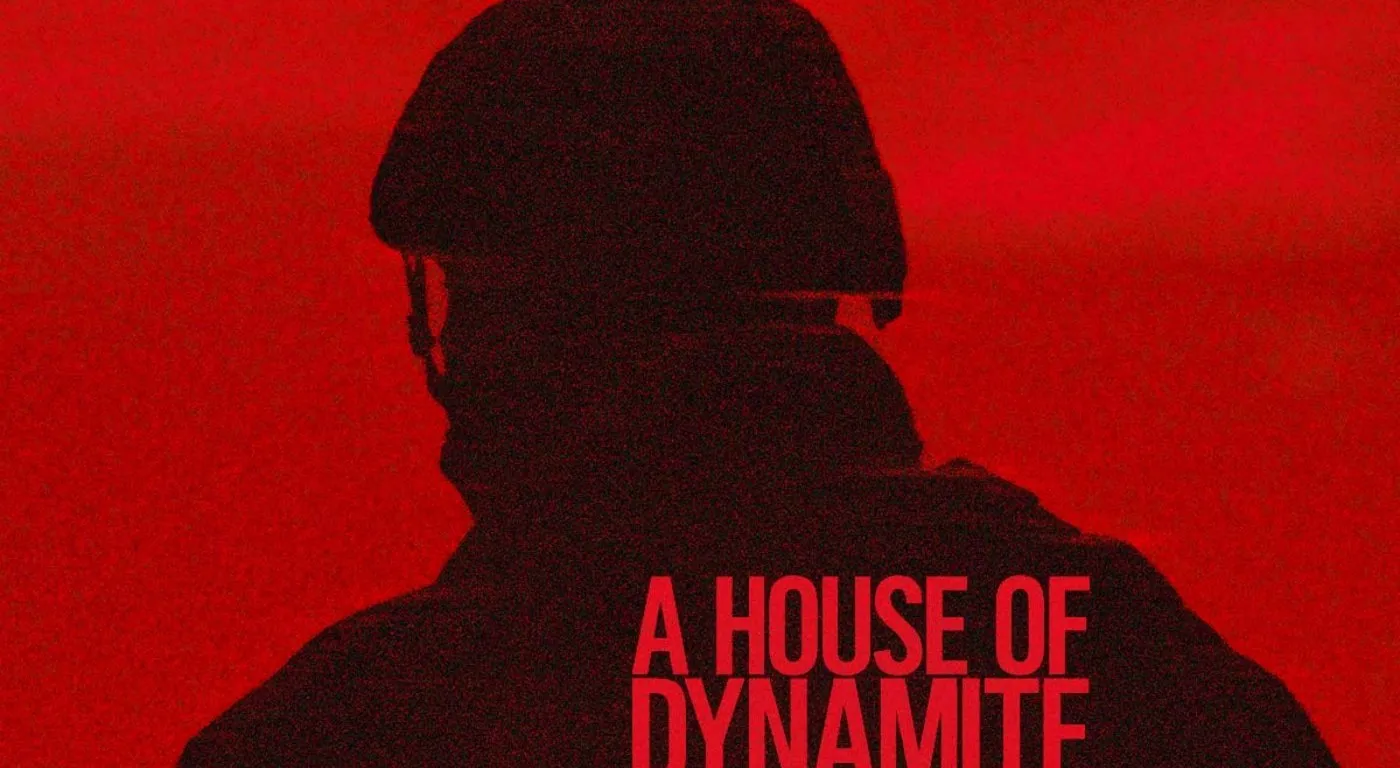

An unidentified missile slices through the upper atmosphere on a direct path to the American Midwest. Impact is in eighteen minutes. This is the stark, brutally simple premise of Kathryn Bigelow’s A House of Dynamite.
The film drops us directly into the crisis, a race against a clock where the stakes are not simply intercepting a weapon, but deciphering an impossible political equation without a key variable: who sent it?
Bigelow has crafted a relentlessly tense procedural for our specific moment in history. It is a chillingly plausible thriller about how our most carefully constructed systems of command and control react when faced with a scenario they were designed for but can never truly be prepared for. The film revives the nuclear doomsday drama for an age of ambiguous, anonymous threats.
Rewind, Repeat, Re-escalate
The film’s most audacious move is its structure. I remember watching Christopher Nolan’s Memento for the first time, feeling the story’s architecture become as important as the plot itself. Noah Oppenheim’s screenplay for A House of Dynamite creates a similar effect, though its purpose is dread instead of mystery.

The narrative is fractured into three parts, each replaying the same eighteen-minute countdown from a different level of the hierarchy. We start on the ground floor, inside the antiseptic White House Situation Room with officers played by Rebecca Ferguson and Jason Clarke. Here, the crisis is a stream of data and acronyms, an abstract problem being managed with professional detachment.
Then, the film rewinds. The second loop places us with mid-level security advisors and military brass at STRATCOM. The abstract threat now has a voice, embodied by the hawkish General Brady (Tracy Letts). The strategic arguments become heated, personal, and terrifyingly real. The final repetition elevates us to the lonely pinnacle of power with Jared Harris’s Secretary of Defense and Idris Elba’s President. This Rashomon-style approach layers information brilliantly.
A garbled voice heard over a speakerphone in the first segment becomes a desperate, fully rendered plea in the third. This repetition builds suspense not through forward momentum, but by deepening the vortex. It mirrors the modern experience of consuming news, catching fragmented reports that only form a coherent, horrifying picture over time. The tension comes from the unbearable weight of the procedure, a cycle of analysis and argument that brings the characters no closer to a solution, only to the inevitable deadline.
Portraits in a Pressure Cooker
The film’s ensemble cast populates this procedural with keenly observed portraits of professionals pushed to their limits. At the top is Idris Elba’s President, a man presented as charismatic and capable, yet totally unprepared for the situation at hand. He is pulled from a school photo-op into a helicopter where he is handed a binder with options for planetary destruction.

There is a terrifyingly resonant scene where he reviews these “retaliation options,” comparing the list of escalating horrors to a diner menu. Elba’s performance captures the profound idea that the most important part of the world’s most powerful job is a task no single human is qualified to perform. Below him, the classic hawk and dove archetypes are given flesh.
Tracy Letts is spectacular as General Brady, the military chief who argues for a preemptive strike with a grim, matter-of-fact weariness. He is not a warmonger, but a man whose entire career has been spent planning for this exact moment, and his logic is chillingly sound within its own destructive framework.
Opposing him is Gabriel Basso’s Jake Baerington, a young advisor whose frantic energy represents the human instinct for survival fighting against institutional momentum. Elsewhere, the film finds its heart in the smaller moments. Jared Harris, as the Defense Secretary whose estranged daughter is in Chicago, grounds the global threat in a devastatingly personal reality.
His quiet, hollowed-out expression as he listens to the strategic debates is more powerful than any shouting match. Rebecca Ferguson’s Captain Walker serves as our entry point, the consummate professional whose calm exterior slowly cracks as the minutes tick away, her journey mirroring our own mounting panic.
The Bigelow Method: Authenticity as Auteurship
Kathryn Bigelow directs with the same meticulous, researched precision that defined The Hurt Locker and Zero Dark Thirty. She generates an almost unbearable amount of tension from people in rooms, talking on phones and staring at monitors. This is her signature: finding the human drama and suspense inside complex, jargon-filled processes.

I’m reminded of the strange quiet in my house during an emergency alert system test on TV; the unnerving sound and stark text created more anxiety than any fictional explosion. Bigelow understands this power of the procedural. Her regular cinematographer, Barry Ackroyd, shoots the film with a documentary-like immediacy.
The roaming, handheld camera and abrupt zooms make us feel like another frantic aide in the room, straining to see a monitor or catch a whispered conversation. The camera’s constant movement reflects the chaotic search for clarity. This visual style is supported by Jeremy Hindle’s convincing production design, which finds the realism in the clutter of a lived-in command center, not a sleek Hollywood set.
The sound design is a chaotic symphony of alarms, overlapping dialogue, and the brittle static of failing communication lines. The oppressive score by Volker Bertelmann avoids manipulative swells, instead providing a persistent, unnerving hum that underscores the gnawing tension.
Living in the House We Built
The film’s title comes from a metaphor about our relationship with nuclear arms: humanity has built a house, filled it with dynamite, and learned to live there. Bigelow’s film is a wake-up call, a stark reminder of the precarity of that arrangement.

By deliberately leaving the missile’s origin a mystery, the story reflects a very contemporary anxiety. The enemy is no longer a specific nation-state but an anonymous threat, making the old logic of mutually assured destruction obsolete. The true antagonist is the system itself, a machine designed for a war that can no longer be understood or controlled.
This leads to the film’s final, and perhaps most challenging, choice. It ends in silence, cutting away before we see the missile’s impact. Mainstream filmmaking conventions demand a resolution, a catharsis. A House of Dynamite denies us this. Unlike Cold War-era films such as Fail Safe or Dr. Strangelove, which offered definitive, if bleak, conclusions, Bigelow’s work refuses to become a historical document or a piece of speculative fiction.
The lack of an ending transfers the responsibility to the viewer. The film is not about the aftermath of the explosion. It is a warning about the eighteen minutes that precede it, suggesting that once the clock has started, the failure has already happened. It leaves its audience with the terrible, hanging question of what we would do.
A House of Dynamite, directed by Kathryn Bigelow, premiered at the 82nd Venice International Film Festival on September 2, 2025. It is set for a limited theatrical release in the UK on October 3, followed by a worldwide release on October 10. The film will later be available to stream globally on Netflix starting October 24, 2025.
Full Credits
Director: Kathryn Bigelow
Writers: Noah Oppenheim, Kathryn Bigelow, Jeremy Hindle, Sumaiya Kaveh, Richard Keeshan, Greg Shapiro
Producers and Executive Producers: Kathryn Bigelow, Noah Oppenheim, Greg Shapiro, Jeremy Hindle, Sumaiya Kaveh, Brian Bell, Sarah Perlman Bremner
Cast: Idris Elba, Rebecca Ferguson, Gabriel Basso, Jared Harris, Tracy Letts, Anthony Ramos, Moses Ingram, Jonah Hauer-King, Greta Lee, Jason Clarke, Malachi Beasley, Brian Tee, Brittany O’Grady, Gbenga Akinnagbe, Willa Fitzgerald, Renée Elise Goldsberry, Kyle Allen, Kaitlyn Dever
Director of Photography (Cinematographer): Barry Ackroyd
Editors: Kirk Baxter
Composer: Volker Bertelmann
The Review
A House of Dynamite
A House of Dynamite is a masterful procedural from director Kathryn Bigelow. Its innovative, repeating narrative structure creates an almost unbearable tension, focusing on the horrifying process of decision making rather than a simple climax. Supported by strong performances and a documentary like realism, the film is a chillingly relevant warning for our times. The unresolved ending is a bold, unforgettable choice that makes this a vital piece of filmmaking.
PROS
- Kathryn Bigelow’s meticulous, tension filled direction.
- The innovative and effective non linear narrative structure.
- Superb performances from the entire ensemble cast.
- An overwhelming sense of authenticity in its cinematography and sound design.
- A thought provoking and timely exploration of modern anxieties.
CONS
- The repetitive structure may be frustrating for viewers seeking a conventional plot.
- Its intense, anxiety inducing tone makes it a demanding watch.
- The deep focus on procedure means some characters are not fully developed.