















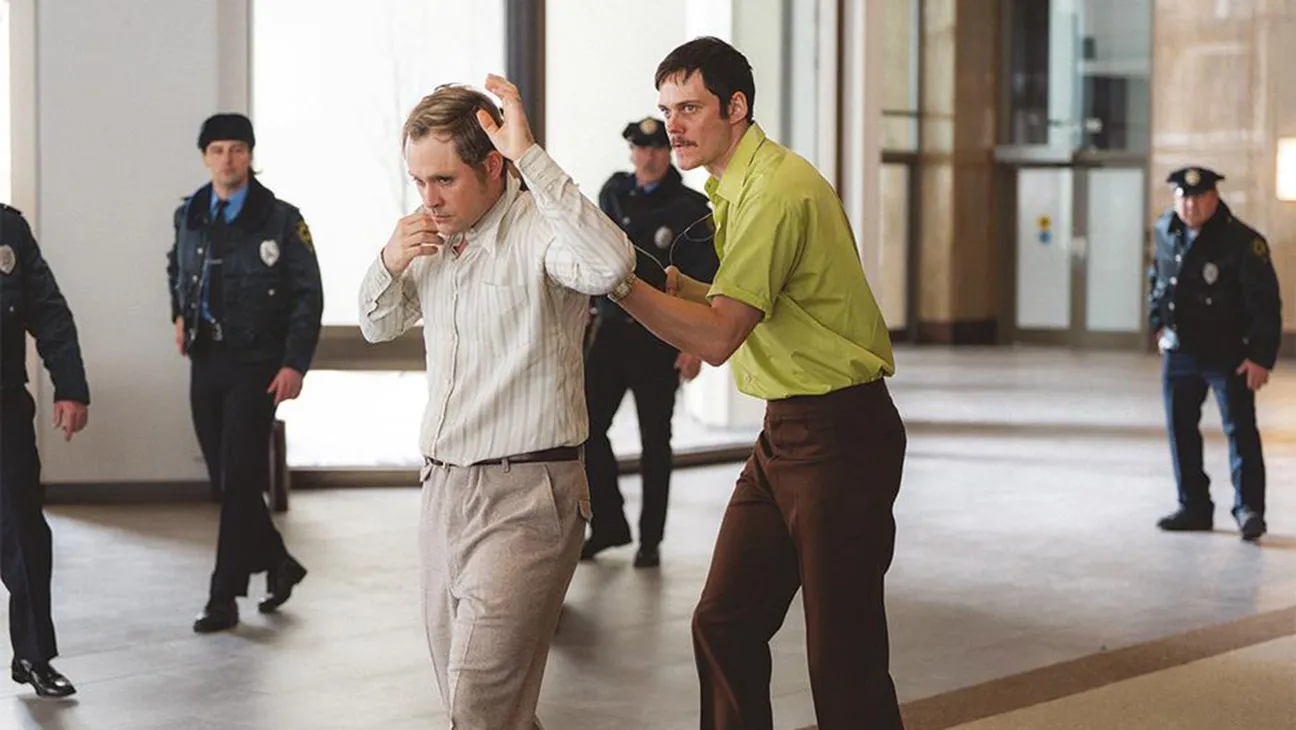

The air in Dead Man’s Wire is cold from the very first frame. We are in Indianapolis, 1977, and a man named Tony Kiritsis walks into the Meridian Mortgage Company with a simmering frustration that feels ready to boil over. Director Gus Van Sant wastes no time establishing the stakes.
The film’s central image is a shocking piece of homemade engineering: a sawed-off shotgun connected by a wire from its trigger to the neck of its hostage, Richard Hall. This is the titular device, a mechanism ensuring that any sudden move or police intervention will have immediate, fatal results.
This true-crime story quickly establishes its foundation as a portrait of an ordinary man pushed to an extraordinary, violent extreme. Kiritsis believes the company has systematically destroyed his future by sabotaging a land deal. The narrative is immediately set, exploring the razor-thin line between righteous anger and a dangerous obsession that is about to become a public spectacle.
The Revolution Will Be Televised
At its center, Dead Man’s Wire is about a man declaring war on a system he feels has left him for dead. Kiritsis’s grievance is specific: he claims that Meridian Mortgage, run by Richard’s father M.L. Hall, intentionally prevented him from developing a shopping center on land he owned so the company could seize the valuable property for itself.
The film frames his subsequent hostage-taking less as a simple crime and more as a final, desperate act of protest. Unlike most criminals who seek anonymity, Kiritsis craves an audience. He notifies the police himself and marches his hostage through downtown Indianapolis, creating a bizarre parade that invites public attention.
This is where the narrative’s pacing truly excels, showing how a private dispute rapidly metastasizes into a city-wide media event. The police force, including an incredulous local cop played by Cary Elwes, struggles to manage a situation for which there is no playbook. The media descends, represented by ambitious TV reporter Linda Page, who recognizes the chaos as her one shot at a career-making story. The entire city, and soon the nation, becomes a captivated audience.
The film’s exploration of economic frustration feels shockingly current. Through radio call-in shows, we hear citizens voice their support for Kiritsis, transforming him into a temporary folk hero. He becomes a symbol for countless others who feel crushed and ignored by powerful institutions. His story, rooted in 1977, reflects contemporary anxieties about corporate greed and the perceived powerlessness of the individual, showing how one man’s fury can resonate with a generation.
A Cast on the Brink
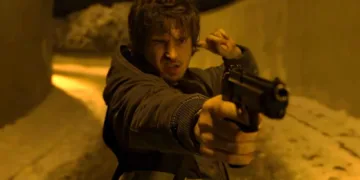
The film is anchored by Bill Skarsgård’s incendiary performance as Tony Kiritsis. He portrays the man not as a one-dimensional villain but as a complex antihero, whose wiry intensity makes him completely unpredictable. Skarsgård perfectly captures Kiritsis’s self-perception as a “goddamn national hero,” a man who genuinely believes his actions are justified.
He is at once frightening and strangely sympathetic, a cornered animal lashing out. The performance is layered with a dark humor born from misplaced confidence; he is a man who can point a shotgun at someone’s head while simultaneously apologizing for his coarse language. Skarsgård masterfully plays a foolish man who believes himself to be intelligent, organized, and in control of his destiny.
His explosive energy finds its necessary counterpoint in Dacre Montgomery’s subdued work as the hostage, Richard Hall. His is a quiet, intelligent performance of a man constantly calculating his odds of survival while dealing with a volatile captor and a coldly indifferent father. Montgomery conveys the immense exhaustion of the ordeal without ever feeling passive.
The supporting ensemble elevates the material further. Colman Domingo is effortlessly charismatic as Fred Temple, the smooth-talking jazz radio DJ Kiritsis idolizes. He becomes an unlikely intermediary, bringing a cool, rational authority to the escalating chaos.
And in a brief but unforgettable cameo, Al Pacino appears as M.L. Hall, the stubborn patriarch and the story’s true antagonist. From his Florida retreat, he refuses to give Kiritsis the apology he demands, showing a callous disregard for his own son’s life. His presence is a direct and clever nod to Dog Day Afternoon, positioning this film as a spiritual successor to the great anti-establishment thrillers of that era.
The Texture of Discontent
Gus Van Sant’s direction confidently channels the spirit of 1970s crime thrillers, giving the film a lean, efficient narrative drive reminiscent of Sidney Lumet’s work. Van Sant has long shown an interest in outsiders and marginalized figures, and Tony Kiritsis fits perfectly within his cinematic universe of characters pushed to the fringe.
The film’s tone is a delicate balancing act, mixing the high-stakes tension of the hostage crisis with a sharp, black-comic sensibility that finds humor in the absurdity of the situation. This vision is realized through a distinct visual language. The kinetic, handheld camerawork creates a sense of vérité, making the viewer feel like another bystander caught in the chaos.
This feeling of authenticity is enhanced by Van Sant’s choice to switch between slick color film and grainy footage that mimics archival newsreels. This technique deliberately blurs the line between dramatization and historical document, giving the events a visceral, immediate impact. The production design meticulously recreates the 1970s aesthetic, felt most acutely in the claustrophobic interior of Kiritsis’s apartment.
Its sickly color palette of browns, greens, and oranges serves as a physical manifestation of his troubled mind and decaying American dream. The space becomes a character itself, a pressure cooker for the drama. Small details, like the sweat stains that appear on Hall’s shirt as the hours drag on, effectively mark the passage of time and heighten the sense of oppressive realism.
The Rhythm of Revolt
The music in Dead Man’s Wire functions as another character, shaping the mood and providing constant commentary. The soundtrack’s curated “needle drops” are essential for establishing the time and place, acting as active storytelling devices.
Deodato’s bombastic jazz-funk version of “Also Sprach Zar Zarathustra (2001)” gives the opening a sense of chaotic grandeur, perfectly setting the stage for the bizarre events to follow. Roberta Flack’s protest song “Compared To What” directly underscores the story’s social themes of inequality and injustice.
In one of the film’s most potent musical cues, the use of B.J. Thomas’s “Raindrops Keep Falling on My Head” ironically links Kiritsis to the romanticized outlaws of Butch Cassidy and the Sundance Kid, complicating his status as a hero.
Working alongside these iconic tracks is Danny Elfman’s score. His compositions accentuate the bizarre, almost surreal nature of the standoff, capturing the strange, circus-like atmosphere of the unfolding media event. The music amplifies the story’s weirdness without sacrificing the genuine life-or-death volatility of Kiritsis’s desperate act.
The film’s final, powerful statement comes from Gil Scott-Heron’s anthem “The Revolution Will Not Be Televised” over the end credits. It’s a choice that feels both fitting and deeply ironic, leaving the audience to ponder the nature of protest and the strange, televised revolution they just witnessed.
The historical crime film Dead Man’s Wire, directed by Gus Van Sant, is based on a real-life hostage incident from 1977. It premiered at the 82nd Venice International Film Festival on September 2, 2025, and is also scheduled for the Toronto International Film Festival on September 7, 2025.
Full Credits
Director: Gus Van Sant
Writers: Austin Kolodney
Cast: Bill Skarsgård, Dacre Montgomery, Colman Domingo, Al Pacino, Cary Elwes, Myha’la
Director of Photography (Cinematographer): Arnaud Potier
Editors: Saar Klein
Composer: Danny Elfman
The Review
Dead Man’s Wire
Gus Van Sant directs Dead Man's Wire with a gritty, confident energy that channels the best of '70s thrillers. Anchored by an incendiary and brilliantly complex performance from Bill Skarsgård, the film is a taut, unsettling, and darkly funny examination of a man pushed to the brink. It transforms a bizarre true-crime story into a startlingly relevant portrait of economic desperation. While its unvarnished look at a dangerous antihero may be unsettling, it is a compelling and masterfully crafted piece of filmmaking that resonates long after the credits roll.
PROS
- A powerful and nuanced lead performance from Bill Skarsgård.
- Confident direction from Gus Van Sant that perfectly evokes classic ‘70s thrillers.
- Timely and resonant themes of economic frustration and individual protest.
- A strong supporting cast, particularly Colman Domingo.
- Effective use of music and production design to create an authentic atmosphere.
- A compelling blend of high-stakes tension and dark humor.
CONS
- The sympathetic portrayal of a dangerous and unstable protagonist may be alienating for some viewers.
- Its tight focus on the central standoff might feel repetitive to those expecting a more conventional crime film.