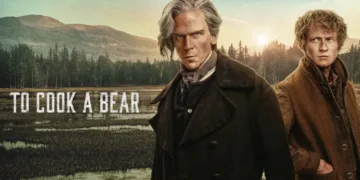

























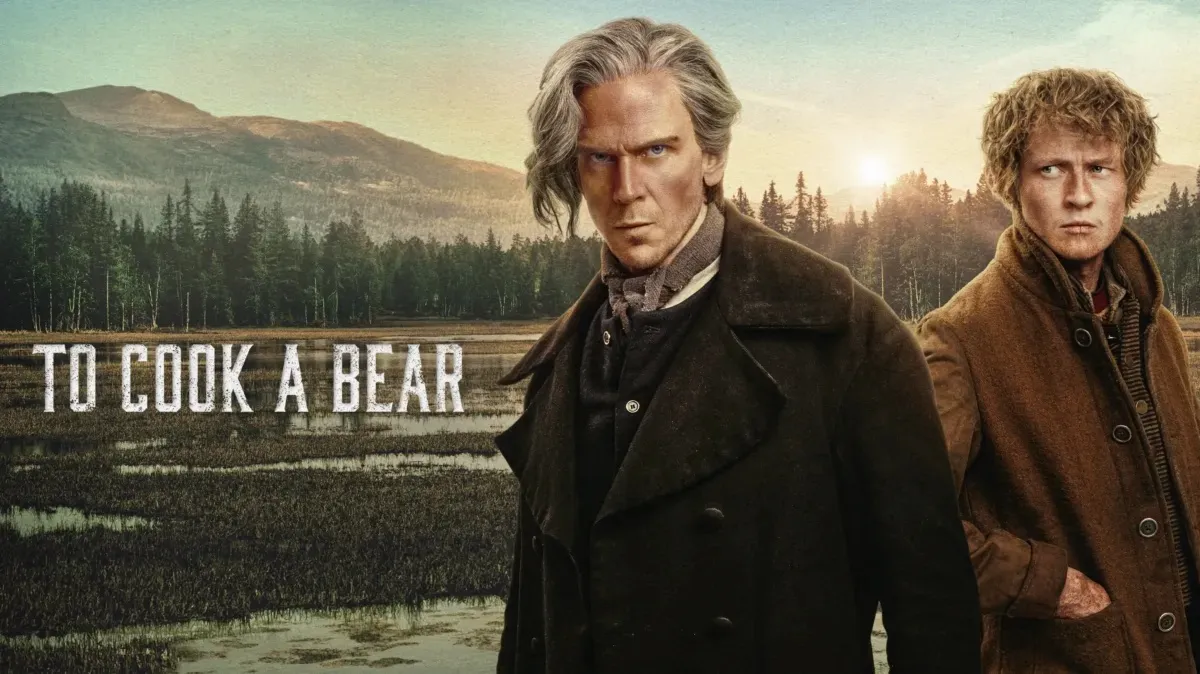

To Cook a Bear arrives as a six-part drama from Mikael Niemi’s novel, a work shaped where historical epic, murder mystery, and the chill of Nordic Noir meet. The story unfolds in the winter of 1852, within the cloistered and devout Swedish village of Kengis. Custom hardens into superstition, and the labor of staying alive breeds social cruelty. The Pastor, played by Gustaf Skarsgård, enters with a fierce devotion to justice and a need to expose the rituals that protect power.
He comes with his adopted Sámi son, Jussi, played by Emil Karlsen, who stands as a visible outsider in a stratified place. Their arrival unsettles the order guarded by the mill owner Madam Sjöhdahl, played by Pernilla August, and Sheriff Brahe, played by Magnus Krepper. Disappearances fracture the village, beginning with the brutal death of a young girl. While the local authorities fasten on a mythical bear, the Pastor and Jussi begin a quiet inquiry that pursues a human hand. The mystery becomes an inquiry into the moral and spiritual rot that stains Kengis.
The Fable of Justice and The Savage Heart
To Cook a Bear builds a structure that doubles as an arena for ideas, where the detective form carries the weight of an epic Western. The Pastor acts as an almost scientific investigator, a believer who relies on logic with a steadiness that recalls Sherlock Holmes.
This pursuit of truth faces a community that clings to dark myth, where an invented beast provides relief from a human crime. The central argument studies the hard road of justice and the lure of quick blame. The 1852 setting feels present in its attention to ethnic prejudice against the Sámi and to the refusal of social change, which turns history into a study of human habit.
Figures who protect corruption read as emblems within a moral fable, which limits full emotional reach. The scale of the project strains the rhythm. The middle episodes lose push and shape, and the final chapter compresses intensity into a short span that follows the earlier slackness.
The Performance of Contradiction
The performances anchor tension through a steady wrestling with ethics. Gustaf Skarsgård’s Pastor offers a vivid study of contradiction. He speaks like a reformer and challenges hierarchy with heat and care for reason. He also carries a devotion that narrows his view, and family peace yields to the urgency of his cause.
Also Read







Skarsgård shifts between the blaze of public speech and a private softness that admits doubt. Emil Karlsen’s Jussi provides an answering center. He gives the adopted Sámi boy a reserved and steady sorrow. Jussi moves under the Pastor’s expectations while meeting a village that works to strip his dignity. Karlsen shapes a mix of youth, a wish for ordinary tenderness, and an anger that simmers under constant insult.
This conflict supplies the emotional ballast to the Pastor’s intellectual drive. Pernilla August’s Madam Sjöhdahl and Magnus Krepper’s Sheriff Brahe protect their rule through scapegoating of the Sámi and hold fast to the social order. Simon J Berger’s Beronius adds a steady unease as a creepy artist whose presence roughens the air.
A Geography of Unsettling Grandeur
Director Trygve Allister Diesen guides the six episodes with control and a sense for scale that holds close to faces and reaches out to the world around them. The anamorphic frame gives the land a severe grace while allowing fine detail in the smallest gesture. The northern terrain acts with the cast. Daylight carries the “sunlight the color of burnt corn,” and night settles with an “inky violence” that presses on the eye.

The soundscape builds pressure through the breath and knock of the steel mill, which turns labor into a constant percussion that marks the weight of living here. The opening sequence carries the voice of Faroese singer Eivør; “Trøllabundin” lays out an ethereal unease that sets the tone.
Production design brings careful detail, with costuming that speaks through silhouette and fabric. The Pastor’s heavy wool coat cuts a commanding line against the mud-streaked workers, and this image states the gap that rules Kengis. The vision reaches for epic scope, rooted in the region, and frames human darkness with a clarity that feels vast and near at once.
To Cook a Bear is a six-part Nordic Original crime and historical drama series that premiered on Disney+ on October 15, 2025. Set in 1852 in the isolated village of Kengis, Northern Sweden, the series is an adaptation of the best-selling novel by Mikael Niemi. It centers on the newly appointed, radical Pastor (Gustaf Skarsgård) and his young Sámi protégé, Jussi (Emil Kárlsen), who start their own investigation after a series of disappearances and murders are incorrectly attributed to a rampaging killer bear, forcing them to confront the dark secrets and social rifts within the fragile community.
Full Credits
Director: Trygve Allister Diesen
Writers: Jesper Harrie
Producers and Executive Producers: Mia Welin, Miira Paasilinna, Martin Persson, Nanna Mailand-Mercado
Cast: Gustaf Skarsgård, Emil Kárlsen, Pernilla August, Simon J. Berger, Magnus Krepper, Ane Dahl Torp, Tyra Wingren, Jaakko Ohtonen, Jonas Karlsson, Johan Widerberg, Tobias Zilliacus, Sigrid Johnson, Sampo Sarkola, Dick Idman, Jonna Järnefelt, Eleonoora Kauhanen
Director of Photography (Cinematographer): Aril Wretblad
Editors: Sofia Lindgren, Tomas Beige
The Review
To Cook a Bear
This is a haunting series, offering a compelling vision of moral conflict set against a savage northern expanse. Its grand ambition in blending historical epic with existential crime is largely realized through powerful visual direction and complex lead performances. While the narrative's grip loosens in the middle act, leading to a structural unevenness, the core inquiry into human darkness and the relentless fight for truth against ingrained societal prejudice remains profoundly resonant. It is a difficult, rewarding watch, a potent reflection on how little humanity has truly evolved from its darkest superstitions.
PROS
- Strong exploration of justice vs. vengeance, rationality vs. myth.
- Complex, layered portrayal of a zealous but flawed Pastor.
- Majestic northern setting used effectively as a "character" in the drama.
- Detailed costuming, production design, and a powerful, distinctive soundscape.
- Successfully merges Nordic Noir, Western, and historical mystery.
CONS
- The middle episodes slow the narrative momentum significantly.
- The density of the climax feels rushed after the mid-series drag.
- Some characters feel more like ciphers or emblematic figures than fully realized individuals.