





























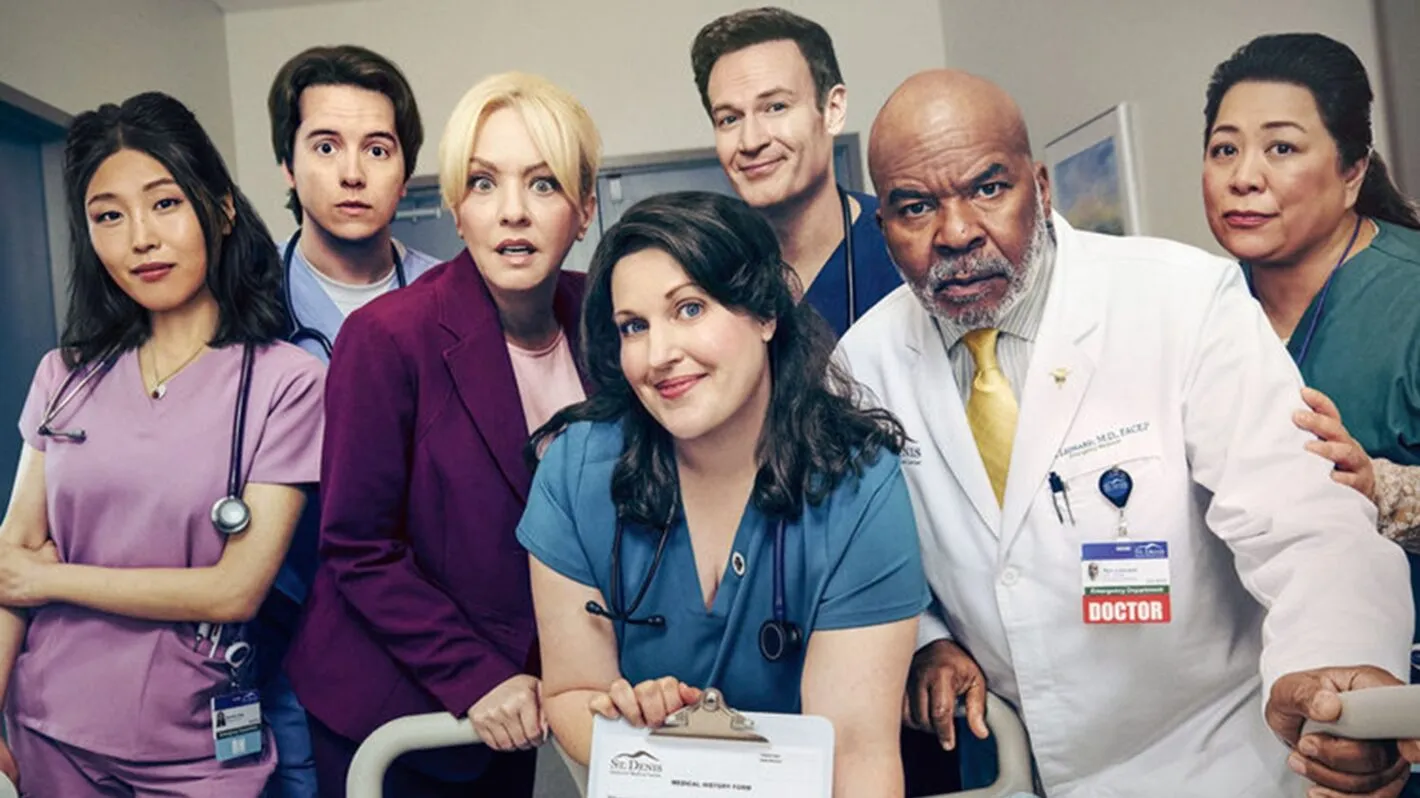

St. Denis Medical opens its second season with a firmer grip on its workplace mockumentary identity, set inside an under-resourced Oregon hospital that never stops buzzing. Co-creators Justin Spitzer and Eric Ledgin lock in a tone that marries frantic energy with a steady, warm wit.
Spitzer’s history with Superstore and American Auto is visible in the clean scaffolding of the episodes. Where season one found momentum late, season two starts from a position of control. The creative team centers humor in the ensemble’s defined personalities and relationships, a storytelling emphasis that sharpens the show from the first minutes.
Character Arcs and The Cast Dynamic
The clearest step forward lies in how the writers deploy the principal cast. Stories now spring from character interplay, which gives scenes speed and clarity.
Wendi McLendon-Covey’s Joyce remains a portrait of executive ambition gone sideways. The performance channels restless energy while maintaining sincerity, even when Joyce backs a themed birthing center with “Old Hollywood” suites instead of addressing staff needs. That fixation doubles as a structural critique of hospital administration, and the character stays human through the misfires.
Supervising nurse Alex (Allison Tolman) functions as the audience’s compass. She returns from a restorative Hawaiian vacation trying to protect a “Chill Alex” mindset, a premise that quickly buckles under day-to-day emergencies. The gradual slip in her calm fuels reliable comedy. She also starts voicing her needs, a measured shift that moves her from passive observer to active participant.
The bench is sharper. Josh Lawson’s Bruce, an ego-first trauma surgeon, brings the broadest bits: a new compass tattoo no one notices, a goose collision that sends him into melodrama. The insecurity driving him powers each gag. David Alan Grier’s Ron counters with dry cynicism that steadies scenes. A near father-daughter rapport with Serena emerges, highlighted by their competitive strength debate. Around them, Nurse Val (Kaliko Kauahi) and Nurse Keith (Dave Theune) contribute in quick beats that keep the floor’s rhythm intact.
Writing choices lean on ensemble chemistry. Standalone jokes give way to friction born from personality. Bruce’s bluster rubs against Alex’s warmth. Serena’s acerbic edge meets Matt’s open-eyed optimism. The balance holds.
Subplots and the Rhythm of Character Foibles
Season two builds its emotional spine from small subplots that breathe without swallowing the main story.

The Matt (Mekki Leeper) and Serena (Kahyun Kim) slow burn anchors the personal stakes. The room keeps moving while their will-they-won’t-they thread shades Matt beyond the bumbling surface. It begins with both asking for schedules in different zones after his crush surfaces. Later, Matt announces he is “over her,” thinking that’s what Serena wants. Her quiet disappointment sells the mutual feeling and promises a patient rollout. Kahyun Kim finds fresh notes here, trading simple disdain for something more wounded.
Episodic laughs land because they sit on mapped-out flaws. Alex keeps offering Hawaiian-themed advice that misses the mark; Val’s dry, accurate corrections work because Val is from Kauai. Bruce spirals after a so-called car park “attack,” only to reveal a single goose as the culprit, a payoff built on his need for grand self-pity. A cold open with Matt accidentally wrecking a gender reveal does double duty: the hospital’s crisis management remains shaky, and Matt’s chaos magnet status holds.
Stylistic Confidence and Thematic Context
Comedy feels tighter in year two. Jokes grow from relationships and internal conflict instead of a constant stream of setups. When a physical gag arrives, like Ron injuring his back while trying to scare Serena, it hits because the character context does the heavy lifting.

St. Denis Medical draws on mockumentary language popularized by shows like The Office. The series embraces a familiar frame and does not chase reinvention. Fourth-wall glances do clear work here, especially from Alex and Joyce. Those withering looks give instant punctuation and an easy audience foothold. Within busy workplace TV, the show carves out a tender corner.
The hospital backdrop keeps a line of social critique running. Character humor leads, yet the broken health-care system and lean resources remain visible. Joyce funds themed birthing suites while basic security cameras languish, a clean illustration of misaligned priorities and the gap between administrative vision and staff reality. The setting sustains conflict, from everyday friction to the hinted violence faced by healthcare workers in Bruce’s scare, and it gives the writers a stable platform for wider thematic threads should the series keep expanding.
St. Denis Medical is a mockumentary-style workplace comedy series that centers on the dedicated, if often chaotic, staff of an underfunded and understaffed hospital in Oregon. The series was co-created by Justin Spitzer, known for his success in the genre with Superstore. Season 2 premiered on Monday, November 3, 2025, with back-to-back episodes. The show airs on NBC and new episodes are available to stream the following day, Tuesdays, on the platform Peacock. It blends sharp humor with the relatable stress of the healthcare profession.
Credits
Title: St. Denis Medical Season 2
Distributor: NBC, Peacock
Release date: November 3, 2025
Rating: TV-14
Running time: Approximately 22 minutes (per episode)
Director: Ruben Fleischer
Writers: Eric Ledgin, Justin Spitzer, James Renfroe, Christian Kinnard, Elizabeth Praino, Missy Hernandez
Producers and Executive Producers: Justin Spitzer, Eric Ledgin, Simon Heuer, Ruben Fleischer, Bridget Kyle, Vicky Luu
Cast: Wendi McLendon-Covey, Allison Tolman, David Alan Grier, Josh Lawson, Mekki Leeper, Kahyun Kim, Kaliko Kauahi, Frankie Quiñones, Ariana Madix, Kristen Schaal, Lauren Weedman, Lauren Lapkus, Tim Baltz, Jonah Beckett, Jeremiah Brown
The Review
St. Denis Medical Season 2
St. Denis Medical returns with heightened confidence, benefiting immensely from its settled ensemble and sharper writing. The season successfully leans into the personal dynamics and familiar workplace chaos, using the hospital backdrop for character-driven humor rather than heavy social commentary. This evolution results in a show that is consistently funnier and structurally sounder than its initial outings. The cast synergy is excellent, making the small subplots, like the Matt and Serena tension, feel genuinely earned and engaging. This season is a strong step forward for the series.
PROS
- The cast synergy is greatly improved, allowing relational dynamics to drive the comedy.
- Gags and situations land with greater impact because they emerge directly from established character foibles.
- The slow-burn development of the Matt/Serena subplot and the introduction of the Ron/Serena dynamic are engaging.
- The Season 2 structure is tighter and more consistently funny than the show's initial episodes.
- Fourth-wall breaks are used precisely to enhance comedic reactions.
CONS
- The series willingly relies on established workplace comedy tropes and doesn't aim to break new ground structurally.
- The show is currently light on deep social commentary, preferring humor over tackling the heavier issues presented by the healthcare setting.