
























![Kingdom Hearts Collection [I-III] Review](https://gazettely.com/wp-content/uploads/2026/10/Kingdom-Hearts-Collection-I-III-1-360x180.webp "Kingdom Hearts Collection [I-III] Review: KHII Holds Steady as Newer Entries Fluctuate 37")





Júlia De Paz’s second feature, The Good Daughter, opens a stark window onto a family trying to live through a shattered aftermath. Adapted from her short film Harta, the story follows Carmela, a teenager played with striking complexity by Kiara Arancibia Pinto. Her parents’ separation is shaped by the state as much as by grief: a judicial restraining order is placed against the father, Julián Villagran, for domestic violence, and contact is reduced to supervised visits.
Carmela worships him anyway, drawn to an artist whose charisma feels limitless and whose capacity for harm proves just as vast. De Paz sets the film inside that chasm, where adolescent love swells in the shadow of authenticated abuse. The child’s gaze becomes the place where conflict is inherited and re-lived, one visit at a time.
The Vicarious Bruise
De Paz sidesteps the expected trauma portrait of the primary victim and turns her attention to the quieter psychological violence that lands on the child after the main target is gone. The film calls it vicarious violence, a subtle weapon wielded by a successful, celebrated father.
His manipulation is refined. Money, charm, and public esteem form a net of devotion around Carmela, until loyalty feels like the only way to breathe. Their bond is deeply intimate and plainly toxic. She shows eagerness and anxiety in the same moment, always reaching for his approval.
A disturbing scene crystallizes this dependence. Carmela asks him to shave her head so her hair matches his short cut. He agrees, savoring the visible sign of allegiance and the predictable pain it will cause her mother. Allegiance matters to him above tenderness.
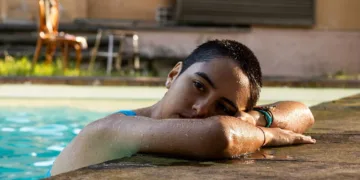
The dynamic can turn from warmth to discipline in a heartbeat. When Carmela resists his will, he answers with a chill withdrawal and then with calculated physical force, hinted at during a play-fight in a swimming pool. That flicker of aggression is enough. The fear that follows in Carmela’s body and face signals danger with a clearer force than any overt explosion.
The Language of Silence
De Paz directs with sharp sensitivity and a calm assurance that refuses melodrama. She draws layered work from her young cast. Sandra Roca’s cinematography offers a visual counterpart to this emotional pressure. Close-ups isolate Carmela’s face, a surface where loyalties wrestle in small tremors. Wider shots often leave her disconnected, alone even among friends. The camera acts like a tuning device, catching stress as it builds in quiet increments.

Arancibia Pinto carries the film with an intuitive, inward performance. She communicates what cannot be said through her eyes and the precise economy of her movement. De Paz trusts silence. At moments of greatest strain, Carmela retreats into herself, letting her gaze hold the weight.
Late in the film she gives a friend a small, solemn hint of home life, saying that her parents argued and that the fights went further. The line lands like a confession, a brief easing of a heavy existential burden.
The Inevitable Rift
The film’s central theme is the psychic burden placed on a child who must reconcile an abuser with an idealized father figure. Carmela’s mother, Marta, is filtered through her daughter’s anger and devotion, often seen as an irritant whose warnings are waved away under paternal charisma.

De Paz charts the necessary separation between father and daughter, with divorce serving as the ground beneath their slow undoing. The drama asks a painful question about development: when does the illusion shatter, and how does the self recover after being burned by a cherished figure?
The thematic design holds firm, yet the narrative pace can drift. Tension accumulates with a quiet reserve that some may read as slow, since extended sequences delay the confrontations that feel inevitable. That slowness echoes the gradual poisoning of the relationship. The emotional weight stays with Carmela, tracing how these early dynamics might shape her later experiences of love and intimacy. Seeking parental support becomes a lifelong negotiation with her own sense of worth.
The movie The Good Daughter (La buena hija) premiered internationally on November 15, 2025, at the Tallinn Black Nights Film Festival (PÖFF). This Spanish-Belgian co-production, which explores the intimate and toxic aftermath of domestic violence through the eyes of a teenage girl, is currently on the film festival circuit. It is anticipated to receive a wider theatrical release in Spain in 2026, distributed by Avalon. Global viewing outside of festivals will depend on securing international distribution deals, as Beta Cinema is handling world sales.
Full Credits
Title: The Good Daughter
Distributor: Avalon (Spain), Beta Cinema (World Sales)
Release date: November 15, 2025 (World Premiere)
Running time: 1 hour 46 minutes
Director: Júlia de Paz Solvas
Writers: Júlia de Paz Solvas, Núria Dunjó
Producers and Executive Producers: Sergio Grobas, Stefan Schmitz, Maarten D’Hollander, Tim Marteens
Cast: Kiara Arancibia, Janet Novás, Julián Villagrán, Petra Martínez, Júlia de Paz Solvas
Director of Photography (Cinematographer): Sandra Roca
Editors: Oriol Milán
Composer: Natasha Pirard
The Review
The Good Daughter
The Good Daughter offers a profound, unflinching look at the emotional cost of family violence seen through a child's eyes. Director Júlia De Paz handles the complex, sensitive subject with great care, anchored by Kiara Arancibia Pinto’s exceptional and intuitive performance. The narrative sometimes prioritizes slow-burn atmosphere over momentum, yet this deliberate pacing reinforces the insidious, quiet nature of the trauma. The movie is a significant examination of inherited conflict and the painful process of necessary, existential separation from a damaging love.
PROS
- Exceptional central performance by Kiara Arancibia Pinto.
- Sensitive and assured direction by Júlia De Paz.
- Nuanced exploration of "vicarious violence."
- Effective cinematography and use of silence.
- Profound thematic resonance regarding power and loyalty.
CONS
- Pacing is highly deliberate and may feel slow or thin in certain sequences, delaying the build-up of tension.







