












“Have you ever even met one?” Stella Sneedly asks her teacher, and that small, sharp question sets the moral stakes in motion. Stella is a young Star-Bellied Sneetch living in a beach society that has sworn, for centuries, to see itself as superior. The 2024 Netflix animated musical adapts Dr. Seuss’s classic story The Sneetches, expanding a ten-page fable into a 45-minute feature. The film uses a children’s musical format to deliver its argument.
An entire society of yellow, bird-like creatures is split by a baseless, generational hatred between two factions who share the same shore: Sneetches marked by stars and Sneetches marked by moons. Life on the beach is organized around that separation.
The story follows Stella, an inventive and curious Star-Belly, and Pearl Puddlesnuff, a shy Moon-Belly builder, as their forbidden friendship presses directly against the dogma they were raised to repeat. The movie frames its message about tribalism and the foolishness of prejudice as a lesson for the moment.
Charting a New Narrative Course
Turning Seuss’s brief text into a feature brings narrative bloat, introducing new characters and an expanded plot. The major shift lies in the conflict itself. Seuss wrote about Star-Bellied Sneetches snubbing plain-bellied neighbors, a fable of snobbery tied to status and an economic divide. This adaptation introduces Moon-Bellied Sneetches as direct, long-standing rivals, steering the theme toward two-sided tribal hatred and a separatist ideology that rules the beach.
Stella’s character is built around her desire to invent and her willingness to question restrictive traditions. Pearl, her counterpart, begins from a place of insecurity, providing a quiet counterweight to Stella’s boldness. Their eventual friendship becomes the emotional anchor for the feature, giving the plot a steady human scale even as the society around them stays locked in ritualized contempt. Most of the dialogue arrives in standard prose, while Seussian rhyme is largely limited to the songs and a sparse narration delivered by a pelican.
The most consequential revision involves McBean, the original story’s amoral agent of mischief and capitalism. Here, he is reshaped into “Bean,” a pet monkey obsessed with food. That choice strips away the source material’s subtle anti-capitalist edge, leaving the narrative trained almost entirely on social prejudice. The result is a gentler story than Seuss wrote, with less bite in its satire, yet the basic call for tolerance remains intact inside its new frame.
Animation and Songcraft
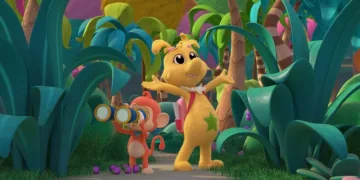
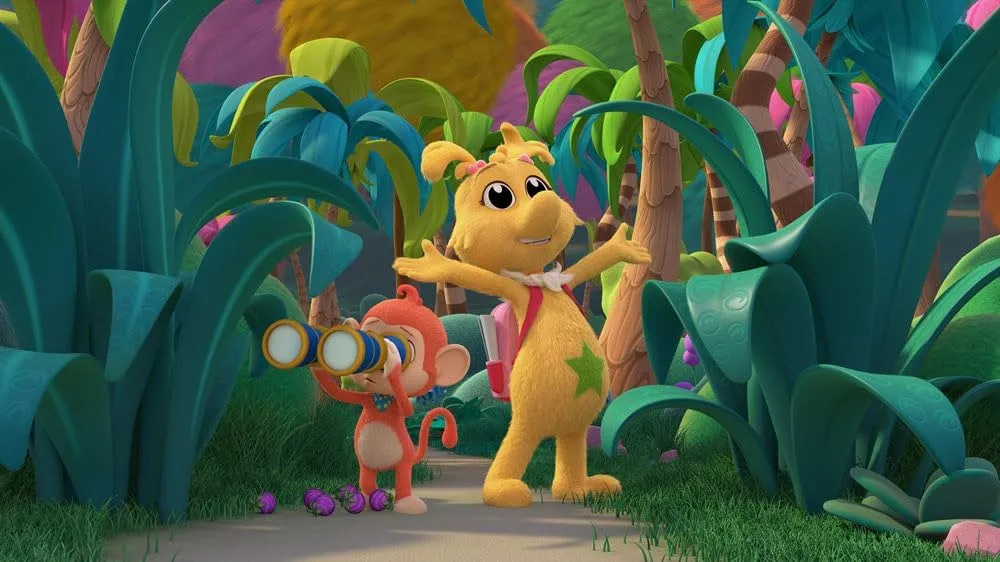
Visually, the film favors bright, buoyant color aimed squarely at young viewers. The yellow Sneetches, with stars or moons on their bellies, are designed to look cute and approachable, and the designs land with easy charm. The animation style stays conventional, missing the chaotic, artistically daring quality of Seuss’s drawings, so the image can feel blander than the book. A memorable lift arrives during a scene where the characters look up at the night sky, which glows with a beautiful intensity that briefly sharpens the film’s sense of wonder.
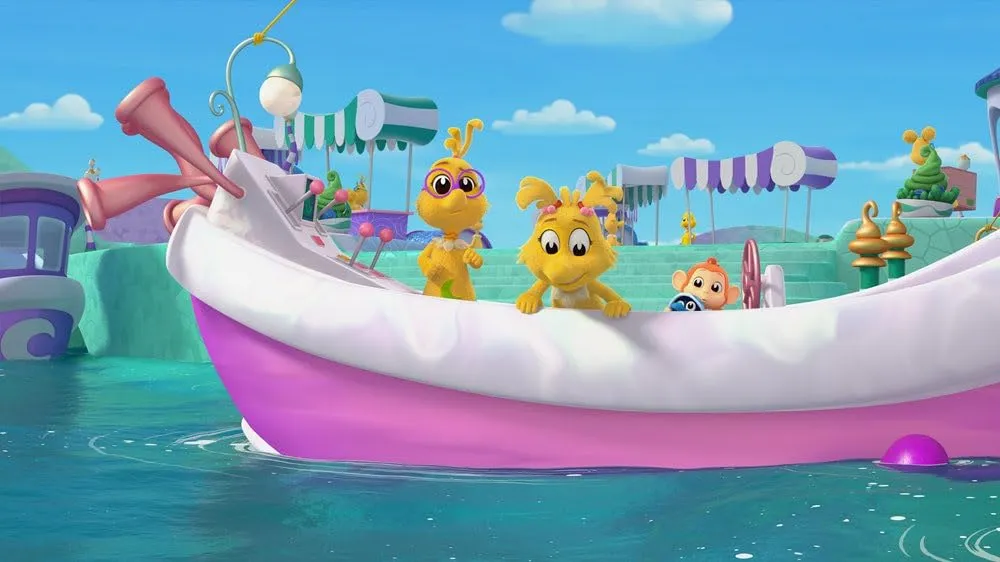
For the voice acting, the production casts actual children, Amari McCoy and Sophie Petersen, in the lead roles. They bring conviction to Stella and Pearl and handle the musical demands with clear, steady singing. A professional ensemble supports them capably, though the rest of the voicework leaves little imprint.
The songs themselves sit in familiar “kiddie musical” territory, often sounding interchangeable. Their lyrics return again and again to questioning authority, valuing invention, and accepting change, keeping the film’s themes plainly on the surface.
The Timely Lesson
The film works as a heavy-handed, straightforward lesson about the absurdity of prejudice and separatism, pitched at viewers around six years old. The expanded story opens space for another theme: the difficulty of balancing tradition with progress, and the moment when challenging social authority becomes right.
Adult Sneetches prove unable to defend their separation when pressed; one adult dismisses the very idea of change as “just not realistic.” Against that wall of inherited certainty, Stella and Pearl act with a simple insistence on friendship. Their bond “unbrainwashes” the adults’ propaganda through patience and warmth, offering a plain demonstration of how entrenched hate can be dismantled.
The extremism of the adult culture is underlined by a Sneetch in a wheelchair who still repeats prejudiced rhetoric rooted in his star marking, showing how deeply the ideology has saturated every corner of public life. The film’s clear statement that long-held traditions can be wrong is likely to spark conversations in the homes and classrooms where this adaptation will play. The plot departs from Seuss in several ways, yet the feature keeps and reinforces the source’s essential plea for tolerance and integration.
The animated musical special Dr. Seuss’s The Sneetches premiered on Netflix on November 3, 2025. This 45-57 minute feature brings the classic story of the Star-Bellied and Moon-Bellied Sneetches to life, offering a timely lesson on the absurdity of tribalism and prejudice for families and children aged 5-10. You can currently watch the film exclusively on the streaming platform, Netflix.
Full Credits
Title: Dr. Seuss’s The Sneetches
Distributor: Netflix
Release date: November 3, 2025
Rating: G
Running time: 44-57 minutes (44 minutes main feature, 57 minutes including credits)
Director: Bronagh O’Hanlon
Writers: Based on the book by Dr. Seuss (Theodor Geisel)
Producers and Executive Producers: Dustin Ferrer, Becky Friedman
Cast: Amari McCoy, Sophie Petersen, Christopher Fitzgerald, Ian James Corlett
Composer: Gregory Nicolett (Score), Rob Cantor (Songs)
The Review
Dr. Seuss's The Sneetches
The film delivers a vital, if heavy-handed, moral lesson on tribalism and prejudice, utilizing a vibrant but visually conventional animation style. While the narrative expansion and generic musical numbers detract from the source material’s artistic sharpness and anti-capitalist edge, the core message of tolerance remains strong and perfectly suited for young audiences. The performances of the child leads are charming, making it a sweet and entertaining watch, though the book's concise brilliance is superior.
PROS
- Successfully translates the original's message into a critique of two-sided tribal hatred and separatism, highly relevant today.
- The friendship between Stella and Pearl provides an engaging, emotionally honest core for the narrative.
- Effective use of actual children in the lead roles who deliver spirited performances and can sing.
- Colorful and buoyant animation style is attractive and appropriate for a younger audience.
CONS
- Expanding a short story into a 45-minute feature leads to overlong sections and unnecessary character additions.
- The reduction of McBean to a pet compromises the original story's complex layer of anti-capitalism.
- The musical numbers are largely forgettable and detract from the viewing experience.
- The visual style lacks the unique, daring eccentricity of Dr. Seuss's original art.