












![Kingdom Hearts Collection [I-III] Review](https://gazettely.com/wp-content/uploads/2026/10/Kingdom-Hearts-Collection-I-III-1-360x180.webp "Kingdom Hearts Collection [I-III] Review: KHII Holds Steady as Newer Entries Fluctuate 40")


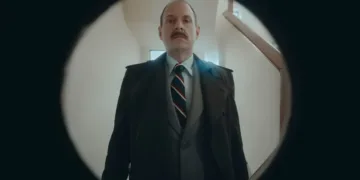
Bogotá in late 1986 plays here like a city trained to speak softly, then flinch at the next hard sound. The San Marzino restaurant becomes the setting for a tragedy that continues to mark the Colombian psyche. Jeremías Salgado sits at his table, finishes his drink, summons the specter of Travis Bickle, then opens fire on the crowd.
This Netflix miniseries builds its story on the real Pozzetto massacre, carrying a weight that feels caked on with historical dust. Directors Carlos Moreno and Claudia Pedraza shape a world where the violence of the Vietnam War spills back into South America with a terrifying immediacy.
The narrative follows Jeremías, a veteran who moves through his home country like a foreigner, and Camilo León, a student convinced he can examine darkness from a protected distance. Their collision lands with the sense that the era’s violence hung over everyone, a shadow pressing into daily life.
Drawing from the work of Mario Mendoza, the production sidesteps the flashy pulse of familiar crime-drama packaging. A colder, clinical look guides the events. Bogotá arrives in greys and deep blues, mirroring the inner weather of men stranded inside their own histories.
Intellectual Shadows and Shared Silences
Jeremías and Camilo connect in the quiet aisles of a library and the back rows of a literature seminar, places where people hide in plain sight behind paper and posture. Camilo is a young writer raised in wealth, and the older veteran’s strange reading list pulls him in. Their conversations drift through Robert Louis Stevenson and the theories that cast Arthur Conan Doyle as Jack the Ripper. On the surface, it reads like the playful obsession of bright minds chasing a puzzle; underneath, it signals the risk of getting close to Jeremías at all.
After the massacre, Camilo wakes with dissociative amnesia. He cannot explain why he was there during the shooting. He moves through the aftermath as a man cut off from his own memory, frightened that he played a role in what his friend did. Indira Quinchía becomes his link to what he cannot reach. She used to work in forensics; now she drives a taxi, surviving at the edges of the legal system. Her pursuit aims at comprehension of the event, reaching past the narrow satisfaction of a courtroom win.
Jeremías remains defined by isolation. He lives with his mother, absorbs rejection, and passes time watching adult films alone in the hush of his room. His influence on Camilo arrives gradually, like a toxin administered in calm doses. He positions himself as a mentor and offers Camilo a dark reflection of his academic vanity. The relationship echoes a strain found in Indian parallel cinema, where the guru-disciple dynamic turns into a slow moral rot, step by step, toward an abyss.
Visual Stillness and the Fractured Frame
The series uses a nonlinear structure, moving between the approach to the massacre and the investigation that follows. Each timeline carries its own visual identity, keeping the past’s fragile hope separate from the present’s dread. The directors lean on tight close-ups that cage faces inside the frame, a visual corollary to lives that feel psychologically trapped.

Andrés Parra plays Jeremías with a quiet, unsettling stillness. He moves with a soldier’s precision, and his eyes suggest a mind already gone elsewhere. José Restrepo charts Camilo’s slide from youthful arrogance into trembling, total confusion, his body and voice registering the cost of what he cannot remember.
The pacing stays slow, close to hypnotic, pressing the viewer to register the domestic details that sit beside the coming carnage. Sound carries a sharp portion of that pressure: the clink of a fork against a plate of spaghetti, the specific lines Jeremías recites from film, the ordinary noise that turns sinister through placement and timing.
That attention to the everyday recalls filmmakers like Satyajit Ray, who used the hush of a room to announce a storm gathering offscreen. Cinematography treats Bogotá as a city of shadows, with secrets tucked into its corners. The lighting stays dim, implying a world where truth gets hidden on purpose. Scenes move with careful precision, keeping sensationalism at arm’s length even as the story stares directly at horror.
The Sound of State Secrets
The final episodes widen the frame to reveal a conspiracy that stretches past the actions of one disturbed man. A clandestine military project called the Program surfaces, pointing to Jeremías as a subject of brainwashing and experimentation during his time as a soldier. Camilo finds five audio recordings hidden in a tomb. The tapes give voice to someone crushed by institutional violence, laying out the massacre’s details and the state’s part in shaping the monster it unleashed.
From there, the series pivots from character study to an indictment of how governments consume people, then discard them. Camilo reaches a form of catharsis through the recordings, using them to break his mental block. He writes his first book, reshaping trauma into literature and finding a sense of personal liberation on the page. The story offers no clean resolution and no victory lap for justice. Jeremías’s body vanishes from the morgue, a grim sign that the power structures remain in place, ready to erase anyone who knows too much.
The lack of closure fits the texture of historical tragedy, where full truth stays out of reach. The series ends on a society trained to live with its scars, and on the possibility of private healing inside a system that refuses to change. The final images carry unease. The tapes sit heavy, their weight left behind like an object you cannot put down.
Fugue State 1986 is a Colombian psychological thriller miniseries that premiered on Netflix on December 4, 2025. The show revisits the haunting memory of a 1986 massacre in Bogotá, exploring the blurred lines between reality and fiction through the eyes of a young writer and a traumatized war veteran. Currently, you can stream all eight episodes of the first season exclusively on Netflix, where it has gained attention for its gritty atmosphere and historical depth.
Full Credits
Title: Fugue State 1986
Distributor: Netflix
Release date: December 4, 2025
Rating: TV-MA
Running time: 45 minutes
Director: Carlos Moreno, Claudia Pedraza
Writers: Ana María Parra, Alejandro Convers, Antonina Kerguelen, Felipe Useche
Producers and Executive Producers: Mario Mendoza, Rodrigo Guerrero, Ángela Lozano
Cast: Andrés Parra, José Restrepo, Carolina Gómez, Camila Jurado, Jorge Enrique Abello, Consuelo Luzardo, Paulina Diazgranados, Juan Sebastián Calero
Director of Photography (Cinematographer): Diego Jiménez
Editors: Alejo Alas
Composer: Manuel J. Gordillo
The Review
Fugue State 1986
The series succeeds as a cold examination of how institutional violence deforms the individual soul. It avoids the easy traps of sensationalism, choosing instead to focus on the quiet, corrosive nature of shared trauma. While the pacing demands patience and the nonlinear structure can feel dense, the lead performances provide a grounded emotional center. It is a haunting reflection on a city still living with its ghosts, suggesting that true recovery requires facing the darkest versions of our history.
PROS
- Andrés Parra’s disciplined, quiet performance
- Atmospheric cinematography of 1980s Bogotá
- Original take on the military conspiracy theme
- Detailed sound design that builds tension
CONS
- Slow pacing may alienate some viewers
- Complex timeline requires high concentration
- Bleak tone remains heavy throughout
- Supporting characters feel underutilized