























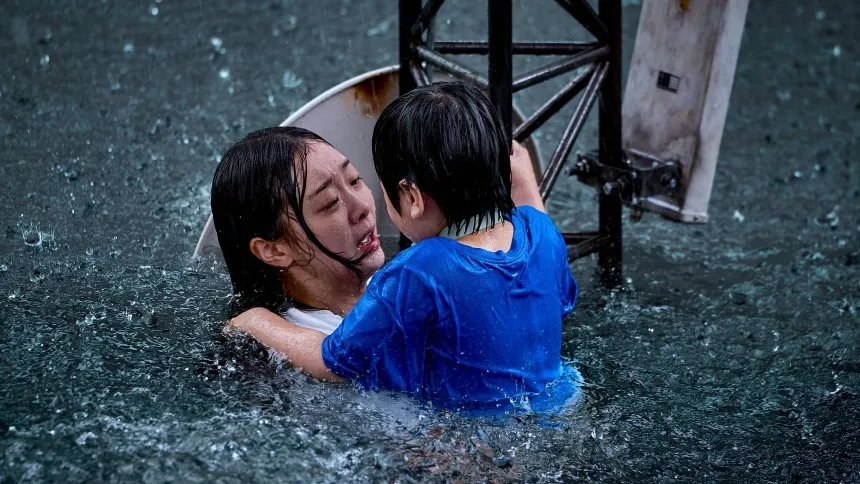

When a director like Kim Byung-woo, known for stripping genre habits down to the studs in films like The Terror Live and Omniscient Reader, announces a new project, expectations shift fast. The Great Flood wants tension with teeth. It presents itself as a high-concept South Korean disaster thriller, then uses that frame as an entry point for a much knottier design. The opening goes straight to catastrophe: Seoul is being swallowed by tsunamis and punishing, unprecedented rainfall, with the disaster reading as the planet’s final hours.
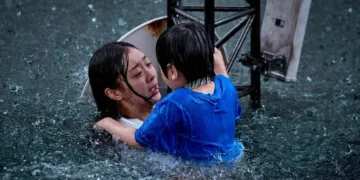
That scale becomes the setting for a tight, personal survival line. An-na (Kim Da-mi), an AI developer and mother, is trying to keep her young son Ja-in (Kwon Eun-seong) alive. Their flight gets interrupted by Hee-jo (Park Hae-soo), a corporate security officer sent to extract An-na, a move that suggests old history and a purpose that goes past a standard rescue.
Early scenes line up like a traditional survival run, then the film pivots away from enclosed physical danger toward speculative science fiction. The choice creates a high-risk structure. The first half invests in fear, exhaustion, and a mother’s desperation. The second half asks viewers to process dense ideas at speed, and the film’s emotional momentum has to carry that load.
The Visceral Pacing of Immediate Peril
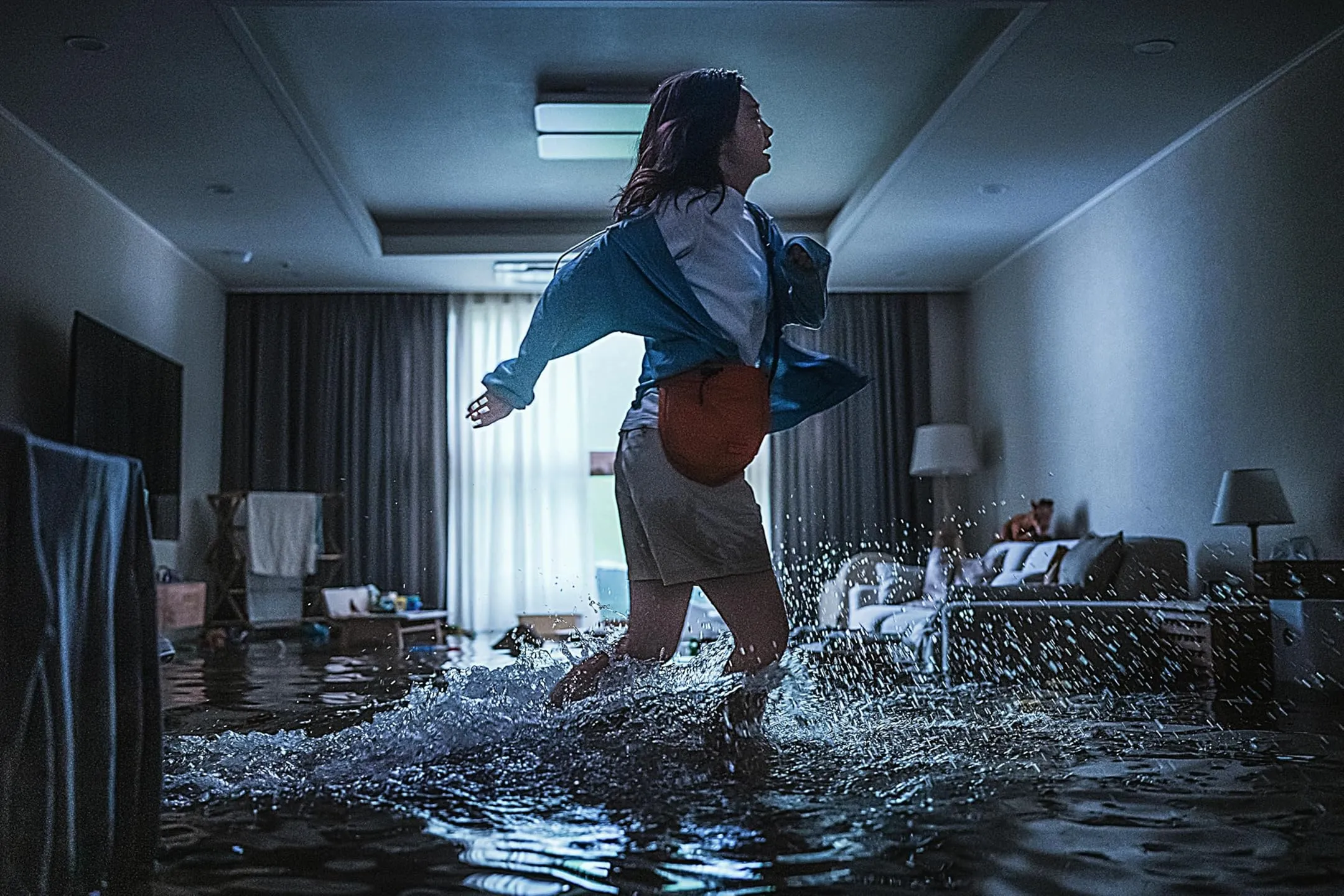
The first act locks in physical tension almost immediately. The pacing is aggressive and immediate, built to keep your pulse from settling. There is no patient ramp-up. The deluge hits, and the apartment complex turns into a pressurized trap. That instant drop into chaos creates a harsh, nerve-tight atmosphere. The building’s layout becomes the film’s main gameplay space in cinematic form: a vertical problem with shrinking margins, familiar rooms turning hostile as water climbs.
Kim Byung-woo’s visual language in this stretch is clear and functional. The digital effects largely sell both the global scale and the close-range terror of rising water swallowing floor after floor. Dedicated effects watchers can still catch small CGI roughness, a familiar talking point in effects-heavy releases, yet the scene design keeps shoving attention back toward immediate danger. The spectacle has a job beyond showing destruction. It supports the film’s survival emphasis and keeps the stakes legible moment to moment.
An-na’s early struggle is structured around a simple, brutal objective: climb. She starts on the second floor, and every step upward plays like progress earned through risk. The film treats this section as pure survival logic, a chain of frantic micro-decisions where each choice is measured in seconds and breaths. An-na and Ja-in get separated repeatedly, pushing her into submerged hallways where air becomes a timed resource and panic becomes a constant opponent.
Also Read






The physical demands on Kim Da-mi are heavy in these passages. The review notes she reportedly trained extensively for long underwater sequences, and the on-screen effort reads as real strain rather than movie strain. That physicality grounds the scenario, which makes the tension feel punishing in a way that lands emotionally.
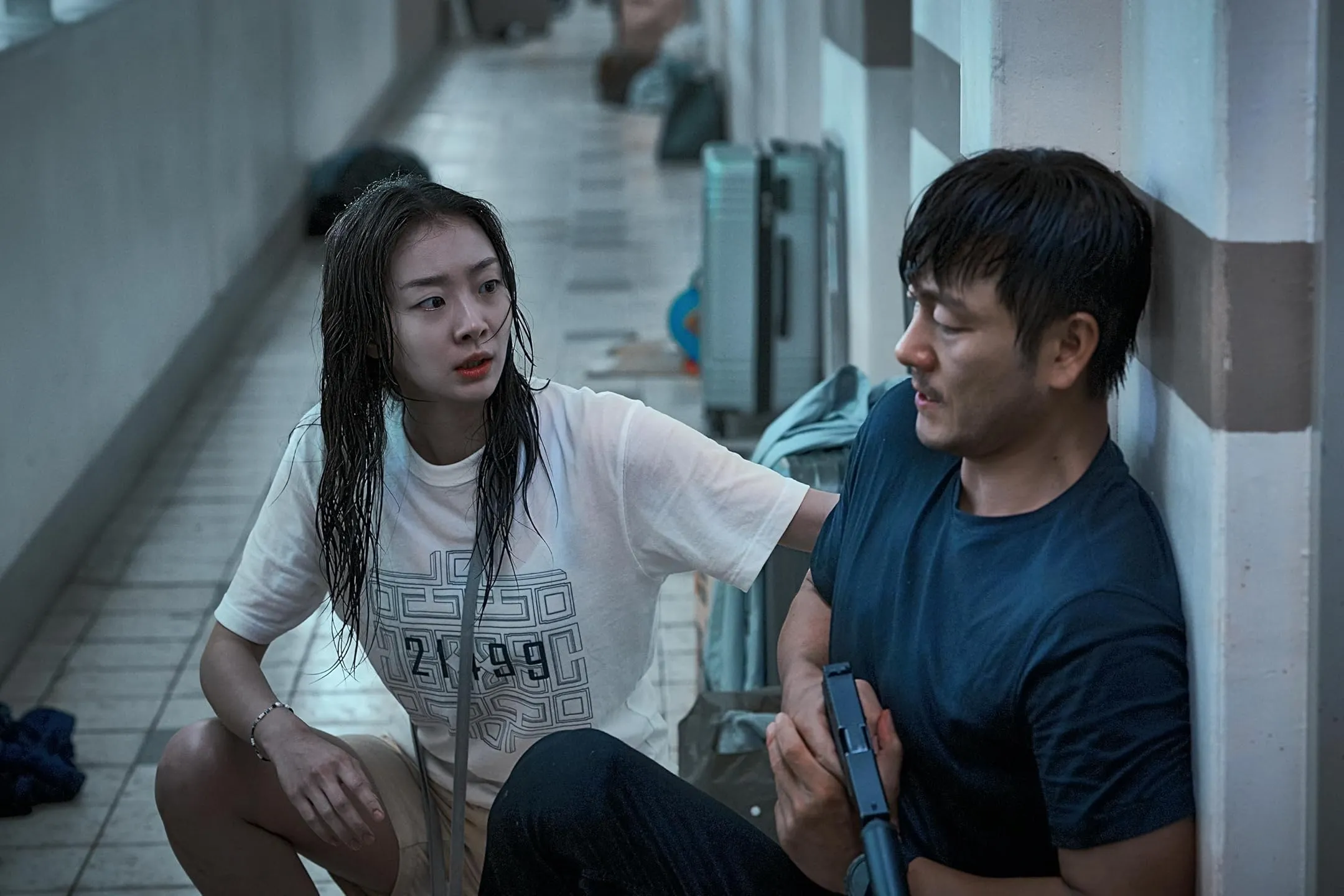
Hee-jo’s arrival adds a new system to the survival loop: uncertainty. He enters like a solution, yet his presence suggests control, planning, or at least a larger significance behind the event. His directive to retrieve An-na because of her research ties their crisis to something bigger than a random disaster. The first movement uses that mixture well, binding the audience to the mother-son relationship before the film starts rewriting its own rules. It plays a lot like a well-designed survival game tutorial, where movement and resource management become the hook. Here, the resources are air and elevation, and the “level design” is the building itself.
Structural Break: The Narrative Cascade
The film hits a hinge point once An-na and Hee-jo reach the rooftop. From there, The Great Flood stops behaving like a straight disaster movie. An-na is confronted with the reality of the asteroid impact, the true scale of the threat, and the importance of her work as an AI researcher. The story rebuilds its foundation in real time, shifting away from the established survival structure and pushing hard into speculative science fiction.
That transition throws the film into a more conceptual mode, a mystery shaped like a puzzle box where the rules of the world feel open to dispute. The framework aims high, gesturing toward the mind-bending theory and mental traps associated with certain celebrated Hollywood thrillers. Kim Byung-woo appears drawn to the philosophical space this turn creates. The threat expands beyond physical danger into something framed as existential, tied to reality’s structure and humanity’s future.
The film’s biggest trouble sits in how this break plays in practice. The action remains absorbing, and the film keeps moving. That same speed starts to work against clarity once the script begins dropping revelation after revelation. The ideas arrive in a barrage that can be hard to process, creating a sense of intellectual fog. The early act’s contained power gets swamped by theory and sharp narrative turns that strain coherence. The film feels like it overruns the channel it built for itself, with the later material threatening to drown the clean survival line that made the opening hit so hard.
A second strain comes from the commentary threaded into the sci-fi mechanics. The speculative element involves recursion, built around a mechanism that pushes An-na to “correct” emotional or selfish responses in her interactions. The structure reads like a comment on how emotion gets processed, sorted, and optimized, with a side glance at how media and algorithm-driven entertainment try to package feelings into calibrated products. The film hints at a cold view of that “optimized” future, suggesting a willingness to trade emotional authenticity for theoretical survival.
The idea has bite, and the film keeps pointing toward it, yet that philosophical angle clashes with the cleaner emotional logic established during the disaster stretch. The review connects this friction to a familiar issue in Korean sci-fi that tries to fuse high-concept speculation with family melodrama. The result here is a tone and clarity problem, where the concepts and emotional register struggle to sit in the same frame.
The Power of Performance and Maternal Focus
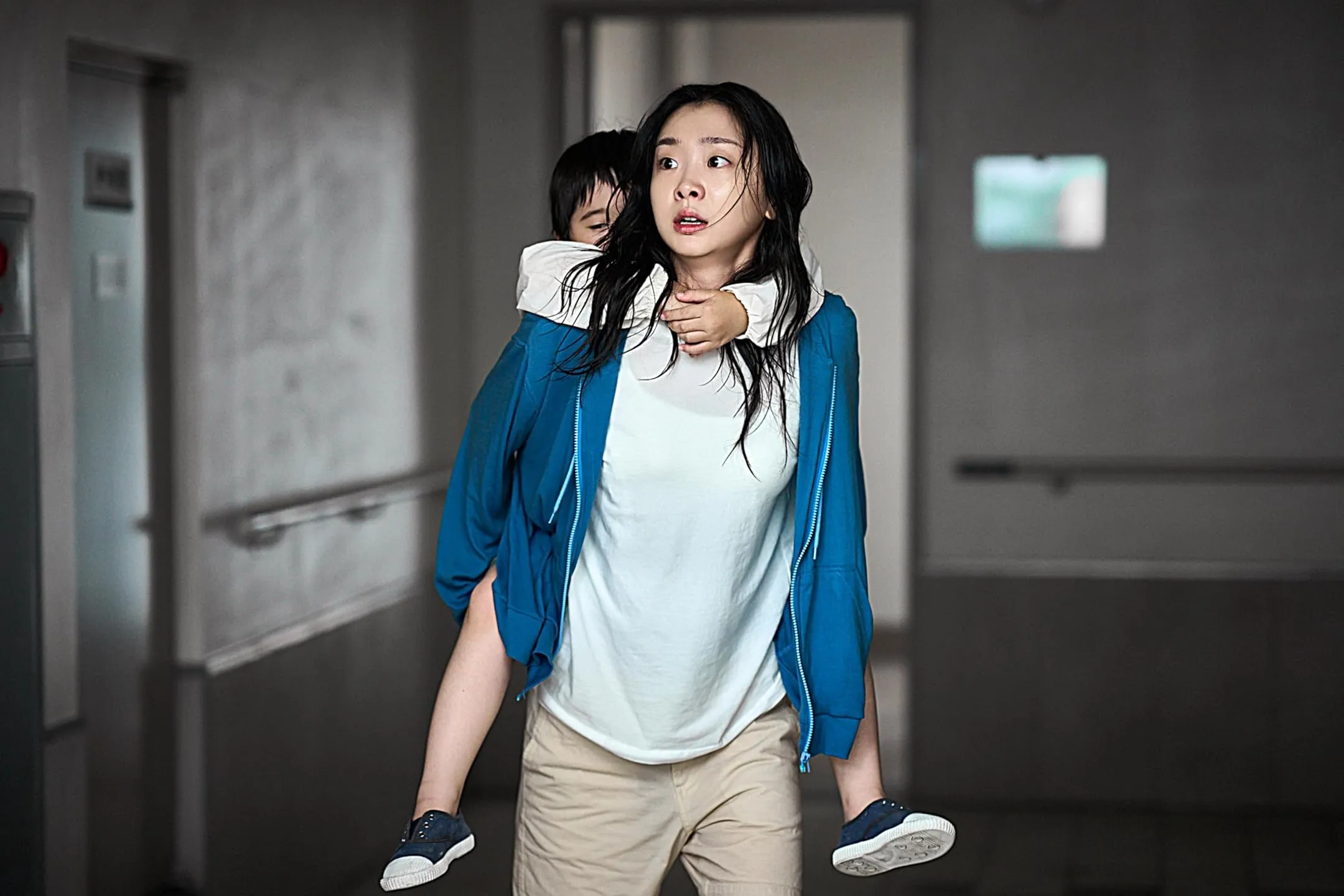
Even with the story’s tangled mid-film turn, the film keeps its grip largely through its lead performance. Kim Da-mi serves as the emotional anchor with a force that holds scenes together when the narrative starts pulling in too many directions. She plays An-na as fierce and locked-in, giving the stranger situations a human weight that keeps them from floating away into pure abstraction. That work matters because she is fighting two battles at once: the rising water and the script’s widening scope.
An-na’s arc is the film’s main emotional line. She begins as a complicated figure, a mother who can read as cold or distant, with her attention pinned to survival and her work. That early demeanor can feel harsh, yet the film gradually reframes her choices as the stakes widen. The mother-child theme remains the story’s primary emotional current, with An-na’s drive to protect Ja-in acting as the throughline even when the sci-fi machinery spins faster.
By the final stretch, she reaches a transformation that goes past physical endurance and toward an emotional understanding of what her child needs. That payoff supplies the closure the film requires for viewers to stay invested, even when the speculative mechanics stay confusing.
Park Hae-soo gives Hee-jo a solid, tense presence. His performance supports the action sequences and generates strong audience reactions, often suspicion or open antagonism. The character itself stays thin, though. The script keeps Hee-jo closer to function than fully realized personhood, withholding the extra shading that would make his role feel richer. The dramatic load lands back on Kim Da-mi, and her ability to sell the sincerity of the central relationship becomes the film’s emotional success. She keeps the image of a mother protecting her child as the lasting impression, outliving the technical rough spots and the structural turbulence.
Integrating Theme and Technique
The Great Flood works well as a case study in mixed cinematic technique. Its clearest strengths live in the mother-child drama and the relentless action pacing that powers the first hour. The film gives the audience very little room to breathe, and that constant pressure creates strong bodily reactions, a direct method for suspense and immersion.
The weaknesses come from the attempt to fuse elements that resist clean synthesis. The science fiction concepts and the family melodrama can feel like two separate films edited into the same runtime. That uneasy fit leads to a collapse in narrative logic, where the film often pushes emotional stakes forward while the conceptual machinery becomes harder to follow. The end result is an ambitious film with unstable storytelling, and the theory-heavy final act leaves viewers battered and bewildered, with satisfaction harder to reach.
Kim Byung-woo delivers a spectacle that hits hard through visceral tension and then challenges viewers through narrative density. The film’s audacity gives it a presence that sticks, and Kim Da-mi’s performance provides the emotional engine driving it forward. The Great Flood plays as a memorable, chaotic experience, and its messy structure invites debate about what viewers can forgive in exchange for intensity and feeling. The emotional foundation remains strong enough to stay standing through the film’s own dramatic flaws.
The South Korean science fiction disaster film, The Great Flood (Korean: 대홍수), had its world premiere at the 30th Busan International Film Festival on September 18, 2025. The high-concept thriller, set on what may be Earth’s final day, depicts a desperate fight for survival in a flooded apartment building. The film is available for global streaming on Netflix, which released the movie worldwide on December 19, 2025.
Full Credits
Title: The Great Flood (대홍수)
Distributor: Netflix
Release date: December 19, 2025 (Global Streaming Release)
Rating: TV-MA
Running time: 108 minutes or 1 hour 48 minutes
Director: Kim Byung-woo
Writers: Kim Byung-woo, Han Ji-su
Producers and Executive Producers: Chun Roy-kyoung (Producer)
Cast: Kim Da-mi, Park Hae-soo, Kwon Eun-seong, Kim Kyu-na, Kim Byung-nam, Lee Dong-chan, Kim Su-Kyung, Jeon Yu-na
Director of Photography (Cinematographer): Kim Tae-soo
The Review
The Great Flood
The Great Flood successfully marries visceral, pulse-pounding survival cinema with a deep, emotional story of a mother's resolve. Its dazzling ambition to pivot to complex science fiction, however, ultimately overwhelms its narrative clarity, leaving the final act bewildering. The film is a flawed, yet unforgettable spectacle.
PROS
- Breathlessly tense and constantly action-packed.
- Kim Da-mi provides a fierce and compelling emotional anchor.
- The strong, moving mother-child survival theme.
- A cynical, intriguing commentary on algorithmic control and human emotion.
CONS
- The ambitious sci-fi turn leads to incoherence.
- Melodrama and theoretical concepts merge uncomfortably.
- Hee-jo (Park Hae-soo) remains a functional plot device.
- The barrage of revelations in the latter half is difficult to follow.