




























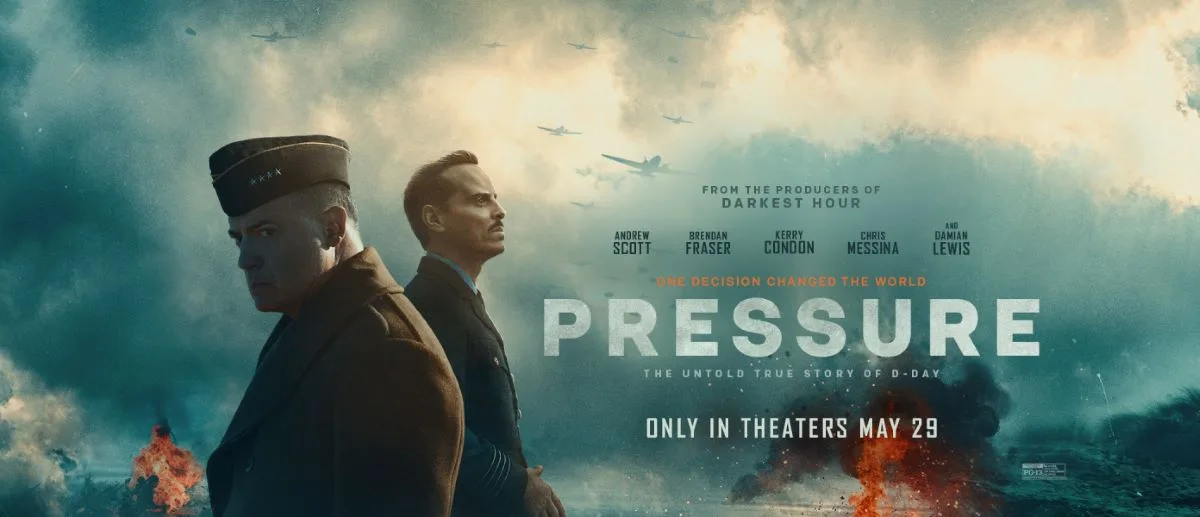

World War II has been documented, dramatised, and dissected so thoroughly that the genre risks becoming its own kind of historical furniture: familiar, functional, unremarkable. Anthony Maras’s Pressure, adapted alongside playwright David Haig from Haig’s 2014 West End production, locates its drama somewhere the cameras rarely point: a room full of maps, a contested forecast, and 72 hours on a clock that cannot be stopped.
The film’s central question sounds almost comic on paper. Did the weather determine D-Day? The answer, it turns out, is essentially yes. Pressure follows Scottish meteorologist Captain James Stagg (Andrew Scott), recruited on Winston Churchill’s personal recommendation to deliver a reliable forecast for June 5, 1944, the date earmarked for the Allied invasion of Normandy. Andrew Scott takes the lead. Brendan Fraser plays General Dwight D. Eisenhower. Kerry Condon plays aide Kay Summersby. Chris Messina plays rival American forecaster Irving P. Krick. Damian Lewis plays General Bernard Montgomery. The action is largely confined to Southwick House in southern England. The runtime is a disciplined 100 minutes.
What Maras has made is a procedural chamber drama that functions as a quiet thriller, the tension generated not by gunfire but by the gap between what is true and what those in power wish to hear.
Forecasting the Unfaceable
The film opens on Exercise Tiger, the disastrous D-Day rehearsal that killed roughly 700 Allied soldiers. The imagery is blunt: bodies in bloodied surf, Eisenhower walking a beach strewn with the dead. The screen offers no equivocation: “This is a true story.” No “inspired by,” no “based on.” Just the claim, and then the carnage.
From there, Maras cuts to something almost aggressively ordinary. Stagg makes breakfast for his heavily pregnant wife, Liz (Tamsin Topolski), before departing for an assignment he cannot name. The contrast is deliberate. The horror of Exercise Tiger has just been established; now we are watching a man in a kitchen, folding domesticity into the machinery of history.
Churchill has personally vouched for Stagg, and Eisenhower needs a forecast for June 5 within 62 hours of his arrival. The task is already borderline impossible. What Stagg finds on arrival makes it worse. Irving Krick, the American incumbent meteorologist, has been operating via an “analog” system, mapping current weather conditions onto historical data to identify the most similar past scenarios and then extrapolating forward. Krick is proud of this system. He once used it to predict weather for the filming of the burning-of-Atlanta sequence in Gone With the Wind, for producer David O. Selznick. He name-drops this with the confidence of a man who believes meteorological success and Hollywood anecdote are the same currency.
Stagg is not impressed. Analogs work in stable climates, he argues, like the North African theatres where Krick built his reputation. Northern Europe’s weather systems are volatile and require real-time data from observation posts around the globe. Stagg is tracking two storm systems that his calculations suggest will converge over the Channel on June 5. Rain. High winds. Impossible landing conditions.
He recommends a postponement of at least 24 hours. The military leadership, Eisenhower, Montgomery, Admiral Bertram Ramsay, resists with the collective energy of men who have structured every logistical plan around a specific calendar square. A delay of weeks would risk compromising operational secrecy. Shorter windows for the right tidal and lunar conditions simply do not exist.
Running beneath all of this is a quieter thread. Stagg’s wife remains in London, still within range of German bombing. A phone call during the crisis delivers potentially devastating news about her condition. Maras and Haig have the good sense to keep this strand thin; it flavours Stagg’s urgency without swamping the procedural drama in sentiment.
The Performances, Ranked by the Weather They Generate
Andrew Scott does not make James Stagg likeable. This is the correct decision.
Stagg is prickly, officious, unmoved by hierarchy, and constitutionally incapable of offering reassurance he does not believe. Scott plays him with a dour stillness, the kind that draws cameras closer rather than pushing them away. The performance is built on compression. When Stagg receives troubling news about his wife over the telephone, Scott barely registers it on his face: a slight tightening around the eyes, a careful arrangement of brief questions. The anguish is entirely visible, located somewhere beneath the professional surface where Stagg has chosen to store it. It is among the more quietly devastating single-scene performances of recent years.
Scott has made a career of characters whose interior lives are pitched at frequencies only the camera picks up. Stagg is perhaps his most compressed work to date. Where another actor might court sympathy, Scott courts something harder to achieve: trust. You trust Stagg because Scott makes plain that the character has no interest in being trusted.
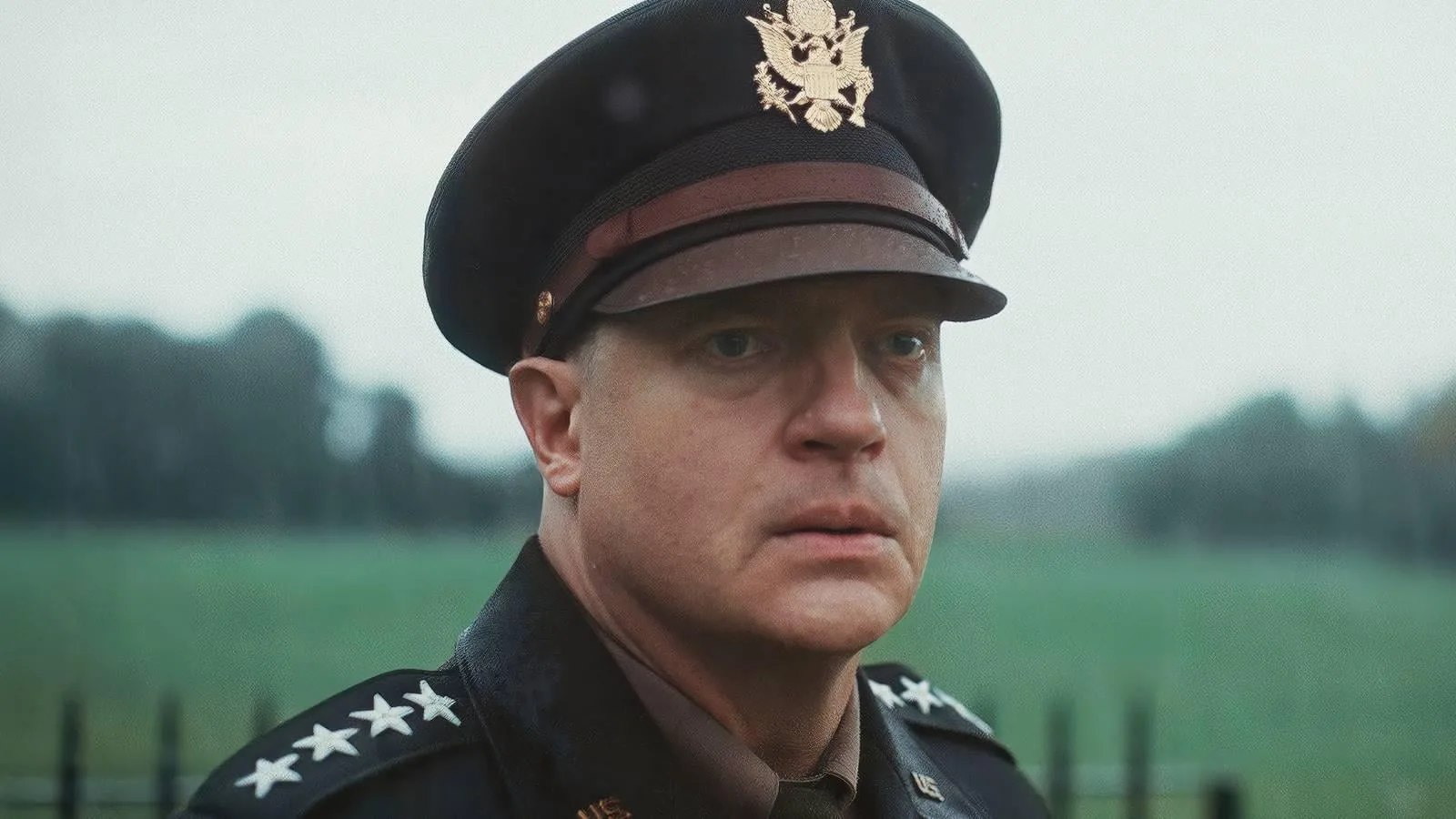
Brendan Fraser’s Eisenhower is a more complicated case. The physical resemblance to the historical figure is, charitably, minimal. Fraser’s performance runs hotter than the real Eisenhower’s famously controlled temperament, and some of his broader moments sit awkwardly against Scott’s discipline in their shared scenes. Scenes built around Condon and Scott operate at a different voltage than those belonging exclusively to Fraser. This is the film’s central imbalance, and it is worth naming plainly. And yet: Fraser’s Eisenhower does convey the particular psychological weight that comes from having sent men to their deaths once already. The eyes, at least, understand what is at stake.
Chris Messina as Krick is one of the film’s genuine pleasures. Slick, territorial, and equipped with the supreme confidence of a man who has mistaken applause for competence, Krick arrives fully formed as a type. Messina plays the smarm with relish, nearly stealing every scene he enters, which is saying something given his company. The character’s willingness to arrange data selectively in order to deliver the answer the generals want makes him the film’s most recognisable contemporary figure: the credentialled expert who has discovered that certainty sells better than accuracy.
Kerry Condon, following her assured work in F1: The Movie, brings quiet authority to Kay Summersby that the role technically does not demand and practically requires. She receives one sharp line about men being “too fond” of the word “genius,” delivered with such dry control that Summersby briefly becomes the most interesting person in the room. The film gestures at the historical speculation surrounding Summersby and Eisenhower’s personal closeness without dramatising the alleged affair, a disciplined choice.
Damian Lewis leans into Montgomery’s supercilious grandeur and chews the available scenery with evident satisfaction. It is broad work done with commitment, providing the British military camp with its necessary antagonistic charge.
The Art of the Contained Drama
Maras made Hotel Mumbai, a nerve-shredding film about the 2008 terrorist siege, and his experience managing confined-space suspense is visible throughout Pressure. The drama lives in rooms: maps on walls, bulletin boards dense with data, officers arranged around contested information. Maras does not strain to open the film up cinematically. Where he does reach for wider scale, archival footage from the period is deployed with restraint, and brief exterior sequences provide breathing room rather than grandeur.
The screenplay, co-written with Haig, retains the density of its stage origins without apologising for them. Meteorological jargon sits untranslated in the dialogue, and the film trusts its audience to track the procedural logic. This is the same pleasurable confidence found in films like All the President’s Men or Apollo 13, where watching skilled people work through an intractable problem at full intellectual speed is itself the entertainment.
Jamie D. Ramsay’s cinematography adopts a muted palette: cool blues, military greens, browns lit by sodium warmth. The effect evokes a mid-century world as it exists in the cultural imagination, sepia without the costuming of nostalgia. His camera tightens during the argument sequences with an almost physical quality, the room itself seeming to contract as the disagreement grows.
Volker Bertelmann’s score (he composed All Quiet on the Western Front, and the pedigree is audible) thrums with controlled urgency beneath the action, without overwhelming it. Restraint, again, is the operative discipline.
The film’s significant failure is its ending. The recreation of the Normandy landings that closes the picture trades the film’s specific strengths for generic war-movie spectacle. The combat imagery is derivative, caught in the long aesthetic shadow of Saving Private Ryan, and the choice abandons the tonal logic of everything that preceded it. A film that earned its power through compression and interiority should not close by suddenly becoming a different kind of film entirely.
What the Barometer Measures
The title carries two meanings, and Maras earns both.
Barometric pressure is the meteorological variable Stagg and Krick are tracking: the atmospheric reading that predicts the coming storm. Pressure is also the psychological condition shared by everyone in the building, from Eisenhower’s command authority down to Stagg’s precise, difficult, accurate forecasts. The film understands that these two registers are, in this particular story, the same thing.
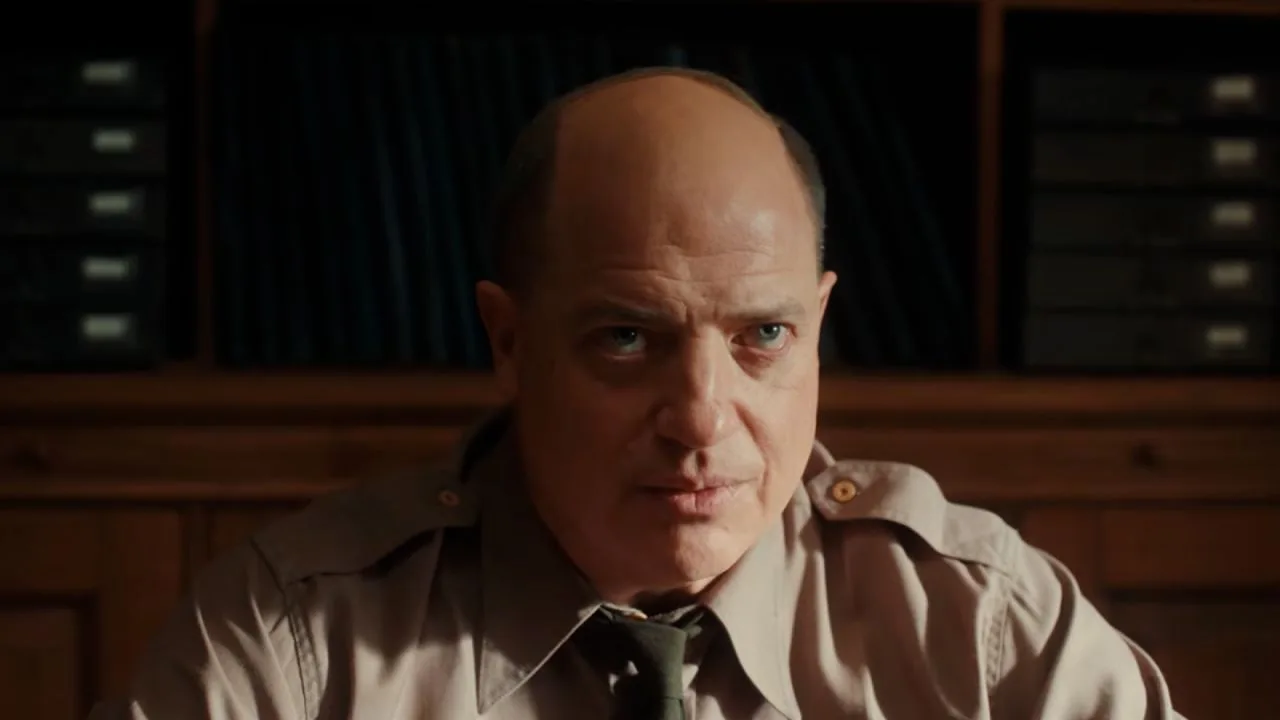
The clash between Stagg and Krick forms the film’s intellectual spine, and it maps almost too cleanly onto the contemporary political mood. Krick’s method is to select data that produces a palatable conclusion. Stagg’s is to collect all available data and report what it shows, including the inconvenient reading. Krick is the easier man to be around. The film, set more than 80 years ago, reads as an argument for epistemic honesty at a moment when that argument needs making rather urgently.
Pressure also finds something quietly original in treating the D-Day planning as workplace drama. This is a war film about a knowledge worker. (One might coin the term “bureaucratic sublime” for what Maras is working in here: grand historical events compressed into the grammar of office politics.) The mechanics of Stagg’s predicament, bringing an unwelcome analysis to a resistant leadership while a better-connected colleague undercuts him, are recognisable to anyone who has presented inconvenient findings in a professional setting. The historical scale is incomparable, of course. The social dynamics are disturbingly familiar.
What the film leaves slightly underexplored is the science itself. Pre-radar meteorological forecasting in the 1940s is a genuinely strange and fascinating discipline, and the film gestures at its complexity without fully inhabiting it. A more immersive treatment of the actual technique might have distinguished Pressure from comparable procedurals more sharply.
The character dynamics, too, cycle through familiar beats with some regularity. Eisenhower demands. Krick reassures. Stagg corrects. Summersby mediates. The cycle repeats. This is a minor structural complaint against a film that otherwise manages its 100 minutes with real intelligence.
History, Pressure quietly insists, does not always bend on the decisions of generals. Sometimes it bends on a barometric reading, delivered by a difficult man in a room full of resistant listeners. The unglamorous truth is that the latter may matter more.
Pressure is a taut historical war drama that captures the high-stakes, ticking-clock environment of World War II just before the pivotal Normandy landings. The film chronicles the 72 hours leading up to D-Day, tracking the intense conflict between General Dwight D. Eisenhower and British meteorologist James Stagg over whether an approaching massive storm system will ruin the invasion or offer the perfect window of opportunity. The movie is set to release theatrically in the United States on May 29, 2026, and is scheduled for a United Kingdom theatrical release later this year on September 11, 2026. Audiences can currently experience this gripping true story on the big screen in commercial theaters across North America, with standard video-on-demand and streaming availability expected in the following months through Universal Pictures’ associated digital platforms.
Where to Watch Pressure (2026) Online







Full Credits
Title: Pressure
Distributor: StudioCanal, Focus Features, Universal Pictures
Release date: May 29, 2026
Rating: PG-13 (Moderate scenes of wartime violence and injury)
Running time: 100 minutes
Director: Anthony Maras
Writers: Anthony Maras, David Haig
Producers and Executive Producers: Tim Bevan, Eric Fellner, Cass Marks, Lucas Webb
Cast: Andrew Scott, Brendan Fraser, Kerry Condon, Chris Messina, Damian Lewis, Henry Ashton, Con O’Neill, Daniel Quinn-Toye, Toby Williams, Max Croes
Director of Photography (Cinematographer): Jamie D. Ramsay
Editors: Anthony Maras
Composer: Volker Bertelmann
The Review
Pressure
Pressure works because it trusts its premise and its lead. Andrew Scott carries a film that understands restraint as a dramatic virtue, finding genuine tension in a story where the weapon is a weather forecast. Fraser's performance creates an imbalance the film never fully corrects, and the closing combat sequence betrays the chamber drama that earned your investment. A flawed but intelligent piece of historical filmmaking.
PROS
- Andrew Scott's extraordinary, restrained lead performance
- Sharp, procedural screenplay that respects audience intelligence
- Disciplined pacing and elegant cinematography
- Timely thematic resonance around expertise and truth
CONS
- Fraser's Eisenhower lacks Scott's precision
- Repetitive character dynamics throughout
- The D-Day recreation finale undermines the film's tonal strengths
- The meteorological science deserved deeper exploration