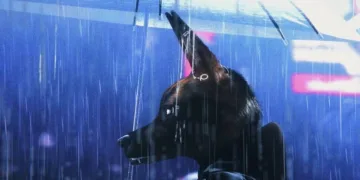










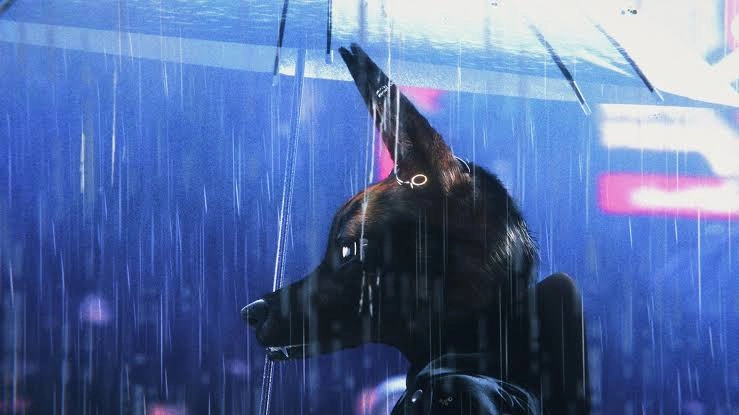

The emotional trick of Bouchra is that a jackal on a subway can feel less artificial than a polite family phone call. Meriem Bennani and Orian Barki’s animated docufiction feature turns a deeply personal story into a world of anthropomorphic animals, then lets the real texture of speech pull that world back toward lived experience. It is a strange design choice, and it does not work equally well in every scene. Still, the risk gives the film its pulse.
Bouchra, voiced by Bennani, is a queer Moroccan filmmaker living in New York and struggling to finish a project about a mother and daughter. The resemblance to her own life is obvious, even when she insists otherwise. Her mother, Aicha, remains in Casablanca.
They speak often, with the easy rhythm of people who know each other’s habits, but their conversations keep sliding around the one subject that shaped the distance between them: Bouchra’s sexuality. That is where the film finds its cleanest emotional mechanism. The animation creates distance, then the voices erase it.
The Letter That Keeps Calling Back
The mother-daughter story is built from avoidance. Bouchra and Aicha can talk about work, family, travel, and practical details, yet the silence around Bouchra’s romantic life grows louder because everything else sounds so ordinary. The film understands that some families do not break through shouting. They learn to speak around the wound.
The coming-out letter gives that wound a physical shape. Bouchra sent it to her parents years earlier, and their reaction left something unresolved that neither time nor distance has softened. Her later trip to Casablanca carries quiet suspense because she is trying to find the letter while living inside the house that once received it. There is no thriller machinery here, only a daughter moving through family space with an old version of herself hidden somewhere inside it.
Aicha’s most painful admission comes when she explains why Bouchra’s coming out frightened her: she imagined her daughter would never be able to live freely in Morocco. It is a devastating line because it comes from fear, love, shame, and cultural pressure at once. The film does not flatten Aicha into cruelty. It lets her hurt Bouchra while still being a mother who calls, worries, laughs, and wants closeness.
Bouchra’s film-within-the-film gives her a way to ask what she cannot ask directly. She frames the mother character as fictional, then keeps using that fiction to test the truth. Anyone who has needed an excuse to start a hard conversation will recognize the move.
Desire in Another Language
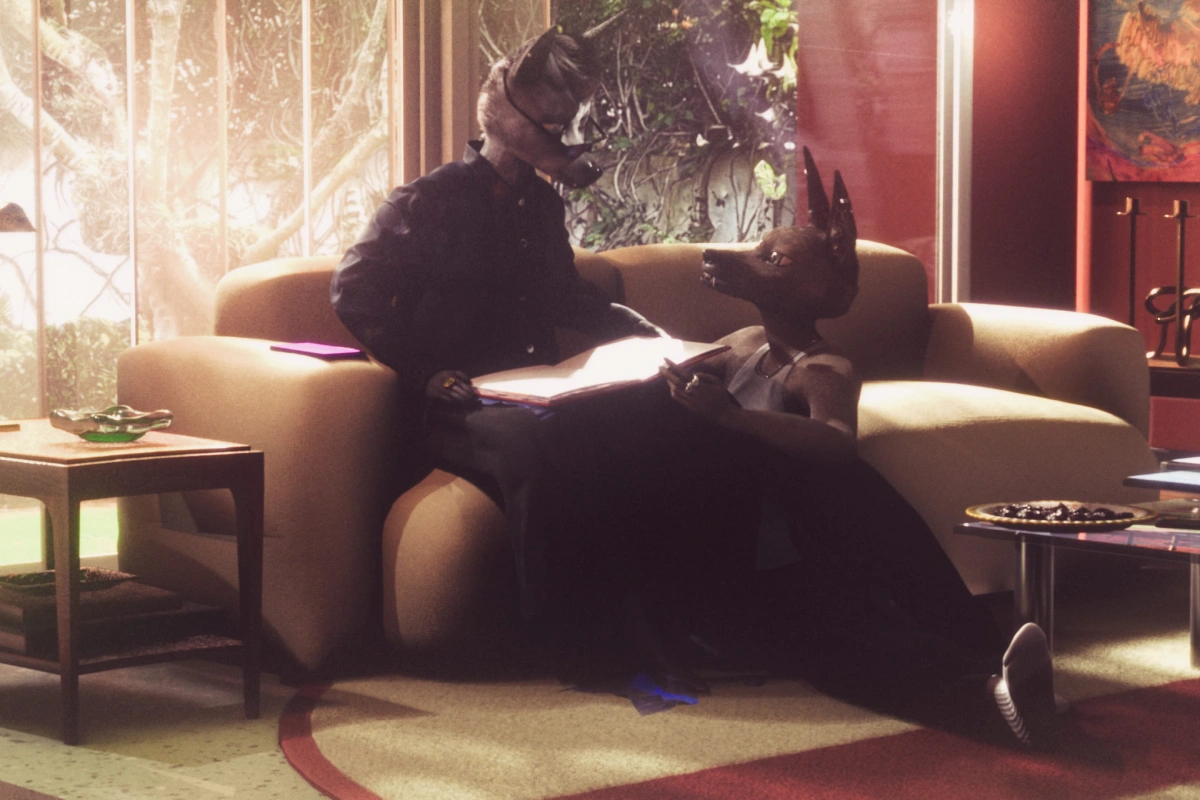
The New York scenes give Bouchra a different kind of fluency. With friends and lovers, she can be funny, guarded, flirtatious, needy, and annoyed in ways she cannot risk with her mother. Her best friend Yani brings loose comic energy to the film, especially in exchanges that feel half-gossipy and half-therapeutic. Those scenes matter because they show Bouchra outside the wound. She is not only a daughter waiting to be understood. She is a messy adult with rent, desire, creative panic, and bad romantic judgment.
Nikki, Bouchra’s ex, reappears with a job offer, and their bar meeting has the nervous rhythm of people pretending they are done with each other. The conversation moves from work talk to old resentment to attraction with almost no clean border between them. That blurriness feels truthful. Queer friendship, employment, attraction, and history can overlap in ways that make every practical offer emotionally radioactive.
The line that cuts deepest is Bouchra saying she has never been with someone who spoke her own language. It reveals the split in her life without turning it into a speech. French and Arabic belong to family, childhood, Morocco, and the mother she still wants to reach. Her romantic life has formed elsewhere, in another city and another social code. The film makes that separation hurt.
The erotic scenes are surprisingly tactile for a film full of animal avatars. A glance, a tooth, the brush of fur, the joke of storyboard cards replacing explicit action: the film keeps finding ways to make desire playful rather than abstract.
When the Animation Helps, and When It Holds Back
The film’s visual language is both shield and obstacle. The anthropomorphic designs protect the real people behind the story from direct exposure, which feels ethically smart for material this private. Bouchra can be a jackal, Yani a lizard, Nikki a cow, Lamia a bear, and somehow the displacement makes confession easier to receive. The unreality softens the risk.
Yet the animation has limits. Character movement can feel heavy, and some faces do not hold enough detail for scenes built around tiny emotional shifts. In the most delicate moments between Bouchra and Aicha, a pause in the voice often carries what the model cannot. Some backgrounds are spare to the point of flatness, while darker, neon-heavy scenes can swallow character detail. The film has style, but the style sometimes stands between the viewer and the ache.
The best formal touches are the ones that admit the whole thing is constructed. The smartphone POV, the storyboards, the late glimpse of people behind the characters, all of these remind us that Bouchra is making sense of memory by reshaping it. That self-awareness could have made the film cold. Instead, it makes the act of making feel vulnerable.
Bouchra works because its rough edges match its subject. This is a film about trying to speak after years of careful silence, so it makes sense that its most moving moments arrive imperfectly: a cracked voice over a digital face, a daughter pretending to ask about fiction, a mother saying the loving thing far too late and still meaning it.
The innovative computer-animated arthouse drama Bouchra launched its exclusive United States theatrical rollout on June 26, 2026, through independent distributor Film Movement. Following highly praised festival runs at the Toronto International Film Festival and the New York Film Festival, the visually distinctive production is available to watch in select specialized indie theaters and arthouse cinemas. The semi-autobiographical storyline follows a 35-year-old queer Moroccan filmmaker living in Brooklyn who navigates a severe creative drought and her own sexual identity while documenting an intimate, long-distance relationship with her mother in Casablanca through a series of phone calls.
Where to Watch Bouchra (2026) Online








Full Credits
Title: Bouchra
Distributor: Film Movement, Lucky Number
Release date: October 31, 2024 (Milan Premiere), September 5, 2025 (TIFF), June 26, 2026 (United States Theatrical Release)
Running time: 83 minutes
Director: Meriem Bennani, Orian Barki
Writers: Meriem Bennani, Orian Barki
Producers and Executive Producers: Fondazione Prada, 2 Lizards Production, Hi Production, SB Films
Cast: Meriem Bennani, Orian Barki, Fatim-Zahra Alami, Yto Barrada, Dounia Berrada, Ariana Faye Allensworth
Director of Photography (Cinematographer): Meriem Bennani, Orian Barki
Editors: Orian Barki, Meriem Bennani
Composer: John Michael Boling, Jason Coombs
The Review
Bouchra
Bouchra finds its strongest feeling in the space between distance and confession. The animal avatars can stiffen the drama, and some scenes ask for facial detail the animation cannot always provide. Yet the film has a rare emotional mechanism: real voices moving through invented bodies, letting pauses, laughter, and old hurt do the work. Its mother-daughter story is quiet, specific, and gently painful, with queer desire and diaspora loneliness held in the same frame.
PROS
- Intimate real voice work
- Tender mother-daughter conflict
- Specific queer diaspora detail
- Playful docufiction form
- Strong use of pauses and silence
CONS
- Stiff character movement
- Sparse visual environments
- Emotional distance in key scenes
- Some wandering early pacing