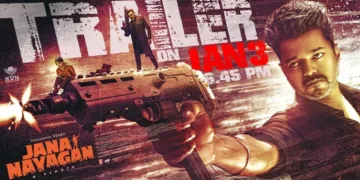












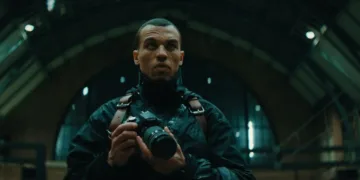











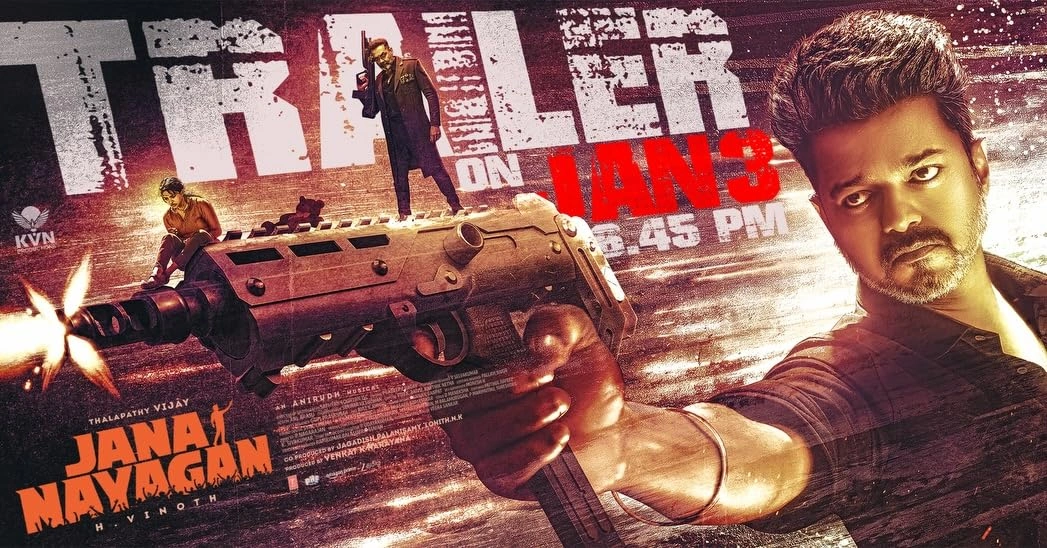

Helping a fallen elder rise while the Constitution of India rests in his hands is less an introduction than a declaration of office. The image arrives early in Jana Nayagan, announcing how H Vinoth’s film intends to present Vijay: protector of the vulnerable, guardian of democracy, paternal authority, and leader already prepared for public life. The fictional character is named Thalapathy Vetri Kondan, yet the distance between actor and role has been reduced to a ceremonial inch.
That overlap gives Vijay’s purported final film an unusual cultural charge. Indian cinema has a long history of screen personas migrating into politics, but Tamil Nadu made that relationship especially potent through MGR and Jayalalithaa. Jana Nayagan does not merely acknowledge that lineage. It stages Vijay’s entry into it, complete with political slogans, references to public rivals, images of voting, and an artificial conversation with MGR himself.
The film is an official remake of the 2023 Telugu action drama Bhagavanth Kesari, reshaped around Vijay’s star image and directed by a filmmaker known for placing political thought inside commercial frameworks. Yet the task becomes unwieldy. This must be a remake, a farewell, an election-season statement, a father-daughter drama, a musical celebration, and a three-hour action vehicle. Every demand receives screen time. Few receive patience.
Its delayed release, censor dispute, legal fight, and piracy problems increased the sense of occasion. That history hangs over each entrance and song. The audience is invited to watch a film, bid farewell to a star, and greet a politician. The first invitation gradually disappears beneath the other two.
A Daughter Between Speeches
The inherited dramatic structure remains the strongest material. Vetri, a righteous former police officer and ex-convict, assumes responsibility for Viji after the death of her father, Inspector Srikanth. Viji lives with trauma-induced panic attacks. A plate striking the floor can fracture her composure, while sudden noise turns military training into a confrontation with memory.
Mamitha Baiju gives those moments a physical truth the surrounding film often lacks. Her breath shortens, her shoulders lock, and her eyes search for an exit before dialogue explains what is happening. The performance makes fear an involuntary bodily event rather than a convenient obstacle placed before the heroine.
Vetri’s task is to help her fulfil Srikanth’s wish that she enter the Indian Army. The relationship carries the familiar emotional grammar of Indian popular cinema: the guardian who refuses the title of father, the young woman who slowly grants it, and the dead parent whose dream governs the living. “Kanne Maniye” supplies tenderness through melody and montage, allowing Anirudh Ravichander’s music to create continuity that the screenplay rushes past.
The first act moves through Srikanth’s introduction, his bond with Vetri, his death, and Viji’s adoption with startling speed. When Vetri later overhears her call him Thalapathy, brother, uncle, and finally “Appa,” Vijay’s tears announce a major emotional arrival. The scene would carry greater force if the film had allowed the relationship to grow through quieter exchanges. Instead, music and performance must construct an intimacy the editing has treated as an appointment.
H Vinoth retains the original film’s emphasis on female independence, then surrounds it with additional lessons. Vetri teaches children about good touch and bad touch, confronts a misogynistic marriage prospect, defends a woman protesting beneath the Kannagi statue, and delivers a lengthy speech after beating a man who boasts of his strength over Viji.
These ideas belong within the social tradition of Tamil masala cinema, where the star often serves as teacher, judge, and public advocate. The problem lies in their arrangement. Each episode arrives like a campaign promise, complete with a problem, an offender, a punishment, and a lecture. Viji’s own development receives less room than Vetri’s explanation of what her development should represent.
The contradiction becomes harsher when women are repeatedly threatened to produce moral urgency. A flashback involving a pixelated naked corpse thrown from a van ends with Vetri covering the body using the national flag. The film condemns the violence while extracting shock from the victim’s humiliation. Its politics of dignity are repeatedly staged through images of indignity.
Democracy Needs a Hero
The interval marks a decisive change in emphasis. The first half adjusts Bhagavanth Kesari to fit Vijay’s commercial rhythm. The second turns Vetri into an answer for nearly every crisis facing Tamil Nadu and India.
Bobby Deol’s John Himmler plans to destabilize the country through religious hatred, caste conflict, social-media manipulation, and technologically assisted warfare. His surname settles the moral question before he enters the plot. Later revelations supply a personal connection with Vetri, a split personality, and an expanded history, yet none gives him much interior life. Deol is left to glare while exposition builds the conspiracy around him.
The political anxiety is recognizable. India’s religious and linguistic diversity can be weaponized by leaders who benefit from division, while social media accelerates rumor into violence. Vinoth has the material for a sharp commercial thriller. His own Nerkonda Paarvai and Valimai showed an interest in using genre to examine public behavior, legal structures, masculinity, and fear.
Here, every concern must pass through Vetri. He settles domestic conflicts, teaches children, disciplines men, trains Viji, intimidates local villains, identifies national threats, and lectures citizens on democracy. Characters on opposing sides describe his greatness before he arrives, turning resistance into another form of praise.
The result is a curious defence of democratic life built around singular authority. Institutions appear weak, crowds are easily manipulated, and politicians are corrupt or divisive. Vetri remains immune to each failing. The Constitution may be held up as the nation’s moral foundation, but the screenplay places its faith in a man who can interpret, defend, and embody it without meaningful challenge.
Vijay has always excelled at this form of concentrated star power. His dialogue delivery turns threats into rhythmic performance, while the chin swipe, tongue movement, and deliberate pauses create instant recognition. Those gestures once worked inside stories where the hero’s political meaning emerged through conflict. Jana Nayagan frequently begins with the political meaning and constructs the scene afterward.
The late image of Vijay leaving a polling booth and asking the audience for change removes the remaining fictional veil. The character has completed his purpose. The candidate has the frame.
Masala Without Bodies
Tamil star cinema depends on physical communion. Dancers, fighters, musicians, junior artists, and spectators create a living field around the hero. A song can turn a marketplace or factory yard into a temporary public festival. A fight gains force from bodies reacting inside a shared space. Jana Nayagan repeatedly replaces that material presence with AI-generated or AI-enhanced imagery.
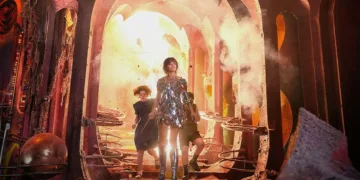
Synthetic extras surround Vijay during musical numbers, while oversaturated digital backgrounds make dancers appear detached from the floor beneath them. The compositions are crowded, yet they feel empty. This is a severe loss for a farewell designed to celebrate an actor whose stardom was built through the collective energy of theatres, fan associations, dancers, and mass choreography.
“Thalapathy Katcheri” has the rhythmic intention of a career-spanning celebration. Anirudh’s percussion and vocal hooks are shaped for audience participation, with musical phrases leaving space for cheers. The images work against that design. Artificial crowds cannot return Vijay’s energy, so the sequence resembles a star performing before an imitation of his own following.
The action reaches its visual nadir during the climactic confrontation involving soldiers, laser-firing androids, remote-controlled warfare, robot dogs, a helicopter, and a rocket launcher. The scale expands while spatial clarity contracts. Combatants appear in a landscape with little weight, impact, or geographic logic. Vetri destroys the helicopter and follows the explosion with “Blast!”, a line seeking the playful absurdity of classic masala action. The dead digital environment gives the joke nowhere to land.
Mamitha Baiju briefly restores physical excitement when Viji joins the fight. Her movement is fast and precise, and her superhero-style landing gives the sequence a tangible human centre. For a few shots, the empowerment theme leaves Vetri’s speeches and enters her body.
Sathyan Suryan frames Vijay with polished control, especially during entrances and confrontations. Low angles, forward movement, and symmetrical compositions understand the grammar of mass heroism. Those choices clash with backgrounds that flatten depth and erase the tactile relationship between actor and setting.
The AI-powered exchange with MGR makes the problem impossible to ignore. The scene seeks to connect two actor-politicians across generations, but technology turns a historical lineage into an uncanny promotional device. Tamil cinema already possesses songs, gestures, costumes, dialogue rhythms, and archival images capable of carrying memory. The synthetic resurrection feels less respectful than anxious, as if Vijay’s political inheritance requires digital certification.
The Man Inside the Monument
Vijay remains a magnetic performer when the film permits him to act through rhythm. The early sequence where Vetri forces a would-be assassin and his gang to sing a lullaby mixes intimidation, comedy, and affection. The punchlines rarely land, but Vijay understands the changing temperature of the scene, moving from threat to playfulness without losing authority.
His confrontations with misogynists and political enemies benefit from the same command. He can hold silence before a threat, shift his weight, and let the audience anticipate the line. His sentimental work is less assured. The scenes with Viji often rely on tears, swelling music, and frontal close-ups, leaving little room for uncertainty or restraint.
Baiju supplies the film’s clearest arc. Viji moves from panic and dependence toward military confidence, then fights beside Vetri rather than waiting for rescue. The screenplay keeps returning attention to her guardian, yet her performance protects the character from becoming a simple emblem of his benevolence.
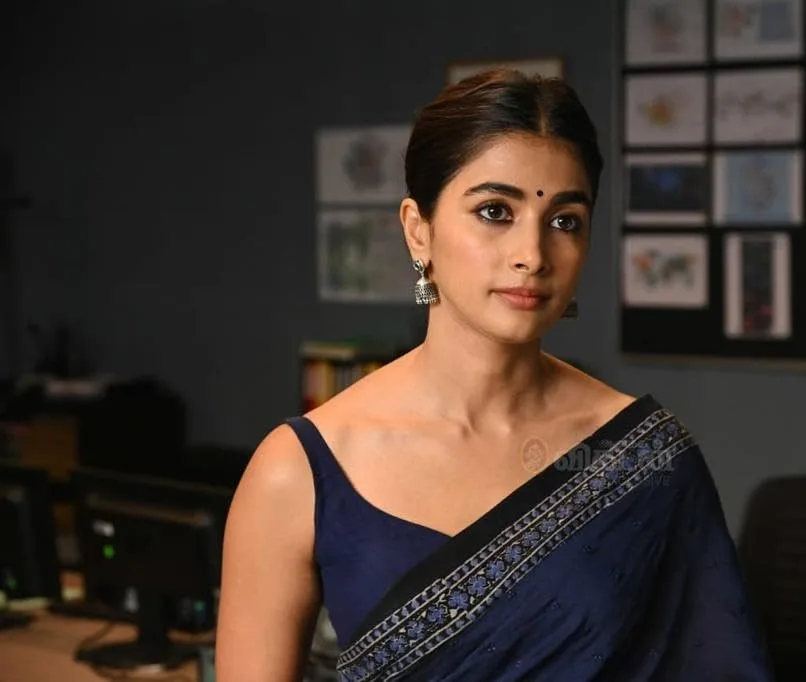
Gautham Vasudev Menon gives Srikanth enough warmth to make his absence legible, though the film removes him before the relationship can gain texture. Prakash Raj handles the local antagonist with practiced ease, using pride and irritation to prepare Vijay’s retorts. Pooja Hegde brings energy to the songs and to her work as a journalist, but the romantic material appears attached from another commercial draft.
A possible final Vijay release carries genuine sadness beyond the quality of the film. His career helped shape the rituals of contemporary Tamil stardom: dawn screenings, ticket battles, banners, milk ceremonies, dance videos, arguments, and songs heard long before their films arrived. Jana Nayagan understands the scale of that attachment. It keeps mistaking attachment for permission.
The polling-booth exit leaves Vijay walking from one institution of popular belief toward another. Behind him sits a film crowded with speeches, robots, digital ghosts, and remembered gestures. Ahead waits the public stage he has spent three hours rehearsing for.
Jana Nayagan is an Indian Tamil-language political action drama film that premiered in theaters on July 23, 2026. The film follows a former police officer whose path crosses with an authoritarian figure when a child’s fear reignites past conflicts. Viewers can watch the film in cinemas globally through theatrical distribution.
Where to Watch Jana Nayagan (2026) Online
Full Credits
Title: Jana Nayagan
Distributor: KVN Productions
Release date: July 23, 2026
Running time: 183 minutes
Director: H. Vinoth
Writers: H. Vinoth, Anil Ravipudi
Producers and Executive Producers: Venkat K. Narayana, Jagadish Palanisamy, Lohith N. K., Ramkumar Balasubramanian
Cast: Joseph Vijay, Bobby Deol, Pooja Hegde, Mamitha Baiju, Nassar, Prakash Raj, Gautham Vasudev Menon, Narain, Priyamani
Director of Photography (Cinematographer): Sathyan Sooryan
Editors: Pradeep E. Ragav
Composer: Anirudh Ravichander
The Review
Jana Nayagan
Jana Nayagan turns Vijay’s farewell into a mass-cinema coronation, complete with political declarations, legacy callbacks, and songs built for packed theatres. The quieter material carries greater force: Mamitha Baiju’s panic-stricken physicality, Viji’s military training, and the fragile emergence of a father-daughter bond. H Vinoth buries those strengths beneath campaign rhetoric, synthetic crowds, robot warfare, and a swollen third act. Vijay’s charisma remains intact, yet the film surrounding him feels strangely hollow, replacing the tactile pleasure of Tamil star cinema with artificial spectacle.
PROS
- Mamitha Baiju’s physical performance
- Vijay’s enduring screen presence
- Anirudh’s emotional songs
- Strong father-daughter premise
- Energetic hero framing
CONS
- Distracting AI-generated imagery
- Rushed emotional development
- Sermon-heavy political writing
- Bloated robot-war climax
- Thinly written antagonist