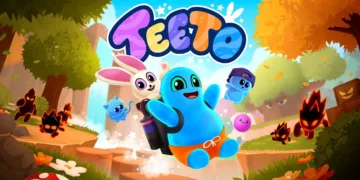

























Turning into a sofa should be a dead-end gag, yet Nory calmly settles onto Teeto’s cushions as if this were the logical result of scientific progress. That tiny animation captures the game’s strongest instinct. Its mechanics arrive wearing jokes, and its jokes are usually attached to something the player can touch.
Eat Pant Games builds this cheerful 3D platformer from several recognizable traditions. Teeto absorbs objects with the functional clarity of Kirby, moves through hub-linked stages shaped by Western collectathons, and chases mascots with the same modern appetite that made Astro Bot’s rescued characters so effective.
The Australian flavor keeps the borrowing from feeling anonymous. Machines, animals, and stray objects speak with broad local accents, while the missing-human premise is treated with comic casualness. Civilization is gone. The furniture has opinions.
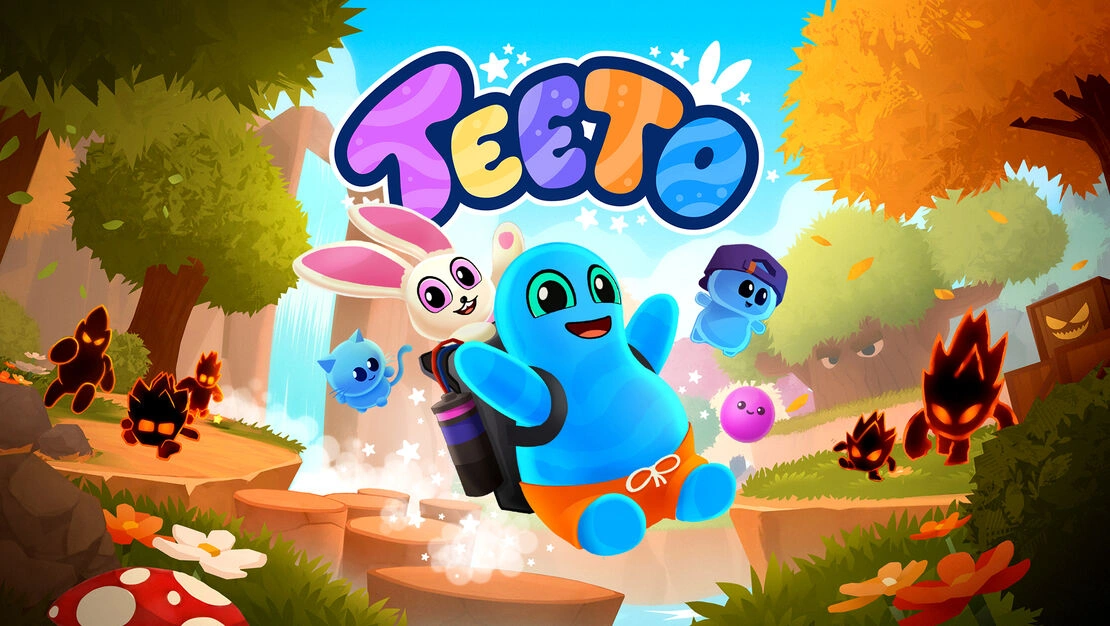
Nory, the inventive rabbit riding on Teeto’s back, gives the loose plot its only stable emotional line. She creates the silent blue blob to resist shadow creatures, recover the scattered Michaels, and investigate the disappearance of humanity. The worldbuilding rarely joins these pieces neatly, which suits a game that would rather open another dimensional door than explain its apocalypse.
Borrowed Shapes, Useful Powers
Teeto’s standard movement kit is broad and immediately readable. A double jump handles most gaps, holding the button deploys a forgiving glide, and ledge grabs rescue jumps that fall a little short. The dodge roll has a satisfying burst of speed, while spin attacks, ground pounds, and the normal-form blaster cover basic combat. Frequent checkpoints soften failure, and optional invulnerability offers an escape route when a boss suddenly demands tighter timing than the preceding level.
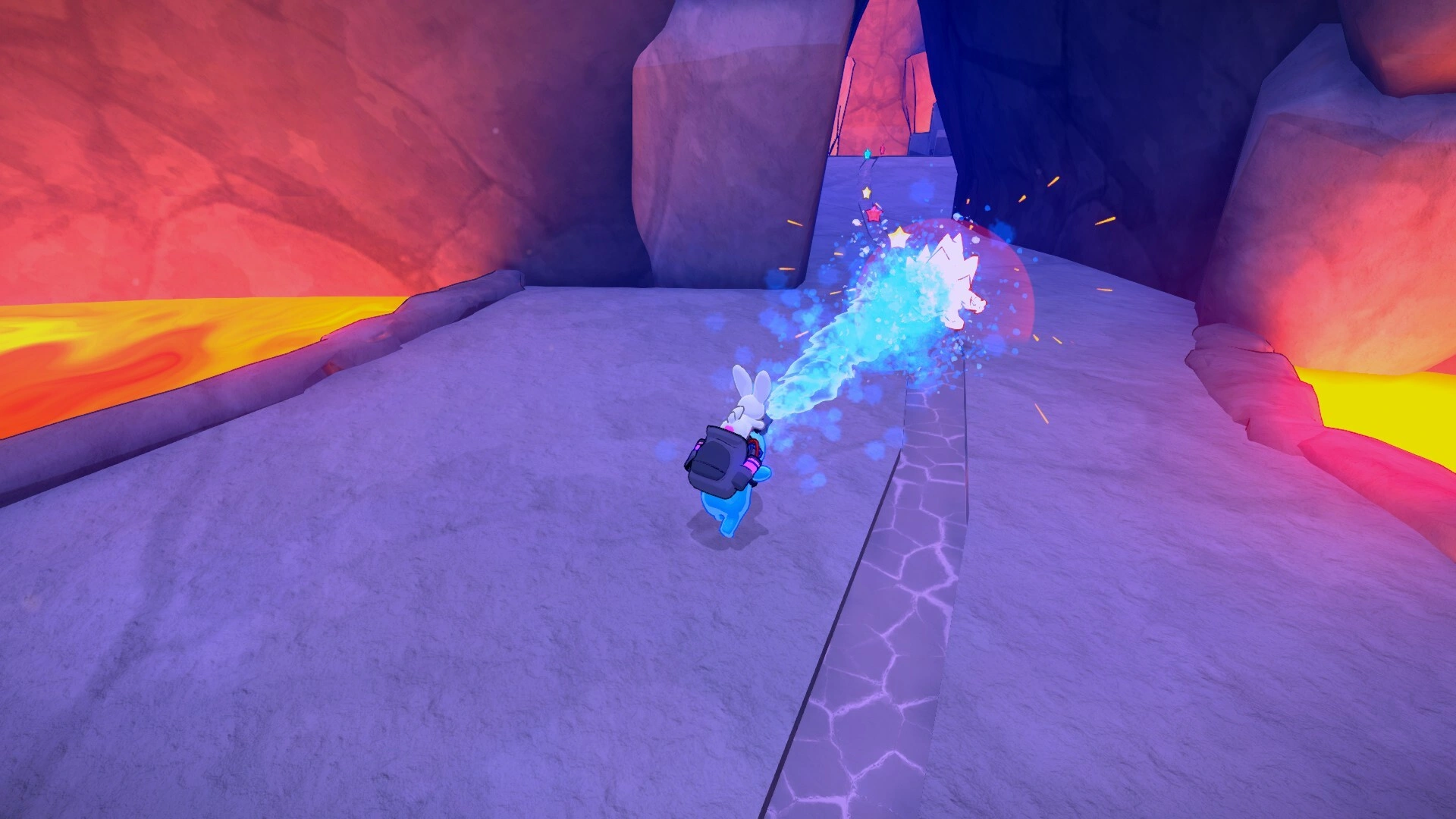
The absorption system gives each stage its own grammar. A flower wraps Teeto in petals and creates a stem used to grapple across fixed nodes. Rock form breaks cracked floors and walls. Water extinguishes flames, fire melts ice, and electricity wakes dormant machinery. Magnets pull suitable objects into place. Cardboard turns packaging into a tool, which is a sentence few platformers earn honestly.
These powers are strongest when a puzzle asks for a sequence rather than a single answer. Building a sandcastle requires water before the shovel-and-bucket form can finish the task. Elsewhere, a transformation changes the route through an area, then gives way instantly to Teeto’s normal body for combat or movement. The quick return keeps the system playful instead of procedural.
Control quality is less consistent. Long jumps can feel floaty, yet midair corrections are oddly twitchy. The camera sometimes drifts between Teeto and the landing point, making an easy platform harder to read. Lowering sensitivity helps with the initial dizziness, though it cannot fix every obscured angle or jump that lands a few pixels away from where the animation suggests.
Local Absurdity, Global Platforming
The campaign’s four areas and roughly two dozen stages keep changing their scenery before familiarity turns stale. Beaches and forests establish the expected collectathon language, then a regular house turns Teeto into a miniature intruder. Supermarket aisles become obstacle lanes. A giant tree hosts a stealth sequence. One cave contains harmless bears recording a podcast around a table, a joke that works because the game treats it as ordinary local business.
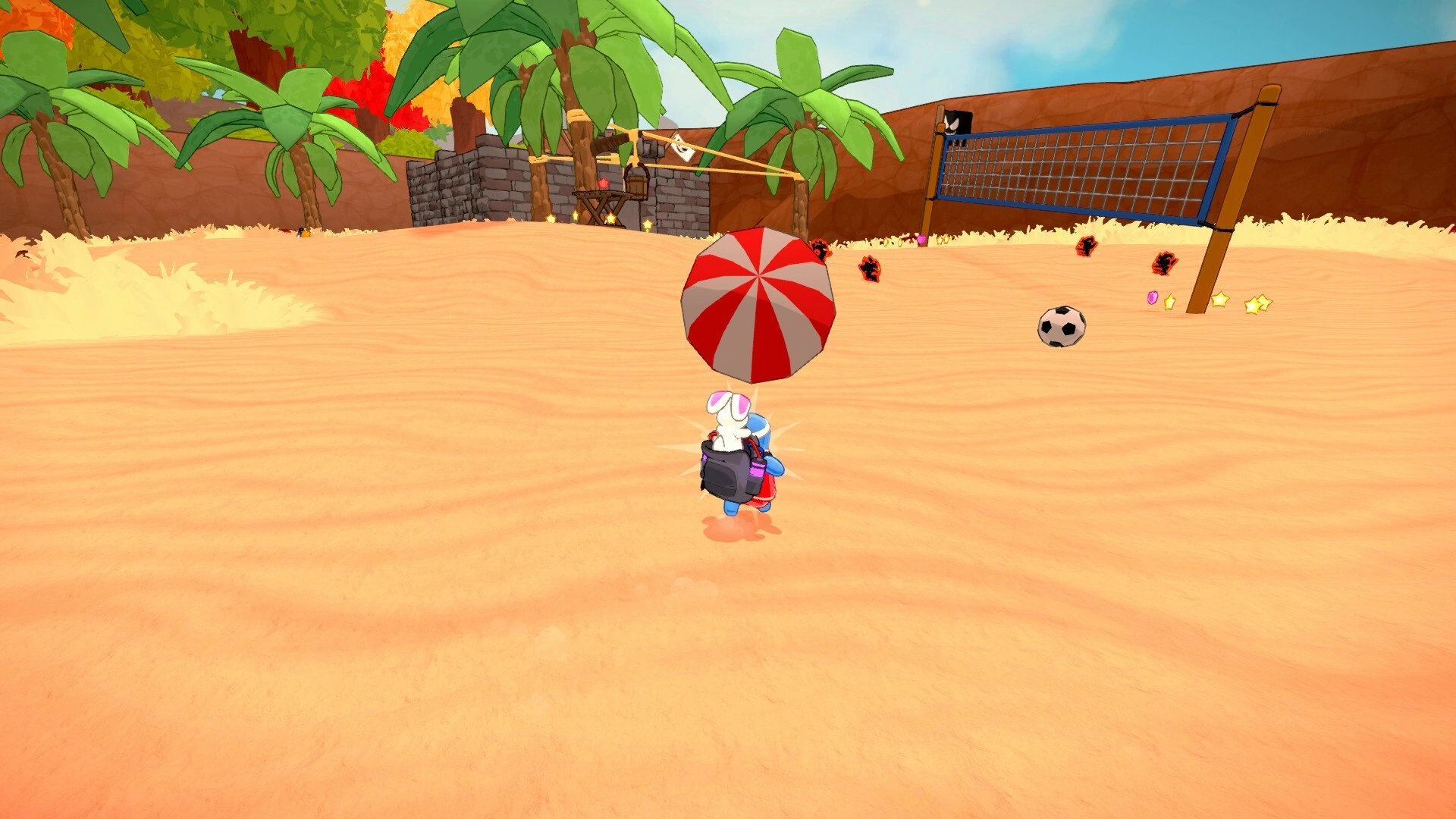
That mixture of global genre design and Australian comic performance gives Teeto its identity. The level structure speaks the international language of Banjo-Kazooie, Spyro, and newer mascot games, while the voices deliver campy quips with regional rhythm.
Nory’s brighter, steadier performance keeps the louder NPCs from flattening into noise. Some jokes arrive too forcefully during the tutorial, and mild swearing feels misplaced beside the soft shapes and family-facing presentation. Still, the cast rarely sounds manufactured by committee.
Difficulty creates a similar mismatch. Most objectives are gentle: shoot flags, locate a key, power a device, or follow a transformation prompt. Bosses occasionally ask for cleaner dodges and sharper positioning than the movement system reliably supports. A stealth side mission is frustrating for a different reason, since the expected behavior is poorly signposted. The game is welcoming until it forgets to explain itself.
The Michael Economy
Progress follows a familiar hub-and-spokes pattern. Vionites unlock later clusters, stars purchase costumes, and optional tasks fill each stage with reasons to leave the direct path. A button can point toward the nearest collectible, which lets younger players avoid aimless searching while leaving traditional exploration intact for anyone who ignores it.
The Michaels are the smarter reward. Nory’s previous experiment shattered into tiny blue pieces, each with a costume, trait, or personality joke. Cool Michael, Business Michael, and Emotionally Unavailable Michael offer no stat upgrade and no mechanical advantage. Curiosity does the work. A ledge becomes tempting because another strange little face might be waiting behind it.
Rescued Michaels gather on an island in the hub, where their accumulation turns completion into a visible community rather than a percentage on a menu. Local split-screen co-op extends that logic by letting two players search, solve, and collect together.
The bright polygonal art, expressive facial animation, and muted digital music make the world feel like a toy box imported from another console generation, then repainted for a new audience. The strongest reward remains gloriously unnecessary: throwing a Michael into the hub’s basketball hoop and watching the little guy fly.
The Review
Teeto
Teeto borrows the shape-shifting logic of Kirby and the hub-world cadence of late-1990s Western collectathons, then filters both through a proudly Australian comic register. Flower grapples, cardboard tricks, sofa transformations, and the absurdly specific Michaels give its stages a personality that travels well beyond nostalgia. Floaty movement, erratic camera work, and uneven bosses keep the adventure from joining its genre’s finest, yet its warmth and mechanical curiosity carry it through. This is a small platformer with a clear cultural accent and a generous sense of play.
PROS
- Inventive object transformations
- Distinct Australian comic voice
- Lovable Michael collectibles
- Varied, playful stages
- Welcoming co-op design
CONS
- Floaty movement
- Unreliable camera
- Uneven boss difficulty
- Limited transformation applications