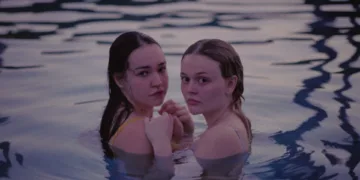


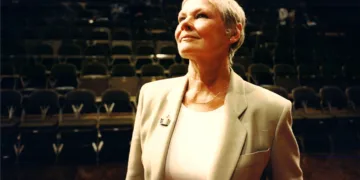


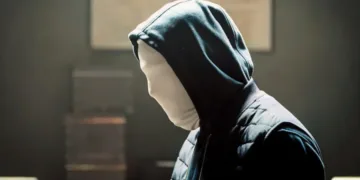
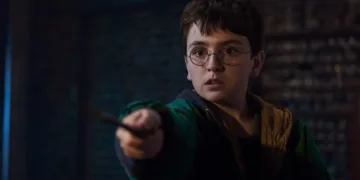














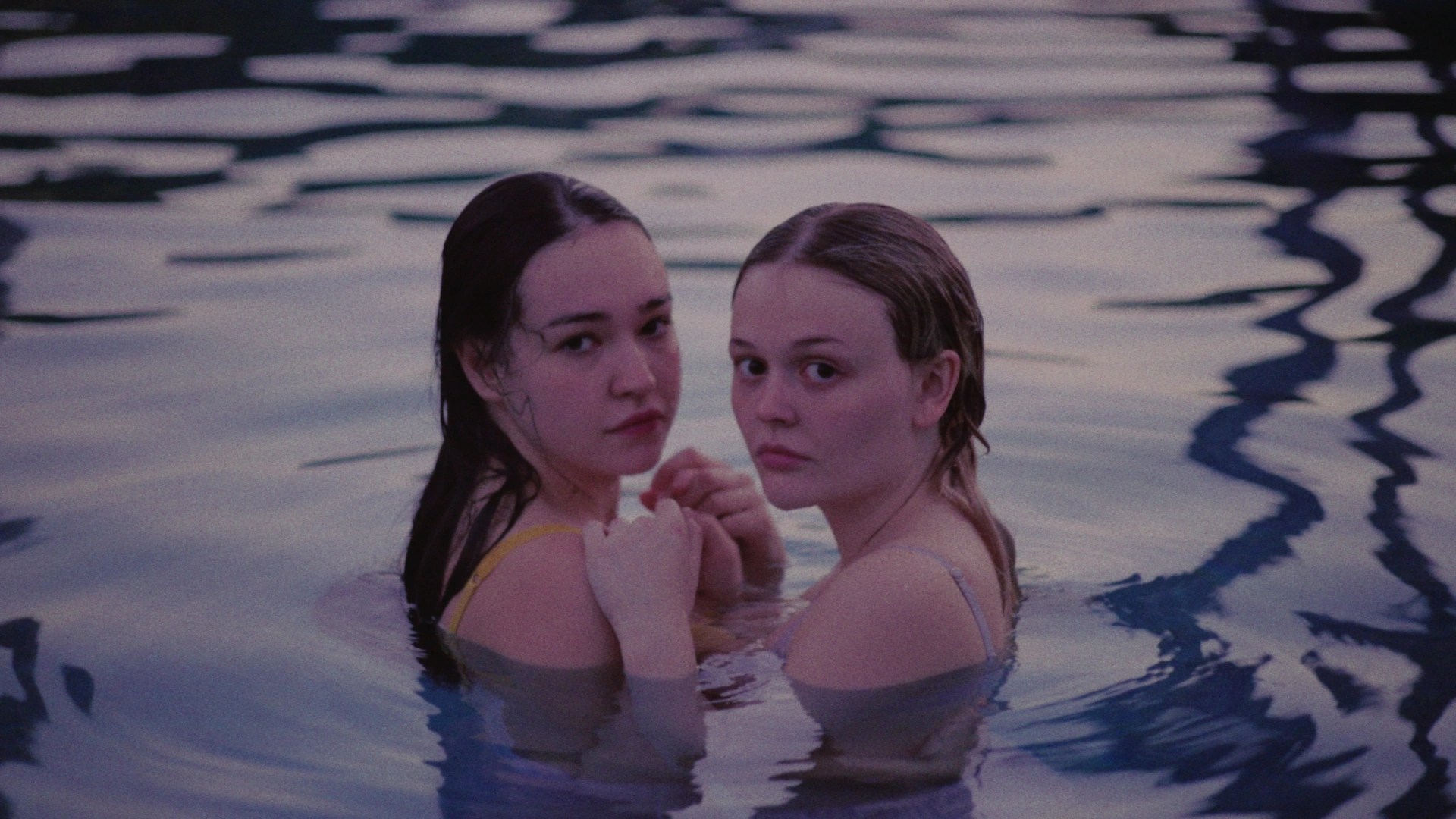

Marie and Luna have learned to imagine adulthood through women who existed for them long before either girl understood what fame costs. Hedy Lamarr, Joan Crawford, and Bette Davis provide the vocabulary. What Ever Happened to Baby Jane? supplies the ritual. When the friends perform “I’ve Written a Letter to Daddy,” the song feels less like imitation than a private promise that the world waiting outside their small town must contain something larger.
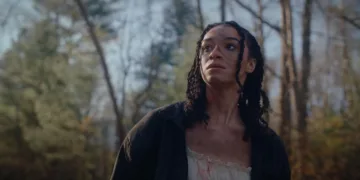
Tyler-Marie Evans builds Pretty Babies around the moment that promise stops protecting them. Marie (Emily Alyn Lind) has grown up under a religious mother who restricts her movie diet to old Hollywood. Luna (Sadie Stanley), nicknamed for her supposed lunacy, treats those same films as evidence that stardom can be seized through nerve alone. Marie still imagines college and training. Luna wants Los Angeles now.
Their escape begins after Marie is sexually assaulted at Luna’s house. Luna retaliates with a bottle, the girls steal the man’s car, and suddenly their movie-star fantasy has wheels. Evans turns the road west into a steady erosion of everything they thought Hollywood meant.
Dream Girls on a Bad Road
Money dismantles the fantasy first. Gas stations, motels, diners, and empty stretches of highway replace premieres and auditions. One young man asks Luna to pose for his camera before drawing her into bed, a small encounter that captures how easily attention can imitate opportunity for someone desperate to be seen. Then Gemma (Madelaine Petsch) and Sapphire (Ashley Benson) enter the car.
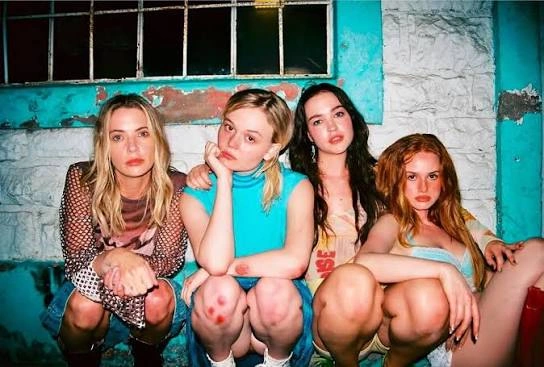
The older women work in the sex industry and quickly recognize the younger pair’s financial problem. Their proposal is practical: paid encounters can fund the trip. Marie approaches the idea with visible unease. Luna adapts faster, partly because she has already convinced herself that every compromise belongs to the larger plan.
Evans is strongest when she keeps Gemma and Sapphire from becoming easy villains. They offer companionship, information, and moments of genuine tenderness. The quartet briefly creates its own mobile support system, particularly in scenes where the women can simply exist together away from men. Yet money keeps pressing against those connections, turning affection into something harder to separate from survival.
The film becomes shakier when violence carries too much structural responsibility. Marie’s assault launches the trip, while later abuse again pushes the story into its next phase. These scenes communicate the danger surrounding young women without much ambiguity, but their placement sometimes makes trauma feel like narrative machinery. That bluntness sits awkwardly beside the patience Evans gives smaller moments, such as Marie hesitating before meeting a client or Luna performing confidence after it has clearly started collapsing.
Two Girls, Two Exits
Stanley gives Luna the film’s most dramatic transformation without announcing each stage of it. Early on, her certainty is infectious. She speaks as though Los Angeles has already accepted them and they merely need to arrive. As the trip deteriorates, that confidence mutates into drug use, anger, reckless decisions, and pressure on Marie to keep participating.
Her most painful scenes arrive when Marie begins pulling away. Luna’s fury initially resembles possessiveness, yet Stanley lets panic leak through it. Losing Marie means losing the person who has been confirming Luna’s version of reality.
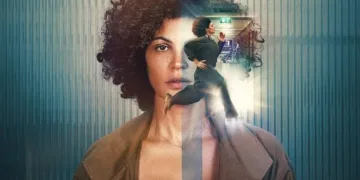
Lind plays the opposite rhythm. Marie spends long stretches observing, absorbing, and delaying decisions. Her romance with a young man she meets on the road gives her another possible exit, eventually drawing her toward Las Vegas. The relationship itself carries a touch of the same screen romance Marie has grown up watching, which makes its apparent safety feel both comforting and suspiciously familiar.
A one-way FaceTime call with Marie’s mother cuts deeper than the film’s larger confrontations. With distance, danger, and embarrassment finally stripping away the performance of independence, Marie looks like a teenager again. Lind keeps the moment small. There is no grand speech capable of repairing what has happened.
The friendship between Marie and Luna hurts because neither girl is entirely wrong to seek another life. Their conflict comes from discovering that the life each wants may require leaving the other behind.
Glitter, Grain, and Borrowed Stardom
Lauren Guiteras photographs the trip in sun-burnished tones, grain, lens flare, motel darkness, and bursts of glitter. Alyssa Blair Cawthon’s costumes extend that idea through Luna’s heavier makeup and performative glamour, set against Marie’s comparatively restrained appearance. The girls keep dressing for the movie they think they are entering while the locations insist on another genre entirely.
Benjamin Rodriguez Jr.’s editing makes the clash literal by inserting fragments of classical Hollywood romance throughout the trip. Those images once taught Marie what desire should look like. Placed beside paid encounters, cheap rooms, roadside arguments, and unstable romance, they start to resemble false memories from a life she never lived.
The repeated connection to Davis and Crawford is especially sharp because Marie and Luna understand the surface before they understand the damage underneath it. They borrow glamour, melodrama, and devotion without recognizing how much sadness sits inside the mythology they adore.
Music occasionally gives the film room to soften. Édith Piaf’s “Sous le ciel de Paris” accompanies an all-female moment that briefly suspends the economic pressure shaping nearly every relationship. For a few minutes, these women are allowed to enjoy one another’s company without calculation.
That temporary lightness matters because Pretty Babies works best when its craft lets us feel the exact distance between the girls’ fantasy and their circumstances. Evans keeps Hollywood visible like a destination on a map, while every mile toward it makes the dream harder to recognize.
Pretty Babies made its world premiere on August 14, 2026, at the Edinburgh International Film Festival, with production backed by Killer Films and Wagner Entertainment. The drama follows two teenage girls who flee their home to chase stardom in Hollywood, only to become trapped in the dark underbelly of the sex work industry as they journey from Texas to California.
Where to Watch Pretty Babies (2026) Online
Full Credits
Title: Pretty Babies
Distributor: Killer Films, Wagner Entertainment
Release date: August 14, 2026
Running time: 1 hour 32 minutes
Director: Tyler-Marie Evans
Writers: Tyler-Marie Evans
Producers and Executive Producers: Ashley Benson, Christine Vachon, Jordan Wagner
Cast: Ashley Benson, Emily Alyn Lind, Madelaine Petsch, Sadie Stanley, Elias Kacavas, DeVaughn Nixon, Wyatt Yang, Simon Roszak, Ana Berry
Director of Photography (Cinematographer): Lauren Guiteras
Editors: Benjamin Rodriguez Jr.
Composer: Roman Molino Dunn
The Review
Pretty Babies
Pretty Babies finds its strongest pulse in the space between Marie and Luna, especially when the road begins pulling them toward different versions of escape. Sadie Stanley gives Luna’s swagger a painful decay, while Emily Alyn Lind makes Marie’s quieter retreat feel equally consequential. Tyler-Marie Evans gives their trip a seductive visual haze, then lets motel rooms, transactional encounters, and violence stain it. Some trauma beats feel too blunt for the delicacy surrounding them, yet the friendship keeps the film emotionally alive.
PROS
- Strong chemistry between the leads
- Sadie Stanley’s unraveling performance
- Expressive grainy cinematography
- Effective classic-Hollywood inserts
- Female friendship carries real weight
CONS
- Uneven tonal shifts
- Sexual violence handled too bluntly
- Marie is occasionally underwritten
- Some melodrama weakens the realism