





























Andrew Haigh’s relocation of Colm Tóibín’s story from the Spanish Pyrenees to early-1950s Colorado changes the meaning of isolation. The Rocky Mountain farm where Mike lives with his parents and younger brother carries a specifically American promise: land, self-reliance, distance from interference. Lester has built his life around that promise. Louise experiences the same landscape as confinement.
That distinction gives A Long Winter much of its tension. Tommy, played by Kit Connor, is preparing to leave for military service in Korea and speaks openly about wanting another life. Mike, played by Fred Hechinger, has already tried leaving, working on a farm elsewhere before returning home because he missed the mountains. Their opposing impulses turn the cabin into a tiny argument about postwar America. One son looks outward while the other clings to familiarity.
Louise’s Cosmopolitan magazines complicate that picture further. She hides them among the household provisions because Lester regards such spending as frivolous. Their glossy clothes, rooms and city lives belong to an America she can see but cannot reach. Her records serve a similar purpose. Even Lester’s abandoned mandolin and old furniture-making ability hint that he once possessed a creative life before hardship reduced him to work, discipline and resentment.
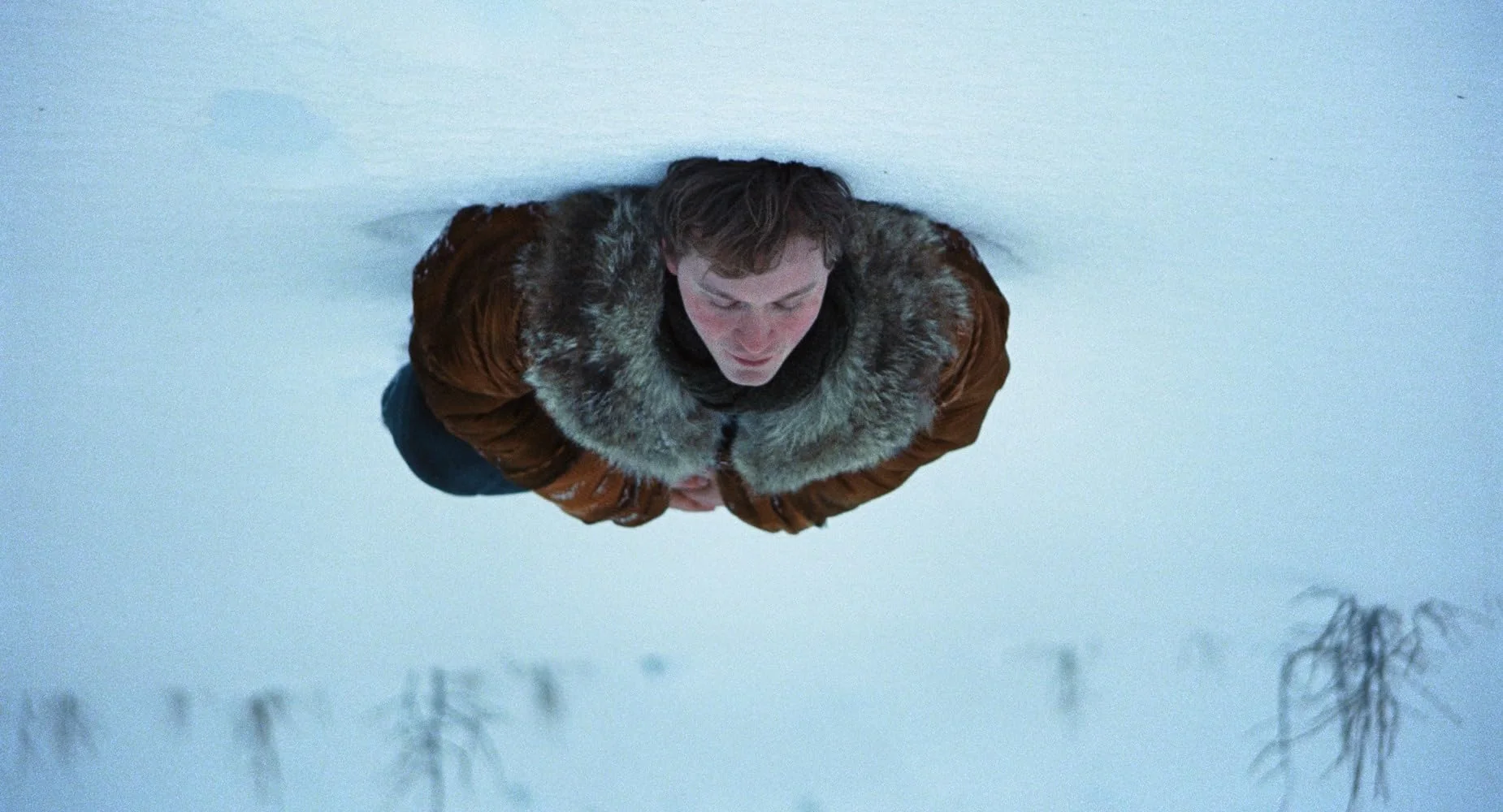
André Turpin shoots the surrounding peaks with crystalline grandeur, yet the scale rarely suggests freedom. Tiny figures disappear inside white valleys and dark forests. The landscape that might sell Colorado as paradise instead makes the family’s separation from the world feel nearly absolute.
Louise Leaves
Mike’s discovery of Louise’s drinking comes through deception rather than confession. During a supply trip, he sees her take a drink in town, then listens as she later denies it. Everyone else seems to understand what is happening. Mike has been protected from the truth, which makes him the last person inside the family to recognize how badly its structure has already failed.
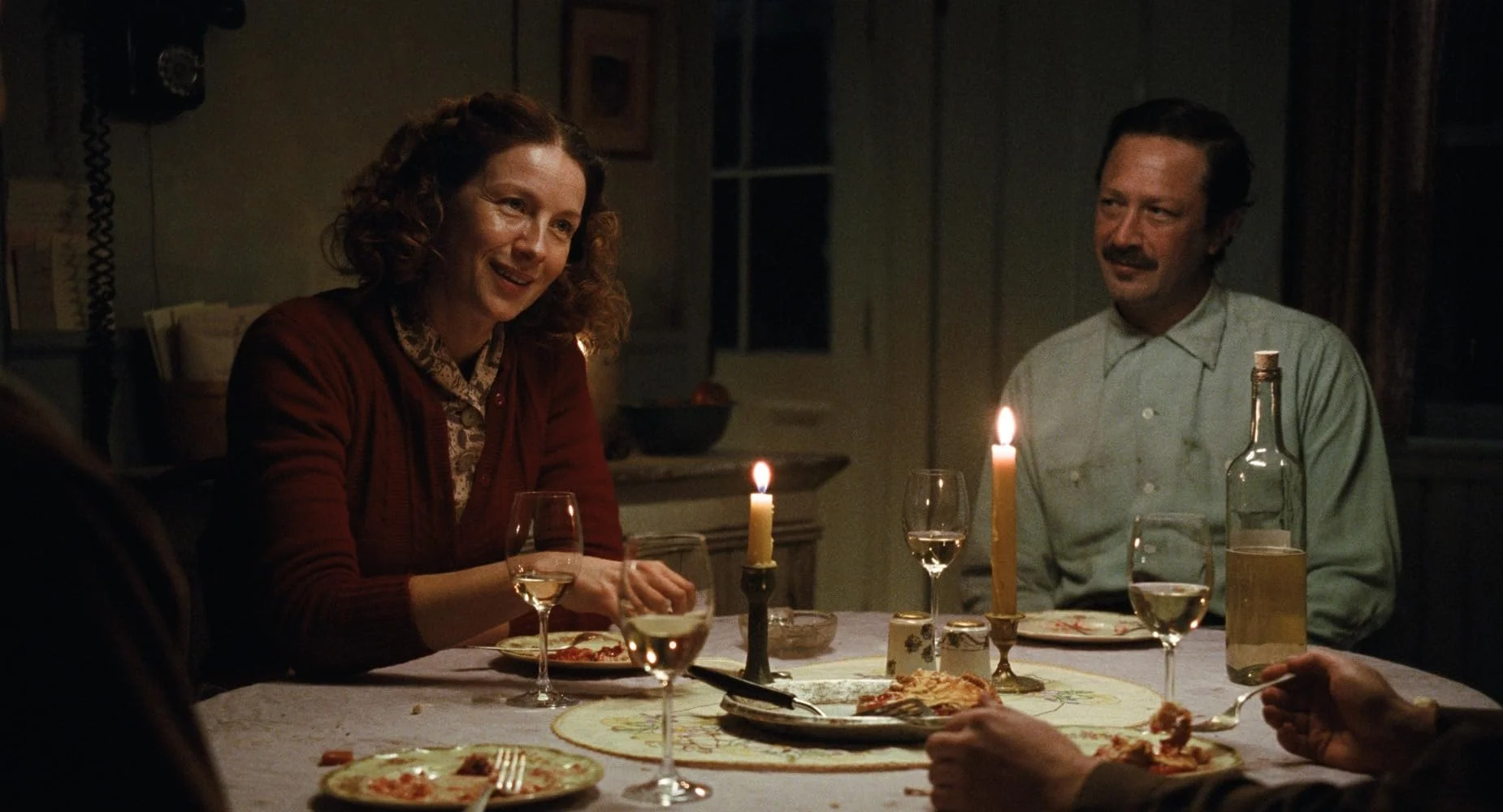
Lester responds with the logic he applies to nearly everything: remove the problem and endure the consequences. He pours away Louise’s hidden wine and expects abstinence to repair her. Ebon Moss-Bachrach makes the cruelty of that decision sharper by refusing to play Lester as a cartoon tyrant. His family history with alcoholism gives his rigidity a source, while his inability to comprehend Louise’s unhappiness turns fear into control.
Caitríona Balfe makes Louise’s breakdown at the kitchen table especially difficult to dismiss. Her anger, panic and exhaustion reveal someone who experiences alcohol as one of the few remaining means of surviving the life around her. Shortly afterward, she puts on her winter coat and leaves on foot while a storm approaches.
The disappearance shifts the film’s cultural register. The frontier mythology of surviving nature becomes useless when the missing person may have fled the household itself. Search parties and state troopers can read tracks in the snow. They cannot easily read why Louise wanted out.
Men Doing Women’s Work
Once snow makes the search nearly impossible, the cabin settles into a peculiar male domesticity. Lester can raise animals and maintain a remote farm, yet cooking and household labor immediately expose the limits of his cherished self-sufficiency. The contradiction is dryly funny, especially once Jimmy arrives to perform the work previously assigned to Louise.
D’Pharaoh Woon-A-Tai plays Jimmy with a quietness that pushes against Lester’s need to classify everyone. He is biracial, younger, socially vulnerable and hired to do tasks Lester regards as feminine. Lester mocks him for precisely the labor that keeps the household functioning. The insult reveals how tightly gender, work and authority have been fused inside the cabin.
Mike initially treats Jimmy as an intrusion. Jimmy sleeps in Tommy’s empty bed, occupying a space attached to Mike’s childhood and to the brother now overseas. Their relationship shifts after Mike defends him from Lester’s ridicule. Soon they are walking the mountain together, continuing the search long after Lester has lost faith in finding Louise alive.
Haigh finds an odd freedom here. Perry Como’s “A Dreamer’s Holiday” plays across a house suspended between catastrophe and routine. The men ration bathwater, eat, work and pass time. Grief has disrupted the roles that organized their lives, and for brief stretches the disruption feels almost liberating. The film allows that discomfort to remain unresolved.
Desire Without a Vocabulary
Mike’s sexuality develops inside a culture with few available words for what he feels. His attraction first surfaces through eye contact with a young police officer helping with the search. Later fantasies make the desire explicit, yet Mike never turns his feelings into the kind of identity statement a contemporary story might supply.
That choice places his sexuality firmly inside the film’s period setting. Louise finds images of another possible life in magazines. Mike looks at those same pages and discovers something different. One object travels between mother and son, carrying separate forms of longing across gender and generation.
His attraction eventually shifts toward Jimmy, but Haigh keeps the relationship uncertain. Jimmy’s presence matters partly because he offers Mike companionship outside the family hierarchy. Their walks through the snow move farther from Lester each time, physically extending the distance Mike has begun creating inside the cabin.
Hechinger plays that change through small adjustments rather than dramatic rebellion. Mike continues searching for Louise when his father has largely stopped. He challenges Lester at home. He becomes less guarded around Jimmy. Turpin’s close-ups give those decisions room to register, while Paul Haslinger’s restrained score rarely dictates what any of them should mean.
The film’s American setting sharpens one final tension: Lester chose isolation as independence, Louise experienced it as captivity, and Mike slowly begins to understand that home can contain both truths at once. His future does not require rejecting the mountain. It requires seeing what the mountain cost everyone who lived there.
A Long Winter premiered at the 53rd Telluride Film Festival on September 4, 2026, ahead of upcoming festival screenings and its eventual streaming debut on Mubi. Set high in the mountains as autumn draws to a close, the drama follows a rural family preparing for a brutal seasonal shift that tests their resilience.
Full Credits
Title: A Long Winter
Distributor: Mubi, Film4
Release date: September 4, 2026 (Telluride Film Festival)
Running time: 1 hour 57 minutes
Director: Andrew Haigh
Writers: Andrew Haigh (Based on the short story by Colm Tóibín)
Producers and Executive Producers: Tristan Goligher, Chad Oakes, Mike Frislev, Michael Elliott
Cast: Fred Hechinger, Kit Connor, D’Pharaoh Woon-A-Tai, Ebon Moss-Bachrach, Caitríona Balfe, Manuel Garcia-Rulfo, David Furr
Director of Photography (Cinematographer): André Turpin
Editors: Jonathan Alberts
The Review
A Long Winter
A Long Winter turns Colm Tóibín’s mountain isolation into distinctly American postwar loneliness, using the Rockies as both refuge and prison. Andrew Haigh is strongest when cultural repression emerges through behavior: Lester policing domestic roles, Louise clinging to magazines and records, Mike discovering desire without language for it. André Turpin’s snowbound 35mm images give those tensions physical scale, while Fred Hechinger keeps Mike’s awakening tender and uncertain. Its restraint occasionally leaves character development frustratingly faint, yet the film’s quiet strangeness lingers.
PROS
- Striking Rocky Mountain cinematography
- Hechinger’s restrained performance
- Rich portrait of postwar masculinity
- Louise’s absence shapes every relationship
- Subtle handling of queer desire
CONS
- Mike’s development can feel underdrawn
- Jimmy receives limited dramatic space
- Deliberate pacing may test patience