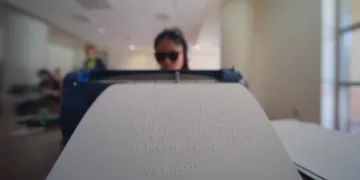




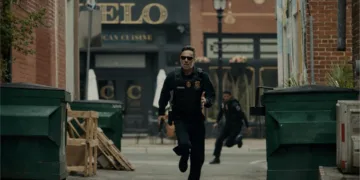




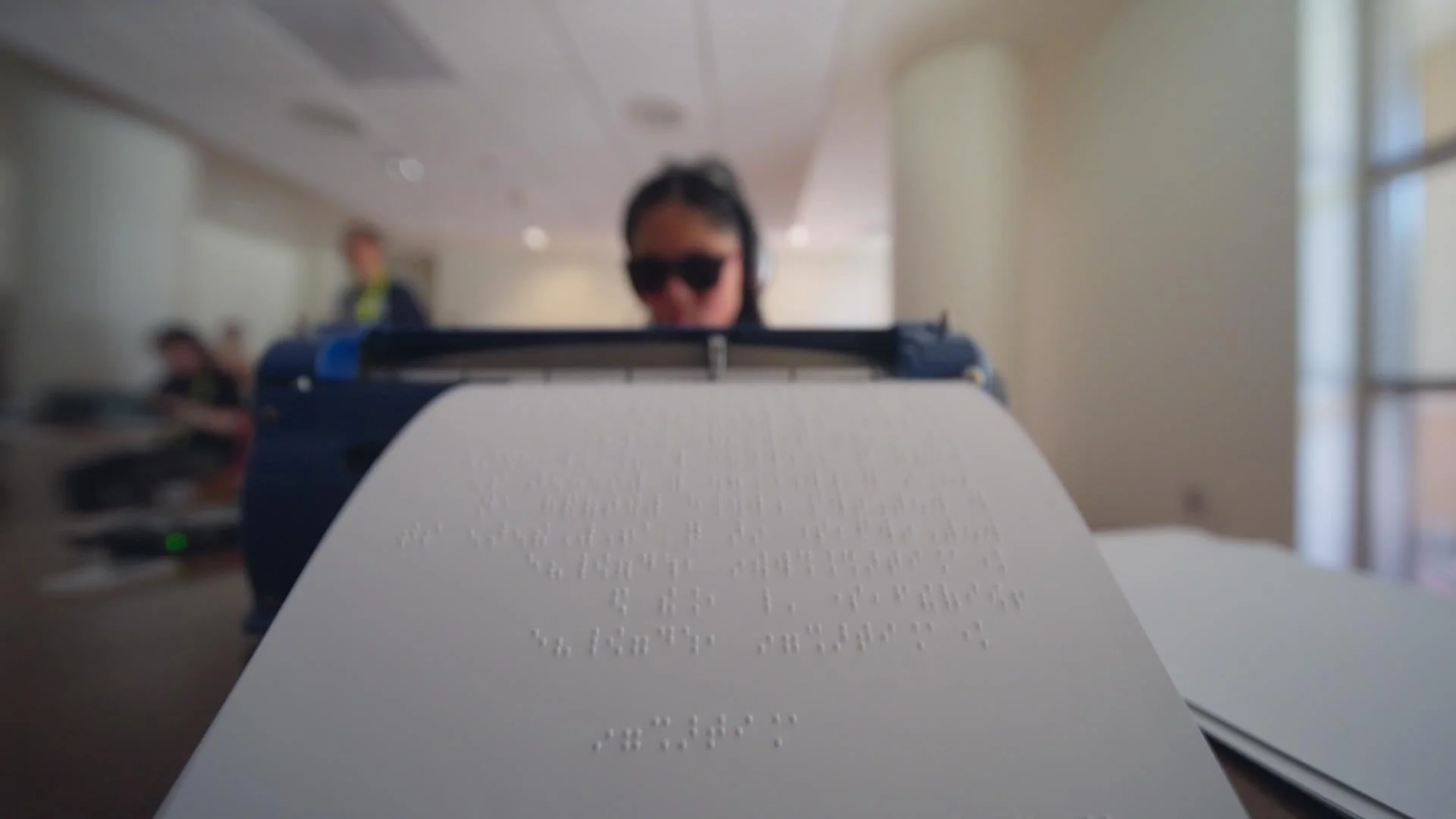

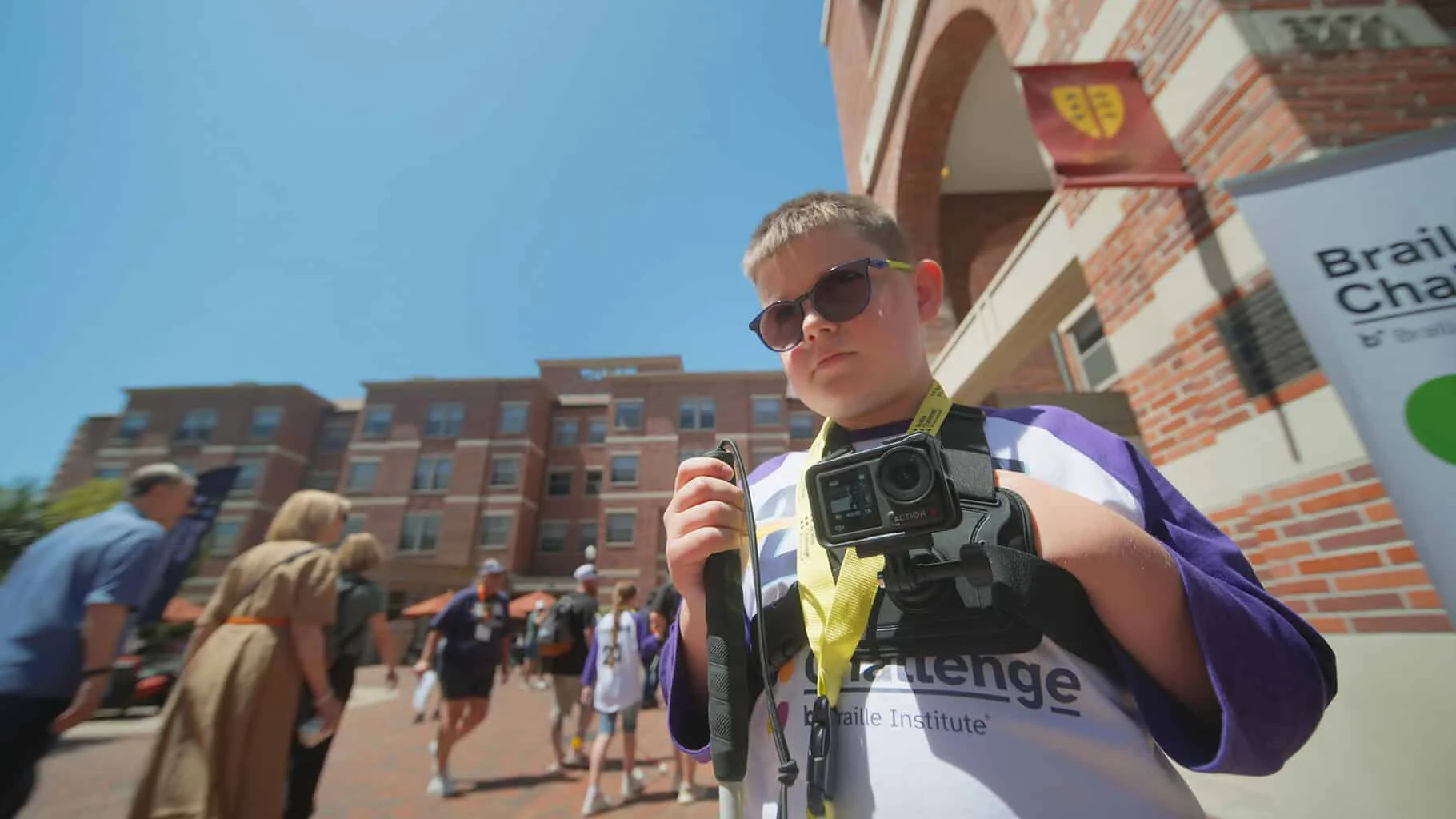
The camera is supposed to know where to look. Cinema has trained us to expect this small act of obedience: a face centered at the right moment, a gesture preserved before it disappears, an emotion waiting patiently inside the frame. Brailled It gives some of that authority away. Salome Cummins, Isaiah Gauthier, and Christopher Morgan wear cameras as they move through the annual Braille Challenge in Los Angeles, and the images often shake, drift, arrive late, or point somewhere a conventional cinematographer would never choose. What matters is that the choice belongs partly to them.
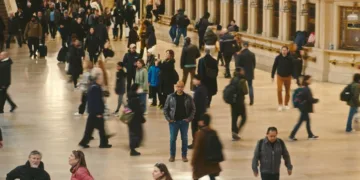
David Grabias builds the documentary around blind and low-vision students competing in Braille literacy, but he resists shaping them into neatly introduced subjects who sit before a camera and explain themselves. Instead, the film remains close to bodies in motion. Salome, Isaiah, and Christopher walk through hallways, prepare for tests, speak with friends, worry about results, and carry the recording apparatus with them. At times this produces footage that can feel physically disorienting. Faces disappear. Spatial relationships become difficult to read. A sighted audience accustomed to images being arranged for its comfort may feel the absence immediately. That discomfort has meaning.
The film never grants us direct access to another person’s perception, and it would be foolish to pretend a chest-mounted camera could accomplish such a thing. What the device changes is the balance of control. These young filmmakers can decide when the camera operates, and the resulting images are shaped by where their bodies happen to be rather than by an outside observer constantly repositioning them. Brailled It becomes less concerned with showing us blind and low-vision children than with allowing three of them to determine part of the way they will be encountered.
The Braille Challenge gives this experiment its dramatic structure. Students gather to test their speed and literacy, and the stakes are treated seriously by the competitors themselves. Christopher has attended for twelve years and has reportedly taken first place ten times. He moves through the event with the ease of someone returning to a familiar social world, seeking people out and talking readily.
Isaiah, eleven and visiting from Canada, shows a fascination with technology and at one point imagines a camera designed with Braille controls. Salome carries herself with fiercer competitive tension. She wants to beat Leo, another contestant, and when she becomes hard on herself after competing, the moment lands because the film allows disappointment to remain disappointment.
That distinction matters. There is always a temptation in documentaries involving disability to convert every achievement into inspiration before the person experiencing it has even had time to decide what it meant. Brailled It usually resists that reflex. An organizer may regard qualification itself as victory, yet the contestants are still allowed to want the prize. They have trained. They compare themselves with others. They can be proud, anxious, irritated, disappointed, ambitious. Their dignity does not require them to transcend competition. Sometimes dignity is simply being permitted to care about winning.
Around that competition, another film slowly reveals itself. Christopher talks with fellow attendees. Salome spends time with her friend Jane and their families over ice cream sandwiches. Isaiah’s attention drifts toward equipment and possibility. Conversations move toward food, friendships, rivalries, future plans. The contest creates the gathering, yet what accumulates is a temporary community in which Braille does not need to be explained before anything else can happen.
There is something quietly moving in that change of scale. For most of the world, Braille may appear as a specialized system encountered from a distance. Here it becomes literacy, labor, proficiency, status, frustration, and social connection. Fingers move across raised dots with astonishing speed. Braillers turn that literacy into competition. The participants measure themselves against one another through a skill that elsewhere can become another marker of difference. Within these rooms, difference becomes the common language.
Sound carries a remarkable amount of the film’s weight. Meredith Stein’s visual descriptions accompany footage that would sometimes be difficult to follow even without considering accessibility. Her narration identifies movements, surroundings, and actions that the cameras do not reliably frame.
Practically, this helps stabilize the documentary. Formally, it creates something stranger. A medium so accustomed to treating sight as its highest authority repeatedly depends on language to explain what the image cannot contain. The effect is less philosophical than it sounds when described abstractly. You simply begin listening differently.
Still, the freedom of the film’s method has a cost. The chest-mounted footage can become excessively shaky, and some viewers may find it physically uncomfortable. The decision to avoid traditional interviews also leaves certain gaps around the three participants. We learn pieces of their lives and personalities through observation, yet a little extra context might have deepened our understanding without stripping the film of its first-person character.
Seeing the process of receiving and learning to use the cameras, for instance, could have revealed another layer of the experiment. The mechanics of the Braille Challenge itself could also be explained with greater clarity, particularly when the competition becomes the immediate source of tension.
These shortcomings grow from the same decision that gives the film its power. Brailled It wants proximity badly enough to surrender polish, conventional coverage, and some explanatory control. Sometimes that sacrifice feels liberating. Sometimes it merely leaves us wishing we knew a little more.
Perhaps that uncertainty is the most fitting place for the film to remain. Salome, Isaiah, and Christopher are not always clearly framed, yet over seventy-three minutes their voices, anxieties, jokes, rivalries, habits, and ambitions begin to form a presence no clean composition could guarantee. We see less of them in the conventional cinematic sense and, at certain moments, encounter them with greater intimacy. To look at someone is easy; relinquishing control over how they will be seen is harder.
Brailled It opened in select theaters nationwide in September 2026, distributed by Suncatcher Productions. The documentary follows blind and low-vision youth competing in the annual Braille Challenge, capturing their authentic experiences as they document the event themselves.
Full Credits
Title: Brailled It
Distributor: Suncatcher Productions
Release date: September 2026
Running time: 1 hour 13 minutes (73 minutes)
Director: David Grabias, Brendon Schulze, Salome Cummins, Isaiah Gauthier, Christopher Morgan
Cast: Salome Cummins, Isaiah Gauthier, Christopher Morgan
Director of Photography (Cinematographer): Salome Cummins, Isaiah Gauthier, Christopher Morgan
The Review
Brailled It
Brailled It works because its formal risk and its subject are inseparable. By letting Salome, Isaiah, and Christopher help control the image, the film trades visual polish for a rarer intimacy, one built from movement, sound, rivalry, friendship, and the ordinary desire to win. The shaky footage and thin biographical context sometimes limit that experiment, yet its imperfections belong to the same act of surrender that gives the documentary its identity.
PROS
- Participant-controlled perspective
- Strong use of audio description
- Honest competitive tension
- Warm sense of community
- Distinctive documentary form
CONS
- Frequently shaky footage
- Limited biographical depth
- Competition mechanics need clearer explanation
- Some dramatic tension dissipates quickly