























The impostors in Skeleton Knight in Another World Season 2 have chosen their disguises well. Arc and his companions are recognizable enough for criminals to borrow their identities, and familiar enough for the premiere to rebuild an episode around their established habits.
A rescue earns them a feast and a hot-spring visit; the next morning, frightened villagers mistake them for kidnappers. Clearing up the confusion requires another rescue. This returning adaptation makes recognition its organizing pleasure, inviting viewers back through the same combination of righteous intervention, excessive force, and companionable exasperation that carried the first season.
The impersonation plot also reveals where the episode places its attention. Kidnapped children need rescuing, but the heroes’ damaged reputation supplies the immediate problem to solve. Their name must become trustworthy again before the adventure can settle back into its comfortable rhythm.
That emphasis helps explain the series’ peculiar relationship with its dark material. Slavery and persecution create urgent reasons for action, while attachment to the returning party determines how those emergencies are experienced. The victims’ danger moves the story; the heroes’ vindication supplies much of its satisfaction.
Arc’s outlook makes that arrangement easy to sustain. Transported into another world in the skeletal body of his MMORPG character, he retains the enthusiasm of someone delighted to discover that his abilities actually work. A spring in the Wind Dragon Mountains may restore his body, yet the prospect struggles to compete with whatever intervention presents itself along the road.
His distracted progress suits episodic adventures, though it leaves the season’s ostensible destination feeling optional. The first stretch repeatedly returns to kidnappers, slavers, and bandits, producing dependable local resolutions without much sense that the party’s circumstances have changed.
Dependability has its pleasures, especially when Arc’s power becomes an inconvenience to his friends. Destroying part of a forest and collapsing an underground hideout turn heroic intervention into a problem of scale: he can defeat the enemy while making everyone nearby less safe.
The comedy depends on our confidence in his goodness, which protects him from sustained scrutiny when his judgment fails. Ariane’s irritation supplies the correction that the narrative itself rarely presses very hard. The fantasy offers an enormously powerful hero and then delegates the supervision of that power to his companions.
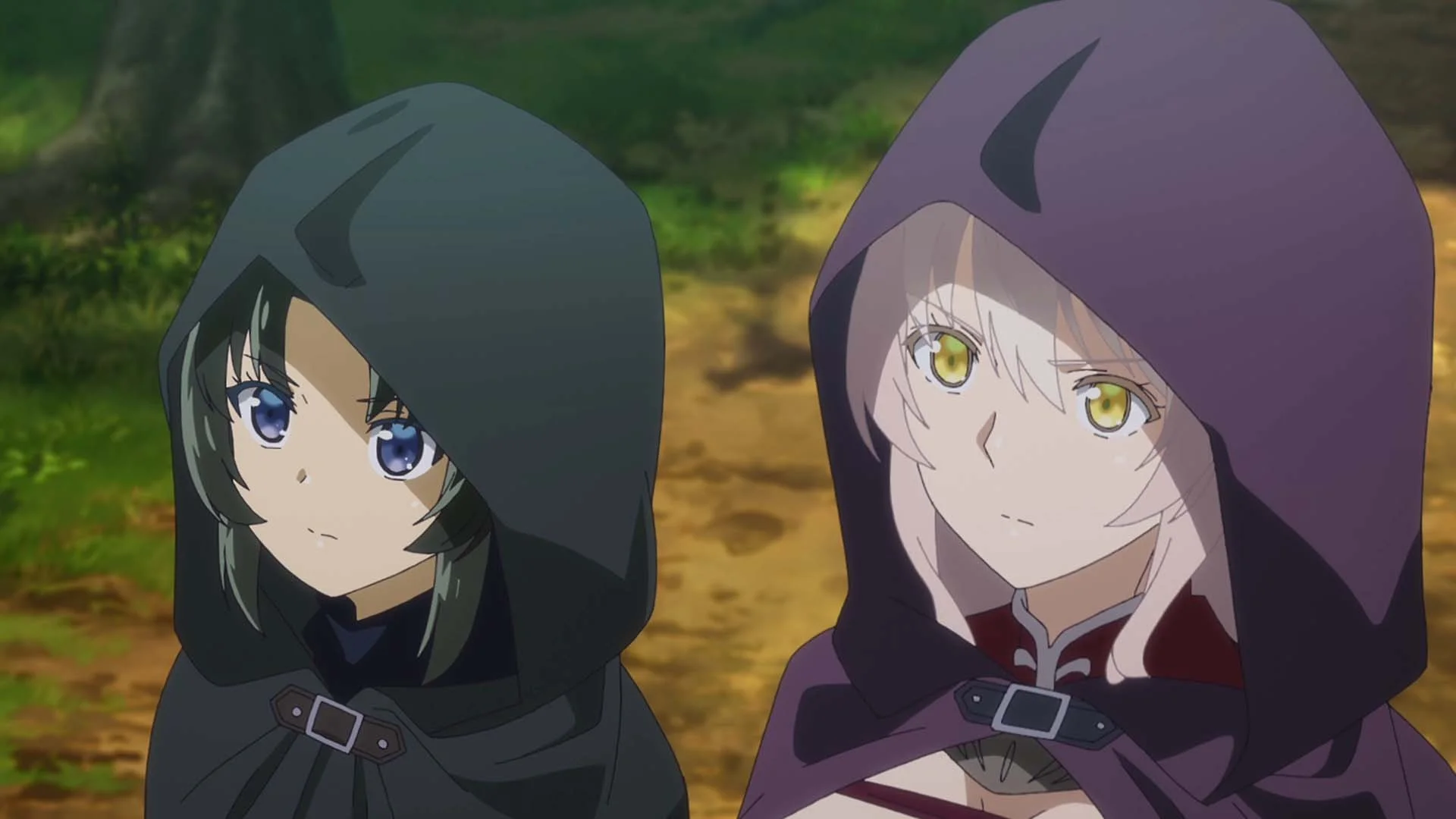
Episode 2 makes that supervision genuinely consequential. Arc and Ariane arrive in Lord Petros Lamburt’s domain, where attempts on the life of his prospective elven bride, Toreasa, require investigation rather than overwhelming force. Arc can stand in a hallway pretending to be armor or enter the former ruler’s chamber disguised as an artifact.
Neither trick equips him to interpret what he learns. His distraction by lobster, accompanied by exaggerated comic music, turns the investigation into an amiable demonstration of misplaced priorities. Ariane’s grasp of the situation gives his abilities a useful direction. Their trust has a practical function here: he needs someone whose understanding exceeds his own.
That division of labor complicates an easy dismissal of the women as accessories to Arc’s adventure. Ariane and Chiyome deliberately permit their capture in the premiere so that he can track them to the kidnappers’ hideout. Their participation involves a plan, not passive waiting. Chiyome’s willingness to accommodate Arc’s excesses also gives Ariane someone with whom to share her frustration.
Yet the production places these capable collaborators inside a familiar package of sexual threat and bath-house display. The infiltration grants them tactical control; the fan service directs attention toward their bodies. Both choices belong to the episode, and the competence of the characters does not settle the question of how the show presents them.
The wedding story gives the season’s opposition to prejudice a sharper political shape. Petros has displaced and imprisoned a father whose rule was hostile to elves. His marriage to Toreasa places an elf inside the ruling household, making acceptance a matter of status and authority.
The assassination attempts threaten a changed social arrangement. Even the crude business of leaving a snake on her bed carries that implication: someone is trying to prevent the new order from becoming ordinary. The mystery’s brisk resolution limits its complexity, but its premise gives racial hatred a specific object beyond another group of captives.
The exposed conspirator’s attempted leap from a cliff is the episode’s harshest expression of that hatred. Personal survival becomes intolerable beside the prospect of elves living with humans and sharing their authority. Imprisonment then has an unusual force as punishment, keeping the antagonist alive to witness the arrangement they tried to destroy.
This is a pointed consequence, though the episode contains entrenched prejudice within a quickly defeated conspiracy. Toreasa’s position matters enormously to the plot; the investigation gives us less access to her experience of occupying it. The marriage changes the domain, while much of the dramatic attention remains with the people protecting it.
The season eventually begins connecting its local adventures to developments around the Hilk Church. The monster-control devices introduced in the premiere also raise a useful question about the organization behind individual perpetrators.
Devices have makers and suppliers, suggesting that defeating whoever happens to possess one may leave the source of the danger untouched. These threads give the later stretch a firmer direction than the repeated early detours. They also offer a way for the series to deepen its social argument through the structures that enable persecution, rather than continually replenishing the supply of conveniently hateful villains.
The open-ended finale and its additional scene after the credits leave that expansion unfinished. Another installment may enlarge the conflict, but enlargement alone cannot address the limitations already visible in the rescue formula.
The wedding episode supplies a more persuasive possibility: a changed arrangement of power that people must live with after the heroes have intervened. As the Hilk Church becomes more prominent, the series has an opportunity to follow consequences of that kind across its fantasy world, giving the people Arc protects something to do after he has won.
Skeleton Knight in Another World Season 2 premiered on July 4, 2026, continuing its broadcast across various Japanese networks and streaming internationally on Crunchyroll. The fantasy isekai series follows Arc, a powerful knight trapped in a game avatar body, as he resumes his journey across a mystical realm to protect the innocent.
Where to Watch Skeleton Knight in Another World Season 2 Online




Full Credits
Title: Skeleton Knight in Another World Season 2
Distributor: Crunchyroll, AT-X, Tokyo MX
Release date: July 4, 2026
Rating: TV-14
Running time: 23 minutes per episode
Director: Katsumi Ono
Writers: Toshizo Nemoto
Producers and Executive Producers: Yasuhiro Uema
Cast: Tomoaki Maeno, Fairouz Ai, Nene Hieda, Miyu Tomita, Takuya Eguchi, Rumi Okubo, Marina Inoue, Kunihiro Kawamoto
Director of Photography (Cinematographer): Satoshi Yamamoto
Editors: Yumi Jinguji
Composer: eba, Takahide Yasui
The Review
Skeleton Knight in Another World Season 2
Arc’s immense power remains an effective comic asset, especially when Ariane gives it a useful direction. Season 2’s familiar rescue adventures provide an easy return, but repetition weakens momentum. The wedding mystery gives prejudice a concrete political stake, while fan service complicates the treatment of its capable heroines. Later Hilk Church developments strengthen the season’s direction; its most persuasive progress comes from showing that heroic power still needs judgment.
PROS
- Arc and Ariane’s affectionate, practically necessary partnership.
- Wedding mystery connects prejudice to political authority.
- Later Hilk Church developments give scattered adventures direction.
CONS
- Repetitive early rescues and weak urgency around Arc’s cure.
- Fan service clashes with the heroines’ capable characterization.
- Wedding conspiracy resolves entrenched prejudice too neatly.