


























Leonor Erasmus corrects a boy for using a racist slur in her home. She seems to mean it. Yet Doreen, who cooks and cleans for the family, cannot bring her grandson Neville into that same house. I first took Leonor’s objection as simple hypocrisy. That seems too easy. She can sincerely dislike the word while accepting the rule that gives it power. Correcting a guest costs her nothing. Making room for Neville would require her to question the household itself.
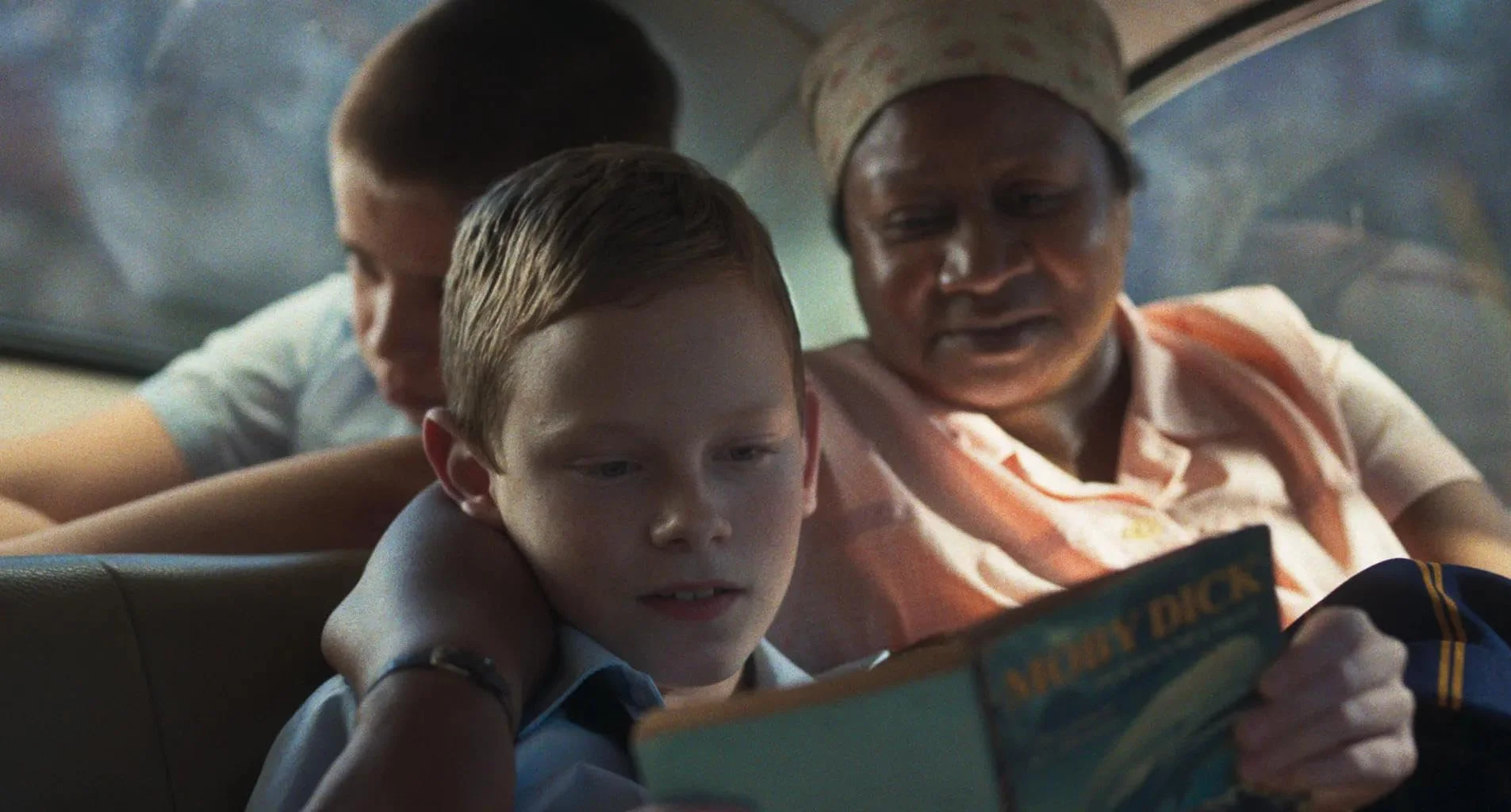
Doreen hears the family discuss Neville’s fate from the half-lit kitchen. She is close enough to listen and has too little authority to join them. John Trengove holds that distance in a single image. The Erasmus family can speak warmly of Doreen, and Marnus can feel genuine affection for her, while the arrangement remains intact. She calls him kleinbaas, “little boss”: an endearment that also tells the eleven-year-old where he stands.
Set in Cape Town in 1974, The Smell of Apples follows Marnus (Dawian van der Westhuizen) through the days before his family’s summer holiday. His father Johan (Hilton Pelser) is an army general, though at home he can be a playful dad. Leonor (Maude Sandham) keeps the family’s pleasant image in place; their teenage daughter Ilse (Karoline Watson) is beginning to see its cracks. Adapted from Mark Behr’s novel, the film stays largely within Marnus’s view. He knows the rules of this world before he has any reason to examine them.
Then his grandfather’s fishing rod goes missing. Marnus points to Neville (Courtlin Baron), and Johan’s response sets terrible consequences in motion. Marnus later finds the rod and tries to conceal it. The object is almost comically small beside the punishment his accusation has unleashed. Trengove makes that imbalance difficult to forget: a white child can misplace something, name a Black teenager, and discover too late how much force stood ready behind his words.
Calling Marnus innocent would let him off too neatly. Calling him responsible in the same way as Johan would ignore what the film shows us about a child learning his father’s values. Van der Westhuizen gives Marnus the awkward certainty of someone who knows he has done wrong but still hopes the adults might make it right. His understanding catches up in pieces. Neville has no such luxury of time.
Marnus also wants to be the sort of son Johan admires. His friend Frikkie (Wian Carstens) is stronger, swims better, and handles a fishing rod with an ease that draws Johan’s approval. Johan’s affection for Marnus is real enough to make his scrutiny painful. The boy watches his father embrace Frikkie’s physical confidence and tries to work out what is lacking in himself. Even childhood recreation comes with a qualifying test.
The family’s Chilean guest, Mr. Smith (Alejandro Goic), seems to offer a gentler version of military authority. He enjoys music, speaks kindly to Marnus, and consults privately with Johan about matters the boy cannot grasp. His cultivated manner makes the generals’ work easier to accommodate at home. Leonor plays the piano; the men talk; the children prepare for the holidays. Trengove trusts those activities to coexist on screen long enough for their proximity to become disturbing.
Production designer Birrie Le Roux fills the house with carefully chosen 1970s details, while Lennert Hillege’s warm light gives the summer its inviting texture. The patterned tiles and garden furniture make the place feel lived in. Doreen’s position in the kitchen, Neville’s exclusion, and Johan’s command over everyone inside it determine how that inviting space can be used. The film’s most effective passages let us notice those restrictions while Marnus is busy enjoying the weather.
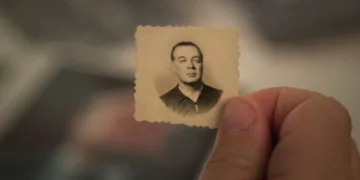
Johan eventually shows the family photographs, and images of military violence appear among pictures of the children. The sequence forces into view what the household has kept apart. Sandham’s Leonor has spent much of the film maintaining her composure; here, watching her face becomes as important as watching the screen within the scene. Marnus sees evidence of what his father has done, though seeing it gives him no immediate way to stop being Johan’s son.
I wondered if a later, more intimate threat made the case against Johan too emphatic. Neville’s fate and the photographs have already exposed him. The film leaves that late possibility unresolved, however, and the uncertainty changes its effect. Marnus is still trying to read gestures of paternal care after learning what Johan is capable of doing with his power. Trengove asks us to sit with the boy’s fear of misreading them again.
The family continues to perform its ordinary life after these discoveries. Their familiarity with one another has survived, along with the unequal rules that made that life possible. Leonor can still object to a cruel word. Doreen can still be addressed with affection. Neville cannot simply come inside.
The drama world-premiered at the Toronto International Film Festival on September 11, 2026. Set in 1974 during Apartheid, the story follows an eleven-year-old boy whose privileged life in South Africa shatters after a violent altercation involving his family’s domestic worker exposes deep-seated cruelties.
Full Credits
Title: The Smell of Apples
Distributor: Portobello Productions, Baldr Film, Quijote Films
Release date: September 11, 2026 (Toronto International Film Festival)
Running time: 1 hour 44 minutes (104 minutes)
Director: John Trengove
Writers: John Trengove, Christopher Ciancimino
Producers and Executive Producers: Eric Abraham, Frank Hoeve, Jack Sidey, Cait Pansegrouw, Giancarlo Nasi
Cast: Dawian van der Westhuizen, Hilton Pelser, Maude Sandham, Celeste Matthews Wannenburgh, Wian Carstens, Karoline Watson, Inge Beckmann, Alejandro Goic
Director of Photography (Cinematographer): Lennert Hillege
The Review
The Smell of Apples
The Smell of Apples makes apartheid visible in the rules of one household: who may enter, who gets believed, and who pays for a missing fishing rod. Trengove’s warm summer images make those rules harder to dismiss, while Marnus’s affection for his father gives his discoveries their sting. I’m less certain the late intimate threat was needed after the photographs and Neville’s fate. Its uncertainty, though, leaves the family’s return to ordinary life deeply uneasy.
PROS
- Precise portrait of power inside the home
- Strong use of Marnus’s limited understanding
- Unsettling contrast between summer warmth and violence
- Family slideshow brings the film’s ideas into focus
CONS
- Late threat risks overstating Johan’s cruelty
- Neville remains outside the central perspective