

















Paul Greengrass has made medieval England feel less like distant history than a political system caught during live failure. The Black Death has already hollowed out villages, war with France keeps draining the kingdom, and the people expected to absorb the cost are those with the least left to give. The logic is familiar enough to require no translation.
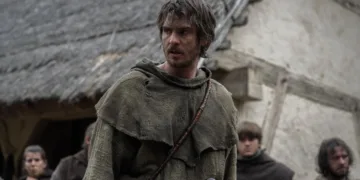
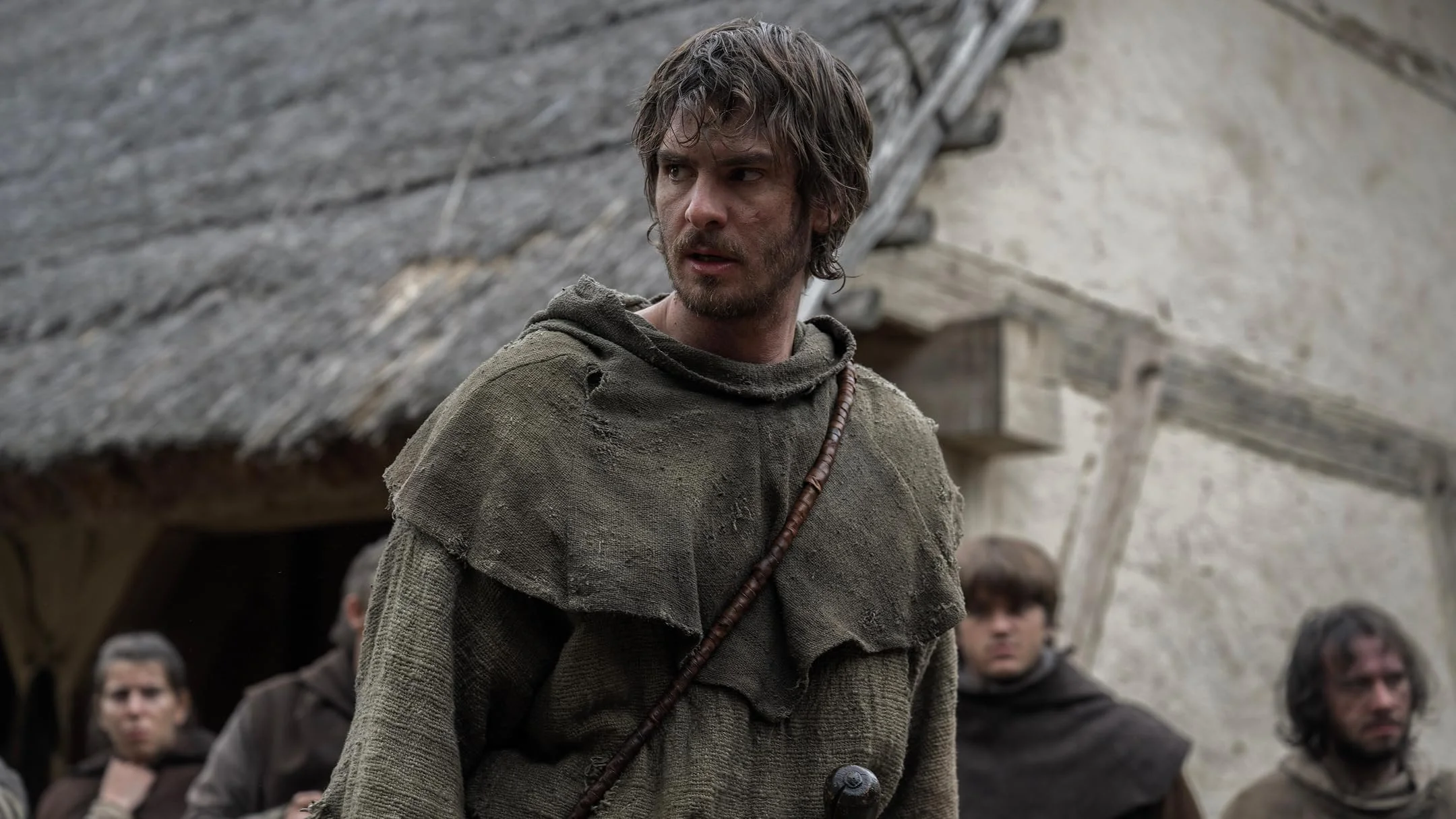
Andrew Garfield’s Ploughman lives beside three graves, one large and two small, marking the family he lost to plague. He works the land compulsively and defines himself with the plain statement, “I am what I do.” Greengrass does not need a speech about trauma when those graves are sitting beside the field. Then another tax arrives.
The collection becomes the spark because the men enforcing it treat poverty as permission. Ploughman watches soldiers and officials abuse his neighbors until resistance becomes physical, and his eruption spreads through surrounding villages. Soon priests, former soldiers, farmers, and laborers are heading toward London.
Greengrass is interested in what might be called revolutionary leakage: anger begins with one legitimate grievance, then seeps into every resentment available. The film keeps testing where political resistance ends and collective appetite begins.
The Man Inside the Symbol
Garfield plays Ploughman as someone who would prefer never to become interesting. His reluctance matters. When a local priest tells him that stories of his resistance have reached neighboring villages, Garfield does not suddenly acquire the posture of a leader. His grief remains visible beneath the attention, as if public significance is merely another burden placed on him.
That modesty gives his eventual growth into a spokesman some weight. Ploughman can address the rebels, confront Richard II, and articulate what the movement wants, yet Garfield avoids turning those moments into actorly declarations. His anger comes through clenched restraint, then breaks loose when violence takes over. I believed the emotional progression before I believed the physical one.
The screenplay asks us to accept that this grieving farmer can suddenly dismantle trained soldiers with startling efficiency. Perhaps myth is already forming around him, and perhaps that exaggeration is intentional. The film does not quite earn the leap. Garfield sells the fury; his combat ability feels imported from another draft.
His larger problem is structural. Once the revolt grows, Ploughman begins sharing narrative space with the people history remembers more clearly. Cosmo Jarvis gives Wat Tyler the grounded authority of someone who understands organized violence. Jamie Bell’s John Ball supplies ideological fire, turning spiritual conviction into political rhetoric. Thomasin McKenzie’s Alyce responds to persecution with a willingness to push the movement toward bloodshed.
Alyce is especially useful because she exposes the dangerous pleasure buried inside righteous anger. She has reasons for wanting vengeance. The film never asks us to ignore them. It simply watches what happens once vengeance becomes easier to justify.
Ploughman, meanwhile, sometimes becomes strangely secondary inside the rebellion his resistance helped ignite. The film wants an everyman and a legend in the same body, and Garfield spends much of the middle trying to keep those identities from cancelling each other out.
Who Gets to Rule England?
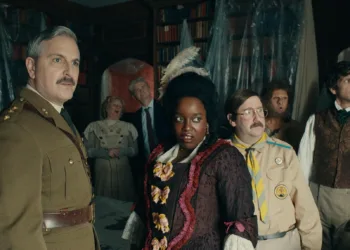
Woody Norman’s Richard II is where the political argument becomes less tidy. He is fourteen, surrounded by older officials who appear to have mistaken proximity to the throne for ownership of it. Treasurer Robert Hales, played by Tom Hollander, joins Archbishop Simon Sudbury, Chief Justice Belknap, and London Mayor William Walworth in protecting a system that would sooner squeeze peasants than disturb wealthy merchants.
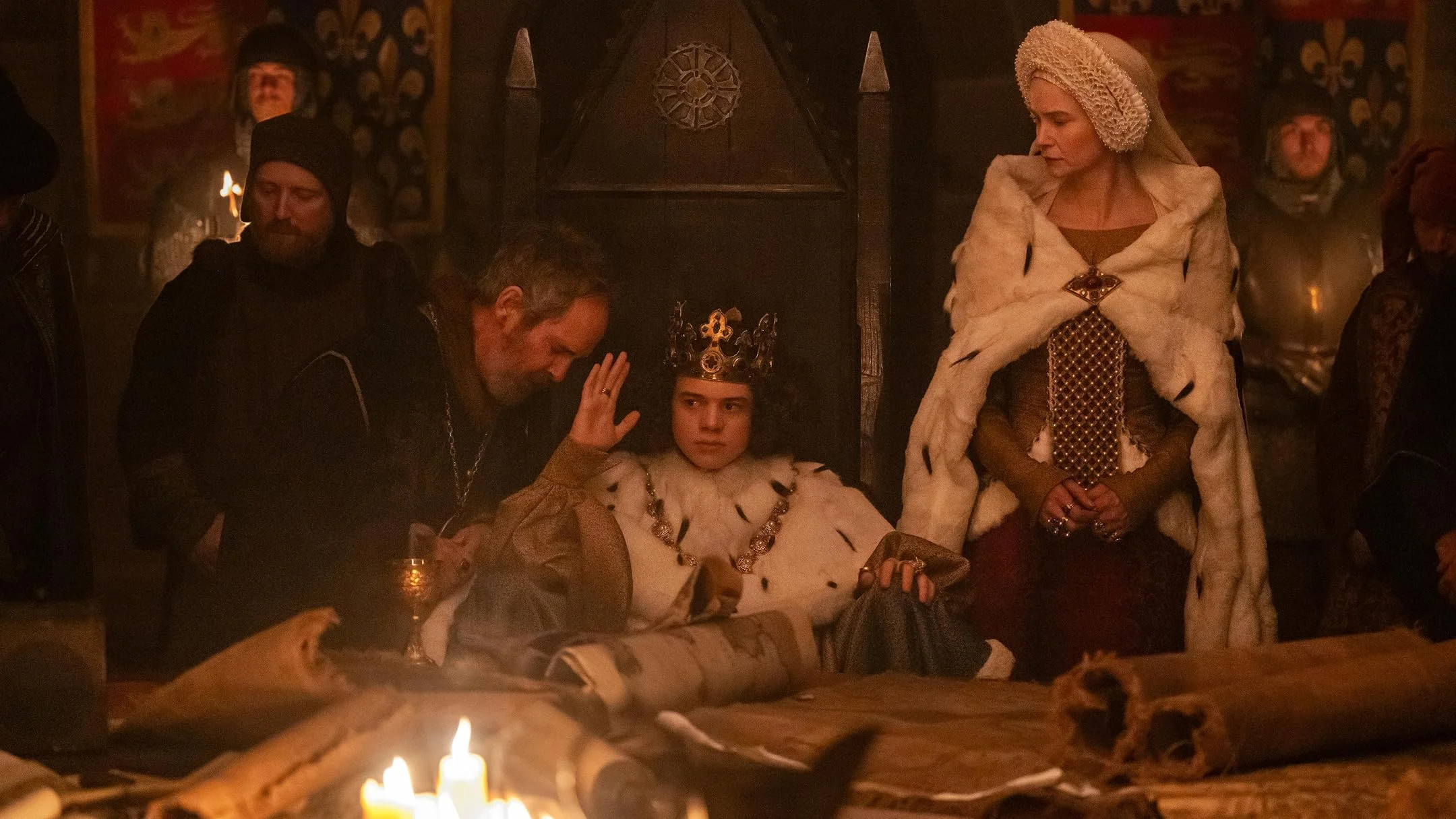
Greengrass makes their calculation explicit. They have a fiscal problem, see a vulnerable class, and treat exploitation as administration. Bureaucracy has always enjoyed dressing violence in paperwork.
Several of these men are written so broadly that the film briefly undermines its own political intelligence. Hales can be formidable, and Hollander gives him flashes of irritation whenever Richard refuses to behave like a compliant ornament, yet the council members rarely receive the ambiguity afforded to the rebels. They function as concentrated embodiments of greed and preservation. Richard is harder to settle.
Norman plays him as frightened, impressionable, wounded, and occasionally much sharper than his advisers expect. His desire to hear the peasants clashes with the machinery around him. Katherine Waterston’s Joan of Kent tries to steer her son toward mercy, mostly through presence and observation because the screenplay gives her limited room to intervene.
The revolt becomes equally unstable once it reaches London. One riot turns its fury toward immigrants accused of taking jobs, and Greengrass refuses to protect the movement from what that reveals. Economic suffering does not automatically produce moral clarity. People who understand oppression can still redirect their rage toward someone weaker.
John Ball’s followers carry their own combustible religious fervor. Alyce increasingly treats violence as purification. Wat Tyler brings military discipline into a movement that can barely keep control of its own momentum.
This is where the film’s modern political language becomes both useful and clumsy. Phrases such as “no kings” and “deplorables” draw the bridge to contemporary politics with a marker pen. I initially found that embarrassingly obvious. Then the riot complicated my objection. Greengrass is not claiming that history repeats neatly. He is interested in how quickly familiar political instincts regenerate. The language still lands like a screenplay elbowing the audience in the ribs. The behavior needs far less translation.
History Through a Shaking Lens
Greengrass brings his handheld camera into the 14th century and occasionally makes it feel as if someone smuggled a news crew into the Peasants’ Revolt. During the large clashes, the method works. The extended royal counterattack gains its force from William Goldenberg’s editing, which keeps bodies, weapons, movement, and tactical reversals arriving faster than the characters can process them. Violence is not arranged into elegant choreography. It behaves like confusion.
Pål Ulvik Rokseth’s cinematography supports that physicality with mud, smoke, dark interiors, and a muted landscape that seems permanently damp. Villages look worked in rather than decorated. Churches feel dense with incense and bodies. Nikolaj Danielsen’s production design uses the Bavarian locations to give England an abrasive material presence, while the costumes separate peasants, clergy, soldiers, and nobility without making anyone look freshly delivered from wardrobe.
Volker Bertelmann’s score pushes hardest during the rebels’ movement toward London, giving their march a sense of gathering pressure without transforming it into a clean heroic procession. Then Greengrass keeps shaking the camera.
Court conversations receive some of the same instability as street violence. Abrupt zooms and restless framing turn political calculation into visual agitation before the dialogue has generated any pressure of its own. The style begins behaving like a machine with one setting. Call it urgency inflation. If every exchange is photographed as if the walls are collapsing, genuine collapse loses some of its force.
The aerial shots create a related problem. Seeing the rebellion spread across the landscape provides necessary scale, especially as groups converge on London, yet repeated sweeping views start announcing magnitude rather than discovering it. Several larger crowd images also reveal the seams of their visual effects.
Greengrass is much stronger when proximity has a reason. Ploughman surrounded by bodies during violence, Richard boxed in by advisers, Alyce moving through a crowd that is slipping beyond anyone’s control: the camera becomes political because space itself tells us who has power and who has lost it.
A Hood Without a Name
The strangest idea surrounding The Uprising barely exists inside the film itself. Ploughman eventually appears in a green hood. That image carries an obvious cultural association, yet nobody calls him Robin Hood. There is no Little John, Maid Marian, or Sheriff of Nottingham waiting for recognition. The actual narrative remains occupied with the 1381 revolt, Richard II, Wat Tyler, John Ball, taxation, class resentment, betrayal, and the collapse of a movement that believed access to the king might be enough.
The connection is more interesting when treated as folklore. Ploughman has no proper name. He begins as a worker defined by his labor, then becomes an idea other people circulate. By the time green enters his clothing, the man and the symbol have started separating.
That fits the film far better than the American marketing attempt to append The Rise of Robin Hood to the title. Turning Ploughman into recognizable intellectual property shrinks what Greengrass is doing with anonymity. A nameless farmer becoming culturally legible through resistance is far stranger than another franchise origin story (and considerably less needy).
The historical-literary thread helps explain the temptation. Piers Plowman sits near early references to Robin Hood folklore, giving Greengrass room to suggest that popular myths grow beside political unrest rather than spring fully formed from a single hero.
His ending takes the harsher route. The revolt fractures. Richard changes under the pressure surrounding him. Violence answers violence, and the people who marched toward London discover that collective action does not magically protect a movement from vengeance, prejudice, ego, or manipulation.
Greengrass seems fascinated by the instant when history stops belonging to the people who lived it. Ploughman can lose control of the rebellion, lose control of his own image, and still become useful to the stories that survive him. Perhaps that is why the green hood works. It arrives after the man has already begun disappearing.
The Uprising arrives in theaters on September 10, 2026, distributed by Focus Features. The historical action drama dramatizes the 1381 Peasants’ Revolt in England, following a humble ploughman who unites commoners in a desperate fight for justice against the crown.
Where to Watch The Uprising (2026) Online





Full Credits
Title: The Uprising
Distributor: Focus Features, Entertainment Film Distributors
Release date: September 10, 2026
Running time: 2 hours 8 minutes
Director: Paul Greengrass
Writers: Paul Greengrass
Producers and Executive Producers: Jason Blum, Paul Greengrass, Gregory Goodman, Joanna Kaye, Joe Neurauter, Lars Sylvest
Cast: Andrew Garfield, Jamie Bell, Stephen Dillane, Tom Hollander, Cosmo Jarvis, Thomasin McKenzie, Jonny Lee Miller, Woody Norman, Katherine Waterston
Director of Photography (Cinematographer): Pål Ulvik Rokseth
Editors: William Goldenberg
Composer: Volker Bertelmann
The Review
The Uprising
The Uprising is strongest when Paul Greengrass treats rebellion as a moral contagion rather than a heroic march. Garfield gives Ploughman’s grief real force, and the riot against immigrants exposes how quickly legitimate anger can be redirected toward cruelty. Yet the film simplifies many of Richard II’s advisers into convenient villains, while its restless handheld camera sometimes confuses agitation with urgency (the Greengrass tax, apparently). The Robin Hood suggestion works better as folklore than franchise bait. Messy, forceful, and politically unsubtle, it still leaves bruises.
PROS
- Garfield’s restrained, furious performance
- Morally complicated rebellion
- Strong Richard II characterization
- Brutal royal counterattack
- Convincing medieval production design
CONS
- Overactive handheld camerawork
- Thin ruling-class villains
- Ploughman’s limited dramatic arc
- Heavy contemporary political language
- Distracting Robin Hood marketing