
























Funding objections have left Christine Molloy and Joe Lawlor with a peculiar problem: how to finish a film about two people who survived. Their proposed drama concerns the artists Claude Cahun and Marcel Moore, whose resistance to Nazi occupation brought them close to execution.
They lived, and their lives continued. Turning that continuation into a satisfying third act, the stretch of a screenplay expected to resolve its central tensions, has proved difficult. In Act 3, the Irish filmmakers discuss this obstacle while considering their own future. Both are now in their sixties, with forty years of shared life available for revision.
The conversation itself gives them a useful way to examine that history. Molloy and Lawlor appear separately, filmed at diagonal angles, with the edit moving between them. This is shot-reverse-shot, the familiar technique of alternating between speakers to construct an exchange.
Here, its separation matters. Two people can spend decades making films and living together while retaining different relationships to the same experience. The camera grants each a space from which to address the other and us. Their partnership becomes something the editing assembles, moment by moment, without making their perspectives interchangeable.
Their quiet, measured delivery takes some adjustment. These are prepared texts, and the pauses and careful phrasing keep the conversation visibly shaped for an audience. I liked the patience this asks of us. A thought has time to become uncertain before the next one arrives.
There is reserve here, too: accounts of marriage, family and artistic work do not necessarily make either speaker easy to know. Yet that slight distance belongs to a film interested in how people compose versions of themselves. Even this personal conversation has passed through the decisions that turn experience into material.
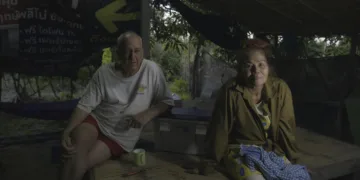
Those decisions become especially absorbing when the film returns to Thailand, where Lawlor’s brother John lives with his Thai wife, Kai. Earlier visits survive in photographs and grainy analogue video; a recent trip supplies digital images and the presence of the filmmakers’ adult daughter, Molly. The different recording formats give time a visible texture. They also allow the couple to look again at people and places whose significance has changed. An image can preserve the appearance of a visit while leaving its meaning available to the people who return to it decades later.
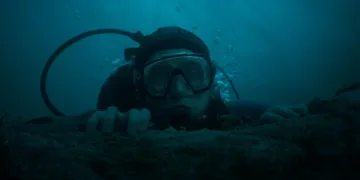
The strongest connection runs through Mister John, their 2013 fiction feature. Molloy and Lawlor recall encountering a corpse drifting down a river in Southeast Asia, an experience that fed into that film. Aidan Gillen plays a man who travels to Thailand after his brother’s death and becomes drawn into the dead man’s identity.
Excerpts from the drama now sit among the personal records and present-day reflections that surround its making. The movement is easy to follow even as the chronology loosens: an encounter becomes fiction, and the fiction later helps its makers recognize what troubled them about the encounter.
This is associative editing, where an idea or feeling supplies the connection between passages that might be separated by years. Its value here comes from the changed understanding those connections permit. The suggestion that travel can unsettle identity gains substance through Mister John’s borrowed life.
Then Lawlor’s reflections on his father’s fatal heart attack give death an immediate family dimension. He wonders about his own inheritance and possible fate. The earlier film’s concern with a dead brother sits differently beside a living man trying to imagine his own death. The material has acquired an urgency its makers could not fully anticipate.
The repeated visits to Mister John eventually produce diminishing returns, though. Once the relationship between travel, identity and death has become clear, further excerpts can linger over an association the film has already established. I sometimes wanted the conversation to move on before it did.
The material about the couple’s experimental theatre work is less securely connected to the developing inquiry, too. Memory supplies a persuasive reason for sudden changes of direction, but each departure still asks for our attention. Across a compact 83 minutes, some passages leave us waiting for a connection to become useful.
Cahun and Moore offer a different kind of difficulty. Born Lucy Schwob and Suzanne Malherbe, they were lovers and artistic collaborators who became stepsisters when their parents married. Their adopted names and constructed photographic identities give Molloy and Lawlor a rich example of people actively making the selves through which they would be seen.
That has an evident relationship to the filmmakers’ staged conversation. Still, the comparison remains incomplete. A shared creative partnership provides an approach to these lives; it cannot account for the specific pressures of gender, artistic reinvention and resistance under occupation.
One particularly pleasing discovery gives that distance a physical location. The attic room the artists occupied in Nantes corresponds to what is now screen 12 of a Pathé cinema. The precision is delightful: a private room can be located inside the present through an ordinary cinema number.
It also shows the appeal of the film’s curious, searching method. History becomes something to look for in a place that has continued changing. Alongside the carefully delivered texts, such discoveries supply the pleasure of inquiry, allowing the film’s intellectual interests to remain approachable without simplifying the people it studies.
The uncertain fit between the two couples can leave the historical strand feeling unfinished, although forcing a closer equivalence would weaken it. Cahun and Moore’s survival poses a stubborn problem for the planned drama because the defeat of an immediate threat does not settle the meaning of the years that follow.
Molloy and Lawlor’s discussion exposes how easily a demand for dramatic resolution can turn continued living into an apparent defect in a story. Their own archive keeps supplying experiences whose meanings remain unsettled. Even a completed film such as Mister John can return to them with something they had not understood when they finished it.
Act 3 premiered at the BFI London Film Festival on October 17, 2026, with international sales handled by 65 Wilding Films. Directed by filmmaking duo Christine Molloy and Joe Lawlor, the Irish-British documentary essay engages in a witty and moving exploration of aging, legacy, family history, and the intersection between personal and artistic relationships through the lens of groundbreaking artists Claude Cahun and Marcel Moore.
Full Credits
Title: Act 3
Distributor: Desperate Optimists, 65 Wilding Films
Release date: October 17, 2026 (BFI London Film Festival)
Running time: 1 hour 23 minutes (83 minutes)
Director: Christine Molloy, Joe Lawlor
Writers: Christine Molloy, Joe Lawlor
Producers and Executive Producers: Joe Lawlor, Alex Thiele, Hannah Patterson
Cast: Christine Molloy, Joe Lawlor
Director of Photography (Cinematographer): Joe Lawlor
Editors: Christine Molloy, Joe Lawlor
Composer: Stephen McKeon, Dennis McNulty
The Review
Act 3
Act 3 makes the process of reconsidering a life surprisingly absorbing. Molloy and Lawlor’s staged conversation and shifting archive show how an old film can reveal something its makers missed. I found that patient attention rewarding, even when repeated Mister John excerpts and loosely connected digressions slowed the inquiry. Its warmth comes from watching two collaborators remain curious about experiences they have shared for decades.
PROS
- Thoughtful editing connects memory, fiction and present-day reflection.
- Separately framed speakers preserve distinct perspectives within a partnership.
- Family history gives the discussion of mortality personal weight.
- Complex storytelling ideas remain approachable.
CONS
- Repeated Mister John excerpts produce diminishing returns.
- Theatre material lacks a clear connection to the developing inquiry.
- The Cahun and Moore parallel remains unevenly developed.







