




























In the not-so-distant future, Earth lies abandoned—its human creators felled by their own hubris, and metallic sentinels now roam ruined cities. Storm in a Teacup, an Italian studio with roots in cinematic storytelling, plants us amid flooded metro tunnels, neon-lit factories, and rusting cathedrals of steel.
Here, Zoe awakens with no memory, her body a fusion of flesh and circuitry. Tasked by a fragmented AI echo of her father to reclaim humanity’s legacy, she must traverse four distinct zones—each shaped by corporate ambition, ecological collapse, or techno-religious fervor.
At its heart, Steel Seed weaves stealth tactics, visceral clashes, and choreographed leaps into its DNA. The familiar pulse of hiding in glitch-field shadows echoes samurai tales of silent movement, while Zoe’s parkour recalls Hong Kong action cinema. Above all, her bond with KOBY, a drone whose beeps mirror the droid-sidekick archetype of global media, infuses each encounter with unexpected warmth.
Narrative threads shift from intimate moments—Zoe’s whispered asides—to sprawling escape set-pieces that span collapsing megastructures. Across roughly a dozen hours, the game balances quiet reflection on loss with kinetic bursts of movement, inviting players to inhabit both stillness and spectacle.
We’ll explore how Steel Seed’s story and systems mirror Italy’s penchant for visual drama, yet speak to a worldwide audience fluent in action tropes. Fair warning: beneath the polished surfaces lie tensions between scripted beats and player agency, a tension we’ll examine without holding back.
Fragments of Humanity in a Machinic World
Italian studio Storm in a Teacup crafts a fallen world where corroded hallways glow with errant neon and junkyard debris frames every vista. Each of the four regions—from flooded archives to towering mech nests—speaks through environmental cues: rusted cables that trace forgotten pipelines, battered posters hinting at corporate propaganda. Sparse voiceovers interrupt exploration, yet when Zoe pauses beside a shattered console or beneath a flickering archway, the setting itself conveys history more potently than expository cutscenes.
Early levels drip mystery as Zoe pursues digital “shards” of her father’s consciousness. Narrative beats arrive in measured intervals: an echoing lab one moment, a collapsing corridor the next. In-game chatter can veer into repetitive reflection, but properly timed cutscenes restore momentum, shifting perspective from solitary wanderer to active agent. Plot threads thread through each shard, guiding players across four distinct biomes with an economy that recalls European graphic novels’ direct pacing.
Zoe’s voice is earnest, her quips revealing both determination and unease. Occasionally she comments on every pickup or enemy scan—an echo of cinematic protagonists who speak to themselves in tense moments. The performance feels genuine when she confronts existential stakes, yet feels strained during mechanical explanations. This oscillation underscores the wider tension between personal drama and genre conventions.
KOBY enters as Zoe’s silent foil. His beeps recall classic sci-fi sidekicks, yet Zoe’s translations grant him unexpected depth. Early on he scouts corridors with bird’s-eye detachment; later, his protective interventions in tight stealth segments cement an emotional rapport that transcends language barriers. Their relationship forms the game’s human axis amidst metal adversaries.
Hogo and his AI lieutenants bear glowing red optics and angular silhouettes. They communicate corporate ruthlessness through design alone, requiring minimal dialogue. Secondary figures such as S4VI serve as expository anchors, yet only Zoe and KOBY achieve true narrative weight.
At stake are themes of machine autonomy, inherited responsibility, hope amid ruin. Moments of quiet restoration—repairing a broken drone joint, tracing circuitry back to a father’s code—evoke genuine empathy. The interplay between Zoe’s lost memories and her mechanical enhancements questions where humanity ends and algorithm begins, leaving us to ponder what survives when steel outlasts flesh.
Mechanics as Cultural Convergence
Steel Seed’s approach to stealth feels both familiar and distinctly techno-European. Instead of slipping through tall grass or shadowy alleyways, Zoe melds into pulsating “glitch” fields—an homage to digital noir in films like Blade Runner 2049—while classic cover points pepper industrial chambers.
Enemy patrols range from methodical sentries that circle on fixed loops (recalling Japanese stealth titles such as Tenchu) to more unpredictable “bug” drones whose erratic paths nod toward Italian horror’s uncanny unpredictability. Players can distract foes with metallic taps or luring pulses, then execute silent takedowns that echo samurai cinema’s precise strike. Levels unfold with generous checkpoints, allowing repeated experimentation in wide-open chambers that evoke Venetian squares or the catacombs of Rome—spaces designed so mistakes feel instructive rather than punitive.
Engagements blend Western action tropes with echoes of sword-form choreography from kung fu cinema. Light and heavy strikes flow into quick dodges or perfect-parry counters, a rhythm that demands pattern learning akin to European fencing manuals or manga-inspired boss duels.
Early enemies absorb blows like armored knights, prompting players to study attack telegraphs. Later, mechanical behemoths force tactical retreats and layered assaults on colored weak points—a design choice that recalls anime mecha battles where precision outshines brute force. The decision to fight or reload at the last safe node evokes roguelike tension, as each confrontation tests one’s mastery of timing without stripping away narrative momentum.
KOBY bridges solitary stealth with cooperative spectacle. Switching control to the drone transforms exploration into a schematic reconnaissance akin to spy films from the UK’s Cold War era, marking enemies and triggering remote traps. In combat, KOBY’s mines and pulse bursts serve like European Bond gadgets—booby traps that reshape skirmishes.
Puzzle sections pivot on alternating between Zoe’s agility and KOBY’s perspective, creating a dialogue between human intuition and digital logic. This dynamic partnership underscores a broader dialogue between analogue traditions of heroism and the coded precision of modern drones.
Rather than straightforward experience points, abilities unlock through challenge completion: silent kills, flawless dodges, or environmental hacks. This rite-of-passage structure draws from martial-arts epics where students earn new techniques through trial. Three distinct branches—stealth, combat, gadgets—encourage players to shape Zoe according to personal style.
Scavenged resources fund upgrades, though harvesting every hidden cache can feel repetitive, a tension familiar to fans of expansive RPGs from both East and West. Yet the satisfaction of discovering an ability that reconfigures an old challenge hints at an ongoing conversation between player and designer, where experimentation yields its own narrative.
By weaving these systems together, Steel Seed asks whether a game built on so many global influences can forge a coherent identity—or whether its very hybridity points toward the next phase of interactive storytelling.
Vertical Narratives: Traversing Ruins and Memory
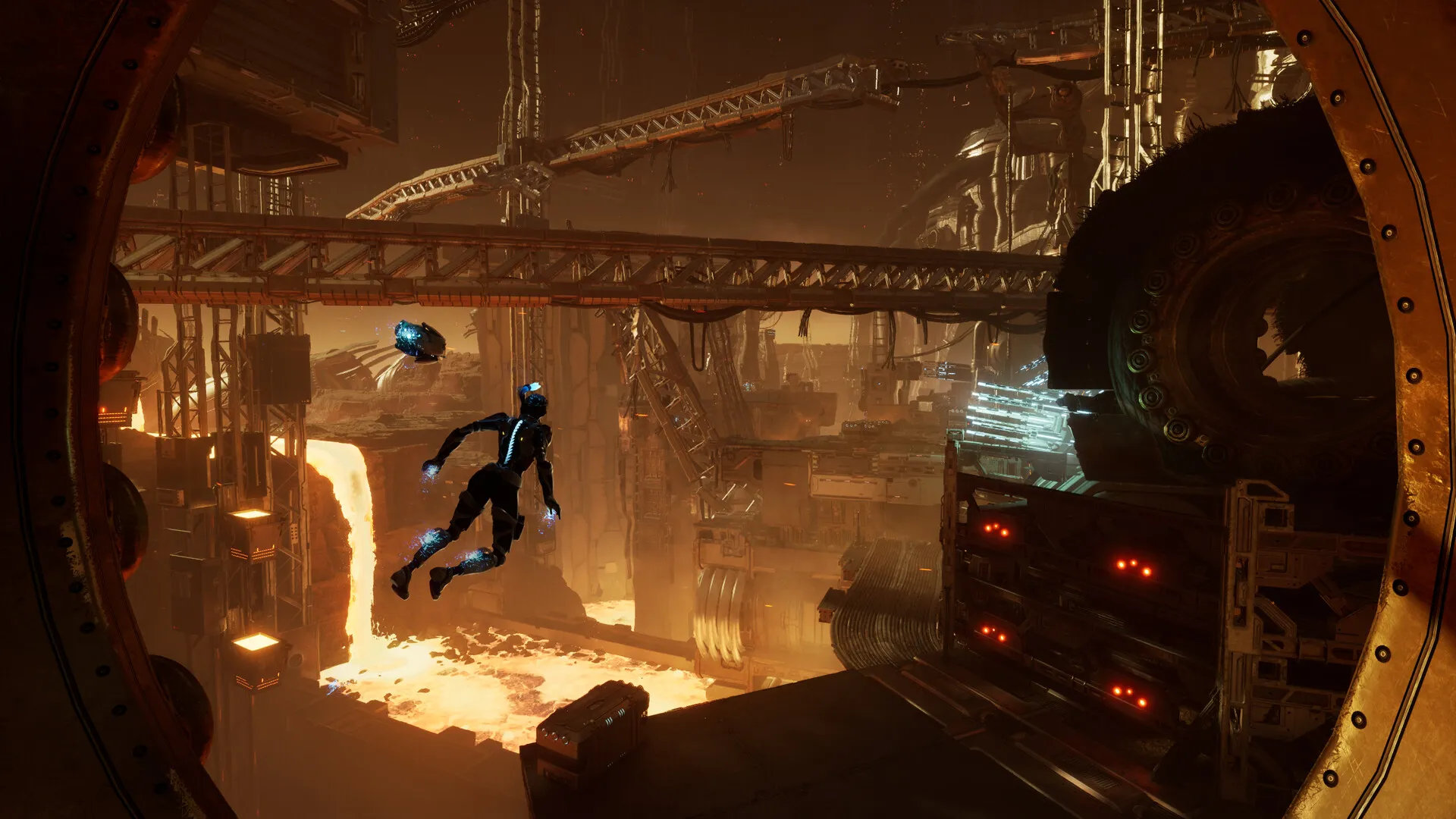
Steel Seed’s parkour channels a blend of Euro-Italian grandeur and Hollywood spectacle through its core movement. Zoe vaults between highlighted ledges like a figure in a Michelangelo fresco come alive, yet zip-lines and bounce pads recall blockbuster set pieces from Western action cinema. These distinct anchors—wall runs that skim rust-chic girders, timed leaps over molten conduits—offer cinematic flourishes without fully inviting freeform exploration.

Dynamic camera work transforms routine platforming into suspenseful choreography. As Zoe races beneath collapsing catwalks, the angle shifts to emphasize vertigo, echoing Uncharted’s setpiece escapes. In another sequence, the perspective flattens into a 2D side-scroll chase where neon-lit debris becomes spikes on the horizon—an homage to Japanese arcade classics. Even a brief hoverboard moment flirts with pulp sci-fi serials, marrying movement to mood in bursts of coordinated tension.
Yet responsiveness unsettles the illusion. On controller, Zoe’s grab animations feel weighty and deliberate; on keyboard, they drag, amplifying missteps when ledges vanish from reach. Precise timing becomes a trial—missing a zip-line snap often means restarting sections rather than improvising new routes. This rigid design recalls European parkour films that map every obstacle, but it clashes with players’ expectations of organic climbing in titles like Prince of Persia.
Surface highlights dictate every ascent, restricting traversal to predetermined paths. While these rails guarantee dramatic framing, they deny the joy of unscripted discovery found in open-world counterparts. Moments of soaring freedom are tempered by the realization that every arch, beam, or scaffold exists solely because the designer placed it there—inviting us to consider whether true exploration can emerge from such carefully constructed ruins.
Echoes in Steel: Visual & Audio Design
Storm in a Teacup’s Italian roots surface in Steel Seed’s art direction, where the grandeur of Renaissance libraries—seen in S4VI’s vaulted archives—meets the cold pragmatism of industrial design. Neon corridors shimmer like Tokyo back-alleys in Akira, while rust-chic junkyards evoke the patina of post–World War II decay familiar to European art-house cinema.

Mech “nests” loom like modern cathedrals, their scale dwarfing Zoe in moments that recall David Lean’s sweeping vistas; every vast hall and constricted maintenance shaft hints at past conflicts through discarded tools, corroded data pads, and graffiti in multiple alphabets.
Robot designs borrow from global sources: insectoid scouts channel Japanese anime’s agile mecha, hulking defense units wear armor plating akin to Western knightly helms, and patrol bots carry the clean lines of Scandinavian minimalism. Zoe herself, with her segmented limbs and organic musculature, blends cyberpunk tropes with subtle Baroque flourishes—her movements animated with a fidelity that makes each shoulder pivot or knee bend feel weighty and intentional.
The soundtrack fuses a synth-heavy pulse with orchestral swells reminiscent of Italian film scores. During stealth, low-frequency drones echo Ennio Morricone’s suspense cues; chase sequences erupt in high-tempo arpeggios more at home in German techno clubs than suburban theaters. Footstep EQs change dynamically, so that running on metal grates shrieks with metallic resonance, while glitch-field activations hum like a malfunctioning cathedral organ.
Voicework alternates between strengths and slips. Zoe’s tone carries genuine fear and resolve, but her constant commentary can jar like overlong ADR on an indie production. KOBY’s beeps, drawn from R2-D2’s lineage, achieve clarity through layered mixing, yet S4VI’s London-accented monologues sometimes lack emotional weight. These audio choices both enrich and occasionally unsettle the game’s ambition—reminding us that in a world of steel and silicon, the human voice remains its most fragile conduit of meaning.
Forging Smooth Play in a Fragmented World
Steel Seed’s ambition is clear in its sprawling levels and detailed visuals, but technical hitches can undercut immersion. On high-end PCs, frame rates typically hover around 60 fps, yet during mech “nest” boss fights and dense junk-yard vistas, dips into the mid-40s emerge, fraying the tension built by dynamic camera angles.

Players have reported clipping through surfaces—most notably when vaulting toward zip-lines—and occasional soft locks require application restarts, a reminder that even European art-house projects can stumble under technical weight.
Checkpoints are sprinkled liberally, echoing accessibility-forward design in Nordic RPGs, yet some late-game stealth zones reset you to their entrances after a single misstep. While this safety net preserves narrative momentum, lengthy segments sometimes need replaying in full, blunting motivation to experiment with alternative approaches. Reload penalties here feel more punitive than instructive, especially when tension already hinges on perfect timing.
Controller input feels intuitive: analog sticks grant subtle control over wall-runs and ledge grabs, aligning with console-first design philosophies from Japan’s action classics. Keyboard and mouse users, however, face stiffer animation lag—missed grabs and delayed zip-line snaps underscore the need for dedicated key remapping, which the settings menu thankfully provides. Load times on current-gen consoles remain swift, though texture streaming pauses briefly in graphically intense arenas.
Accessibility options include difficulty tiers, aim assist toggles, and subtitle customization, reflecting a growing global standard. A “traversal stickiness” feature magnetizes Zoe to climbable surfaces, nodding to design solutions in Western platformers. Absent, however, are color-blind palettes or extensive camera-offset controls—gaps that may challenge players with diverse needs. As Steel Seed stitches together cinematic spectacle and stealth, its technical seams occasionally show, inviting a dialogue on how performance and play must cohere across cultures.
The Review
Steel Seed
Steel Seed’s ambitious fusion of stealth, parkour, and narrative flair delivers memorable cinematic moments and a touching Zoe–KOBY partnership, even as technical hiccups and restrictive traversal dilute its impact.
PROS
- Engaging stealth mechanics with ample tools
- Cinematic parkour set-pieces that thrill
- Striking art direction and environmental variety
- Heartfelt Zoe–KOBY dynamic
- Challenge-driven skill progression
CONS
- Occasional frame-rate dips and clipping bugs
- Restrictive traversal paths limit exploration
- Repetitive stealth segments in late game
- Combat responsiveness can feel sluggish