













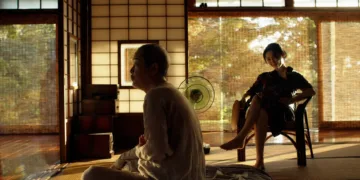













In a picturesque Norwegian town, Eva lives a life of curated respectability. A 48-year-old teacher married to the local mayor, Jostein, she is a pillar of her small community. Her world appears pristine, as immaculate as the fjords that surround her home.
Yet a deep fracture runs beneath the surface. Her husband’s past infidelity has left a silence in their marriage, and Eva drifts through her days feeling profoundly unseen. This quiet desperation, so common in the restrained dramas of Scandinavia, finds its catalyst not in a grand outburst, but in a subtle connection.
When she meets Amir, an 18-year-old Syrian asylum seeker in a language class she teaches, she feels a spark. He is a talented poet, and in her mind, he is a man who sees her, not just the mayor’s wife. A relationship begins, one that crosses forbidden lines of age, culture, and status. It is a story of a woman’s reawakening that quickly spirals into much darker, morally ambiguous territory.
The Unraveling of a Heroine
Eva’s initial pursuit of Amir is born from a recognizable ache of loneliness, a search for validation in a life where she has become part of the decor. This hunger to be witnessed soon morphs into something far more predatory. Her actions, each justified to herself as an act of selfless patronage, are layered with the instinct of possession. Offering him a room in her home is not just charity; it is an act of acquisition.

Praising his poetry is not just encouragement; it is a way of claiming his talent as her discovery. The film charts this descent with chilling precision. This portrayal of a complex woman on the edge recalls the brave female protagonists of 1970s Indian parallel cinema.
Actresses like Smita Patil in Bhumika or Shabana Azmi in Arth gave audiences women who were flawed, driven by desire, and refused to be simple saints or sinners. Pia Tjelta’s work here belongs in that same tradition of courageous performance. Her entire physicality shifts through the film, from the open, hopeful posture in her early scenes with Amir to the coiled tension of a jealous lover.
Her gaze hardens from warmth to a cold, calculating surveillance. Amir himself remains an enigma, a canvas onto which Eva projects her fantasies. We see him only through her obsessive eyes, so when his own secrets and youthful indiscretions surface, they do not register as normal behavior but as a profound betrayal, triggering her complete moral collapse.
A Landscape of Discomfort
Director Nina Knag constructs the film as a slow-burn immersion into Eva’s psyche. The deliberate, quiet pacing of the initial scenes, where tension simmers under polite conversation, makes the eventual psychological implosion all the more potent. Knag trusts the audience to notice the small details, a lingering hand, a furtive glance. This directorial control is amplified by the cinematography.
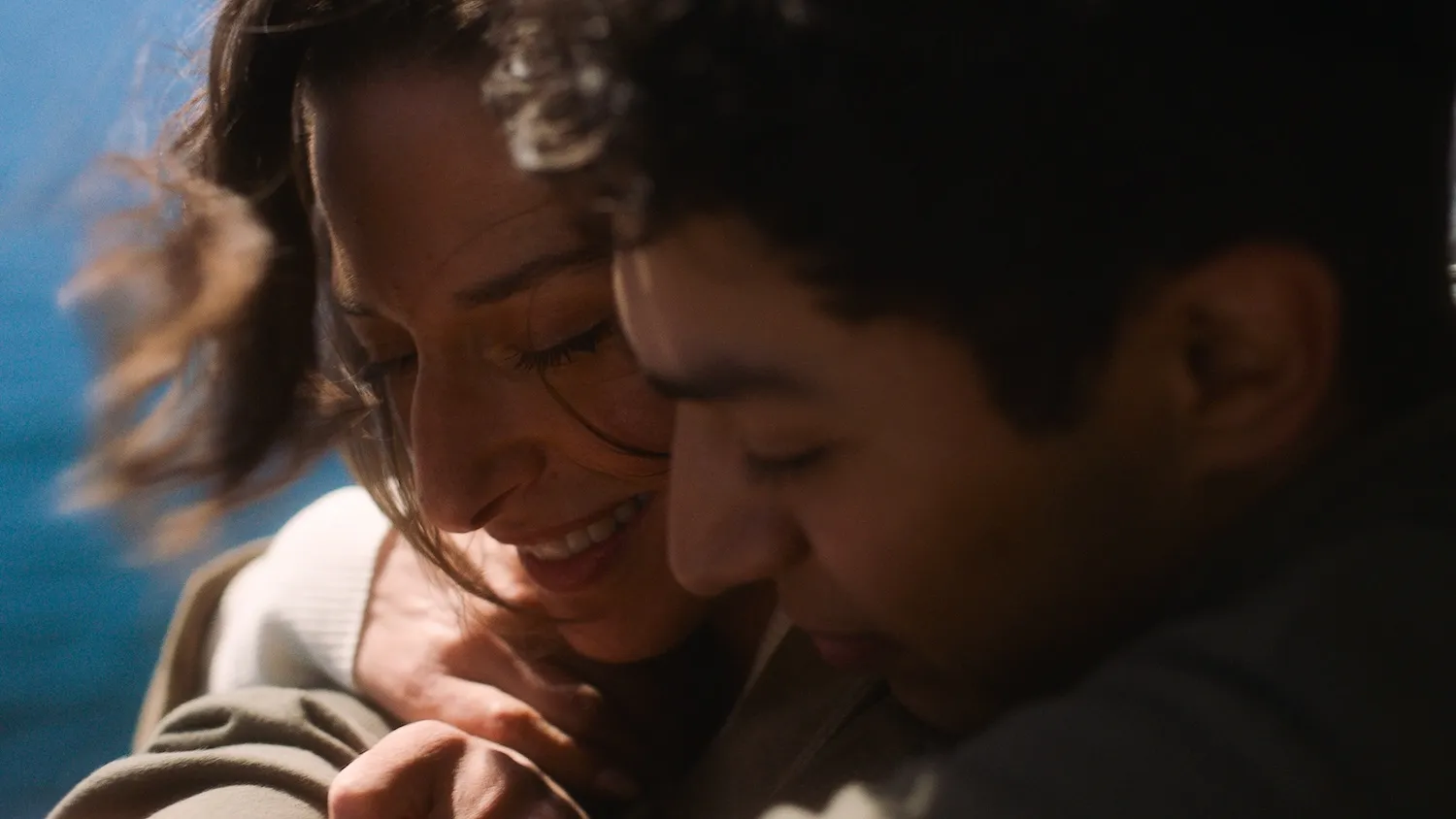
The camera is an active participant, its tight, handheld movements creating a nervous, conspiratorial energy. It stays close to Eva, forcing us to share her shallow breaths and darting eyes. The lighting within the domestic spaces often has a bland, beige politeness that stands in stark contrast to the ugly emotional truths unfolding within the rooms.
The setting is more than a backdrop; it becomes an antagonist. In this small, close-knit town, reputation is everything, a concept that resonates deeply in social fabrics like those in Iran or India, where the preservation of communal honor is a powerful force. The gorgeous but imposing mountains feel less like majestic nature and more like silent, judging witnesses.
They form a natural panopticon, reinforcing the claustrophobia of a place where every action is noted and discussed. A swim in the local pool, at first a symbol of baptismal reawakening for Eva, later becomes a site of paranoid anxiety as her secret life threatens to breach the surface. The film’s tone brilliantly modulates from marital drama to a psychological thriller fueled by this pervasive sense of being watched.
The Currency of Power
The relationship at the film’s center is a clinical dissection of power. It is an unequal equation from its inception, unbalanced by the dynamics of age, gender, and experience. More critically, it is defined by the chasm between their social positions.

Eva wields the institutional power of a citizen over a refugee, the pedagogical power of a teacher over her student, and the immense social capital of being the mayor’s wife. Every interaction is stained by this imbalance, making true consent a murky proposition. The film offers a scalding critique of a certain strain of Western liberal privilege, the kind that champions a cause from a safe distance but recoils when the subjects of that cause become inconveniently human.
The moment Eva’s comfortable existence is threatened, her progressive ideals prove to be a thin veneer for a ruthless self-preservation. The film’s final scene is its most devastating stroke. We return to the bookend image of her husband’s victory speech. Her smile, which may have seemed supportive at the start, is now a hollow mask.
She has won the battle for her social survival, but the victory has cost her humanity. It is a life sentence of private shame. The original Norwegian title, Se meg (“look at me”), echoes with tragic irony. Eva’s journey began with a desperate need to be seen, and it ends with her being forced, finally, to look at the appalling truth of what she has become.
The Norwegian drama film “Don’t Call Me Mama” (Se meg) directed by Nina Knag, premiered at the 59th Karlovy Vary International Film Festival on July 9, 2025. The film is set to be released in Norwegian theaters on October 31, 2025.
Full Credits
Director: Nina Knag
Writers: Nina Knag, Kathrine Valen Zeiner
Producers: Eléonore Anselme, Ingrid Skagestad
Executive Producers: Pia Tjelta, Janne Hjeltnes, Ketil Lømsland, Fridrik H. Mar, Per-Olav Sørensen, Magnus Thomassen
Cast: Pia Tjelta, Kristoffer Joner, Tarek Zayat, Kathrine Thorborg Johansen, Ragnhild Gudbrandsen
Director of Photography (Cinematographer): Alvilde Horten Naterstad
Editors: Vidar Flataukan
Composer: Olav Røyrhus Øyehaug
The Review
Don't Call Me Mama
Don't Call Me Mama is a potent and unsettling psychological drama, anchored by a fearless central performance from Pia Tjelta. Director Nina Knag crafts a claustrophobic and unflinching look at the corrosive nature of power and privilege. While its deliberate pace and morally compromised protagonist make for a difficult viewing experience, it is a sharp, intelligent, and precisely made film that lingers long after the credits roll.
PROS
- A masterful and complex lead performance by Pia Tjelta.
- Unflinching exploration of power, desire, and privilege.
- Tense, atmospheric direction and cinematography.
CONS
- The deliberately slow pace may test some viewers.
- Its unrelenting focus on an unlikable protagonist can be alienating.
- Some third-act plot points follow a familiar trajectory.