










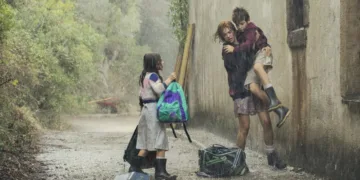
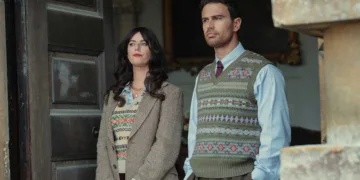

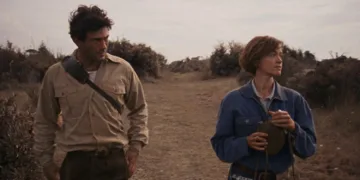














The year is 1977. In Bogotá, the air is thick with the particular anxieties of youth on the verge of disappearing. For the students of José María Root Public School, it is their final year, a period defined by the looming national exam that holds the key to their futures.
Eva Lasting returns for its third season not to wallow in simple nostalgia, but to examine what happens when the dreams of a generation collide with the unyielding realities of adulthood. At the story’s center are Camilo Granados and Eva Samper, two figures now standing on opposite sides of a new divide. Camilo is a father, his world suddenly shrunk to the immediate, demanding presence of his infant daughter, Antonia.
Eva, the revolutionary spark who first ignited his world, has returned with her focus sharpened, channeling her fervor into building a student council. The season immediately establishes its fundamental question: can a shared progressive spirit survive when life pulls its adherents down wildly different, intensely personal paths?
The Activist and the Father
Camilo’s transformation is less a gentle evolution than a sudden, jarring immersion. His new life is a litany of sleepless nights, the foreign weight of a tiny child in his arms, and a responsibility so immense it threatens to suffocate him. The literary abstractions he once cherished feel distant, almost frivolous, replaced by the visceral reality of his daughter’s needs. A new kind of maturity is forged in this crucible, one born not of books but of action.
His worldview sharpens; the political is no longer theoretical but is the very fabric of the world his daughter will inherit. This newfound gravity makes his lingering anxieties about his relationship with Eva all the more acute. She represents a version of himself—intellectual, carefree, rebellious—that he feels is slipping away. His brief, frantic consideration of following her to the United States is the panicked reaction of a young man watching his past burn away, desperately reaching for a familiar flame.
Eva, by contrast, moves with the force of a changing tide. Her energy is channeled into tangible action, with the student council as her first strategic objective. Her mission is to dismantle the school’s calcified status quo from within, but she immediately meets a wall of resistance. It is a nuanced opposition: the paternalistic dismissal from male teachers who see her as a novelty, the quiet warnings from female faculty who have learned the cost of speaking out, and the suspicion of peers unnerved by her intensity.
Each obstacle seems only to temper her resolve, her ambitions expanding beyond the school gates toward the larger social ferment of the era. The dynamic between her and Camilo is therefore completely reconfigured. Their interactions are charged with a new depth, born from their separate ordeals.
She sees in his clumsy, devoted fatherhood a private struggle that reflects a public need for a more supportive society. He, in turn, looks at her unwavering fight and sees not just an idealist, but a pragmatist building a better, more just world for people like his daughter.
Echoes in the Ensemble
A world is defined by its citizens, and Eva Lasting populates its version of Bogotá with a rich, layered community. The central friend group remains the show’s warm, beating heart. Theirs is a “found family” in the truest sense, cemented by the rapid-fire banter and unwavering loyalty that only youth can sustain. Martin’s sardonic humor acts as a necessary release valve, his cynicism a shield against the collective uncertainty they all face.
That uncertainty is crystallized in the national university exams, which hang over them not just as an academic hurdle but as the first great filter of their adult lives, an event that threatens to fracture their tight-knit circle forever. Their solidarity in the face of this pressure is a small, beautiful act of defiance.
The adult world provides a more complicated, often melancholic, counterpoint. The separation of Camilo’s parents, Jose and Ana, is colored by Jose’s attempts to win her back with the romantic gestures of a lovelorn teenager—playing music over the phone, writing sentimental notes. His emotional immaturity is clear. Yet, this portrait is given surprising dimension through his relationship with his other daughter, Janeth.
In the quiet moments spent teaching Janeth, who has Down syndrome, how to drive, Jose reveals a different version of himself. His uncharacteristic patience and the sheer joy of their connection offer a powerful portrait of fatherhood. It is a meaningful subplot, a rebellion against the limitations placed on Janeth by her mother and society, and it shows Jose is capable of a profound tenderness that his main romantic arc struggles to find.
The Texture of Time
The show’s production is an act of meticulous world-building, creating an atmosphere that is both historically precise and emotionally resonant. The cinematography bathes 1970s Bogotá in a warm, nostalgic light without shying away from its grit, making the city feel like a memory brought to life.

Every frame is composed with care, filled with period-specific details—the distinct collar on a shirt, the pattern of wallpaper, the make of a car—that construct a fully immersive reality. The soundtrack, an evocative mix of Latin American and international music, is more than just background noise; it is the era’s pulse, often serving as a subtle commentary on the characters’ internal states. This aesthetic dedication serves a vital cultural purpose.
The series persists in its project of presenting a “different vision of Colombia,” one that sidesteps the violent clichés that have long defined the country in global media. It portrays a nation of intellectual debate, youthful idealism, and profound cultural richness. By grounding its story in this specific, affectionately rendered world, the show gives its characters’ struggles for progress a potent, universal weight.
Full Credits
Directors: María Gamboa, Mateo Stivelberg
Writers: Dago García
Producers: María Isabel Páramo, Manuel Alejandro Gómez, Ángela Vergara
Executive Producers: Dago García, Amparo Gutiérrez, María Isabel Páramo, Ángela Vergara
Cast: Emmanuel Restrepo, Francisca Estévez, Santiago Alarcón, Verónica Orozco, Sergio Palau, Julián Cerati, Brandon Figueredo, Mateo García, Sara Pinzón, Santiago Alarcón, Cecilia Navia, Adriana Arango, Billy Heins, Santiago Heins, Hans Martínez, River Rodriguez, Jhon Álex Toro, Jacques Toukhmanian
Director of Photography (Cinematographer): Andres Camilo Paez Arias (jib operator: cameraman), Pablo Arellano Spataro (still photographer), Daniel Santoyo Dangond (camera/steadicam operator)
Editors: Cory Landroche (dialogue editor), Luis A. Morales (dialogue recordist), Alexander Verbitskiy (foreign language mixer: English), David Ward (dialogue editor), Daniel Sebastián Gómez (boom operator)
Composers: Santiago Uribe, Juan Felipe Uribe, Runa, paccino
The Review
Eva Lasting Season 3
Eva Lasting matures alongside its characters, trading simple teenage rebellion for the far more complex terrain of early adulthood. The season excels in its thoughtful examination of how responsibility shapes identity, anchored by strong performances and beautifully realized subplots. While the central romance sometimes circles familiar anxieties, the show’s rich atmospheric detail and its commitment to presenting a culturally significant, stereotype-defying vision of 1970s Colombia make it essential viewing. It is a heartfelt and intelligent continuation of a truly special series.
PROS
- A mature exploration of themes like parenthood and responsibility.
- Deeply felt character development for the two leads, Eva and Camilo.
- Meaningful supporting stories that add emotional weight, particularly the bond between Jose and Janeth.
- Exceptional production design and cinematography that create an immersive 1970s atmosphere.
- Presents an important and refreshing cultural portrait of Colombia.
CONS
- The central romantic conflict can feel repetitive at times.
- Some supporting character arcs, like Jose's attempts to win back Ana, can feel less developed.
- Minor anachronisms in costume design might distract some viewers.