

























Dream Eater, the second feature birthed from Eli Roth’s The Horror Section imprint, announces itself with sharp, unsettling force. Jay Drakulic, Mallory Drumm, and Alex Lee Williams build it as a collective project, with Drumm and Williams embodying the doomed pair at the center. The setup is spare: Mallory and Alex withdraw to a remote cabin in Quebec’s Laurentians to track his escalating parasomnia.
Found footage carries a clear rationale, since Mallory works as a documentarian and records his nights for diagnosis. The opening refuses the slow creep and lands with the crackle of a 911 call about self-harm, an overture that feels like a blast of cold air. From there the film fuses domestic fracture with the chill of the paranormal, even the cosmic, the way a household squabble can start to feel like a message from deep time.
The Price of Documentation and Isolation
This brand of found footage emphasizes craft and calculation rather than raw verité. Mallory’s pricey camera and professional habits justify why the material exists at all. A non-diegetic score and neat jump cuts announce curation, so the home-recorded aura doubles as a frame for commerce and myth.
The result suggests a deliberately packaged trauma reel, a docu-horror-commodity (a handy label for a self-aware pocket of the form). The couple’s worst hours read like saleable content and, in a more ominous register, like a circulated scripture.
That logic steers the film toward tougher questions. The medical surface—sleep disorder as threat—opens onto a study of a partnership eroding under pressure and of codependency that functions like faith. The primal dread arrives in the familiar bedroom: the person next to you turns unfamiliar when sleep lowers every guard.
Mallory’s grinding loyalty echoes the “I can fix him” reflex, a form of unpaid labor with a long lineage in imbalanced relationships where one partner keeps paying the emotional bill until the system collapses. Winter scenery does thematic work.
Blank snowfields and the hush of a white horizon create a trap with crisp edges. The cabin offers shelter and still feels like a locked ward, a geographical model of illness that consumes time. The landscape’s indifference hints at cosmic scale, which miniaturizes their crisis and, paradoxically, sharpens it.
The Duality of Performance and the Specter of Inaction
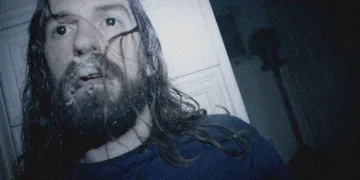
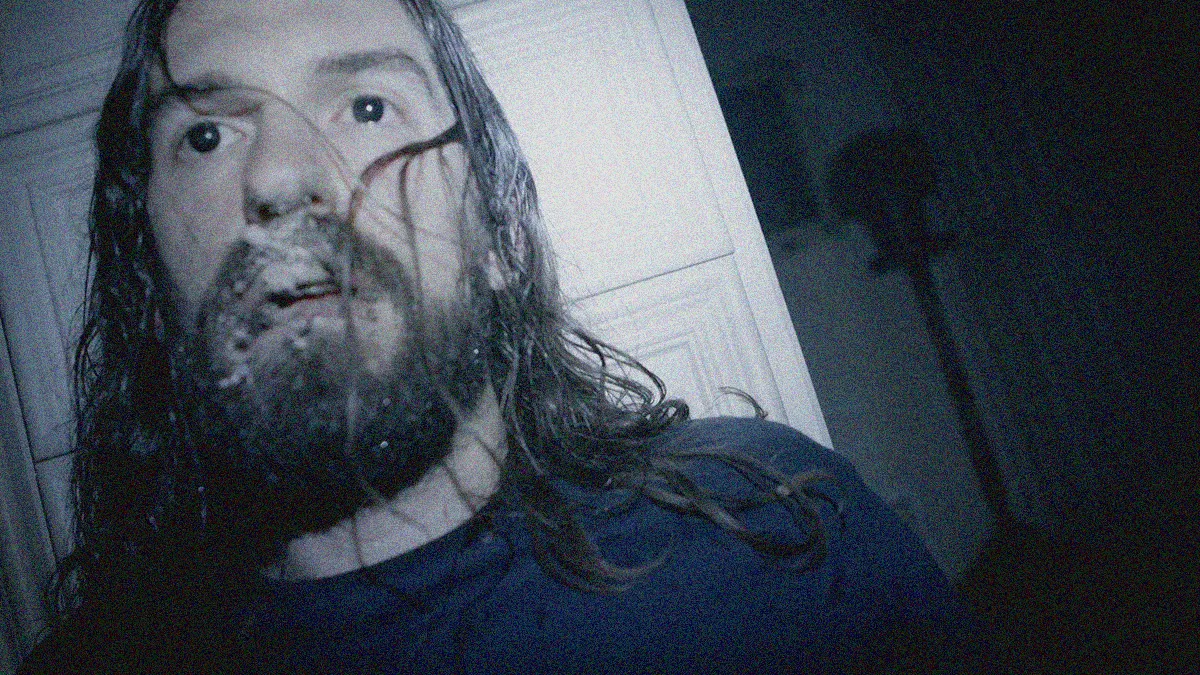
Alex Lee Williams gives the film its hinge. Daylight Alex reads as playful and approachable, the kind of presence that invites trust. Nighttime Alex becomes a slack-eyed revenant, a body with the lights off. The gap between the two generates much of the film’s sting, since the same face holds opposite meanings across a few hours. He turns into the channel through which the external menace travels.
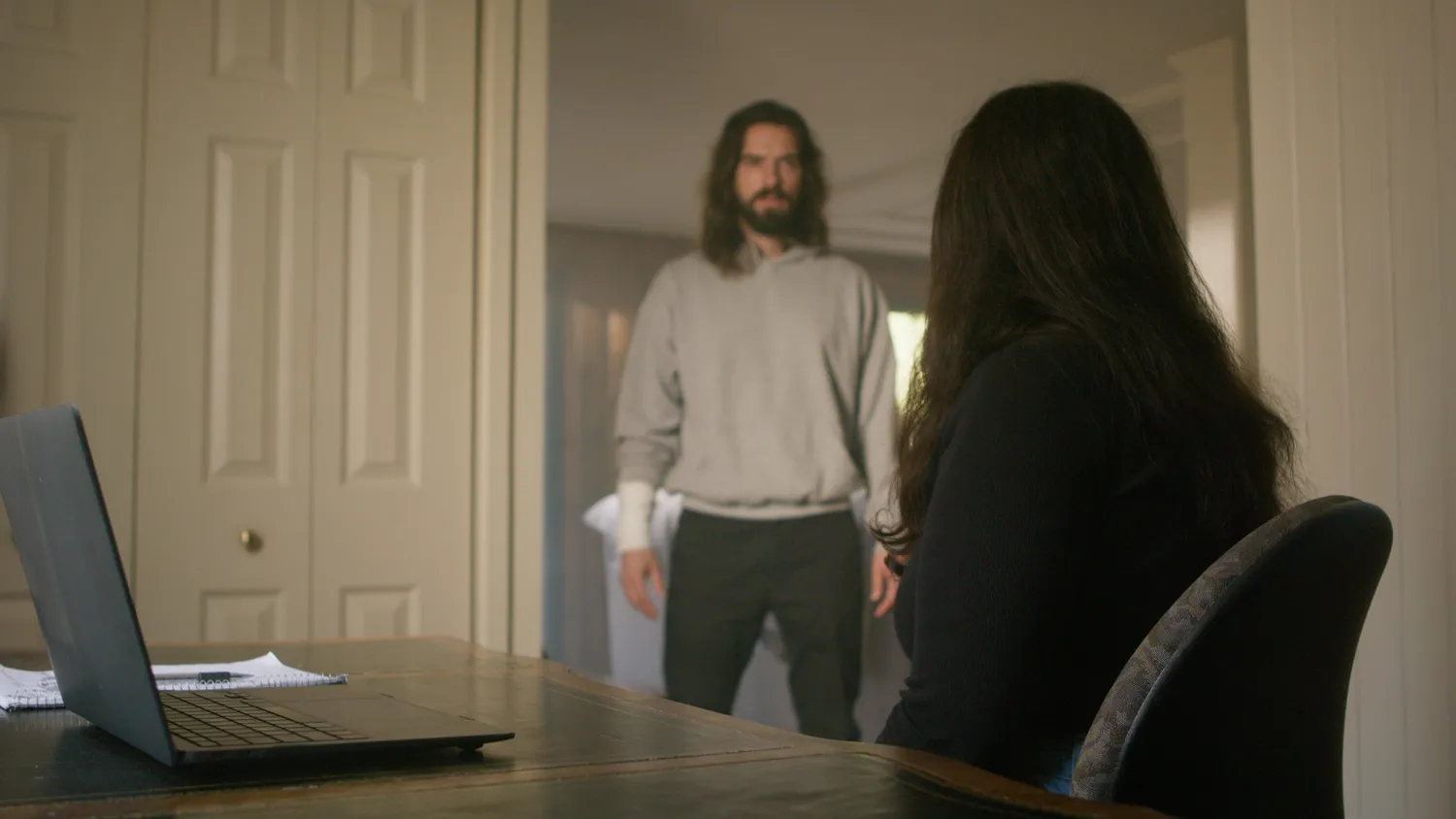
Mallory Drumm carries the counterweight: witness, researcher, caretaker, and uneasy anchor. Her choice to remain in place while risk keeps rising tests patience. The script aims at a portrait of attachment and dependence; it also asks the viewer to accept the long stall of staying put.
That stall bends sympathy out of shape and exposes a pacing problem that traps her character in cycles. The story sprints into high gear early, then revisits the same nocturnal convulsions, which flattens momentum and keeps Mallory on a loop. Some uneven line readings make that loop feel longer.
Whispers in the Dark: Execution and Mythology
Sound becomes the film’s sharpest instrument. Extended sequences in full darkness rely on audio alone, so fear arrives as a wave of sonic cues. A spare, unsettling motif, a whistle with a human edge, stitches the room to whatever presses in from outside. The ear does the seeing.
The images work with scarcity economics. Handheld wobble, the soft smear of consumer sensors, and the green glow of night vision (genre staples) turn limitation into mood. Grain obscures and enlarges. The camera’s vulnerability becomes a philosophy of looking.
The engine under the hood is possession cinema with a cosmic tint, a Lovecraftian flavor connected to pieces of Alex’s earlier life. The film builds this lore with care, then trips near the end on a familiar hazard for existential horror: an explanatory surge that spells out the malevolence and thins the hard-earned mystery.
The move drains oxygen from the unknown and narrows the interpretive field. Even so, the picture lands persuasive frights, including a smartly staged jolt telegraphed from the edge of the frame that still hits. The final stretch kicks back into motion, throws out a run of effective scare beats, and plants images that stick. Inside a format with visible wear, precise staging and rigorous sound carry the experience.
Across the whole, Dream Eater thinks about how couples manage illness and how media packages that stress. It looks at devotion as a technology of survival and as a sinkhole. It treats the camera as both tool and witness, a recording device that can heal by diagnosing and harm by commodifying.
The film also brushes against a larger social archive. Sleep disorders, remote cabins, and curated footage form a small myth about modern life: retreat looks like safety, surveillance looks like care, and both can feel like traps. Even the cosmic gestures fold back into the bedroom, which is where the oldest stories have always measured terror.
The title names a creature and a practice. Something feeds, and the meal is private life. The movie watches that feeding with clinical fascination and occasional pity. The pity matters. It tells us that horror still counts as an ethics lesson, that a documented nightmare can read as warning, that codependency can hide in a beautiful snowfield. The camera keeps rolling. The sound keeps whispering. The night keeps getting longer.
Dream Eater is a found-footage horror film that premiered in select theaters on October 24, 2025, distributed by Iconic Events Releasing under the banner of Eli Roth’s studio, The Horror Section. The story follows Mallory, a documentarian, and her boyfriend Alex, as they retreat to a remote cabin in the snowy Laurentian Mountains to address Alex’s worsening, violent parasomnia (sleepwalking). Using her camera to document his episodes for medical reasons, Mallory soon suspects a more sinister, occult force is responsible for the escalating terror. The film, which has a running time of 90 minutes, was co-written and co-directed by its two stars, Mallory Drumm and Alex Lee Williams, alongside Jay Drakulic.
Credits
Title: Dream Eater
Distributor: Iconic Events Releasing, The Horror Section (Eli Roth’s studio)
Release date: October 24, 2025
Running time: 1 hour 30 minutes (90 minutes)
Director: Jay Drakulic, Mallory Drumm, Alex Lee Williams
Writers: Jay Drakulic, Mallory Drumm, Alex Lee Williams
Producers and Executive Producers: Thomas Chambers, Mallory Drumm, Alex Lee Williams, Jay Drakulic, Michael Caterina, Julian Stirpe, Vigo Vasquez
Cast: Mallory Drumm, Alex Lee Williams, David Richard, Dainty Smith, Kelly Williams, Brittany Hayward, Robin Akimbo, Sade Green
Director of Photography (Cinematographer): Michael Caterina
Editors: Vigo Vasquez
Composer: Julian Stirpe
The Review
Dream Eater
Dream Eater offers an unsettling and technically competent entry into found footage, effectively using evocative sound design (especially the repeated sinister whistling) and a bleak, isolated setting to generate pervasive fear. Alex Lee Williams’ focused, dual performance grounds the terror in palpable domestic dread. While the thematic exploration of codependency and the unknowable partner is intellectually sharp, structural issues related to pacing and a frustrating lead character prevent the movie from achieving classic status. The late-runtime mythology is unnecessarily over-explained, dissipating the atmosphere of the unknown. It succeeds as an eerie, stylish frightfest that points toward a sophisticated future for its studio.
PROS
- Effective sound design (sinister whistling motif, sequences in darkness).
- Alex Lee Williams' strong, unsettling dual performance.
- Found footage meta-layer (edited for profit, non-diegetic score).
- Bleak, isolated winter cabin setting amplifies psychological tension.
- Strong thematic basis in relationship decay and codependency.
CONS
- Pacing dissonance due to early intensity; action becomes repetitive.
- Mallory's inaction strains credibility and frustrates the audience.
- Heavy-handed, late-film exposition over-explains the mythology.
- Some unevenness in Mallory Drumm's performance.