































Maxton Hall – The World Between Us has established itself as a significant streaming success. The German-language Prime Video original translates the familiar “rich boy meets scholarship girl” dynamic into a polished audiovisual grammar that found a broad international audience.
The series adapts Mona Kasten’s “Save” novels and stages its action inside a deliberately stylised fictional British elite private college. The second season opens directly after a sharply destabilising event that concluded the first installment: the death of James and Lydia’s mother, an occurrence that sets the new episodes on a path of sustained emotional reckoning.
The Diminished Voice of the Working Class Heroine
The new season moves the series away from the breezier tone of the first and into a darker emotional register. Season 1 derived much of its momentum from the quick-witted friction and mutual provocation between Ruby Bell and James Beaufort; in Season 2 that particular spark is muted as the narrative presses deeper into pain. This approach is visible across a number of contemporary Young Adult streaming shows, where creators raise stakes by intensifying suffering rather than by enlarging the inner life of characters. When dramatic escalation depends predominantly on escalating anguish, authentic moments of vulnerability have less room to breathe and the feel of lived experience is compressed.
Ruby Bell, played by Harriet Herbig-Matten, initially functions as the show’s working-class lens. Her scholarship status and sustained ambition provided an engine through which the programme could interrogate class and mobility. In this season Ruby too often becomes reactive. External pressures mounted by the Beaufort family repeatedly shape her decisions, and the show curtails the agency that once allowed her to act decisively. This narrative choice undercuts the series’ promise to examine how an outsider might pursue self-determination inside an elite institution.
Certain plot elements return in familiar form. Ruby’s prolonged effort to secure a place at the series’ version of Oxford University and her continued role organising school events appear as recurring markers of identity. Those details maintain continuity but rarely signal meaningful development. The central couple is repeatedly sent through separation, sharp conflict, and reconciliation in a pattern that grows predictable. By constantly escalating emotional stakes without restructuring relationship dynamics, the show diminishes the potency of individual scenes that in the first season felt earned.
This pattern matters because Ruby’s perspective supplies the clearest path to a substantive conversation about privilege and access. Reducing her power to influence outcomes lessens the series’ ability to stage sustained, systemic critique and turns class into a backdrop for melodrama instead of a field for persistent analysis. The season’s approach also changes the show’s tonal calibration.
Also Read






Scenes that might have functioned as quiet, character-building breaths are repurposed as setup for the next crisis. As a result, the episodic architecture privileges shock and reversal over gradual accumulation. Consequently, Ruby’s daily work and small acts of care receive less dramatic weight than staged confrontations, and that reduces the programme’s capacity to present a textured portrait of working-class striving.
When Class Conflict Becomes Cartoonish Villainy
The season attempts to dramatise anxieties about concentrated wealth and unchecked influence. That impulse is channelled through Mortimer Beaufort, portrayed by Fedja van Huêt. In the first season Mortimer acted mostly as a menacing background figure; in the new episodes his role expands into a dominant source of oppression. The escalation pushes his character into excess. He initiates a focused vendetta against Ruby and her family that exceeds preservation of status and takes on a tone of deliberate cruelty.
This amplification has mixed consequences. It supplies a clear dramatic engine and explains several sudden reversals, but it also flattens complexity. Mortimer’s interventions so frequently override institutional checks that adult authority figures and school leaders increasingly appear as extensions of his will.
When those institutional actors function primarily as proxies for one patriarchal force, the show loses opportunities to depict how real institutions resist or complicate elite power. Mortimer’s outsized presence reshapes viewer sympathies; when an antagonist’s cruelty becomes overwhelmingly central, storytelling too easily collapses into a binary of villain and victim, and the systemic networks that enable harm go underexamined.
Set against that concentrated weight, Damian Hardung’s James Beaufort supplies the season’s most sustained interior work. The death of his mother propels James into self-destructive behaviours, including heavy drinking and drug use, and then into a tentative process of repair and introspection. Those sequences render a vulnerable portrait of grief inside privilege and show the difficulty of disentangling personal need from inherited obligation.
The series includes short, earnest references to therapy and to structured emotional work; those moments register as sincere interventions even when they remain brief within the larger melodramatic sweep. If those references expand into longer arcs, they could ground James’s recovery in more credible and sustained dramatic labour.
Supporting relationships offer important counterweight to the Beaufort shadow. The friendship that develops between Ruby and Lydia becomes a warm, stabilising bond that helps anchor Ruby when the romantic plot frays. Ruby’s connection with her sister Ember supplies domestic texture and a reminder of what she stands to lose outside the elite bubble. Many adult secondary characters, however, remain underwritten; teachers and administrators too often act as narrative shortcuts that service Mortimer’s designs and limit the series’ ability to show institutional nuance.
The Aesthetics of Heightened Emotion and Global Trends
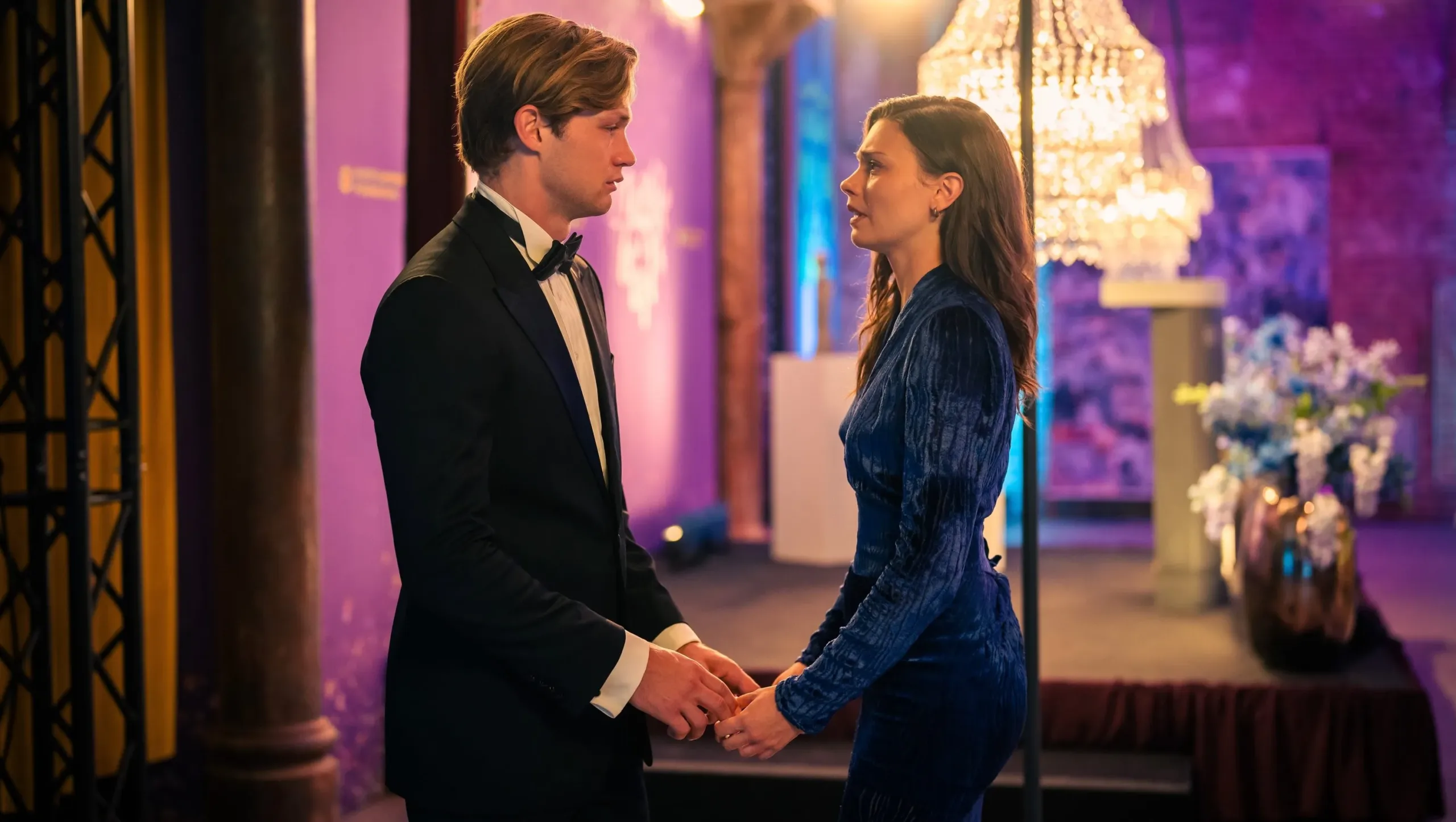
Production craft and lead performances remain central to the season’s broad appeal. Harriet Herbig-Matten and Damian Hardung sustain a palpable on-screen rapport that communicates ardour, volatility, and emotional urgency. Their presence sustains investment when plotting drifts into predictability, and Hardung’s depiction of grief provides necessary ballast for the season’s tragic core.

Visually the show commits to a polished, highly produced look. The production favours a lush palette, composed set design, and repeated use of slow-motion and amplified visual motifs to register feeling with immediacy. That aesthetic choice privileges immediate emotional payoff over long-form character accumulation; scenes are arranged to deliver concentrated emotional refrains that produce a rapid, intense response. Maxton Hall’s fairytale-like settings codify an escapist atmosphere that amplifies romantic fantasy and focuses attention on mood and sensation.
This coupling of refined technical craft with recognisable Young Adult formulas reflects an explicit streaming logic. Maxton Hall demonstrates how a national production can be calibrated to travel across languages by foregrounding visual clarity and concentrated affect. The show’s visual and performative choices reduce the friction of cultural difference and explain part of its standing as one of Prime Video’s commercially effective non-English-language originals. At the same time, that alignment narrows the kinds of narrative risks the series takes, steering it toward emotionally dense moments that prioritise measurable engagement.
The season’s visual tempo resembles the structure of a pop song: repeated refrains, immediate crescendos, and easily recognisable hooks. That design suits a younger audience that values instantaneous affect and shareable emotional moments. For streaming platforms, that configuration produces clear engagement signals, but it also shapes creative incentives. Producers may prioritise projects that deliver quick emotional payoffs over slower, riskier narratives. That dynamic helps explain why Maxton Hall became an international hit while also explaining the limits of the kinds of stories such hits make room for.
Escapism and the Cost of Emotional Overload
Season 2 functions effectively as concentrated escapism for viewers who prioritise romantic heat and aesthetic polish. For the show’s devoted fanbase, the repeated crescendos of passion and melodrama supply steady engagement and support the commercial logic behind a commissioned third season.

At the same time, the programme’s continual reliance on heightened antagonism and manufactured crisis constrains its potential for lasting cultural impact. The series would gain depth if it allowed core characters extended intervals of quieter reflection and incremental change. Trusting organic character moments would enable authentic emotional truths to accumulate and register with greater force.
Excessive villainy and nonstop conflict frequently act as substitutes for rigorous narrative work; they produce spectacle at the expense of interior discovery. Visually arresting and intermittently affecting, Season 2 nevertheless sacrifices a portion of the original spirited charge that first made the show feel noteworthy.
The broader implication is clear: commercial success and formal ambition do not always coincide. Maxton Hall demonstrates how streaming economies shape storytelling choices and how pressure for continuous engagement can steer a promising property toward recurring spectacle. If future episodes re-centre Ruby’s agency and allow slower, patient sequences to breathe, the series could deepen its commentary on class and grief while retaining the passionate intensity that has won its audience. As it stands, Season 2 confirms that a programme can be widely popular while narrowing the kinds of political and emotional inquiry it stages.
Maxton Hall – The World Between Us, is a German-language Young Adult romance drama based on the “Save” novel trilogy by author Mona Kasten. The show became a breakout international success for its distributor, Amazon Prime Video. Season 2, which premiered on November 7, 2025, continues the turbulent relationship between scholarship student Ruby Bell and millionaire heir James Beaufort as they navigate immense personal loss and escalating class conflict at the elite Maxton Hall private school. The second season, which adapts the book Save You, consists of six episodes and can be watched exclusively on Prime Video.
Full Credits
Title: Maxton Hall – The World Between Us Season 2
Distributor: Amazon Prime Video
Release date: November 7, 2025
Rating: TV-MA (Based on general TV Guide rating for the series)
Running time: Approximately 40-45 minutes per episode (6 episodes total)
Director: Martin Schreier, Tarek Roehlinger
Writers: Ceylan Yildirim (Head Writer), Juliana Lima Dehne, Marlene Melchior, Daphne Ferraro
Producers and Executive Producers: Markus Brunnemann, Valentin Debler (Producer), Ceylan Yildirim (Executive Producer)
Cast: Harriet Herbig-Matten, Damian Hardung, Sonja Weißer, Fedja van Huêt, Justus Riesner, Ben Felipe, Andrea Guo, Runa Greiner, Eidin Jalali
Director of Photography (Cinematographer): Christof Wahl
The Review
Maxton Hall – The World Between Us Season 2
Maxton Hall Season 2 is a visually stunning and emotionally charged spectacle, sustained almost entirely by the magnetic chemistry of its lead actors. However, the season sacrifices narrative depth for excessive, repetitive melodrama. By elevating Mortimer Beaufort to a cartoonish villain, the show stifles the protagonist's agency and forces predictable conflicts. It is an effective, highly polished escapist watch that ultimately prioritizes manufactured angst over genuine emotional progression.
PROS
- The powerful, magnetic performances and undeniable spark between Harriet Herbig-Matten and Damian Hardung.
- James Beaufort receives the season's most genuine character growth, dealing with grief and confronting toxic family control.
- High-quality, stylized aesthetics and visual language (slow-motion, bombastic visuals) that successfully convey heightened emotion.
- The warm and stabilizing friendship between Ruby and Lydia provides essential emotional respite.
CONS
- Mortimer Beaufort is transformed into an overwhelming, cartoonish antagonist, stifling narrative nuance.
- The narrative constantly cycles through the same conflicts, sacrificing plot evolution for continuous high-stakes drama.
- The protagonist, Ruby Bell, is frustratingly sidelined, becoming a passive figure in her own story.
- The first season's essential "charming" and "playful" dynamic is replaced by an "unrelenting gloom" that feels manufactured.