














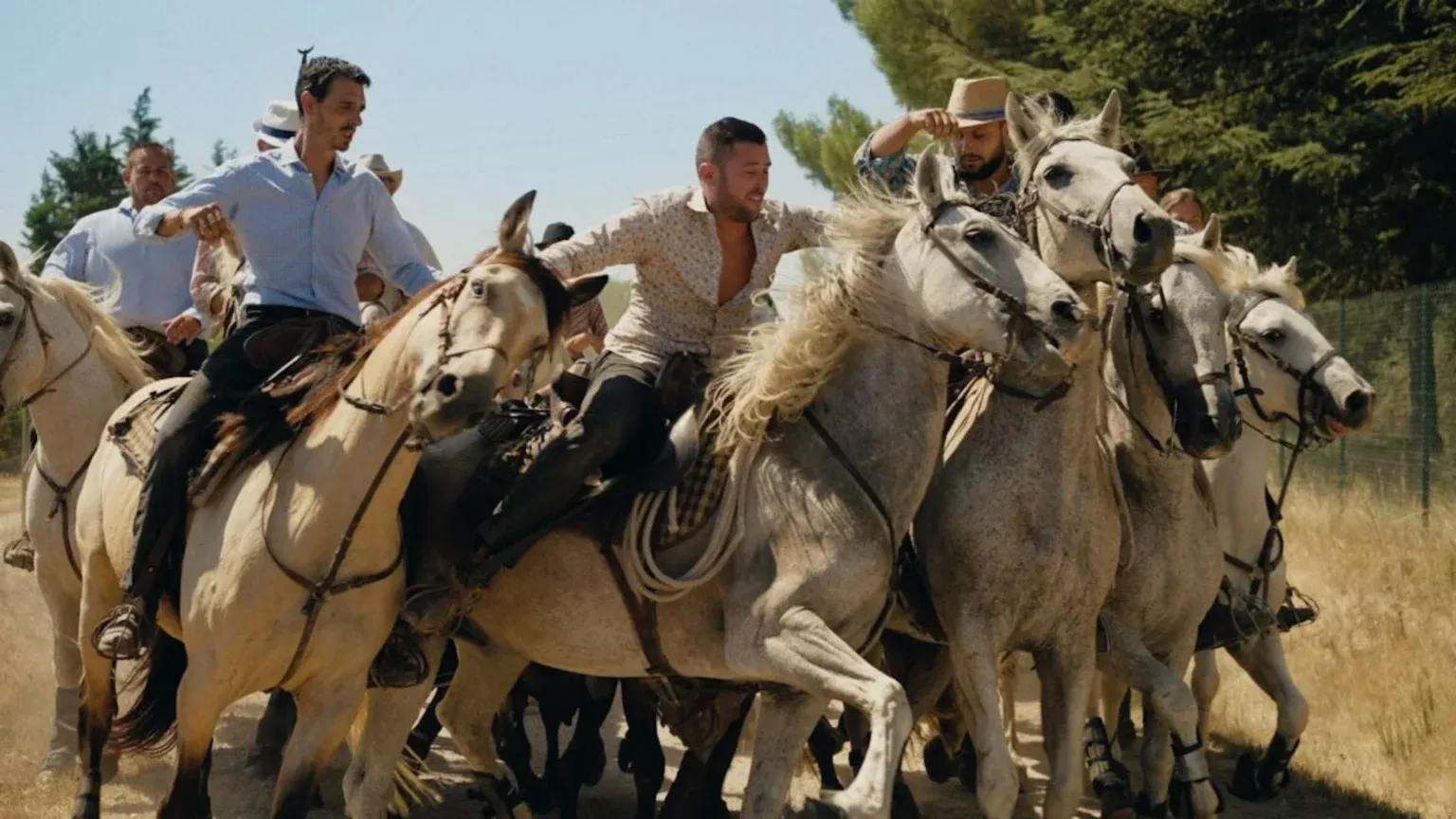

In the sun-scorched wetlands of the Camargue, where the Mediterranean murmurs against the marsh, a ritual of restrained violence takes shape. Jérémie Battaglia’s A French Youth watches the course camarguaise with an unblinking patience.
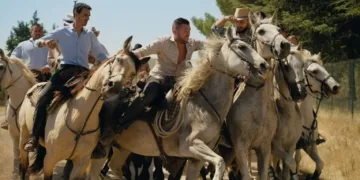
The bull lives. The goal is the horn’s adornment. Raseteurs sprint into the animal’s orbit and reach for silken ribbons as the charge closes the distance that separates sport from injury. It plays like a rehearsal with death that never grants the release of a final act. Our guides through this old landscape are Jawad Bakloul and Belkacem Benhammou, young French citizens of North African descent.
They carry inheritance in their bodies and voices, even as they perfect a Provençal tradition rooted in local identity and guarded by memory. The film records their hunger for excellence, the way ambition turns into a private form of prayer. They want a place inside a cultural history that can treat their presence as curiosity, sometimes as intrusion. Battaglia keeps the gaze near. He plants us in the arena’s heat and lets us feel a subculture made of quiet tension, sudden impact, and the hard thunder of hooves.
The Altar of the Beast
The camera moves with frantic grace, as if it shares the jittery heartbeat of a man facing half a ton of muscle and horn. Battaglia uses slow motion to stretch seconds until they feel like whole lifetimes. Sweat beads on a lip. A runner’s eyes flicker with calculation. In this world, the bull reigns. Statues rise for it. The crowd’s veneration belongs to it.
The opening night shots lay down that hierarchy, framing the animal as a primordial force, never an object of pity. The men read as visitors in the bull’s domain. Their white uniforms resemble vestments, bright enough to look ceremonial, fragile enough to feel doomed. The fabric becomes a record of struggle, marked by the red of their wounds and the grey dust of the arena floor.
Benhammou and Bakloul pay the physical tax of this devotion. Muscle tears and broken bones become the price of a moment that vanishes as soon as it arrives. The sport plays like choreography built for survival, a precise tango where a small miscalculation invites a horn into flesh. Beauty lingers here, and it comes from vulnerability that never pretends it can be mastered.
The Ghost of the Arena
Their struggle runs on two planes. Inside the ring, ribbons decide status. Outside, they pursue legibility in a country that refuses to grant it. A cruel irony hangs over the spectacle: North African athletes protect a French tradition as the bleachers vibrate with racial animosity. Spectators often lean toward the animal, craving the instant where the man is punished for stepping too close.
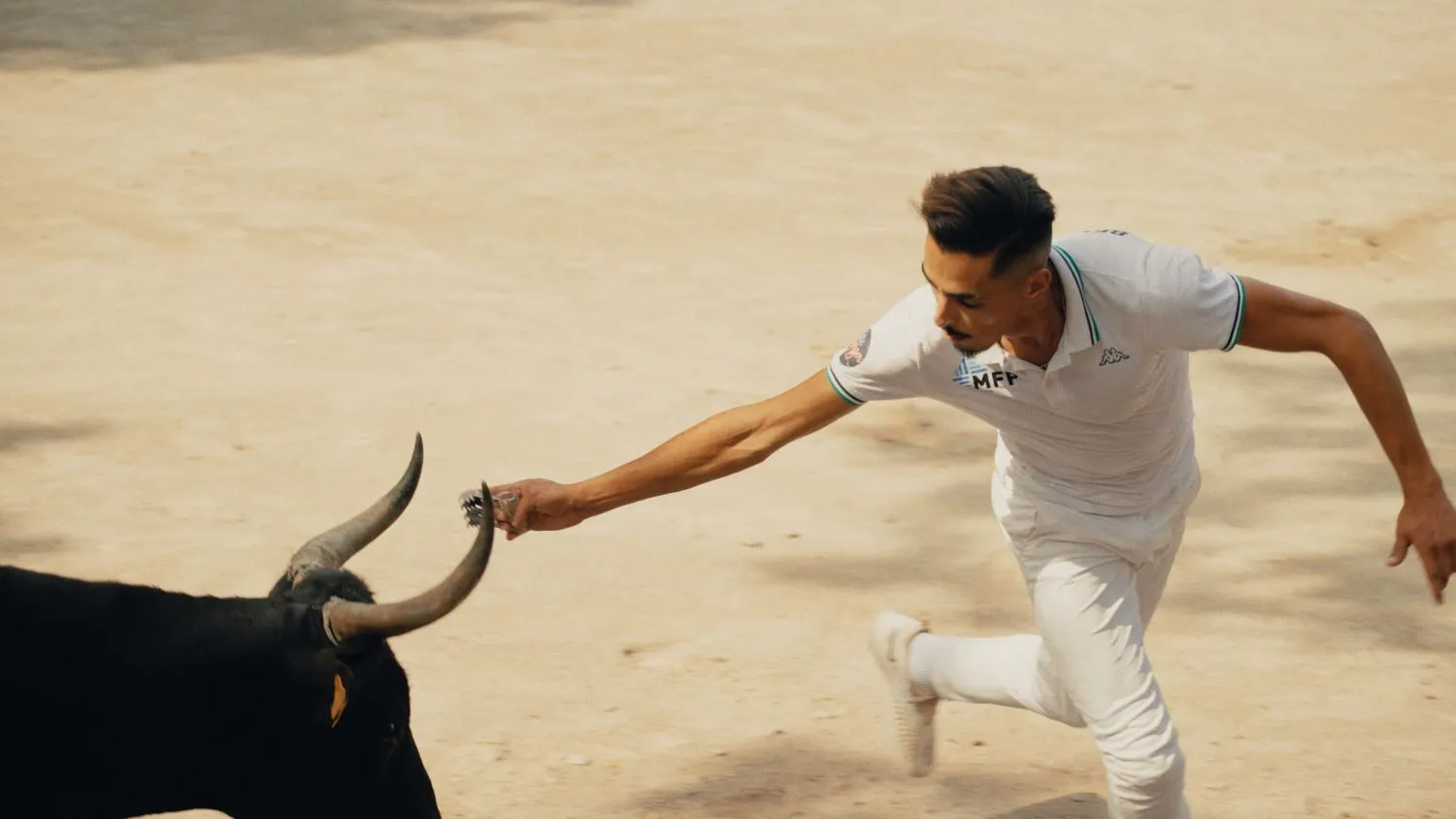
That friction follows them beyond the arena gates and into the plain texture of daily life. Benhammou stands as a champion on the sand, and he still works as a security guard in the city. The triumph in the ring fails to carry into economic stability or easy belonging. Systemic barriers cut with the same sharpness as horn and hoof.
Battaglia shows the quiet anxiety of Benhammou’s mother, a woman who worked as a cleaner to raise her son, watching him risk his body for a culture that meets him with suspicion. Islamic faith, Moroccan or Algerian roots, and a deep love for the Provençal dialect sit side by side, all of it true at once. The ring becomes a physical echo of the immigrant experience: constant evasion, constant poise, constant exposure, all within the enclosure of a society that demands total assimilation.
Echoes of an Immersive Truth
Battaglia shapes a portrait that feels human because it trusts exhaustion to speak. He holds back from overt instruction and lets the men’s fatigue, pride, and fear gather their own meaning. Armand Glowinski’s soundscape supplies a low thrum of dread, a pressure that seems to seep from the marshland into the chest.
It hints that the turmoil inside these lives has the same vastness as the landscape around them. Andrea Henriquez’s editing links the scale of the Arles arenas with the cramped reality of social housing complexes, and that cut exposes the distance between the mythic hero and the marginalized citizen. The film stands against the flat, hostile images of North African youth that circulate in mainstream media. Here, their tenderness appears without apology.
Fear arrives without melodrama. Quiet courage holds its ground. Culture passes between friends as a living, painful inheritance, shared in glances, rituals, and the small acts that keep a community intact. The documentary catches friendship at its most fragile, tested by chaos and held together by trust. It leaves a troubling question in the air: how much pain can a person endure before belonging becomes another form of injury, one that the arena simply makes visible.
A French Youth premiered globally on May 1, 2024, at the Hot Docs Canadian International Documentary Festival and saw its theatrical release in Quebec on November 15, 2024. As of today, December 29, 2025, the film is available for streaming on platforms such as True Story and MUBI in select regions. This immersive documentary captures the life of young North African men in Southern France who participate in the tradition of Camargue bullfighting, exploring deep themes of identity and social integration through the lens of a non-lethal sport.
Full Credits
Title: A French Youth (Une jeunesse française)
Distributor: Les Films du 3 Mars, True Story
Release date: May 1, 2024
Running time: 84 minutes
Director: Jérémie Battaglia
Writers: Jérémie Battaglia
Producers and Executive Producers: Amélie Lambert Bouchard, Elodie Pollet, Valérie Dupin, Cyrille Perez, Gilles Perez
Cast: Jawad Bakloul, Belkacem Benhammou, Tito Sanchez, Rachida Benhammou, Mohamed Benhammou, Julia Rodriguez, Mehdi Ait Idir
Director of Photography (Cinematographer): Jérémie Battaglia
Editors: Andrea Henriquez
Composer: Armand Glowinski
The Review
A French Youth
Jérémie Battaglia succeeds by grounding a massive social tension in the specific, bruised bodies of his subjects. The film avoids easy answers. It prefers to let the dust and the danger define the cost of belonging. While the pacing occasionally stutters, the raw intimacy remains a powerful force. It is a quiet, necessary observation of a struggle that feels both ancient and immediate.
PROS
- Visceral arena sequences that capture the immediate danger.
- Intimate access to the private lives and families of the subjects.
- Avoiding stereotypical portrayals of North African youth.
- Striking use of silence and slow motion to emphasize physical toll.
CONS
- Occasional repetitive pacing during the training segments.
- Some narrative disjointedness in the midsection of the film.