












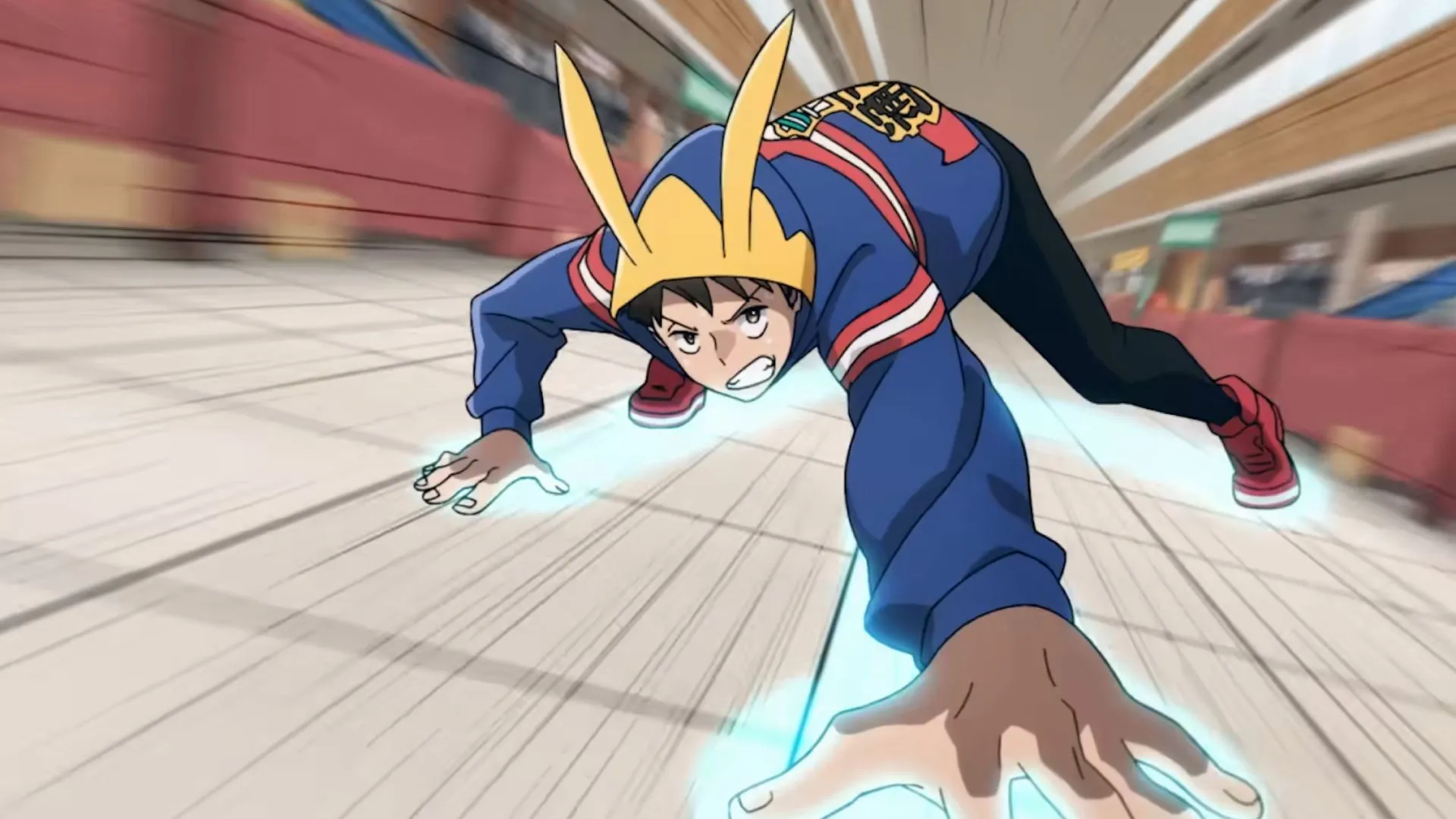
Koichi Haimawari plants his palms on the freezing metal skin of a speeding bullet train. Wind claws at his clothes. He is a college student who bought too much food and missed his seat, and the mistake turns physical. His quirk, the plain little ability to slide, mutates in the instant he needs it most. The force flips. It drags him toward the surface where it once sent him away. The terror of clinging to the outside of the Shinkansen sets the tone for the series’ return, a hero shaped in panic, learning with his body before he can form a plan.
The unlicensed life comes across as messy labor, far from the polished dormitories of U.A. High School. Koichi’s amateurism stays one of the story’s sharpest tools. Power feels earned through sweat and split-second instinct, grounded in consequence. A blur of blue and grey streaks against the Japanese landscape while the train screams toward Osaka at hundreds of miles per hour, and the season offers that image as its entry point: desperate, unintentional clinging as a portrait of growth that arrives unannounced.
The story shifts to Osaka and picks up a different current. The Glico Running Man appears, and here the figure is All Might. The image lingers, a reminder that the Number One Hero’s presence blankets the nation. The symbol casts a long shadow even in a city known for its own culture and food. Pop Step and Koichi arrive as outsiders, stepping into streets that do not know them. The change of location widens the world on screen and frames hero society as a national machine, a network that runs through malls, idol stages, and police work in equal measure.
The Physics of Accidental Salvation
Koichi’s evolution arrives by accident, and the series treats that accident as essential. Professional heroes train in schools designed for power, with teachers and labs built to measure and refine quirks. Koichi gets a missed train and a fear of falling. The slide turns into a stick, and the change lands because it ties itself to survival. Quirks read as living parts of the body, responsive to stress, capable of shifting under pressure like muscle memory pushed past its limit.
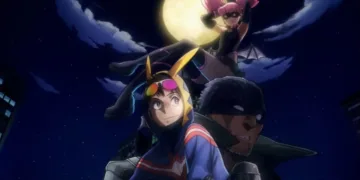
The animation mirrors that idea through texture. The lines carry a grainy, comic-book bite, while the main series favors a glossy finish. The choice suits these characters. They operate at street level, working inside the cracks of the system where rules blur into habit and necessity. The visuals keep the focus close to the skin of the city and the strain in a limb, matching a story interested in what power costs when there is no institution to catch the fall.
The season keeps its gaze on everyday friction, letting mythic scale sit in the distance. Koichi’s new capability stays small in shape: no massive explosion, no sudden new form, just a revised relationship with the surfaces around him. That attention to the fine print of a quirk gives the world weight. Superpowers register as biological traits, built from impulse and movement, with logic that can be traced through the body.
The attract-and-repel mechanics show up through his physical decisions. He already used the adhesive side of the ability to take turns, building momentum through contact and release. The missing piece was awareness. Realizing what the body had already been doing becomes the key motor of his growth, and the series lets that realization feel like earned knowledge instead of a gift dropped from the sky.
The Commercial Shell of Heroics
Osaka introduces Monika Kaniyashiki in a robotic crab suit used to sell seafood, an image that lands as both absurd and pointed. Hero imagery becomes product packaging, quirks become advertising language, and the culture turns performance into currency. Pop Step ends up inside the suit later, and the story makes the costume’s physicality impossible to ignore. It is heavy. Movement becomes work. The crab shell plays as a metaphor for the burden of public presentation, the way idols and heroes share an economy of masks and crowds, each smile shaped for consumption.
Monika’s job adds another angle. She works undercover as a cop, hiding behind the crab shell to watch for drug deals. The police use the spectacle as cover, turning the city’s appetite for hero theatrics into a tool of surveillance. The episode puts dignity under pressure. A profession built on public trust shares space with costumes designed to sell lunch, and that proximity forces an uncomfortable question about what the work has become.
Fat Gum’s arrival deepens the Osaka flavor. He eats takoyaki, and his presence feels tuned to a city framed through food stalls and bright storefronts. He is a hero defined by physical mass, a figure whose power reads as literal consumption: absorbing energy, holding the peace while snacking. The tone relaxes without losing tension. The world feels lived in, the kind of place where crime can break out at a mall during a concert while people keep shopping and cheering.
Professional authority shows up through figures like Fat Gum and Detective Tsukauchi, and their presence tightens the story’s pressure point. Legal power sits beside the illegal good done by Koichi and Pop Step. The spinoff keeps returning to the everyday, to the small negotiations that happen when people act first and seek permission later.
Trigger gives the setting a gritty edge and frames superpowers as a social problem handled through investigation, stakeouts, and procedure. The shine of hero virtue gets filtered through policing, commerce, and the way a crowd can turn violence into background noise.
The Factory and the Fringe
Eraser Head holds the tether to the established hero world. He remains in Naruhata, fighting the Hotta Brothers as they use a drug called Trigger. Their designs recall grasshopper men from old TV, a clear nod to Kamen Rider that signals the genre’s lineage and the pop history that still pulses under the modern franchise sheen. Eraser Head reads as both fighter and detective. He runs a “good cop” routine to draw out information and searches for the Villain Factory, an organization built to create monsters.
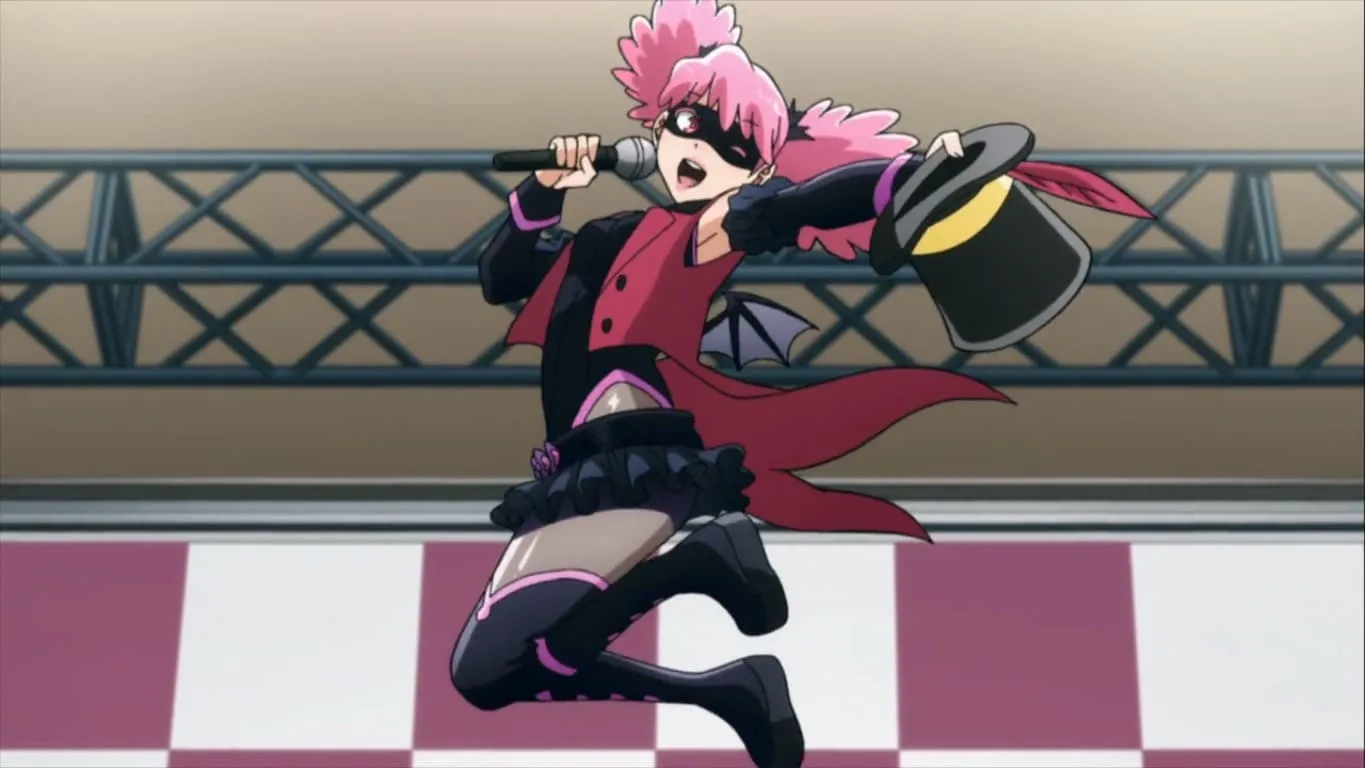
The idol show atmosphere in Osaka sits hard against the dark alleys of Naruhata, and the series gains force from that split-screen sense of society. One side glows with commerce and crowd energy. The other reeks of chemicals and danger. Vigilantes exist in the seam where these worlds touch. They stand outside the police, outside the marketing apparatus, and the story frames them as people who see a problem and move to stop it, guided by impulse and ethics that do not come stamped with a license.
Tsukauchi watches the monitors and spots Pop Step. He knows she is a vigilante and tells his team to keep an eye on her, a quiet instruction that turns the mall’s bright openness into a space of threat. Koichi and Pop Step come to Osaka to enjoy themselves and help a friend, yet the law stays present in the background like camera glass and fluorescent light. The series asks if legality always equals righteousness. Vigilantes save people, and the police still classify them as criminals. That tension drives the spinoff’s critique of a society that demands paperwork for kindness.
Action and craft reinforce the theme. Eraser Head’s animation moves with fluid grace, his scarf behaving like a living thing as it snaps and coils through space. The Hotta Brothers play as clumsy bodies propped up by something artificial. Their power comes from a bottle, and it destabilizes them. The episode introduces a “safer” version of Trigger, one that keeps minds intact while boosting strength. The development carries its own dread. A drug that looks clean spreads faster, and it becomes harder to spot.
Osaka’s mall becomes a maze of shops and stages, and the backgrounds stay richly observed. Signs advertise local food. Crowds fill the walkways. The art team captures the heat of a Japanese summer so strongly that the humidity feels close enough to taste. That grounded approach keeps the characters tangible. They register as people pressed into a crowded mall, moving through noise, sweat, and spectacle while trying to do good in a system built to police the very act.
This television series premiered on January 5, 2026, as a broadcast on Crunchyroll. It expands the lore of the hero society by focusing on individuals who operate without official state recognition. The story provides a grounded look at street level crime and the biological nature of superpowers. You can watch the series on the Crunchyroll streaming platform with new episodes arriving weekly. It functions as a prequel to the main narrative and offers a gritty perspective on the world of professional heroes.
Full Credits
Title: My Hero Academia: Vigilantes Season 2
Distributor: Crunchyroll
Release date: January 5, 2026
Rating: TV-14
Running time: 24 minutes
Director: Sayaka Morikawa
Writers: Hideyuki Furuhashi, Betten Court
Producers and Executive Producers: Kenji Nagasaki, Yoshihiro Oyabu, Wakana Okamura
Cast: Shuichiro Umeda, Ikumi Hasegawa, Junichi Suwabe, Kazuyuki Okitsu, Kana Ueda, Shunsuke Takeuchi, Ryota Osaka, Kenjiro Tsuda
Director of Photography (Cinematographer): Masatane Kanda
Editors: Kumiko Sakamoto
Composer: Yuki Hayashi
The Review
My Hero Academia: Vigilantes Season 2
The premiere succeeds through its focus on the mundane. It rejects the grand spectacle for a grounded study of growth. Koichi remains a sympathetic lead whose accidental progress feels earned. The shift to Osaka provides fresh air. The pace is slow. The world feels lived in and authentic. It honors its origins while finding its own voice.
PROS
- Tangible power growth rooted in survival.
- Detailed urban environmental design.
- Art style captures a raw comic book aesthetic.
CONS
- Narrative momentum feels stalled.
- Heavy reliance on familiar professional heroes.