




















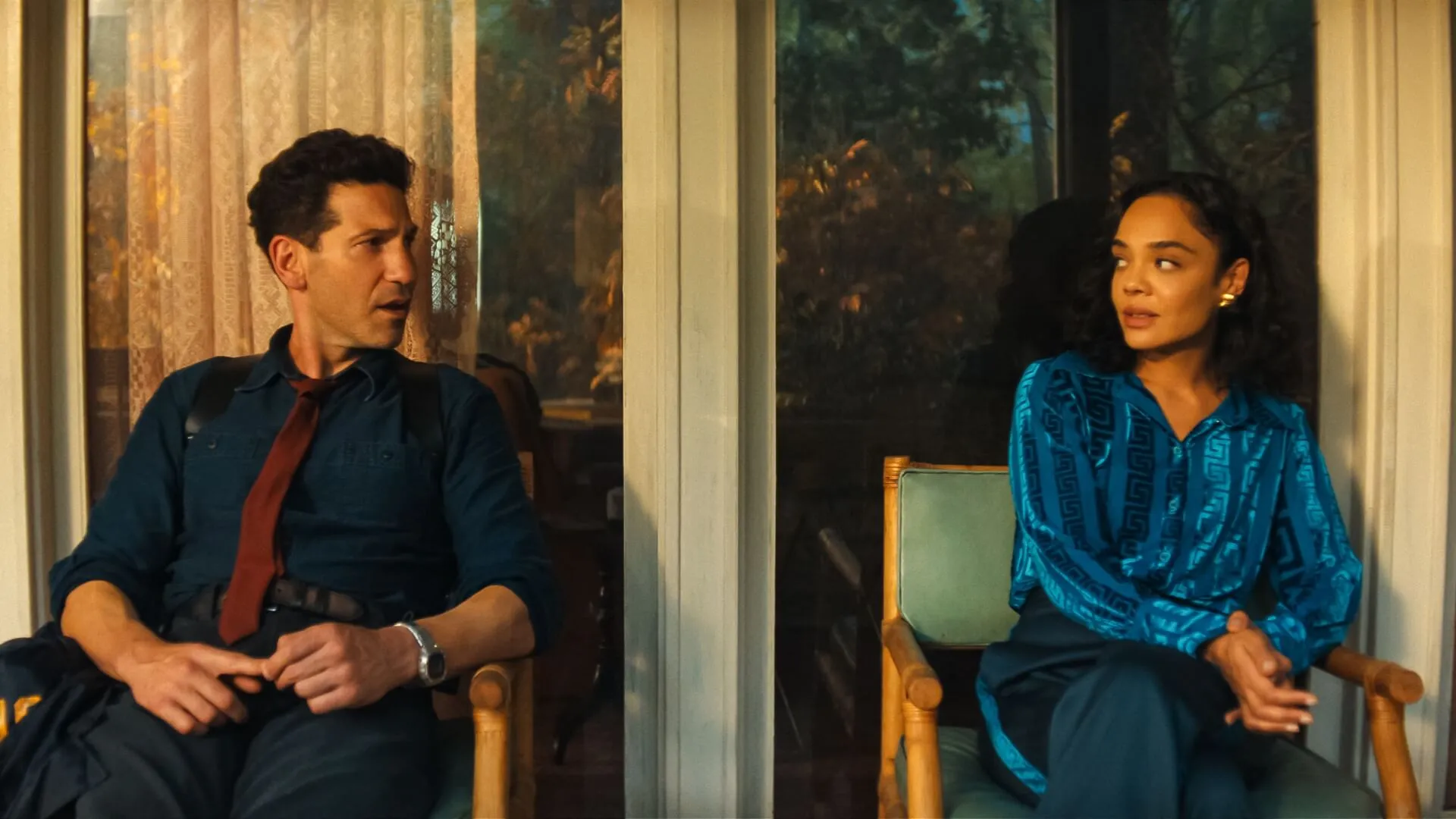

A silver blade flashes under a Georgia moon, then drives down into the upholstery of a parked car. Rachel Hopkins, pinned beneath it, forces out her last words into thick night air while rain starts its patient work, thinning blood, softening footprints, blurring whatever certainty the scene once promised.
His & Hers opens with this blunt fact of harm and immediately treats it like an argument: truth can be shaped, traded, and reheated until it serves the teller. The series carries that fixation from London’s wet, brisk streets to the heavy air of Dahlonega, Georgia, swapping the BBC’s polished corridors for an Atlanta newsroom whose sheen has worn down at the edges.
Place stops functioning as scenery and starts behaving like pressure. Soil clings. Heat lingers. Even the vineyards feel like they were planted to cover something. Inside that atmosphere, the central conflict takes on the weight of an old grievance wearing modern clothes. Two people who once loved each other face the same events and keep arriving at separate realities.
The Architecture of Subjectivity
The storytelling is built on a controlled splintering of perspective. An ambiguous narrator dispenses neat observations about deception, the sort of tidy wisdom that sounds reassuring until the series uses it to excuse contradiction. One event, the show insists, can produce multiple truths, each one convincing to the person speaking. That premise makes skepticism a viewing requirement. Every scene becomes a statement offered with a straight face, then quietly undermined by the next angle.
The move from the United Kingdom to the American South changes the texture of that idea. The Georgia foothills bring stagnant heat and isolation, and the past feels less like a memory than a toxin kept in a sealed jar. The series leans into the professional impropriety baked into its setup.
Anna Andrews, a reporter hungry to regain status, covers a murder investigation led by her estranged husband, Jack Harper. The arrangement invites ethical collapse, and the show treats it as inevitable. Personal agendas crowd the frame. Anna pursues professional revival. Jack carries the ethical weight of his history with the victim, then tries to keep standing under it.
Also Read





Memory becomes the script’s favorite weapon, swung with the confidence of someone sure it will hit. The brutality of the present is traced back to a high school friend group, as if adolescence wrote the first draft of everyone’s adult damage and never stopped editing. Bullying and peer pressure show up as the architects of misery that lasts. Trauma at sixteen does not vanish; it lies dormant until something wakes it, and then it returns with teeth. The result is a moral landscape where suspicion and suffering travel together, often in the same person.
The series refuses the comfort of a clean puzzle. It asks for attention to the slow undoing of two people losing their grip on their own histories, and it does so across six episodes where truth keeps sliding away just as it seems reachable. The shifting perspectives keep certainty out of arm’s reach. The most dangerous lies, the show argues, are the ones people tell themselves so they can keep wearing innocence like a pressed shirt in a life wrinkled by failure.
The Friction of Grief and Performance
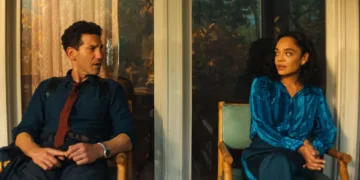
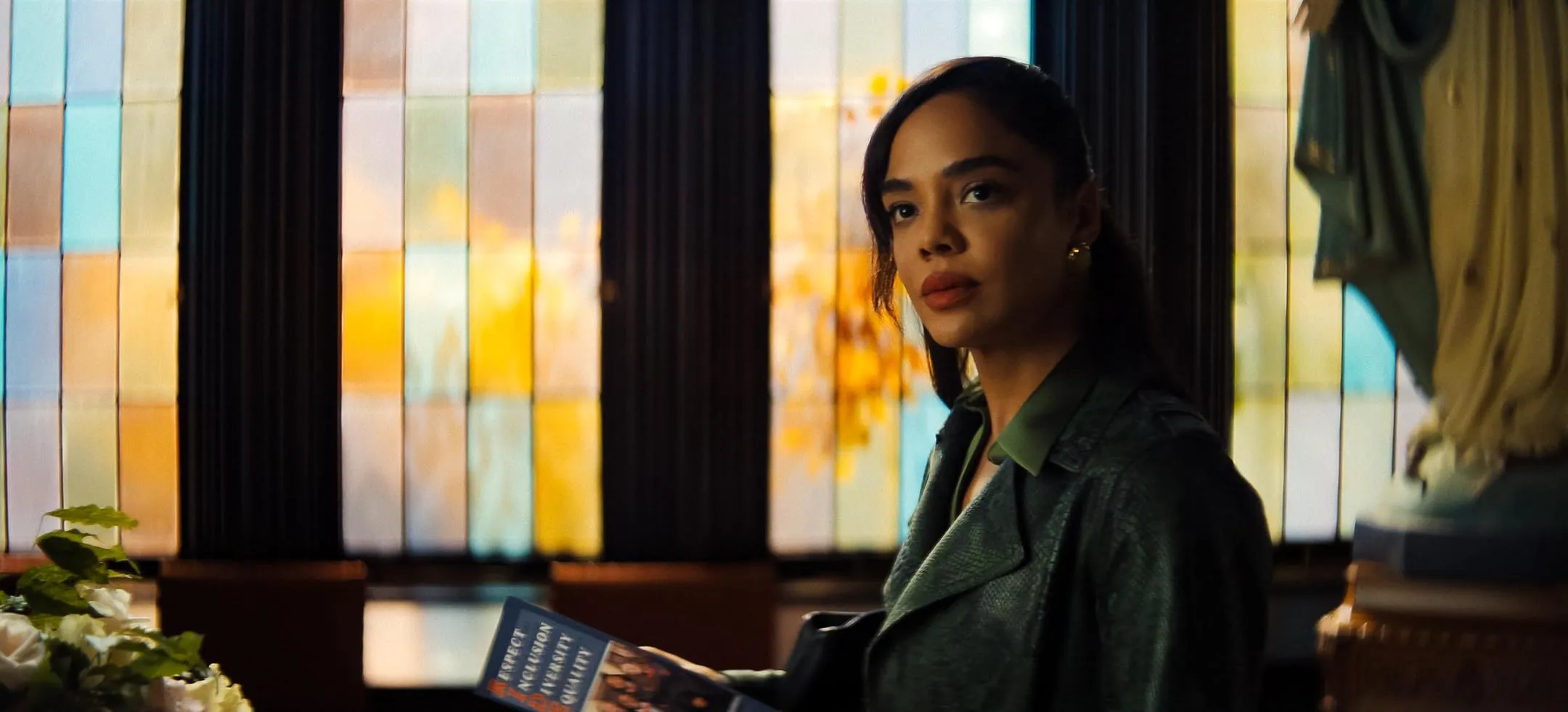
Tessa Thompson plays Anna Andrews with sharp distance and careful restraint. The performance suggests a woman who has folded herself into professional ambition as a way to survive personal tragedy. Her movements land with measured precision. Her gaze drifts, physically present while emotionally far off, as if the room is an obligation and her inner life is somewhere else entirely. That controlled stillness reads as armor, fitted against the memory of a lost child.
Jon Bernthal, as Jack Harper, brings a macho-feral force that feels perpetually on the verge of spilling over. Jack comes across as a detective operating beyond his depth, using aggression to cover incompetence and pain. Volatility drives his rhythms. He barks orders, throws weight around, and projects confidence with the desperation of someone hoping volume can substitute for clarity.
The bravado carries a hollow note, the kind that rings when a person keeps insisting he is fine. Put Anna and Jack in the same space and warmth never arrives. Their shared past functions like sand in the gears. They orbit each other like survivors from the same shipwreck who now flinch at the sight of the other.
The supporting players deepen that fractured dynamic. Marin Ireland stands out as Zoe, Jack’s sister, delivering a raw portrayal of alcoholism and the baggage that comes with small-town upbringing. The performance keeps its footing in exhaustion, the kind that settles into a body and turns every day into a negotiation. Poppy Liu plays Helen Wang with dismissive steel. As headmistress of an elite school, she embodies the lingering authority of the teenage hierarchy that once decided who mattered and who got hurt.
Chris Bauer appears as the victim’s husband and brings an odd, rhythmic strangeness to his line readings, a tonal choice that throws light on the town’s social arrangements and their quiet absurdity. Sunita Mani and Pablo Schreiber receive slimmer material, and they still bring steadiness to their scenes. Their characters operate as observers, positioned close enough to watch Anna and Jack tighten into a spiral of mutual destruction. Even the lack of chemistry between the leads reads as design: two lives moving in parallel, both isolated, both convinced they carry the truer version of the past.
The Aesthetic of the Southern Shadows
The series locks itself into an oppressively gray palette that seems to drain the Georgia scenery of oxygen. Directors William Oldroyd and Anja Marquardt shape a world where sunlight feels distant, blocked by the woods’ canopy and swallowed by interior spaces. The lighting leans artificial and glossy, a sheen that underlines the town’s social pretenses and the emptiness inside them.
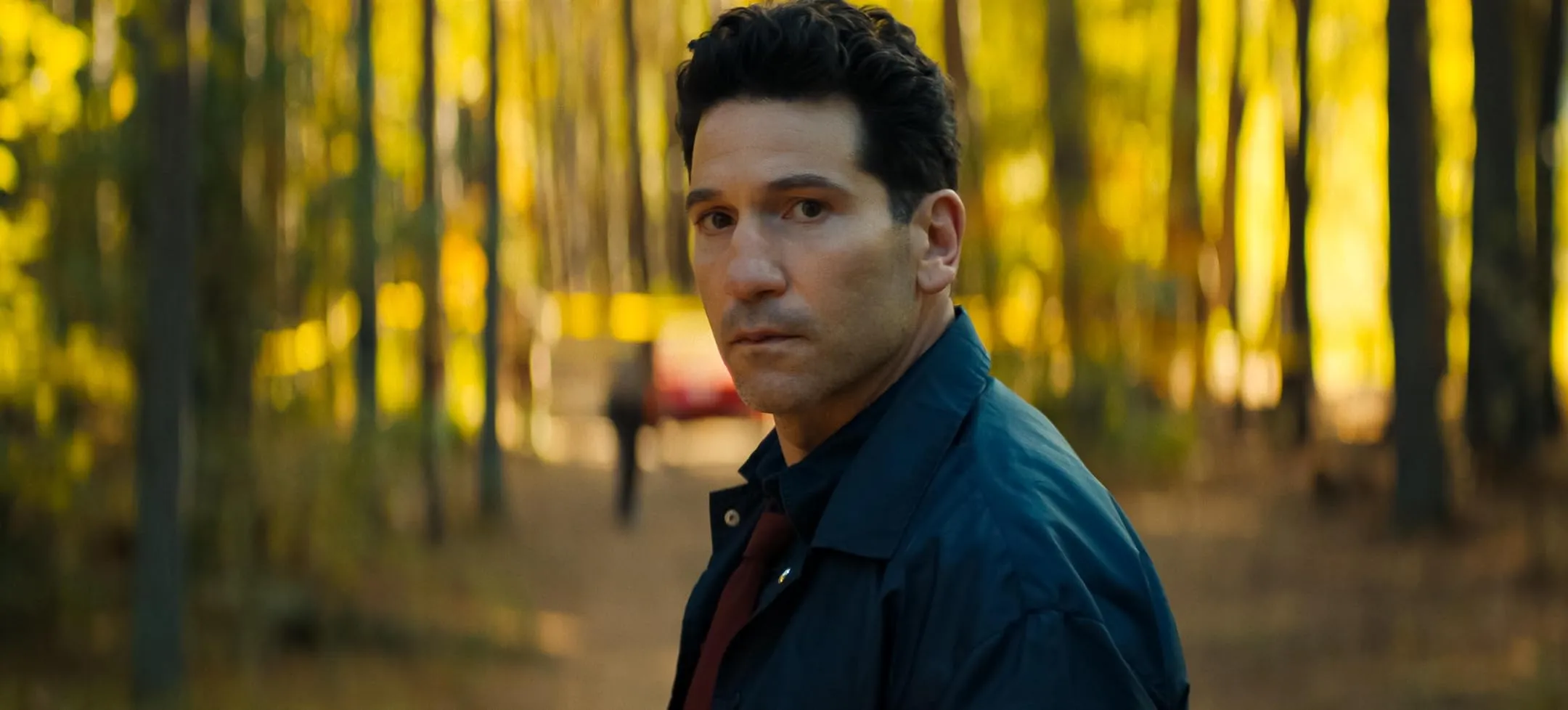
That polish sits uneasily beside the violent material. The show’s craft keeps reminding the viewer of fiction as a constructed object, and that awareness creates distance. High production value becomes a filter, placing the crimes behind glass.
Dahlonega is staged as the setting for a gothic tragedy, complete with performative manners and rot hidden behind beauty. Southern accents slip and wobble, distracting on a literal level while feeding the sense of characters playing parts they learned long ago. The town is drawn as a place of casual racism and rigid class order. The vineyards function like scenery designed to flatter the eye while systemic decay continues beneath the surface.
The environment reads as an extension of the leads’ emotional impasse. Stagnant air and the constant threat of rain echo the deadlock between Jack and Anna, two people stuck in place while time keeps moving around them. The show keeps the colors muted and swampy, turning away from postcard brightness and leaning into a sickly realism. Violence, when it arrives, lands harder because the world has already been bleached of relief.
Direction repeatedly frames characters alone against wide, indifferent landscapes. Isolation becomes a visual rule. Each person occupies their own shot, sealed inside a private account of events, unwilling or unable to grant another point of view real authority. Mood takes priority over regional realism, and Georgia becomes something like dream-space, a place where beauty works like bait. The cinematography pulls the viewer in, then holds them inside a world that has already broken itself and learned to smile anyway.
The Mechanics of the Reveal
Six episodes give the mystery room to expand, and the writing sometimes leans on plot contrivances that strain credibility. Coincidence ties past to present with near-mathematical neatness, as if the story’s universe is determined to keep every thread connected.
Flashbacks serve as the series’ sharpest structural tool. Present-day scenes cut against memories of Anna’s sixteenth birthday, and those returns to adolescence expose the community’s long-running corruption in steady increments. Each glimpse back reshapes the present. Clues change meaning midstream, and the audience is pushed into constant recalibration.
The script uses familiar engines like dementia and alcoholism to move events along. The handling carries enough gravity to keep these elements from feeling weightless, even as they do the practical work of steering the plot. Tension builds toward a finale intent on recontextualizing what came before, tu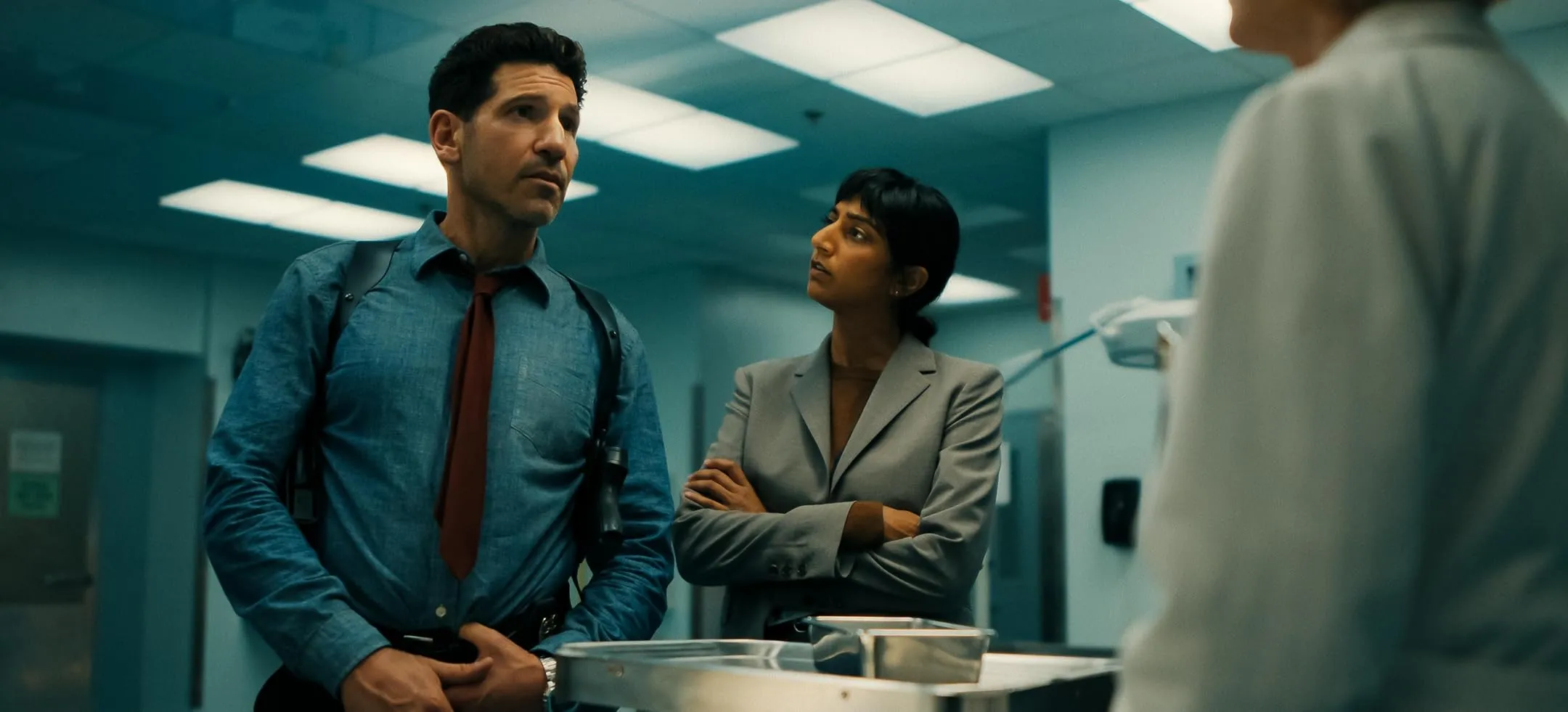 rning earlier statements into evidence for a new reading.
The climax turns inward toward a killer whose motivations spring from a deep thirst for vengeance. The reveal aims for sickness, the kind of shock that makes earlier narration feel suspect in retrospect. The final movement concentrates on what decades of secrecy do to a community and to the people trapped inside its stories. Truth matters here, yet survival often runs on narrative: the versions people repeat so they can keep living with what they chose.
Some logical leaps remain hard to swallow, and the series keeps going anyway, trusting emotional force to carry the weight. The closing stretch reframes the entire experience as a study of silence and its cost, of wounds that stay open because no one knows how to speak without tearing everything wider. The standoff promised by the title ends in exhaustion and quiet, a final moment where the competing accounts stop because language runs out.
His & Hers premiered as a limited series on Netflix on January 8, 2026, offering a gripping adaptation of the popular psychological thriller novel by Alice Feeney. Set against the sweltering backdrop of Georgia, the story follows a reclusive news anchor and a police detective who are drawn into a murder investigation that forces them to confront their own fractured past. The series is currently available for streaming exclusively on the Netflix platform, where viewers can watch all six episodes of this high-stakes mystery.
Full Credits
Title: His & Hers
Distributor: Netflix
Release date: January 8, 2026
Rating: TV-MA
Running time: 39–47 minutes per episode
Director: William Oldroyd, Anja Marquardt
Writers: William Oldroyd, Dee Johnson, Bill Dubuque, Tori Sampson
Producers and Executive Producers: Jessica Chastain, Kelly Carmichael, Kristen Campo, Tessa Thompson, William Oldroyd, Dee Johnson, Bill Dubuque, Kishori Rajan
Cast: Tessa Thompson, Jon Bernthal, Pablo Schreiber, Crystal Fox, Sunita Mani, Rebecca Rittenhouse, Marin Ireland, Poppy Liu, Chris Bauer, Jamie Tisdale, Ellie Rose Sawyer
Composer: Mac Quayle
The Review
His & Hers
His & Hers is a polished, somber exercise in Southern Gothic suspense that thrives on the volatile energy of its leads. While the narrative relies on heavy-handed contrivances and a relentless gray aesthetic, the exploration of how trauma distorts memory offers a biting look at small-town cruelty. It is a show where the atmosphere often outpaces the logic, leading to a climax that prioritizes shock over cohesion. Despite these structural flaws, the series remains an effective, brooding meditation on the stories people craft to survive their pasts.
PROS
- Tense, atmospheric Southern Gothic setting.
- Strong, contrasting performances from Thompson and Bernthal.
- Effective use of flashbacks to build psychological depth.
- High production values and striking cinematography.
CONS
- Over-reliance on improbable plot coincidences.
- Inconsistent regional accents disrupt immersion.
- Melodramatic use of dementia and alcoholism tropes.
- A finale that favors shock value over narrative logic.