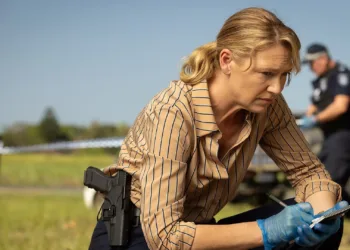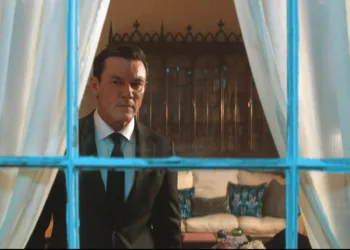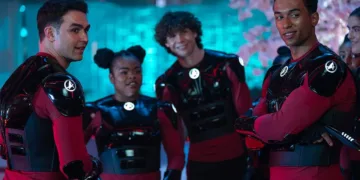


























The thirty-second century gives the Federation a softer, shakier texture. It feels quiet in a way that carries history, not peace. For more than one hundred and fifty years, Starfleet Academy’s grounds in San Francisco sat empty, a landmark turned into a relic. The catastrophe known as The Burn pushed the stars out of reach and broke a sprawling galactic government into scattered, self-contained worlds. The series starts at the moment that silence ends: the Academy reopens, and a first class returns to these halls after generations of absence.
That choice shapes the storytelling from the opening stretch. The show steps away from the usual magnetism of a single legendary captain and builds its dramatic engine around an institution rebuilding itself in public. The recruits come from Federation worlds and from places that used to feel unreachable, which lets the script keep the stakes personal even as it sketches a political reset.
Training plays out on Earth’s shoreline and inside the USS Athena, a ship that doubles as a moving classroom built for field exercises with real consequences. The series tries to connect classic exploration with the inner growth of its young ensemble, asking how a damaged society teaches hope to its next wave of officers. The setting carries a lived-in weight, shaped by a long decline and a return that feels bold, uncertain, and overdue.
The Mechanics of a Post-Dilithium Civilization
The Burn rewired the galaxy’s rules. Dilithium going inert collapses the infrastructure of space travel, and scarcity becomes the unseen hand steering species behavior for a century. Earth pulls inward. The Federation contracts until many people treat it like a story from another era. The show lays out that shift with clarity, then uses it as the spine of its premise: a society stepping away from militarized survival thinking and recommitting to education and diplomacy.
That thematic reset has a visual counterpart on the San Francisco campus. The Academy grounds read as open and light, set against the bay like an intentional signal. Reopening the school after such a long absence is framed as a political act, not a ceremonial ribbon-cutting. It tells the quadrant that the Federation is ready to look outward again, and it tells the cadets that their education is part of a larger repair job.
The technology carries its own identity in this era. Programmable matter creates spaces that reshape themselves on demand. Transporters operate with speed and smoothness. The USS Athena marks a turn away from the heavy metallic language of older ships, leaning into fluid, organic lines. Compared with the twenty-third and twenty-fourth centuries, where vessels could feel like submarines launched into vacuum, this ship reads like a tool designed to respond to the crew’s intent.
The worldbuilding stays consistent with that idea of recovery as a slow, deliberate climb. The script frames Earth’s return to the United Federation of Planets as a victory grounded in ideas and persuasion, and that context sits behind each lesson. The cadets learn piloting and procedure. They also learn how to keep a peace that came close to disappearing for good.
Institutional Leadership and the Weight of Experience
Holly Hunter serves as the show’s anchor as Chancellor Nahla Aké, and the performance carries a deliberate refusal of the stiff authority pose that Starfleet leadership can slide into. Aké is drawn as a bohemian presence, the kind of administrator who walks the Academy halls barefoot and dares anyone to confuse that with softness.
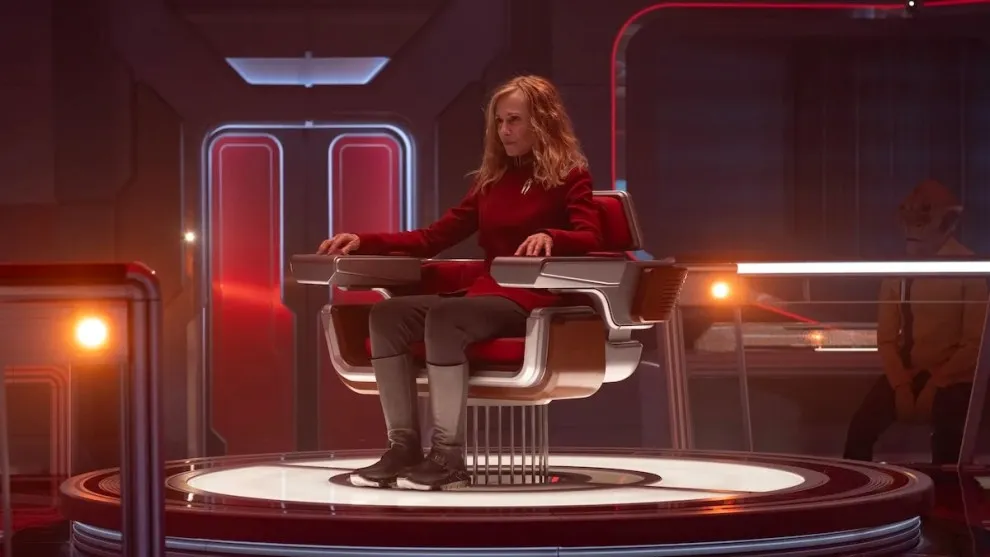
Her part-Lanthanite heritage gives her a perspective stretched across three hundred years, and the series uses that timescale to give her decisions a different gravity. She has seen the old world, lived through collapse, and returned to a moment where rebuilding is finally possible.
Hunter plays Aké with quiet intensity and a discipline that feels earned rather than performed. Warmth is part of her leadership, yet it sits alongside sharp expectations. The writing also gives her a personal wound with narrative consequences: her complicated history with the Mir family, and the choices she made fifteen years ago that caused their separation. That mistake shapes her present mission. She wants redemption through the success of the students in her care, and Hunter makes the Chancellor feel like someone who trusts books and records more than cold data readouts.
Robert Picardo’s return as the Doctor adds a familiar comic edge without breaking the tone. As Chief Medical Officer, he brings a steady presence, and the series lets him branch into campus life by teaching debate and running the Opera Club. The Doctor has programmed himself to age, a decision rooted in social comfort as much as self-concept. He wants his mortal colleagues to relax around his holographic form, and that small choice says a lot about the show’s interest in community building. His presence also links this era to the legacy of the USS Voyager, giving the Academy story a living thread to the past.
Paul Giamatti arrives as the antagonist Nus Braka, a part-Klingon, part-Tellarite criminal with a long history of theft. Braka’s role is tied directly into the cadet drama through the incident that separated Caleb Meir from his mother. Giamatti begins with big, theatrical energy, the kind that can fill a room and make subtlety file a complaint. As the story develops, he shifts into a more controlled and dangerous mode, and Braka starts to feel like a reminder that recovery leaves shadows behind. The Federation may be reopening schools and restoring ideals, yet chaos still thrives at the galaxy’s edges.
The faculty roster builds an academic ecosystem with competing philosophies rather than a single unified doctrine. Admiral Vance serves as Commander-in-Chief, while Sylvia Tilly and Jett Reno appear as instructors, offering continuity for viewers familiar with the fleet’s recent past. Lura Thok brings a harder edge to the staff.
Part-Klingon and part-Jem’Hadar, she serves as the Starfleet Master, charged with maintaining order among students who keep finding new ways to test it. She’s stern, and physical punishment becomes her go-to response for rule-breakers. The mix feels believable for a school that is rebuilding its culture in real time. Starfleet comes across as a collection of perspectives and temperaments, and the cadets are forced to learn that service does not come in a single approved style.
The Friction of the New Recruit Class
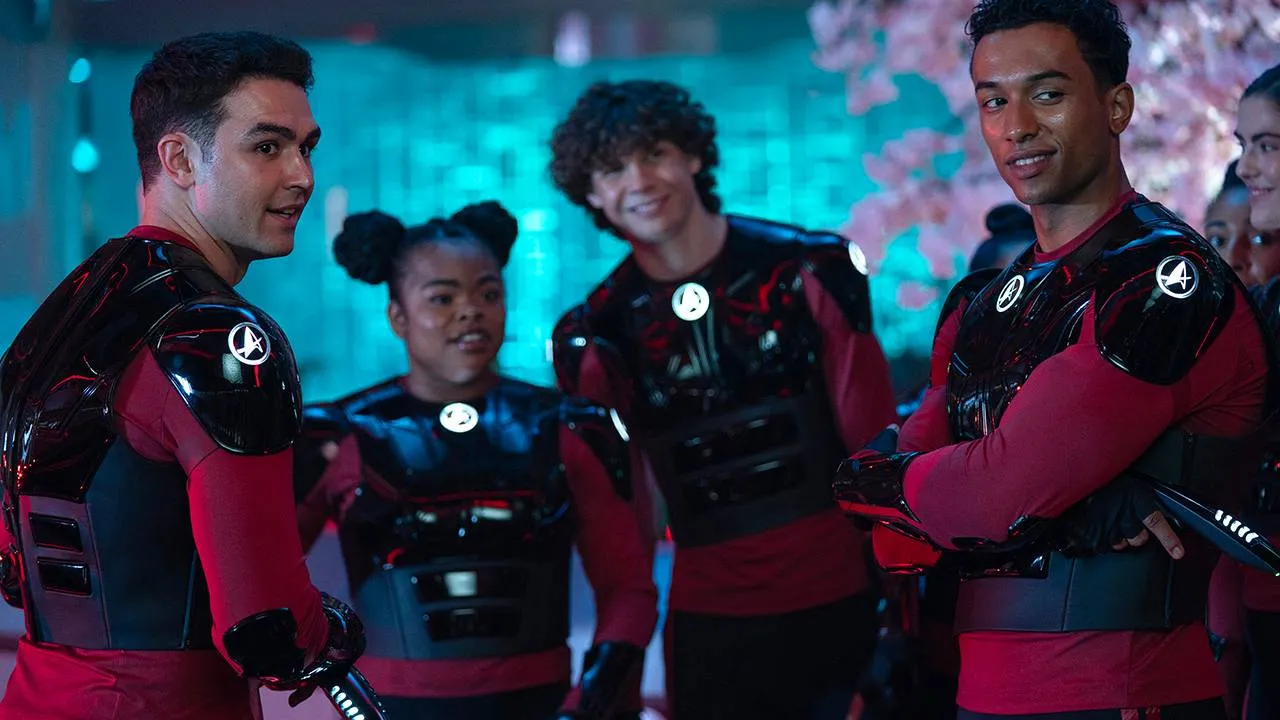
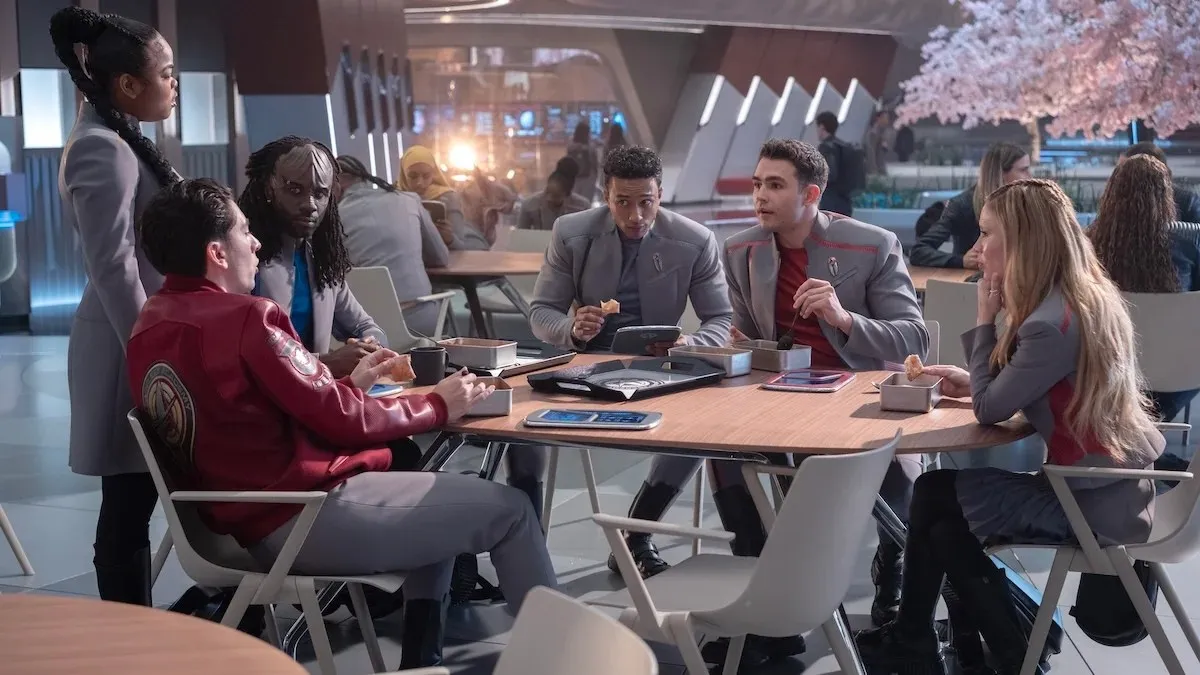
The cadet ensemble revolves primarily around Caleb Meir, played by Sandro Rosta as a brilliant, troubled young man with a talent for turning intelligence into a defensive posture. Caleb is a tech whiz who spent years on the run, and the show keeps that history present in his body language and his impatience with authority. He’s physically strong, arrogant, and openly unimpressed by uniforms and hierarchy.
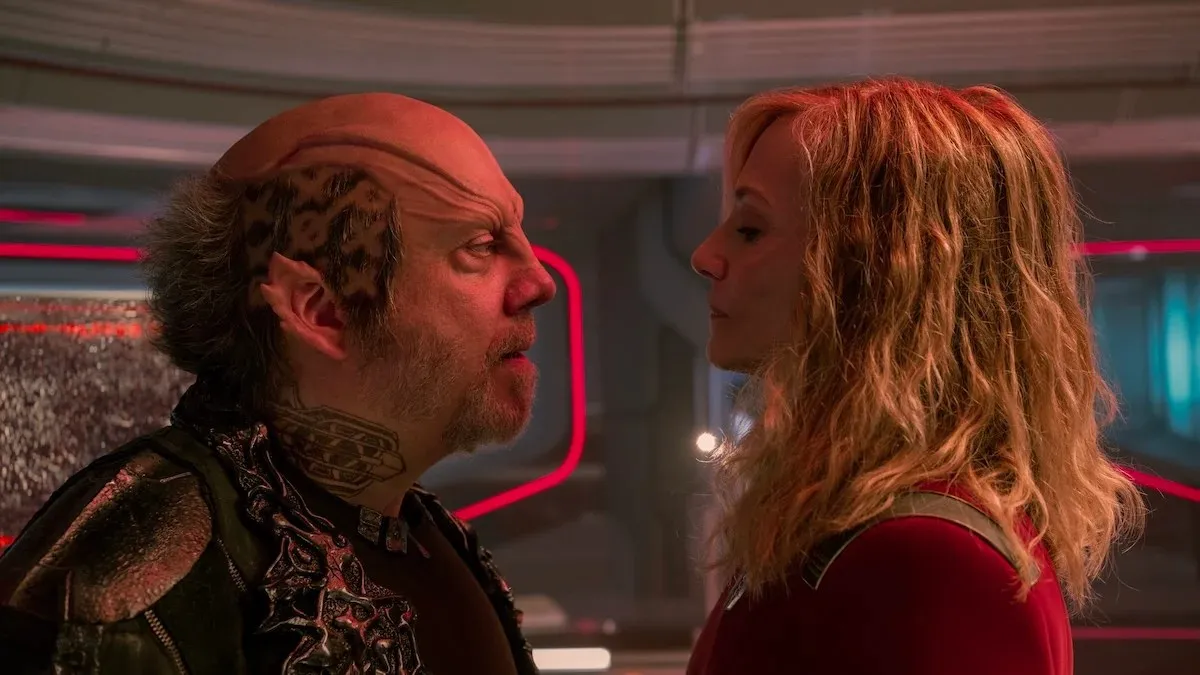
His reason for joining the Academy is personal and urgent: it offers his only path toward finding his missing mother, Anisha. That drive gives the season a throughline that works on two levels, pushing plot momentum while shaping Caleb’s evolution from isolated loner into someone who can function as part of a team.
Jay-Den Kraag provides the cleanest counterweight to Caleb’s aggression. He’s a Klingon who rejects the warrior path and wants to become a healer, a choice that makes him an outlier within his own culture. The characterization leans shy and thoughtful, and his closeness with Caleb produces some of the script’s most sincere scenes. Their bond does important structural work, too. It gives Caleb a relationship that demands patience and reciprocity, which is a more interesting engine for change than a lecture from a superior officer.
Kerrice Brooks plays Sam, described as the first photonic cadet in fleet history. Sam is a sentient hologram from the Kasqian species, and the writing has fun with her talkative, eccentric presence while keeping her social confusion meaningful. She struggles with the cues and rhythms of her organic peers, and the show uses that friction to raise legal and philosophical questions about personhood. It’s one of the series’ smarter choices, because it turns classroom life into a living ethics debate instead of a topic for a single episode’s speech.
Genesis Lythe stands out as a Dar-Sha overachiever: determined, skilled, and socially adept enough to manage group dynamics with charm. Darem Reymi fills the rival slot as a Khionian student with a jock persona, carrying heavy parental pressure to be perfect. That pressure curdles into bullying in the early episodes, and the series treats it as part of the class’s emotional weather rather than a villain costume.
These interpersonal dynamics power the show’s ongoing momentum. The cadets compete with students from the War College, a rival institution geared toward combat and military tactics, while the protagonists lean toward science and diplomacy. The tension writes itself, and the series uses it to test how this cohort forms a found family across cultures, backgrounds, and clashing goals. Life-threatening missions force cooperation, and the writing spends real time on individual histories, showing how personal baggage bleeds into performance in the field. The ensemble focus helps the group read like a crew in progress, not a list of archetypes waiting to be assigned stations.
Structural Logic and Production Values
The series builds its season on a hybrid structure: school drama rhythms paired with science fiction ethics. Episodes focus on specific cadets, which gives the show a reliable method for shifting perspective and keeping the ensemble from flattening into a single protagonist’s supporting cast. Viewpoints rotate between a Klingon pacifist, a holographic student, and the others, and that format gives the season a clear internal logic.
The pilot runs seventy-five minutes and carries movie-scale ambition, built around a high-stakes mission aboard the USS Athena. It establishes the season’s tone by merging classroom expectations with real danger, and it signals that “training” here means more than simulations and speeches. The special effects support that promise with professional polish, grounding space battles and alien landscapes in visuals that feel tangible inside the show’s aesthetic.
Sound design adds texture and a little playful bite. The ship’s computer has a distinct voice provided by Brit Marling, and Stephen Colbert voices the Academy’s public address system, which injects a small dose of levity into daily campus life. The show’s thematic focus stays locked on diplomacy, placing students in refugee crises and cross-cultural philosophy problems that echo classic Starfleet scenarios.
These stories ask how empathy functions in a world that has spent a century growing colder, and the writing balances seriousness with humor in a way that keeps the setting from turning into a museum display. The use of physical media, like phonograph records, reinforces the sense that history is something these characters touch, not something they recite.
Pacing works more often than it stumbles. A few episodes pack in heavy geopolitical detail, and those hours can feel crowded, like the script has notes it refuses to leave out. Most episodes keep attention on the cadets and their evolving relationships, which is where the show’s strongest storytelling lives. The series keeps its focus spread across the class rather than funneling everything into a single hero arc, and that choice makes each cadet feel necessary to the team’s function.
Production values stay high through the first six episodes, and the alien designs for the Khionians and the Dar-Sha add to the sense of a galaxy that is varied and strange in specific, textured ways. The season keeps returning to a simple idea: the next generation inherits tools from the past and has to learn what kind of leaders they want to become. The process is messy, difficult, and convincing, and the school setting gives that mess a structure sturdy enough to hold it.
Star Trek: Starfleet Academy officially premiered on January 15, 2026. Set in the late 32nd century, the series introduces a new class of cadets as they navigate the rigorous training of the Academy in San Francisco. Under the guidance of Chancellor Nahla Aké, played by Holly Hunter, the recruits face personal and political challenges in a galaxy still recovering from the aftermath of “The Burn.” The show is available to stream exclusively on Paramount+, with new episodes released weekly following the two-episode premiere.
Full Credits
Title: Star Trek: Starfleet Academy
Distributor: Paramount+
Release date: January 15, 2026
Rating: TV-PG
Running time: 60 minutes
Director: Alex Kurtzman, Jonathan Frakes
Writers: Gaia Violo, Noga Landau, Alex Kurtzman, Jane Maggs, Alex Taub, Kiley Rossetter, Eric Anthony Glover, Kirsten Beyer, Tawny Newsome, Kenneth Lin
Producers and Executive Producers: Alex Kurtzman, Noga Landau, Gaia Violo, Aaron Baiers, Jenny Lumet, Rod Roddenberry, Trevor Roth, Frank Siracusa, John Weber
Cast: Holly Hunter, Sandro Rosta, Karim Diané, Kerrice Brooks, George Hawkins, Bella Shepard, Zoë Steiner, Robert Picardo, Tig Notaro, Oded Fehr, Paul Giamatti, Gina Yashere, Mary Wiseman, Tatiana Maslany, Stephen Colbert
Director of Photography (Cinematographer): Philip Lanyon
Editors: Bartholomew Burcham, Jon Dudkowski
Composer: Jeff Russo
The Review
Star Trek: Starfleet Academy
This series succeeds by grounding the high-stakes future of the thirty-second century in the relatable, messy growth of its students. It balances the weight of a rebuilding galaxy with the lighter friction of a school setting. While the younger cast occasionally struggles to match the veteran performances, the narrative depth and commitment to classic diplomacy make it a rewarding experience. It honors the history of the fleet while finding its own voice through a hopeful, younger lens.
PROS
- Strong, nuanced performances from Holly Hunter and Robert Picardo.
- Effective use of the thirty-second-century setting to explore themes of reconstruction.
- Detailed world-building that respects the history of previous series.
- Creative character backgrounds that lead to genuine ethical dilemmas.
- High production values and cinematic scale in action sequences.
CONS
- Occasional stiffness in the performances of the less experienced cast members.
- Certain episodes feel overstuffed with geopolitical exposition.
- The school-based humor sometimes misses the mark.
- Predictable friction between the Academy and the rival War College.